Articles | Volume 11, issue 6
https://doi.org/10.5194/esurf-11-1275-2023
© Author(s) 2023. This work is distributed under
the Creative Commons Attribution 4.0 License.
https://doi.org/10.5194/esurf-11-1275-2023
© Author(s) 2023. This work is distributed under
the Creative Commons Attribution 4.0 License.
Short communication: Concentrated impacts by tree canopy drips – hotspots of soil erosion in forests
Ayumi Katayama
CORRESPONDING AUTHOR
Shiiba Research Forest, Kyushu University, Miyazaki, 8830402, Japan
Kazuki Nanko
Department of Disaster Prevention, Meteorology and Hydrology, Forestry and Forest Products Research Institute, Tsukuba, 3058687, Japan
Seonghun Jeong
Department of Forest Environmental Resources, College of Agriculture & Life Sciences, Gyeongsang National University, Jinju, 52828, Republic of Korea
College of Agriculture & Life Sciences, Gyeongsang National University, Jinju, 52828, Republic of Korea
Tomonori Kume
Shiiba Research Forest, Kyushu University, Miyazaki, 8830402, Japan
Yoshinori Shinohara
Faculty of Agriculture, University of Miyazaki, Miyazaki, 8892192, Japan
Steffen Seitz
Department of Geosciences, Soil Science and Geomorphology, University of Tübingen, Tübingen, 72070, Germany
Related authors
No articles found.
Raquel N. R. Falcão, Josef Krása, Martin Neumann, Jan-František Kubát, Corinna Gall, and Steffen Seitz
EGUsphere, https://doi.org/10.5194/egusphere-2025-5908, https://doi.org/10.5194/egusphere-2025-5908, 2026
Short summary
Short summary
We tested five tools that simulate rainfall to study how water affects soil. Because these tools differ in size and performance, we measured how evenly they spray and how strong the falling drops are. We found that each tool produces distinct rain patterns, but all can support soil studies when properly checked. Our work helps researchers choose practical and reliable equipment, especially when working in remote locations.
Corinna Gall, Silvana Oldenburg, Martin Nebel, Thomas Scholten, and Steffen Seitz
SOIL, 11, 199–212, https://doi.org/10.5194/soil-11-199-2025, https://doi.org/10.5194/soil-11-199-2025, 2025
Short summary
Short summary
Soil erosion is a major issue in vineyards due to often steep slopes and fallow interlines. While cover crops are typically used for erosion control, moss restoration has not yet been explored. In this study, moss restoration reduced surface runoff by 71.4 % and sediment discharge by 75.8 % compared with bare soil, similar to cover crops. Mosses could serve as ground cover where mowing is impractical, potentially reducing herbicide use in viticulture, although further research is needed.
Wanjun Zhang, Thomas Scholten, Steffen Seitz, Qianmei Zhang, Guowei Chu, Linhua Wang, Xin Xiong, and Juxiu Liu
Hydrol. Earth Syst. Sci., 28, 3837–3854, https://doi.org/10.5194/hess-28-3837-2024, https://doi.org/10.5194/hess-28-3837-2024, 2024
Short summary
Short summary
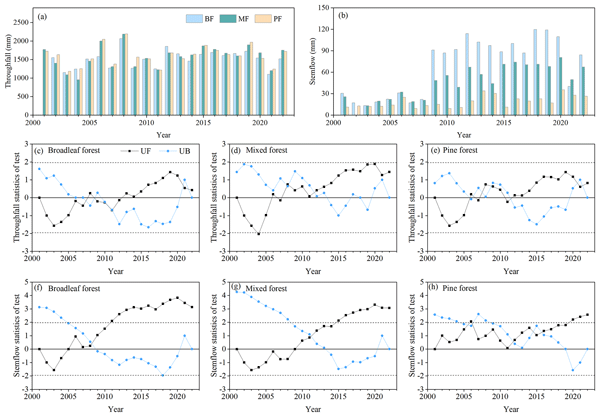
Rainfall input generally controls soil water and plant growth. We focus on rainfall redistribution in succession sequence forests over 22 years. Some changes in rainwater volume and chemistry in the throughfall and stemflow and drivers were investigated. Results show that shifted open rainfall over time and forest factors induced remarkable variability in throughfall and stemflow, which potentially makes forecasting future changes in water resources in the forest ecosystems more difficult.
Nicolás Riveras-Muñoz, Steffen Seitz, Kristina Witzgall, Victoria Rodríguez, Peter Kühn, Carsten W. Mueller, Rómulo Oses, Oscar Seguel, Dirk Wagner, and Thomas Scholten
SOIL, 8, 717–731, https://doi.org/10.5194/soil-8-717-2022, https://doi.org/10.5194/soil-8-717-2022, 2022
Short summary
Short summary
Biological soil crusts (biocrusts) stabilize the soil surface mainly in arid regions but are also present in Mediterranean and humid climates. We studied this stabilizing effect through wet and dry sieving along a large climatic gradient in Chile and found that the stabilization of soil aggregates persists in all climates, but their role is masked and reserved for a limited number of size fractions under humid conditions by higher vegetation and organic matter contents in the topsoil.
Corinna Gall, Martin Nebel, Dietmar Quandt, Thomas Scholten, and Steffen Seitz
Biogeosciences, 19, 3225–3245, https://doi.org/10.5194/bg-19-3225-2022, https://doi.org/10.5194/bg-19-3225-2022, 2022
Short summary
Short summary
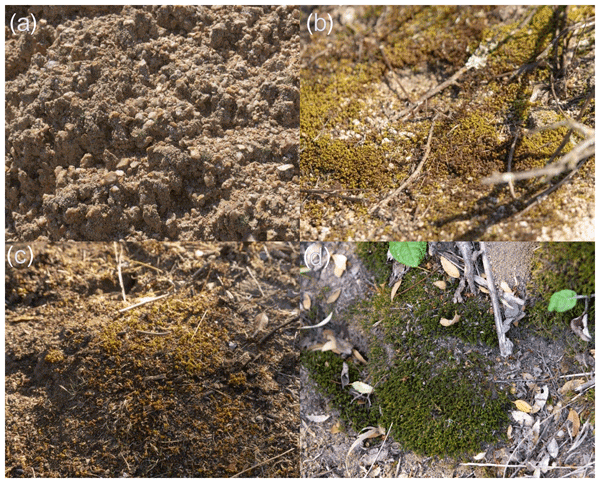
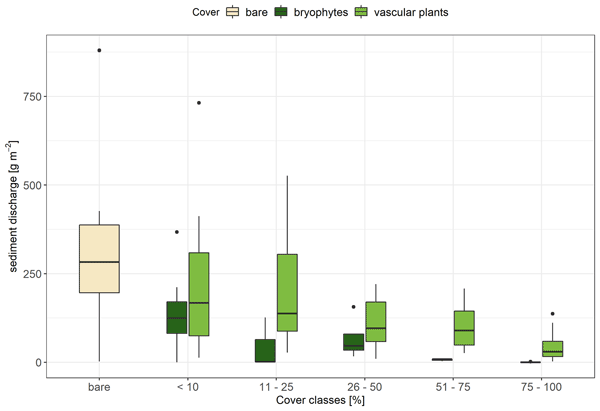
Soil erosion is one of the most serious environmental challenges of our time, which also applies to forests when forest soil is disturbed. Biological soil crusts (biocrusts) can play a key role as erosion control. In this study, we combined soil erosion measurements with vegetation surveys in disturbed forest areas. We found that soil erosion was reduced primarily by pioneer bryophyte-dominated biocrusts and that bryophytes contributed more to soil erosion mitigation than vascular plants.
Cited articles
Abe, H., Fu, D., Kume, T., and Katayama, A.: Exposure of tree roots and its control factors in a mixed temperate forest with no understory vegetation, Bull. Kyushu Univ For., 103, 13–20, https://doi.org/10.15017/4776829, 2022 (Japanese with English summary).
Borrelli, P., Robinson, D. A., Panagos, P., Lugato, E., Yang, J. E., Alewell, C., Wuepper, D., Montanarella, L., and Ballabio, C.: Land use and climate change impacts on global soil erosion by water (2015–2070), P. Natl. Acad. Sci. USA, 117, 21994–22001, https://doi.org/10.1073/pnas.2001403117, 2020.
Chapman, G.: Size of raindrops and their striking force at the soil surface in a red pine plantation, Eos, Transactions American Geophysical Union, 29, 664–670, 1948.
Frazer, G. W., Canham, C. D., and Lertzman, K. P.: Gap Light Analyzer (GLA), Version 2.0: Imaging software to extract canopy structure and gap light transmission indices from true colour fisheye photographs, users manual and program documentation, Simon Fraser University, Burnaby, British Columbia, and the Institute of Ecosystem Studies, Millbrook, New York, 36, 1999.
Deng, J., Fang, S., Fang, X., Jin, Y., Kuang, Y., Lin, F., Liu, J., Ma, J., Nie, Y., Ouyang, S., Ren, J., Tie, L., Tang, S., Tan, X., Wang, X., Fan, Z., Wang, Q.-W., Wang, H., and Liu, C.: Forest understory vegetation study: current status and future trends, Forestry Research, 3, 6, https://doi.org/10.48130/FR-2023-0006, 2023.
Gall, C., Nebel, M., Quandt, D., Scholten, T., and Seitz, S.: Pioneer biocrust communities prevent soil erosion in temperate forests after disturbances, Biogeosciences, 19, 3225–3245, https://doi.org/10.5194/bg-19-3225-2022, 2022.
Geißler, C., Kühn, P., Shi, X., and Scholten, T.: Estimation of throughfall erosivity in a highly diverse forest ecosystem using sand-filled splash cups, J. Earth Sci., 21, 897–900, 2010.
Geißler, C., Kühn, P., Böhnke, M., Bruelheide, H., Shi, X., and Scholten, T.: Splash erosion potential under tree canopies in subtropical SE China, Catena, 91, 85–93, https://doi.org/10.1016/j.catena.2010.10.009, 2012.
Holz, D. J., Williard, K. W., Edwards, P. J., and Schoonover, J. E.: Soil erosion in humid regions: A review, Journal of Contemporary Water Research & Education, 154, 48–59, 2015.
Katayama, A.: Structurally-mediated woody surface drip points for beech tree, TIB [video], https://doi.org/10.5446/61199, 2023.
Katayama, A., Oyamada, M., Abe, H., Uemori, K., and Hishi, T.: Soil erosion decreases soil microbial respiration in Japanese beech forests with understory vegetation lost by deer, J. For. Res., 28, 428–435, https://doi.org/10.1080/13416979.2023.2235499, 2023.
Kawakami, E., Katayama, A., and Hishi, T.: Effects of declining understory vegetation on leaf litter decomposition in a Japanese cool-temperate forest, J. For. Res., 25, 260–268, 2020.
Keim, R. F. and Link, T. E.: Linked spatial variability of throughfall amount and intensity during rainfall in a coniferous forest, Agric. For. Meteorol., 248, 15–21, https://doi.org/10.1016/j.agrformet.2017.09.006, 2018.
Lal, R.: Soil conservation and ecosystem services, Int. Soil Water Conserv. Res., 2, 36–47, 2014.
Levia, D. F., Hudson, S. A., Llorens, P., and Nanko, K.: Throughfall drop size distributions: a review and prospectus for future research, WIREs Water, 4, e1225, https://doi.org/10.1002/wat2.1225, 2017.
Levia, D. F., Nanko, K., Amasaki, H., Giambelluca, T. W., Hotta, N., Iida, S., Mudd, R. G., Nullet, M. A., Sakai, N., Shinohara, Y., Sun, X., Suzuki, M., Tanaka, N., Tantasirin, C., and Yamada, K.: Throughfall partitioning by trees, Hydrol. Process, 33, 1698–1708, https://doi.org/10.1002/hyp.13432, 2019.
Liu, J., Liu, W., Zhang, W., and Wang, P.: The detected effects of driptips and leaf wettability on the kinetic energy of throughfall in rubber-based agroforestry in Xishuangbanna, Ecohydrology, 16, e2492, https://doi.org/10.1002/eco.2492, 2022.
Misik, T. and Kárász, I.: Low understory condition in an oak forest in Hungary, 1972 and 2022 – Síkfőkút Project is 50 years old, Acta Biologica Plantarum Agriensis, 10, 22–35, https://doi.org/10.21406/abpa.2022.10.22, 2022.
Miura, S., Yoshinaga, S., and Yamada, T.: Protective effect of floor cover against soil erosion on steep slopes forested with Chamaecyparis obtusa (hinoki) and other species, J. Forest Res., 8, 27–35, 2003.
Murata, I., Saruki, S., Kubota, K., Inoue, S., Tashiro, N., Enoki, T., Utsumi, and Y. Inoue, S.: Effects of sika deer (Cervus nippon) and dwarf bamboo (Sasamorpha borealis) on seedling emergence and survival in cool-temperate mixed forests in the Kyushu Mountains, J. Forest Res., 14, 296–301, 2009.
Nanko, K., Mizugaki, S., and Onda, Y.: Estimation of soil splash detachment rates on the forest floor of an unmanaged Japanese cypress plantation based on field measurements of throughfall drop sizes and velocities, Catena, 72, 348–361, 2008.
Nanko, K., Watanabe, A., Hotta, N., and Suzuki, M.: Physical interpretation of the difference in drop size distributions of leaf drips among tree species, Agric. For. Meteorol., 169, 74–84, https://doi.org/10.1016/j.agrformet.2012.09.018, 2013.
Nanko, K., Giambelluca, T. W., Sutherland, R. A., Mudd, R. G., Nullet, M. A., and Ziegler, A. D.: Erosion potential under Miconia calvescens stands on the island of Hawai'I, Land Degrad. Dev., 26, 218–226, 2015.
Nanko, K., Onda, Y., Kato, H., and Gomi, T.: Immediate change in throughfall spatial distribution and canopy water balance after heavy thinning in a dense mature, Ecohydrology, 9, 300–314, 2016.
Nanko, K., Tanaka, N., Leuchner, M., and Levia, D. F.: Throughfall Erosivity in Relation to Drop Size and Crown Position: A Case Study from a Teak Plantation in Thailand, Forest-Water Interactions, Ecological Studies. Springer International Publishing, Cham, 279–298, https://doi.org/10.1007/978-3-030-26086-6_12, 2020.
Nanko, K., Keim, R. F., Hudson, S. A., and Levia, D. F.: Throughfall drop sizes suggest canopy flowpaths vary by phenophase, J. Hydrol., 612, 128–144, 2022.
Pimentel, D. and Burgess, M.: Soil erosion threatens food production, Agriculture, 3, 443–463, 2013.
R Core Team: R: A Language And Environment for Statistical Computing, R Foundation for Statistical Computing, Vienna, Austria, https://www.R-project.org/ (last access: 2 December 2012), 2019.
Safari, A., Kavian, A., Parsakhoo, A., Saleh, I., and Jordán, A.: Impact of different parts of skid trails on runoff and soil erosion in the Hyrcanian forest (northern Iran), Geoderma, 263, 161–167, 2016.
Scholten, T., Geißler, C., Goc, J., Kühn, P., and Wiegand, C.: A new splash cup to measure the kinetic energy of rainfall, J. Plant. Nutr. Soil Sc., 174, 596–601, 2011.
Seitz, S., Goebes, P., Song, Z., Bruelheide, H., Härdtle, W., Kühn, P., Li, Y., and Scholten, T.: Tree species and functional traits but not species richness affect interrill erosion processes in young subtropical forests, Soil, 2, 49–61, 2016.
Seitz, S., Nebel, M., Goebes, P., Käppeler, K., Schmidt, K., Shi, X., Song, Z., Webber, C. L., Weber, B., and Scholten, T.: Bryophyte-dominated biological soil crusts mitigate soil erosion in an early successional Chinese subtropical forest, Biogeosciences, 14, 5775–5788, https://doi.org/10.5194/bg-14-5775-2017, 2017.
Shinohara, Y., Ichinose, K., Morimoto, M., Kubota, T., and Nanko, K.: Factors influencing the erosivity indices of raindrops in Japanese cypress plantations, Catena, 171, 54–61, 2018.
Song, Z., Seitz, S., Li, J., Goebes, P., Schmidt, K., Kühn, P., Shi, X., and Scholten, T.: Tree diversity reduced soil erosion by affecting tree canopy and biological soil crust development in a subtropical forest experiment, For. Ecol. Manag., 444, 69–77, 2019.
Takatsuki, S.: Effects of sika deer on vegetation in Japan: a review, Biol. Conserv., 142, 1922–1929, 2009.
van Dijk, A. I. J. M., Bruijnzeel, L. A., Rosewell, and C. J.: Rainfall intensitykinetic energy relationships: a critical literature appraisal, J. Hydrol., 261, 1–23, 2002.
Wang, P. K. and Pruppacher, H. R.: Acceleration to terminal velocity of cloud and raindrops, J. Appl. Meteorol. Climatol., 16, 275–280, 1977.
Yao, X., Yu, K., Wang, G., Deng, Y., Lai, Z., Chen, Y., Jiang, Y., and Liu, J.: Effects of soil erosion and reforestation on soil respiration, organic carbon and nitrogen stocks in an eroded area of Southern China, Sci. Total Environ., 683, 98–108, 2019.
Zemke, J. J.: Runoff and soil erosion assessment on forest roads using a small scale rainfall simulator, Hydrology, 3, 25, https://doi.org/10.3390/hydrology3030025, 2016.
Short summary
Even under forests, soil is eroded by rainfall. This is particularly true when human impact damages vegetation layers. We found that the erosion risk can be greatly increased by structural drip points at branches forming large drops under the tree canopy in the foliated and non-foliated seasons. Our measurements with sand-filled splash cups in Japanese beech forests showed drop energies up to 50 times greater than under freefall precipitation, indicating locally severe sediment detachment.
Even under forests, soil is eroded by rainfall. This is particularly true when human impact...