
Articles | Volume 14, issue 1
https://doi.org/10.5194/esurf-14-141-2026
© Author(s) 2026. This work is distributed under
the Creative Commons Attribution 4.0 License.
the Creative Commons Attribution 4.0 License.
https://doi.org/10.5194/esurf-14-141-2026
© Author(s) 2026. This work is distributed under
the Creative Commons Attribution 4.0 License.
the Creative Commons Attribution 4.0 License.
Research article
| 
13 Feb 2026
Research article |
| 13 Feb 2026
| 13 Feb 2026
A numerical model for duricrust formation by laterisation
Institute of Geophysics of the Czech Academy of Sciences, Boční II/1401, 141 00 Prague 4 – Spořilov, Prague, Czech Republic
Helmholtz Centre for Geosciences, Telegrafenberg, 14473 Potsdam, Germany
Jean Braun
Helmholtz Centre for Geosciences, Telegrafenberg, 14473 Potsdam, Germany
Institute of Geosciences, University of Potsdam, Am Neuen Palais 10, 14469 Potsdam, Germany
Cécile Robin
Université Rennes 1, Géosciences Rennes, 35042 Rennes, France
François Guillocheau
Université Rennes 1, Géosciences Rennes, 35042 Rennes, France
Related authors
Caroline Fenske, Petr Brož, and Adriano Mazzini
Earth Surf. Dynam., 14, 433–442, https://doi.org/10.5194/esurf-14-433-2026, https://doi.org/10.5194/esurf-14-433-2026, 2026
Short summary
Short summary
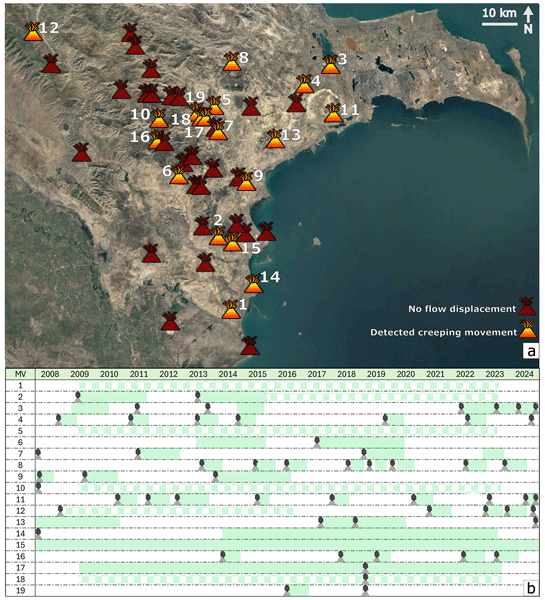
Azerbaijan hosts the world's highest concentration of mud volcanoes, some producing kilometre-scale mud flows. These flows were long thought to form only during major eruptions, but this study shows many instead move slowly over time, similar to glaciers. Using satellite images and field observations, we found 19 volcanoes with measurable creeping, moving a few to tens of metres per decade. While often remote, some flows may threaten nearby infrastructure, highlighting the need for monitoring.
Caroline Fenske, Jean Braun, François Guillocheau, and Cécile Robin
Earth Surf. Dynam., 13, 119–146, https://doi.org/10.5194/esurf-13-119-2025, https://doi.org/10.5194/esurf-13-119-2025, 2025
Short summary
Short summary
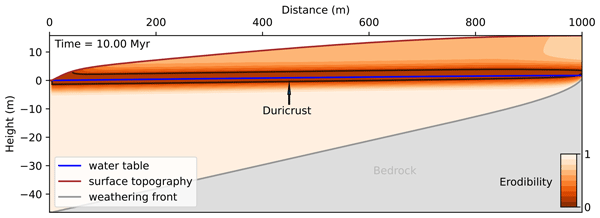
We have developed a new numerical model to represent the formation of duricrusts, which are hard mineral layers found in soils and at the surface of the Earth. We assume that the formation mechanism implies variations in the height of the water table and that the hardening rate is proportional to precipitation. The model allows us to quantify the potential feedbacks they generate on the surface topography and the thickness of the regolith/soil layer.
Caroline Fenske, Petr Brož, and Adriano Mazzini
Earth Surf. Dynam., 14, 433–442, https://doi.org/10.5194/esurf-14-433-2026, https://doi.org/10.5194/esurf-14-433-2026, 2026
Short summary
Short summary
Azerbaijan hosts the world's highest concentration of mud volcanoes, some producing kilometre-scale mud flows. These flows were long thought to form only during major eruptions, but this study shows many instead move slowly over time, similar to glaciers. Using satellite images and field observations, we found 19 volcanoes with measurable creeping, moving a few to tens of metres per decade. While often remote, some flows may threaten nearby infrastructure, highlighting the need for monitoring.
Pierre Dietrich, François Guillocheau, Guilhem A. Douillet, Neil P. Griffis, Guillaume Baby, Daniel P. Le Héron, Laurie Barrier, Maximilien Mathian, Isabel P. Montañez, Cécile Robin, Thomas Gyomlai, Christoph Kettler, and Axel Hofmann
Earth Surf. Dynam., 13, 495–529, https://doi.org/10.5194/esurf-13-495-2025, https://doi.org/10.5194/esurf-13-495-2025, 2025
Short summary
Short summary
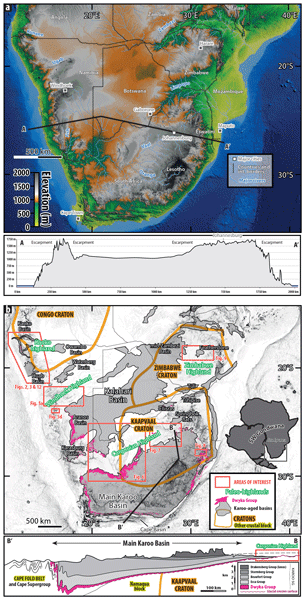
At the evocation of icy landscapes, Africa is not the first place that comes to mind. The modern relief of Southern Africa is generally considered to be a result of uplift and counteracting erosion. We show that some of the modern relief of this region is due to fossil glacial landscapes – striated pavements, valleys, and fjords – tied to an ice age that occurred ca. 300 Myr ago. We focus on how these landscapes have escaped being erased for hundreds of millions of years.
Caroline Fenske, Jean Braun, François Guillocheau, and Cécile Robin
Earth Surf. Dynam., 13, 119–146, https://doi.org/10.5194/esurf-13-119-2025, https://doi.org/10.5194/esurf-13-119-2025, 2025
Short summary
Short summary
We have developed a new numerical model to represent the formation of duricrusts, which are hard mineral layers found in soils and at the surface of the Earth. We assume that the formation mechanism implies variations in the height of the water table and that the hardening rate is proportional to precipitation. The model allows us to quantify the potential feedbacks they generate on the surface topography and the thickness of the regolith/soil layer.
Cited articles
Allard, T., Gautheron, C., Riffel, S. B., Balan, E., Soares, B. F., Pinna-Jamme, R., Derycke, A., Morin, G., Bueno, G. T., and do Nascimento, N.: Combined dating of goethites and kaolinites from ferruginous duricrusts. Deciphering the Late Neogene erosion history of Central Amazonia, Chem. Geol., 479, 136–150, https://doi.org/10.1016/j.chemgeo.2018.01.004, 2018. a, b
Alonso-Zarza, A. and Wright, V.: Chapter 5 Calcretes, Developments in Sedimentology, 61, 225–267, https://doi.org/10.1016/s0070-4571(09)06105-6, 2010. a, b, c, d
Alonso-Zarza, A. M.: Palaeoenvironmental significance of palustrine carbonates and calcretes in the geological record, Earth-Sci. Rev., 60, 261–298, https://doi.org/10.1016/s0012-8252(02)00106-x, 2003. a, b, c
Anand, R. R.: Weathering History, landscape evolution and implications for exploration, Ore Geol. Rev.,, 16, 167–183, https://doi.org/10.1016/s0169-1368(99)00029-3, 2005. a, b
Anand, R. R. and Paine, M.: Regolith geology of the Yilgarn Craton, Western Australia: implications for exploration, Aust. J. Earth Sci., 49, 3–162, https://doi.org/10.1046/j.1440-0952.2002.00912.x, 2002. a
Ansart, C., Quantin, C., Calmels, D., Allard, T., Roig, J. Y., Coueffe, R., Heller, B., Pinna-Jamme, R., Nouet, J., Reguer, S., Vantelon, D., and Gautheron, C.: (U-Th)/He Geochronology Constraints on Lateritic Duricrust Formation on the Guiana Shield, Front. Earth Sci., 10, 888993, https://doi.org/10.3389/feart.2022.888993, 2022. a
Ansart, C., Guinoiseau, D., Quantin, C., Calmels, D., Gautheron, C., Agrinier, P., Bouchez, J., Fekiacova, Z., Pinna-Jamme, R., Demri, D., Balan, E., Heller, B., Bollaert, Q., Ataytür, Ã., and Allard, T.: Lateritic Cenozoic paleoenvironmental and paleoclimatic conditions in the Central Amazon basin, Brazil, inferred from mineralogy, geochemistry and geochronology, Palaeogeogr. Palaeocl., 662, 112674, https://doi.org/10.1016/j.palaeo.2024.112674, 2025. a, b, c, d, e, f
Azmon, E. and Kedar, Y.: Lower cretaceous silcrete-ferricrete, at the northern end of the African Tethys shoreline, Maktesh Gadol, Israel, Sediment. Geol., 43, 261–276, https://doi.org/10.1016/0037-0738(85)90059-4, 1985. a
Bonsor, H. C., MacDonald, A. M., and Davies, J.: Evidence for extreme variations in the permeability of laterite from a detailed analysis of well behaviour in Nigeria, Hydrol. Process., 28, 3563–3573, 2014. a
Boulangé, B.: Les formations bauxitiques latéritiques de Côte d'Ivoire: les faciès, leur transformation, leur distribution et l'évolution du modèle, Travaux et Documents de l'ORSTOM, ORSTOM, Paris, ISBN 2-7099-0715-1, 1984. a
Boulangé, B., Ambrosi, J.-P., and Nahon, D.: Laterites and Bauxites, in: Soils and Sediments Mineralogy and Geochemestry, Springer, 1, 369 pp., ISBN 978-3-642-64443-6, 1997. a
Bourman, R.: Towards distinguishing transported and in situ ferricretes: data from southern Australia, AGSO Journal of Australian Geology and Geophysics, 16, 231–241, 1996. a
Bourman, R. P.: Perennial problems in the study of laterite: A review, Aust. J. Earth Sci., 40, 387–401, https://doi.org/10.1080/08120099308728090, 1993. a
Bourman, R. P., Buckman, S., Chivas, A. R., Ollier, C. D., and Price, D. M.: Ferricretes at Burringurrah (Mount Augustus), Western Australia: Proof of lateral derivation, Geomorphology, 354, 107017, https://doi.org/10.1016/j.geomorph.2019.107017, 2020. a, b
Brantley, S. L. and White, A. F.: Approaches to Modeling Weathered Regolith, Rev. Mineral. Geochem., 70, 435–484, https://doi.org/10.2138/rmg.2009.70.10, 2009. a
Brantley, S. L., Lebedeva, M. I., Balashov, V. N., Singha, K., Sullivan, P. L., and Stinchcomb, G.: Toward a conceptual model relating chemical reaction fronts to water flow paths in hills, Geomorphology, 277, 100–117, https://doi.org/10.1016/j.geomorph.2016.09.027, 2017. a
Braun, J.-J., Ngoupayou, J. R. N., Viers, J., Dupre, B., Bedimo, J.-P. B., Boeglin, J.-L., Robain, H., Nyeck, B., Freydier, R., Nkamdjou, L. S., Rouiller, J., and Muller, J.-P.: Present weathering rates in a humid tropical watershed: Nsimi, South Cameroon, Geochim. Cosmochim. Ac., 69, 357–387, https://doi.org/10.1016/j.gca.2004.06.022, 2005. a
Braun, J.-J., Marechal, J.-C., Riotte, J., Boeglin, J.-L., Bedimo, J.-P. B., Ngoupayou, J. R. N., Nyeck, B., Robain, H., Sekhar, M., Audry, S., and Viers, J.: Elemental weathering fluxes and saprolite production rate in a Central African lateritic terrain (Nsimi, South Cameroon), Geochim. Cosmochim. Ac., 99, 243–270, https://doi.org/10.1016/j.gca.2012.09.024, 2012. a
Bustillo, M. Ã., Plet, C., and Alonso-Zarza, A. M.: Root Calcretes and Uranium-Bearing Silcretes At Sedimentary Discontinuities In the Miocene of the Madrid Basin (Toledo, Spain), J. Sediment. Res., 83, 1130–1146, https://doi.org/10.2110/jsr.2013.85, 2013. a
Butt, C. R. M.: Granite weathering and silcrete formation on the Yilgarn Block, Western Australia, Aust. J. Earth Sci., 32, 415–432, https://doi.org/10.1080/08120098508729341, 1985. a
Campforts, B. and Govers, G.: Keeping the edge: A numerical method that avoids knickpoint smearing when solving the stream power law, J. Geophys. Res.-Earth, 120, 1189–1205, https://doi.org/10.1002/2014jf003376, 2015. a
Candy, I., Black, S., and Sellwood, B.: Quantifying time scales of pedogenic calcrete formation using U-series disequilibria, Sediment. Geol., 170, 177–187, https://doi.org/10.1016/j.sedgeo.2004.07.003, 2003. a
Chardon, D.: Landform-regolith patterns of Northwestern Africa: Deciphering Cenozoic surface dynamics of the tropical cratonic geosystem, Earth-Sci. Rev., 242, 104452, https://doi.org/10.1016/j.earscirev.2023.104452, 2023. a
Chardon, D., Grimaud, J.-L., Beauvais, A., and Bamba, O.: West African lateritic pediments: Landform-regolith evolution processes and mineral exploration pitfalls, Earth-Sci. Rev., 179, 124–146, https://doi.org/10.1016/j.earscirev.2018.02.009, 2018. a
Chen, C.-H., Liu, K.-K., and Shieh, Y.-N.: Geochemical and isotopic studies of bauxitization in the Tatun volcanic area, northern Taiwan, Chem. Geol., 68, 41–56, https://doi.org/10.1016/0009-2541(88)90085-x, 1988. a
Chudasama, B., Porwal, A., González-Álvarez, I., Thakur, S., Wilde, A., and Kreuzer, O. P.: Calcrete-hosted surficial uranium systems in Western Australia: Prospectivity modeling and quantitative estimates of resources. Part 1 – Origin of calcrete uranium deposits in surficial environments: A review, Ore Geol. Rev., 102, 906–936, https://doi.org/10.1016/j.oregeorev.2018.04.024, 2018. a
Chudasama, B., Porwal, A., Wilde, A., González-Álvarez, I., Aranha, M., Akarapu, U., Hirsch, M., and Becker, E.: Bedrock topography modeling and calcrete-uranium prospectivity analysis of Central Erongo Region, Namibia, Ore Geol. Rev., 114, 103109, https://doi.org/10.1016/j.oregeorev.2019.103109, 2019. a
de Oliveira Carmo, I. d. O. and Vasconcelos, P. M.:
Dhir, R., Singhvi, A., Andrews, J., Kar, A., Sareen, B., Tandon, S., Kailath, A., and Thomas, J.: Multiple episodes of aggradation and calcrete formation in Late Quaternary aeolian sands, Central Thar Desert, Rajasthan, India, J. Asian Earth Sci., 37, 10–16, https://doi.org/10.1016/j.jseaes.2009.07.002, 2010. a, b
Dixon, J. C. and McLaren, S. J.: Duricrusts, Springer Netherlands, Dordrecht, 123–151, https://doi.org/10.1007/978-1-4020-5719-9_6, ISBN 978-1-4020-5719-9, 2009. a
Dixon, J. L. and van Blanckenburg, F.: Soils as pacemakers and limiters of global silicate weathering, C. R. Geosci., 344, 597–609, https://doi.org/10.1016/j.crte.2012.10.012, 2012. a
dos Santos Albuquerque, M. F., Horbe, A. M. C., and Danišík, M.: Episodic weathering in Southwestern Amazonia based on (UTh)/He dating of Fe and Mn lateritic duricrust, Chem. Geol., 553, 119792, https://doi.org/10.1016/j.chemgeo.2020.119792, 2020. a, b
Fenske, C.: CarolineFenske/Duricrusts: Duricrust_formation_model_V2_laterisation, Version v2.0, Zenodo [code], https://doi.org/10.5281/zenodo.15780732, 2025. a, b, c
Ferrier, K. L. and Kirchner, J. W.: Effects of physical erosion on chemical denudation rates: A numerical modeling study of soil-mantled hillslopes, Earth Planet. Sc. Lett., 272, 591–599, https://doi.org/10.1016/j.epsl.2008.05.024, 2008. a
Firman, J.: Paleosols in laterite and silcrete profiles Evidence from the South East Margin of the Australian Precambrian Shield, Earth-Sci. Rev., 36, 149–179, https://doi.org/10.1016/0012-8252(94)90056-6, 1993. a, b
Fritsch, E., Balan, E., Nascimento, N. R. D., Allard, T., Bardy, M., Bueno, G., Derenne, S., Melfi, A. J., and Calas, G.: Deciphering the weathering processes using environmental mineralogy and geochemistry: Towards an integrated model of laterite and podzol genesis in the Upper Amazon Basin, C. R. Geosci., 343, 188–198, https://doi.org/10.1016/j.crte.2010.11.002, 2011. a, b
Fritz, B. and Tardy, Y.: Etude thermodynamique du système gibbsite, quartz, kaolinite, gaz carbonique. Application à la genèse des podzols et des bauxites, Sciences Géologiques. Bulletin, 26, 339–367, https://doi.org/10.3406/sgeol.1973.1438, 1973. a
Fujioka, T., Chappell, J., Honda, M., Yatsevich, I., Fifield, K., and Fabel, D.: Global cooling initiated stony deserts in central Australia 2–4 Ma, dated by cosmogenic 21Ne-10Be, Geology, 33, 993–996, https://doi.org/10.1130/g21746.1, 2005. a
Gautheron, C., Sawakuchi, A. O., Albuquerque, M. F. d. S., Cabriolu, C., Parra, M., Ribas, C. C., Pupim, F. N., Schwartz, S., Kern, A. K., Gómez, S., de Almeida, R. P., Horbe, A. M., Haurine, F., Miska, S., Nouet, J., Findling, N., Riffel, S. B., and Pinna-Jamme, R.: Cenozoic weathering of fluvial terraces and emergence of biogeographic boundaries in Central Amazonia, Global Planet. Change, 212, 103815, https://doi.org/10.1016/j.gloplacha.2022.103815, 2022. a
Girard, J.-P., Freyssinet, P., and Morillon, A.-C.: Oxygen isotope study of Cayenne duricrust paleosurfaces: implications for past climate and laterization processes over French Guiana, Chem. Geol., 191, 329–343, https://doi.org/10.1016/s0009-2541(02)00130-4, 2002. a
Goudie, A.: Duricrusts in Tropical and Subtropical Landscapes, Clay Miner., 10, 131–131, https://doi.org/10.1180/claymin.1973.010.2.08, 1973. a, b
Grant, K. and Aitchison, G.: The engineering significance of silcretes and ferricretes in Australia, Eng. Geol., 93–120, https://doi.org/10.1016/0013-7952(70)90007-4, 1970. a
Heller, B. M., Riffel, S. B., Allard, T., Morin, G., Roig, J.-Y., Couëffé, R., Aertgeerts, G., Derycke, A., Ansart, C., Pinna-Jamme, R., and Gautheron, C.: Reading the climate signals hidden in bauxite, Geochim. Cosmochim. Ac., 323, 40–73, https://doi.org/10.1016/j.gca.2022.02.017, 2022. a, b, c, d, e, f, g, h
Hénocque, O., Ruffet, G., Colin, F., and Féraud, G.:
Horbe, A. M. C. and Anand, R.: Bauxite on igneous rocks from Amazonia and Southwestern of Australia: Implication for weathering process, J. Geochem. Explor., 111, 1–12, https://doi.org/10.1016/j.gexplo.2011.06.003, 2011. a, b
Lebedeva, M. and Brantley, S.: A clarification and extension of our model of regolith formation on hillslopes, Earth Surf. Proc. Land., 43, 2715–2723, https://doi.org/10.1002/esp.4426, 2018. a
Lebedeva, M., Fletcher, R., Balashov, V., and Brantley, S.: A reactive diffusion model describing transformation of bedrock to saprolite, Chem. Geol., 244, 624–645, https://doi.org/10.1016/j.chemgeo.2007.07.008, 2007. a
Lebedeva, M., Fletcher, R., and Brantley, S.: A mathematical model for steady-state regolith production at constant erosion rate, Earth Surf. Proc. Land., 35, 508–524, https://doi.org/10.1002/esp.1954, 2010. a
Lebedeva, M. I. and Brantley, S. L.: Exploring geochemical controls on weathering and erosion of convex hillslopes: beyond the empirical regolith production function, Earth Surf. Proc. Land., 38, 1793–1807, https://doi.org/10.1002/esp.3424, 2013. a
Leneuf, N.: L'altération des granites calco-alcalins et des granodiorites en Côte d'Ivoire forestière et les sols qui en sont dérivés, PhD thesis, https://horizon.documentation.ird.fr/exl-doc/pleins_textes/divers09-01/11002.pdf (last access: 5 November 2025), 1959. a
Lichtner, P. C. and Biino, G. G.: A first principles approach to supergene enrichment of a porphyry copper protore: I. Cu-Fe-S subsystem, Geochim. Cosmochim. Ac., 56, 3987–4013, https://doi.org/10.1016/0016-7037(92)90012-8, 1992. a
Lipar, M., Barham, M., Danišík, M., Šmuc, A., Webb, J. A., McNamara, K. J., Šoster, A., and Ferk, M.: Ironing out complexities in karst chronology: (U-Th)/He ferricrete ages reveal wet MIS 5c, Science Advances, 10, eadp0414, https://doi.org/10.1126/sciadv.adp0414, 2024. a
Maher, K.: The dependence of chemical weathering rates on fluid residence time, Earth Planet. Sc. Lett., 294, 101–110, https://doi.org/10.1016/j.epsl.2010.03.010, 2010. a
McFarlane, M. J.: Laterites, in: Chemical sediments and geomorphology: precipitates and residua in the near-surface environment, edited by: Goudie, A. and Pye, K., in: 6. Geological Magazine, Academic Press, London, New York, 7–58, ISBN 0122934806, 1984. a
Milnes, A.: Chapter 13 - Calcrete, in: Weathering, Soils & Paleosols, edited by: Martini, I. and Chesworth, W., Elsevier, Developments in Earth Surface Processes, 2, 309–347, https://doi.org/10.1016/B978-0-444-89198-3.50018-0, 1992. a
Momo, M. N., Beauvais, A., Tematio, P., and Yemefack, M.: Differentiated Neogene bauxitization of volcanic rocks (western Cameroon): Morpho-geological constraints on chemical erosion, CATENA, 194, 104685, https://doi.org/10.1016/j.catena.2020.104685, 2020. a
Monsels, D. A. and van Bergen, M. J.: Bauxite formation on Proterozoic bedrock of Suriname, J. Geochem. Explor., 180, 71–90, https://doi.org/10.1016/j.gexplo.2017.06.011, 2017. a
Monsels, D. A. and van Bergen, M. J.: Bauxite formation on Tertiary sediments in the coastal plain of Suriname, J. S. Am. Earth Sci., 89, 275–298, https://doi.org/10.1016/j.jsames.2018.10.010, 2019. a
Monteiro, H. S., Vasconcelos, P. M., Farley, K. A., Spier, C. A., and Mello, C. L.: (U–Th)/He geochronology of goethite and the origin and evolution of cangas, Geochim. Cosmochim. Ac., 131, 267–289, https://doi.org/10.1016/j.gca.2014.01.036, 2014. a, b, c
Monteiro, H. S., Vasconcelos, P. M. P., and Farley, K. A.: A Combined (U-Th)/He and Cosmogenic 3He Record of Landscape Armoring by Biogeochemical Iron Cycling, J. Geophys. Res.-Earth, 123, 298–323, https://doi.org/10.1002/2017jf004282, 2018. a, b
Nahon, D. and Bocquier, G.: Petrology of elements transfers in weathering and soil systems, in: Pétrologie des altérations et des sols. Vol. II: Pétrologie des séquences naturelles. Colloque international du CNRS, Paris 4-7 juillet 1983, Sciences Géologiques, bulletins et mémoires, 1983. a
Nash, D. J.: Arid Zone Geomorphology, John Wiley & Sons, 131–180, https://doi.org/10.1002/9780470710777.ch8, 2011. a
Nash, D. J. and Shaw, P. A.: Silica and carbonate relationships in silcrete-calcrete intergrade duricrusts from the Kalahari of Botswana and Namibia, J. Afr. Earth Sci., 27, 11–25, https://doi.org/10.1016/s0899-5362(98)00043-8, 1998. a
Nash, D. J., Shaw, P. A., and Thomas, D. S. G.: Duricrust development and valley evolution: Process–landform links in the kalahari, Earth Surf. Proc. Land., 19, 299–317, https://doi.org/10.1002/esp.3290190403, 1994. a, b, c
Norton, K. P., Molnar, P., and Schlunegger, F.: The role of climate-driven chemical weathering on soil production, Geomorphology, 204, 510–517, https://doi.org/10.1016/j.geomorph.2013.08.030, 2014. a
Ollier, C. and Galloway, R.: The laterite profile, ferricrete and unconformity, CATENA, 17, 97–109, https://doi.org/10.1016/0341-8162(90)90001-t, 1990. a, b, c
Paquet, H. and Clauer, N.: Soils and Sediments, Mineralogy and Geochemistry, Springer, https://doi.org/10.1007/978-3-642-60525-3, ISBN 9783642644436, 1997. a, b
Paton, T. R. and Williams, M. A. J.: The Concept of Laterite, Ann. Assoc. Am. Geogr., 62, 42–56, https://doi.org/10.1111/j.1467-8306.1972.tb00842.x, 1972. a
Pelletier, J. D.: How do pediments form?: A numerical modeling investigation with comparison to pediments in southern Arizona, USA, GSA Bulletin, 122, 1815–1829, https://doi.org/10.1130/b30128.1, 2010. a
Pelletier, J. D., Broxton, P. D., Hazenberg, P., Zeng, X., Troch, P. A., Niu, G., Williams, Z., Brunke, M. A., and Gochis, D.: A gridded global data set of soil, intact regolith, and sedimentary deposit thicknesses for regional and global land surface modeling, J. Adv. Model. Earth Sy., 8, 41–65, https://doi.org/10.1002/2015ms000526, 2016. a
Radtke, U. and Brückner, H.: Investigation on age and genesis of silcretes in Queensland (Australia) – Preliminary results, Earth Surf. Proc. Land., 16, 547–554, https://doi.org/10.1002/esp.3290160606, 1991. a
Richardson, P. W., Perron, J. T., and Schurr, N. D.: Influences of climate and life on hillslope sediment transport, Geology, 47, 423–426, https://doi.org/10.1130/g45305.1, 2019. a
Riffel, S. B., Vasconcelos, P. M., Carmo, I. O., and Farley, K. A.: Combined 40Ar/39Ar and (U–Th)/He geochronological constraints on long-term landscape evolution of the Second Paraná Plateau and its ruiniform surface features, Paraná, Brazil, Geomorphology, 233, 52–63, https://doi.org/10.1016/j.geomorph.2014.10.041, 2015. a
Riffel, S. B., Vasconcelos, P. M., Carmo, I. O., and Farley, K. A.: Goethite (U–Th)/He geochronology and precipitation mechanisms during weathering of basalts, Chem. Geol. 446, 18–32, https://doi.org/10.1016/j.chemgeo.2016.03.033, 2016. a
Ritter, B., Albert, R., Rakipov, A., Van der Wateren, F. M., Dunai, T. J., and Gerdes, A.: Late Neogene terrestrial climate reconstruction of the central Namib Desert derived by the combination of U–Pb silcrete and terrestrial cosmogenic nuclide exposure dating, Geochronology, 5, 433–450, https://doi.org/10.5194/gchron-5-433-2023, 2023. a
Rozefelds, A. C., Webb, J., Carpenter, R. J., Milroy, A. K., and Hill, R. S.: Born of fire, borne by water – Review of paleo-environmental conditions, floristic assemblages and modes of preservation as evidence of distinct silicification pathways for silcrete floras in Australia, Gondwana Res., 130, 234–249, https://doi.org/10.1016/j.gr.2024.02.001, 2024. a
Ruffet, G., Innocent, C., Michard, A., Féraud, G., Beauvais, A., Nahon, D., and Hamelin, B.: A geochronological 40Ar39Ar and 87Rb81Sr study of K-Mn oxides from the weathering sequence of Azul, Brazil, Geochim. Cosmochim. Ac., 60, 2219–2232, https://doi.org/10.1016/0016-7037(96)00080-4, 1996. a
Sacek, V., Neto, J. M. M., Vasconcelos, P. M., and Carmo, I. O.: Numerical Modeling of Weathering, Erosion, Sedimentation, and Uplift in a Triple Junction Divergent Margin, Geochem. Geophy. Geosy., 20, 2334–2354, https://doi.org/10.1029/2018gc008124, 2019. a
Shuster, D. L., Farley, K. A., Vasconcelos, P. M., Balco, G., Monteiro, H. S., Waltenberg, K., and Stone, J. O.: Cosmogenic 3He in hematite and goethite from Brazilian “canga” duricrust demonstrates the extreme stability of these surfaces, Earth Planet. Sc. Lett., 329, 41–50, https://doi.org/10.1016/j.epsl.2012.02.017, 2012. a, b
Soler, J. M. and Lasaga, A. C.: A mass transfer model of bauxite formation, Geochim. Cosmochim. Ac., 60, 4913–4931, https://doi.org/10.1016/s0016-7037(96)00319-5, 1996. a
Spier, C. A., Vasconcelos, P. M., and Oliviera, S. M.: 40/Ar39Ar geochronological constraints on the evolution of lateritic iron deposits in the Quadrilátero Ferrífero, Minas Gerais, Brazil, Chem. Geol., 234, 79–104, https://doi.org/10.1016/j.chemgeo.2006.04.006, 2006. a
Spier, C. A., Levett, A., and Rosière, C. A.: Geochemistry of canga (ferricrete) and evolution of the weathering profile developed on itabirite and iron ore in the Quadrilátero Ferrífero, Minas Gerais, Brazil, Miner. Deposita, 54, 983–1010, https://doi.org/10.1007/s00126-018-0856-7, 2019. a
Stephens, C.: Laterite and silcrete in Australia: A study of the genetic relationships of laterite and silcrete and their companion materials, and their collective significance in the formation of the weathered mantle, soils, relief and drainage of the australian continent, Geoderma, 5, 5–52, https://doi.org/10.1016/0016-7061(71)90023-1, 1970. a
Tardy, Y.: Géochimie des altérations. Étude des arènes et des eaux de quelques massifs cristallins d'Europe et d'Afrique, Sciences Géologiques, bulletins et mémoires, CNRS, ISSN: 0080-9020, 1969. a
Tardy, Y.: Chapter 15 Diversity and terminology of lateritic profiles, Developments in Earth Surface Processes, 2, 379–405, https://doi.org/10.1016/b978-0-444-89198-3.50020-9, 1992. a, b
Tardy, Y. and Nahon, D.: Geochemestry of laterites, stability of Al-goethite, Al-Hematite, and Fe-Kaolinite in bauxites and ferricretes: an approach to the mechanism of concretion formation, Am. J. Sci., 285, 865–903, https://doi.org/10.2475/ajs.285.10.865, 1985. a
Tardy, Y. and Roquin, C.: Dérive des continents, Paléoclimats et altérations tropicales, Vol. 1, BRGM, ISBN 2-7159-0865-2, 1998. a
Tardy, Y. and Roquin, R.: Chapter 16 – Geochemistry and evolution of lateritic landscapes, in: Weathering, soils and paleosols, Elsevier, Developments in Earth Surface Processes, 2, 407–443, https://doi.org/10.1016/B978-0-444-89198-3.50021-0, 1992. a, b, c, d
Taylor, G. and Eggleton, R. A.: Silcrete: an Australian perspective, Aust. J. Earth Sci., 64, 987–1016, https://doi.org/10.1080/08120099.2017.1318167, 2017. a, b, c
Thiry, M. and Milnes, A.: Silcretes: Insights into the occurrences and formation of materials sourced for stone tool making, Journal of Archaeological Science: Reports, 15, 500–513, https://doi.org/10.1016/j.jasrep.2016.08.015, 2017. a, b, c
Théveniaut, H. and Freyssinet, P.: Paleomagnetism applied to lateritic profiles to assess saprolite and duricrust formation processes: the example of Mont Baduel profile (French Guiana), Palaeogeogr. Palaeocl., 148, 209–231, https://doi.org/10.1016/s0031-0182(98)00183-7, 1999. a, b, c
Théveniaut, H., Quesnel, F., Wyns, R., and Hugues, G.: Palaeomagnetic dating of the “Borne de Fer” ferricrete (NE France): Lower Cretaceous continental weathering, Palaeogeogr. Palaeocl., 253, 271–279, https://doi.org/10.1016/j.palaeo.2007.01.010, 2007. a
van Leer, B.: Towards the ultimate conservative difference scheme. II. Monotonicity and conservation combined in a second-order scheme, J. Comput. Phys., 14, 361–370, https://doi.org/10.1016/0021-9991(74)90019-9, 1974. a
Vasconcelos, P. M. and Conroy, M.: Geochronology of weathering and landscape evolution, Dugald River valley, NW Queensland, Australia, Geochim. Cosmochim. Ac., 67, 2913–2930, https://doi.org/10.1016/s0016-7037(02)01372-8, 2003. a, b
Vasconcelos, P. M., Renne, P. R., Brimhall, G. H., and Becker, T. A.: Direct dating of weathering phenomena by 40Ar39Ar and K-Ar analysis of supergene K-Mn oxides, Geochim. Cosmochim. Ac., 58, 1635–1665, https://doi.org/10.1016/0016-7037(94)90565-7, 1994. a
Watson, A.: Desert gypsum crusts as palaeoenvironmental indicators: A micropetrographic study of crusts from southern Tunisia and the central Namib Desert, J. Arid Environ., 15, 19–42, https://doi.org/10.1016/s0140-1963(18)31002-4, 1988. a
Webb, J. A. and Golding, S. D.: Geochemical mass-balance and oxygen-isotope constraints on silcrete formation and its paleoclimatic implications in southern Australia, J. Sediment. Res., 68, 981–993, https://doi.org/10.2110/jsr.68.981, 1998. a
Webb, J. A. and Nash, D. J.: Reassessing southern African silcrete geochemistry: implications for silcrete origin and sourcing of silcrete artefacts, Earth Surf. Proc. Land., 45, 3396–3413, https://doi.org/10.1002/esp.4976, 2020. a
Wright, V. P.: Estimating rates of calcrete formation and sediment accretion in ancient alluvial deposits, Geol. Mag., 127, 273–276, https://doi.org/10.1017/s0016756800014539, 1989. a
Short summary
Duricrusts have contributed valuable insight to the evolving field of regolith science over the past two centuries. These mineral-rich layers occur in diverse settings, from hilltops to valley floors, and are thought to form through two main processes. In 2025, we introduced the first numerical model for the hydrological hypothesis; now, we present a complementary model based on laterisation. This framework simulates both the development of duricrusts and their impact on landscape evolution.
Duricrusts have contributed valuable insight to the evolving field of regolith science over the...


