Articles | Volume 14, issue 1
https://doi.org/10.5194/esurf-14-85-2026
© Author(s) 2026. This work is distributed under
the Creative Commons Attribution 4.0 License.
https://doi.org/10.5194/esurf-14-85-2026
© Author(s) 2026. This work is distributed under
the Creative Commons Attribution 4.0 License.
Short Communication: The need for open-source hardware, software, and data-sharing specifications in geomorphology
Andrew J. Moodie
CORRESPONDING AUTHOR
Department of Geography, Texas A&M University, College Station, TX, USA
Eric Barefoot
Department of Earth and Planetary Sciences, University of California Riverside, Riverside, CA, USA
Eric Hutton
INSTAAR, University of Colorado Boulder, Boulder, CO, USA
Charles Nguyen
Saint Anthony Falls Laboratory, University of Minnesota, Minneapolis, MN, USA
Andrew D. Wickert
Saint Anthony Falls Laboratory, University of Minnesota, Minneapolis, MN, USA
Department of Earth and Environmental Sciences, University of Minnesota, Minneapolis, MN, USA
Jeffrey Marr
Saint Anthony Falls Laboratory, University of Minnesota, Minneapolis, MN, USA
Related authors
No articles found.
Fergus McNab, Taylor F. Schildgen, Jens M. Turowski, and Andrew D. Wickert
Earth Surf. Dynam., 13, 1059–1092, https://doi.org/10.5194/esurf-13-1059-2025, https://doi.org/10.5194/esurf-13-1059-2025, 2025
Short summary
Short summary
Alluvial rivers form networks, but many concepts we use to analyse their long-term evolution derive from models that treat them as single streams. We develop a model including tributary interactions and show that, while patterns of sediment output can be similar for network and single-segment models, complex signal propagation affects aggradation and incision within networks. We argue that understanding a specific catchment's evolution requires a model with its specific network structure.
Shanti B. Penprase, Abigail C. Wilwerding, Andrew D. Wickert, Marion A. McKenzie, Phillip H. Larson, and Tammy M. Rittenour
EGUsphere, https://doi.org/10.5194/egusphere-2025-3920, https://doi.org/10.5194/egusphere-2025-3920, 2025
Short summary
Short summary
Slackwater sediments are deposited when a river floods and inundates its tributaries. During deglaciation, these fine-grained sediments can include glacial sediment and serve as a record for glacial meltwater routing. We analyze slackwater sediments from the upper Mississippi River and identify five phases of meltwater routing corresponding to a brief period of ice readvance during deglaciation. Our results connect local and large scale reconstructions of meltwater down the Mississippi River.
Andrew D. Wickert, Jabari C. Jones, and Gene-Hua Crystal Ng
EGUsphere, https://doi.org/10.5194/egusphere-2025-1409, https://doi.org/10.5194/egusphere-2025-1409, 2025
Short summary
Short summary
Two common questions about water in rivers are: (1) "How high is the water?" and "How much water is moving downstream?" Measuring (1) is relatively easy and tells us if a river is flooding. Measuring (2) is relatively difficult, but links flow in the river to upstream rainfall, evaporation, and other watershed processes. Here we provide a straightforward but physically based way to translate between (1) and (2), and our method can keep working even if the river channel changes shape.
Kerry L. Callaghan, Andrew D. Wickert, Richard Barnes, and Jacqueline Austermann
Geosci. Model Dev., 18, 1463–1486, https://doi.org/10.5194/gmd-18-1463-2025, https://doi.org/10.5194/gmd-18-1463-2025, 2025
Short summary
Short summary
We present the Water Table Model (WTM), a new model for simulating groundwater and lake levels at continental scales over millennia. The WTM enables long-term evaluations of water-table changes. As a proof of concept, we simulate the North American water table for the present and the Last Glacial Maximum (LGM), showing that North America held more groundwater and lake water during the LGM than it does today – enough to lower sea levels by 14.98 cm. The open-source code is available on GitHub.
Matias Romero, Shanti B. Penprase, Maximillian S. Van Wyk de Vries, Andrew D. Wickert, Andrew G. Jones, Shaun A. Marcott, Jorge A. Strelin, Mateo A. Martini, Tammy M. Rittenour, Guido Brignone, Mark D. Shapley, Emi Ito, Kelly R. MacGregor, and Marc W. Caffee
Clim. Past, 20, 1861–1883, https://doi.org/10.5194/cp-20-1861-2024, https://doi.org/10.5194/cp-20-1861-2024, 2024
Short summary
Short summary
Investigating past glaciated regions is crucial for understanding how ice sheets responded to climate forcings and how they might respond in the future. We use two independent dating techniques to document the timing and extent of the Lago Argentino glacier lobe, a former lobe of the Patagonian Ice Sheet, during the late Quaternary. Our findings highlight feedbacks in the Earth’s system responsible for modulating glacier growth in the Southern Hemisphere prior to the global Last Glacial Maximum.
Tian Gan, Gregory E. Tucker, Eric W. H. Hutton, Mark D. Piper, Irina Overeem, Albert J. Kettner, Benjamin Campforts, Julia M. Moriarty, Brianna Undzis, Ethan Pierce, and Lynn McCready
Geosci. Model Dev., 17, 2165–2185, https://doi.org/10.5194/gmd-17-2165-2024, https://doi.org/10.5194/gmd-17-2165-2024, 2024
Short summary
Short summary
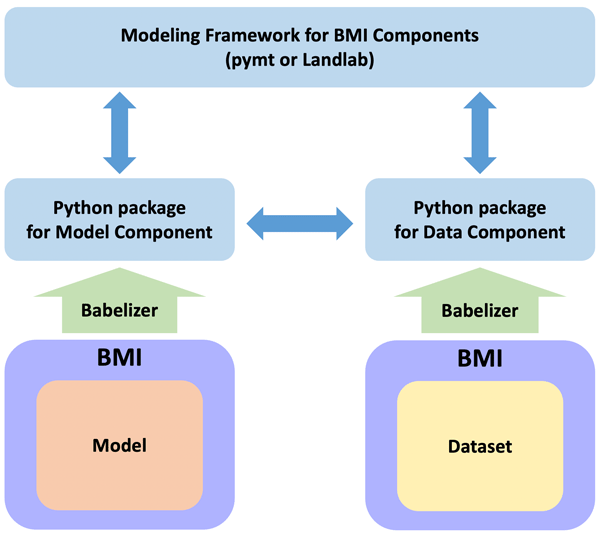
This study presents the design, implementation, and application of the CSDMS Data Components. The case studies demonstrate that the Data Components provide a consistent way to access heterogeneous datasets from multiple sources, and to seamlessly integrate them with various models for Earth surface process modeling. The Data Components support the creation of open data–model integration workflows to improve the research transparency and reproducibility.
Andrew D. Wickert, Jabari C. Jones, and Gene-Hua Crystal Ng
EGUsphere, https://doi.org/10.5194/egusphere-2023-3118, https://doi.org/10.5194/egusphere-2023-3118, 2024
Preprint archived
Short summary
Short summary
For over a century, scientists have used a simple algebraic relationship to estimate the amount of water flowing through a river (its discharge) from the height of the flow (its stage). Here we add physical realism to this approach by explicitly representing both the channel and floodplain, thereby allowing channel and floodplain geometry and roughness to these estimates. Our proposed advance may improve predictions of floods and water resources, even when the river channel itself changes.
Rolf Hut, Niels Drost, Nick van de Giesen, Ben van Werkhoven, Banafsheh Abdollahi, Jerom Aerts, Thomas Albers, Fakhereh Alidoost, Bouwe Andela, Jaro Camphuijsen, Yifat Dzigan, Ronald van Haren, Eric Hutton, Peter Kalverla, Maarten van Meersbergen, Gijs van den Oord, Inti Pelupessy, Stef Smeets, Stefan Verhoeven, Martine de Vos, and Berend Weel
Geosci. Model Dev., 15, 5371–5390, https://doi.org/10.5194/gmd-15-5371-2022, https://doi.org/10.5194/gmd-15-5371-2022, 2022
Short summary
Short summary
With the eWaterCycle platform, we are providing the hydrological community with a platform to conduct their research that is fully compatible with the principles of both open science and FAIR science. The eWatercyle platform gives easy access to well-known hydrological models, big datasets and example experiments. Using eWaterCycle hydrologists can easily compare the results from different models, couple models and do more complex hydrological computational research.
Gregory E. Tucker, Eric W. H. Hutton, Mark D. Piper, Benjamin Campforts, Tian Gan, Katherine R. Barnhart, Albert J. Kettner, Irina Overeem, Scott D. Peckham, Lynn McCready, and Jaia Syvitski
Geosci. Model Dev., 15, 1413–1439, https://doi.org/10.5194/gmd-15-1413-2022, https://doi.org/10.5194/gmd-15-1413-2022, 2022
Short summary
Short summary
Scientists use computer simulation models to understand how Earth surface processes work, including floods, landslides, soil erosion, river channel migration, ocean sedimentation, and coastal change. Research benefits when the software for simulation modeling is open, shared, and coordinated. The Community Surface Dynamics Modeling System (CSDMS) is a US-based facility that supports research by providing community support, computing tools and guidelines, and educational resources.
Maximillian Van Wyk de Vries and Andrew D. Wickert
The Cryosphere, 15, 2115–2132, https://doi.org/10.5194/tc-15-2115-2021, https://doi.org/10.5194/tc-15-2115-2021, 2021
Short summary
Short summary
We can measure glacier flow and sliding velocity by tracking patterns on the ice surface in satellite images. The surface velocity of glaciers provides important information to support assessments of glacier response to climate change, to improve regional assessments of ice thickness, and to assist with glacier fieldwork. Our paper describes Glacier Image Velocimetry (GIV), a new, easy-to-use, and open-source toolbox for calculating high-resolution velocity time series for any glacier on earth.
Richard Barnes, Kerry L. Callaghan, and Andrew D. Wickert
Earth Surf. Dynam., 9, 105–121, https://doi.org/10.5194/esurf-9-105-2021, https://doi.org/10.5194/esurf-9-105-2021, 2021
Short summary
Short summary
Existing ways of modeling the flow of water amongst landscape depressions such as swamps and lakes take a long time to run. However, as our previous work explains, depressions can be quickly organized into a data structure – the depression hierarchy. This paper explains how the depression hierarchy can be used to quickly simulate the realistic filling of depressions including how they spill over into each other and, if they become full enough, how they merge into one another.
Cited articles
Adams, J. M., Gasparini, N. M., Hobley, D. E. J., Tucker, G. E., Hutton, E. W. H., Nudurupati, S. S., and Istanbulluoglu, E.: The Landlab v1.0 OverlandFlow component: a Python tool for computing shallow-water flow across watersheds, Geosci. Model Dev., 10, 1645–1663, https://doi.org/10.5194/gmd-10-1645-2017, 2017. a
Addor, N. and Melsen, L. A.: Legacy, rather than adequacy, drives the selection of hydrological models, Water Resources Research, 55, 378–390, https://doi.org/10.1029/2018WR022958, 2019. a
Altenau, E. H., Pavelsky, T. M., Durand, M. T., Yang, X., Frasson, R. P. D. M., and Bendezu, L.: The Surface Water and Ocean Topography (SWOT) Mission River Database (SWORD): a global river network for satellite data products, Water Resources Research, 57, e2021WR030054, https://doi.org/10.1029/2021WR030054, 2021. a
Astropy Collaboration, Price-Whelan, A. M., Lim, P. L., Earl, N., Starkman, N., Bradley, L., Shupe, D. L., Patil, A. A., Corrales, L., Brasseur, C. E., Nöthe, M., Donath, A., Tollerud, E., Morris, B. M., Ginsburg, A., Vaher, E., Weaver, B. A., Tocknell, J., Jamieson, W., van Kerkwijk, M. H., Robitaille, T. P., Merry, B., Bachetti, M., Günther, H. M., Aldcroft, T. L., Alvarado-Montes, J. A., Archibald, A. M., Bódi, A., Bapat, S., Barentsen, G., Bazán, J., Biswas, M., Boquien, M., Burke, D. J., Cara, D., Cara, M., Conroy, K. E., Conseil, S., Craig, M. W., Cross, R. M., Cruz, K. L., D'Eugenio, F., Dencheva, N., Devillepoix, H. A. R., Dietrich, J. P., Eigenbrot, A. D., Erben, T., Ferreira, L., Foreman-Mackey, D., Fox, R., Freij, N., Garg, S., Geda, R., Glattly, L., Gondhalekar, Y., Gordon, K. D., Grant, D., Greenfield, P., Groener, A. M., Guest, S., Gurovich, S., Handberg, R., Hart, A., Hatfield-Dodds, Z., Homeier, D., Hosseinzadeh, G., Jenness, T., Jones, C. K., Joseph, P., Kalmbach, J. B., Karamehmetoglu, E., Kałuszyński, M., Kelley, M. S. P., Kern, N., Kerzendorf, W. E., Koch, E. W., Kulumani, S., Lee, A., Ly, C., Ma, Z., MacBride, C., Maljaars, J. M., Muna, D., Murphy, N. A., Norman, H., O'Steen, R., Oman, K. A., Pacifici, C., Pascual, S., Pascual-Granado, J., Patil, R. R., Perren, G. I., Pickering, T. E., Rastogi, T., Roulston, B. R., Ryan, D. F., Rykoff, E. S., Sabater, J., Sakurikar, P., Salgado, J., Sanghi, A., Saunders, N., Savchenko, V., Schwardt, L., Seifert-Eckert, M., Shih, A. Y., Jain, A. S., Shukla, G., Sick, J., Simpson, C., Singanamalla, S., Singer, L. P., Singhal, J., Sinha, M., Sipőcz, B. M., Spitler, L. R., Stansby, D., Streicher, O., Šumak, J., Swinbank, J. D., Taranu, D. S., Tewary, N., Tremblay, G. R., de Val-Borro, M., Van Kooten, S. J., Vasović, Z., Verma, S., de Miranda Cardoso, J. V., Williams, P. K. G., Wilson, T. J., Winkel, B., Wood-Vasey, W. M., Xue, R., Yoachim, P., Zhang, C., Zonca, A., and Astropy Project Contributors: The Astropy Project: sustaining and growing a community-oriented open-source project and the latest major release (v5.0) of the core package, The Astrophysical Journal, 935, 167, https://doi.org/10.3847/1538-4357/ac7c74, 2022. a
Barnhart, K. R., Hutton, E. W. H., Tucker, G. E., Gasparini, N. M., Istanbulluoglu, E., Hobley, D. E. J., Lyons, N. J., Mouchene, M., Nudurupati, S. S., Adams, J. M., and Bandaragoda, C.: Short communication: Landlab v2.0: a software package for Earth surface dynamics, Earth Surf. Dynam., 8, 379–397, https://doi.org/10.5194/esurf-8-379-2020, 2020. a
Barragán, H.: Wiring: Prototyping Physical Interaction Design, https://people.interactionivrea.org/h.barragan/thesis/thesis_low_res.pdf (last access: 26 January 2026), 2004. a
Boettiger, C., Chamberlain, S., Hart, E., and Ram, K.: Building software, building community: lessons from the rOpenSci project, Journal of Open Research Software, 3, 8, https://doi.org/10.5334/jors.bu, 2015. a, b, c, d
Buttliere, B. T.: Using science and psychology to improve the dissemination and evaluation of scientific work, Front. Comput. Neurosc., 8, https://doi.org/10.3389/fncom.2014.00082, 2014. a
Carrivick, J. L. and Smith, M. W.: Fluvial and aquatic applications of Structure from Motion photogrammetry and unmanned aerial vehicle/drone technology, WIREs Water, 6, e1328, https://doi.org/10.1002/wat2.1328, 2019. a
Craig, A. P., Vertenstein, M., and Jacob, R.: A new flexible coupler for earth system modeling developed for CCSM4 and CESM1, Int. J. High Perform. C., 31–42, https://doi.org/10.1177/1094342011428141, 2012. a
Dask Development Team: Dask: Library for dynamic task scheduling, https://dask.org (last access: 26 January 2026), 2016. a
Dronova, I., Kislik, C., Dinh, Z., and Kelly, M.: A review of unoccupied aerial vehicle use in wetland applications: emerging opportunities in approach, Technology, and Data, 5, 45, https://doi.org/10.3390/drones5020045, 2021. a
Eaton, B., Gregory, J., Drach, B., Taylor, K., Hankin, S., Caron, J., Signell, R., Bentley, P., Rappa, G., Höck, H., Pamment, A., Juckes, M., Raspaud, M., Blower, J., Horne, R., Whiteaker, T., Blodgett, D., Zender, C., Lee, D., Hassell, D., Snow, A. D., Kölling, T., Allured, D., Jelenak, A., Soerensen, A. M., Gaultier, L., Herlédan, S., Manzano, F., Bärring, L., Barker, C., and Bartholomew, S. L.: NetCDF Climate and Forecast (CF) Metadata Conventions, Zenodo [code], https://doi.org/10.5281/zenodo.14275599, 2024. a, b, c
Esposito, C. R., Di Leonardo, D., Harlan, M., and Straub, K. M.: Sediment storage partitioning in alluvial stratigraphy: the influence of discharge variability, Journal of Sedimentary Research, 88, 717–726, https://doi.org/10.2110/jsr.2018.36, 2018. a
Feng, D., Gleason, C. J., Yang, X., Allen, G. H., and Pavelsky, T. M.: How have global river widths changed over time?, Water Resources Research, 58, e2021WR031712, https://doi.org/10.1029/2021WR031712, 2022. a, b
Fisk, H. N.: Geological Investigation of the Alluvial Valley of the Lower Mississippi River, USACE Record Number RN 735-17c, 1944. a
Grieve, S. W., Clubb, F. J., and Mudd, S. M.: Chapter 12 – Reproducible topographic analysis, in: Remote Sensing of Geomorphology, edited by: Tarolli, P. and Mudd, S. M., Vol. 23 of Developments in Earth Surface Processes, Elsevier, https://doi.org/10.1016/B978-0-444-64177-9.00012-6, 339–367, 2020. a, b
Hobley, D. E. J., Adams, J. M., Nudurupati, S. S., Hutton, E. W. H., Gasparini, N. M., Istanbulluoglu, E., and Tucker, G. E.: Creative computing with Landlab: an open-source toolkit for building, coupling, and exploring two-dimensional numerical models of Earth-surface dynamics, Earth Surf. Dynam., 5, 21–46, https://doi.org/10.5194/esurf-5-21-2017, 2017. a
Hsu, L., McElroy, B., Martin, R. L., and Kim, W.: Building a Sediment Experimentalist Network (SEN): sharing best practices for experimental methods and data management, The Sedimentary Record, 11, 9–12, https://doi.org/10.2110/sedred.2013.4, 2013. a, b
Hughes, J. D., Russcher, M. J., Langevin, C. D., Morway, E. D., and McDonald, R. R.: The MODFLOW Application Programming Interface for simulation control and software interoperability, Environ. Modell. Softw., 148, 105257, https://doi.org/10.1016/j.envsoft.2021.105257, 2022. a
Hutton, E., Piper, M., and Tucker, G.: The Basic Model Interface 2.0: a standard interface for coupling numerical models in the geosciences, Journal of Open Source Software, 5, 2317, https://doi.org/10.21105/joss.02317, 2020. a
Ielpi, A. and Lapôtre, M. G. A.: A tenfold slowdown in river meander migration driven by plant life, Nature Geoscience, 13, 82–86, https://doi.org/10.1038/s41561-019-0491-7, 2020. a
International GEOS-Chem User Community: geoschem/GCClassic: GCClassic 14.6.3, Zenodo [code], https://doi.org/10.5281/zenodo.4437678, 2025. a
Iris contributors: Iris, Zenodo [code], https://doi.org/10.5281/zenodo.595182, 2025. a
Katz, D. S. and Smith, A. M.: Transitive Credit and JSON-LD, Journal of Open Research Software, 3, 7, https://doi.org/10.5334/jors.by, 2015. a
Katz, D. S., McInnes, L. C., Bernholdt, D. E., Mayes, A. C., Hong, N. P. C., Duckles, J., Gesing, S., Heroux, M. A., Hettrick, S., Jiménez, R. C., Pierce, M. E., Weaver, B., and Wilkins-Diehr, N.: Community Organizations: Changing the Culture in Which Research Software Is Developed and Sustained, CoRR, arXiv [preprint], http://arXiv.org/abs/1811.08473 (last access: 8 December 2018), 2018. a, b
Katz, D. S., Chue Hong, N. P., Clark, T., Muench, A., Stall, S., Bouquin, D., Cannon, M., Edmunds, S., Faez, T., Feeney, P., Fenner, M., Friedman, M., Grenier, G., Harrison, M., Heber, J., Leary, A., MacCallum, C., Murray, H., Pastrana, E., Perry, K., Schuster, D., Stockhause, M., and Yeston, J.: Recognizing the value of software: a software citation guide, F1000Research, 9, 1257, https://doi.org/10.12688/f1000research.26932.2, 2021. a
Margolis, M., Jepson, B., and Weldin, N. R.: Arduino Cookbook: Recipes to Begin, Expand, and Enhance your Projects, O'Reilly Media, ISBN 978-1491903520, 2020. a
Mauzey, C., Doutriaux, C., Nadeau, D., Taylor, K. E., Durack, P. J., Betts, E., Cofino, A. S., Florek, P., Hogan, E., Rodriguez Gonzalez, J. M., Kettleborough, J., Nicholls, Z., Ogochi, K., Seddon, J., Wachsmann, F., and Weigel, T.: The Climate Model Output Rewriter (CMOR), Zenodo [code], https://doi.org/10.5281/zenodo.17352037, 2025. a
Müller, S., Schüler, L., Zech, A., and Heße, F.: GSTools v1.3: a toolbox for geostatistical modelling in Python, Geosci. Model Dev., 15, 3161–3182, https://doi.org/10.5194/gmd-15-3161-2022, 2022. a
Nagel, G. W., Darby, S. E., and Leyland, J.: The use of satellite remote sensing for exploring river meander migration, 247, 104607, Earth-Science Reviews, https://doi.org/10.1016/j.earscirev.2023.104607, 2023. a, b
NASA GISS: Panoply netCDF, HDF and GRIB Data Viewer, https://www.giss.nasa.gov/tools/panoply/ (last access: 26 January 2026), 2025. a
Nishio, K., Aiba, A., Takihara, K., Suzuki, Y., Nakayama, R., Kobayashi, S., Abe, A., Baba, H., Katagiri, S., Omoto, K., Ito, K., Shimizu, R., and Hitosugi, T.: A digital laboratory with a modular measurement system and standardized data format, Digital Discovery, 4, 1734–1742, https://doi.org/10.1039/d4dd00326h, 2025. a
Overeem, I., Syvitski, J. P., and Hutton, E. W.: Three-Dimensional Numerical Modeling of Deltas, in: River Deltas–Concepts, Models, and Examples, SEPM Society for Sedimentary Geology, https://doi.org/10.2110/pec.05.83.0011, 2005. a
Paola, C.: Quantitative models of sedimentary basin filling: quantitative models of sedimentary basin filling, Sedimentology, 47, 121–178, https://doi.org/10.1046/j.1365-3091.2000.00006.x, 2000. a, b
Paola, C., Foufoula-Georgiou, E., Dietrich, W. E., Hondzo, M., Mohrig, D., Parker, G., Power, M. E., Rodriguez-Iturbe, I., Voller, V., and Wilcock, P.: Toward a unified science of the Earth's surface: Opportunities for synthesis among hydrology, geomorphology, geochemistry, and ecology, Water Resources Research, 42, 2005WR004336, https://doi.org/10.1029/2005WR004336, 2006. a
Paola, C., Straub, K., Mohrig, D., and Reinhardt, L.: The “unreasonable effectiveness” of stratigraphic and geomorphic experiments, Earth-Sci. Rev., 97, 1–43, https://doi.org/10.1016/j.earscirev.2009.05.003, 2009. a, b
Parker, G., Paola, C., Whipple, K. X., and Mohrig, D.: Alluvial fans formed by channelized fluvial and sheet flow. I: Theory, J. Hydraul. Eng., 124, 985–995, https://doi.org/10.1061/(ASCE)0733-9429(1998)124:10(985), 1998a. a
Parker, G., Paola, C., Whipple, K. X., Mohrig, D., Toro-Escobar, C. M., Halverson, M., and Skoglund, T. W.: Alluvial fans formed by channelized fluvial and sheet flow. II: Application, J. Hydraul. Eng., 124, 996–1004, https://doi.org/10.1061/(ASCE)0733-9429(1998)124:10(996), 1998b. a
Parker, G., Muto, T., Akamatsu, Y., Dietrich, W. E., and Lauer, J. W.: Unravelling the conundrum of river response to rising sea-level from laboratory to field. Part I: Laboratory experiments, Sedimentology, 55, 1643–1655, https://doi.org/10.1111/j.1365-3091.2008.00961.x, 2008a. a
Parker, G., Muto, T., Akamatsu, Y., Dietrich, W. E., and Wesley Lauer, J.: Unravelling the conundrum of river response to rising sea-level from laboratory to field. Part II. The Fly-Strickland River system, Papua New Guinea, Sedimentology, 55, 1657–1686, https://doi.org/10.1111/j.1365-3091.2008.00962.x, 2008b. a
Patel, A., Halgren, J., Wills, Z., Frazier, N., Lee, B., Cunningham, J., Laser, J., Karimiziarani, M., Patel, T., Romero, G., Denno, M., Lamont, S., Maghami, I., Jajula, H. T., Alam, M. S., Koriche, S. A., Singh, M., Minor, N., Duvvuri, B., Neisary, S. N., Lee, Q., Burian, S., Ogden, F. L., Bangalore, P., Carver, J. C., and Ames, D. P.: NextGen In A Box (NGIAB): Open-Source containerization of the NextGen framework to enable community-driven hydrology modeling, Environ. Modell. Softw., 193, 106666, https://doi.org/10.1016/j.envsoft.2025.106666, 2025. a
Peckham, S.: The CSDMS Standard Names: Cross-Domain Naming Conventions for Describing Process Models, Data Sets and Their Associated Variables, in: International Environmental Modelling and Software Society, 7th International Conference on Environmental Modeling and Software, https://scholarsarchive.byu.edu/iemssconference/2014/Stream-A/12/ (last access: 26 January 2026), 2014. a, b, c
Peckham, S. D., Hutton, E. W., and Norris, B.: A component-based approach to integrated modeling in the geosciences: the design of CSDMS, Computers & Geosciences, 53, 3–12, https://doi.org/10.1016/j.cageo.2012.04.002, 2013. a, b
Rew, R., Hartnett, E., and Caron, J.: NetCDF-4: Software implementing an enhanced data model for the geosciences, in: 22nd International Conference on Interactive Information Processing Systems for Meteorology, Oceanograph, and Hydrology, Vol. 6, abstract number A412, https://ams.confex.com/ams/Annual2006/webprogram/Paper104931.html (last access: 26 January 2026), 2006. a, b, c
sandpiper toolchain contributors: sandsuet analysis-ready geomorphology data specification (1.0.0), sandpiper toolchain [data set], https://doi.org/10.5281/zenodo.17884433, 2025. a
Schimanski, L. A. and Alperin, J. P.: The evaluation of scholarship in academic promotion and tenure processes: past, present, and future, F1000Research, 7, 1605, https://doi.org/10.12688/f1000research.16493.1, 2018. a
Schwenk, J., Khandelwal, A., Fratkin, M., Kumar, V., and Foufoula-Georgiou, E.: High spatiotemporal resolution of river planform dynamics from Landsat: The RivMAP toolbox and results from the Ucayali River, Earth and Space Science, 4, 46–75, https://doi.org/10.1002/2016EA000196, 2017. a
Shiloh, M. and Banzi, M.: Make: Getting started with Arduino 4e: The Open Source Electronics Prototyping Platform, Maker Media, Sebastopol, CA, ISBN 978-1680456936, 2022. a
Śledź, S., Ewertowski, M. W., and Piekarczyk, J.: Applications of unmanned aerial vehicle (UAV) surveys and structure from motion photogrammetry in glacial and periglacial geomorphology, Geomorphology, 378, 107620, https://doi.org/10.1016/j.geomorph.2021.107620, 2021. a
Smith, A. M., Katz, D. S., and Niemeyer, K. E.: Software citation principles, PeerJ Computer Science, 2, e86, https://doi.org/10.7717/peerj-cs.86, 2016. a
Stirling, J.: Open instrumentation, like open data, is key to reproducible science. Yet, without incentives it won't thrive, Philos. T. Roy. Soc. A, 382, https://doi.org/10.1098/rsta.2023.0215, 2024. a
Stoica, M. and Peckham, S.: The scientific variables ontology: a blueprint for custom manual and automated creation and alignment of machine-interpretable qualitative and quantitative variable concepts, in: Modeling the World's Systems Conference, http://mint-project.info/assets/publications/stoica-peckham-cwm19.pdf (last access: 26 January 2026), 2019. a, b, c
Straub, K. M., Li, Q., and Benson, W. M.: Influence of sediment cohesion on deltaic shoreline dynamics and bulk sediment retention: a laboratory study, Geophysical Research Letters, 42, 9808–9815, https://doi.org/10.1002/2015GL066131, 2015. a
Tarboton, D. G., Horsburgh, J. S., and Maidment, D. R.: CUAHSI Community Observations Data Model (ODM) Version 1.1 Design Specifications, https://his.cuahsi.org/documents/odm1.1designspecifications.pdf (last access: 26 January 2026), 2008. a
Tucker, G. E., Hutton, E. W. H., Piper, M. D., Campforts, B., Gan, T., Barnhart, K. R., Kettner, A. J., Overeem, I., Peckham, S. D., McCready, L., and Syvitski, J.: CSDMS: a community platform for numerical modeling of Earth surface processes, Geosci. Model Dev., 15, 1413–1439, https://doi.org/10.5194/gmd-15-1413-2022, 2022. a, b, c
Vo, T., Po-Chedley, S., Boutte, J., Lee, J., and Zhang, C.: xCDAT: a Python package for simple and robust analysis of climate data, Journal of Open Source Software, 9, 6426, https://doi.org/10.21105/joss.06426, 2024. a
Watney, W. L., Rankey, E. C., and Harbaugh, J.: Perspectives on Stratigraphic Simulation ModelsCurrent Approaches and Future Opportunities, SEPM Society for Sedimentary Geology, https://doi.org/10.2110/pec.99.62.0003, 1999. a
Wenzel, T.: Open hardware: from DIY trend to global transformation in access to laboratory equipment, PLoS Biol., 21, 1–16, https://doi.org/10.1371/journal.pbio.3001931, 2023. a
Wickert, A. D.: The ALog: inexpensive, Open-Source, automated data collection in the field, Bulletin of the Ecological Society of America, 95, 68–78, https://doi.org/10.1890/0012-9623-95.2.68, 2014. a
Woodget, A. S., Austrums, R., Maddock, I. P., and Habit, E.: Drones and digital photogrammetry: from classifications to continuums for monitoring river habitat and hydromorphology, WIREs Water, 4, e1222, https://doi.org/10.1002/wat2.1222, 2017. a
Wu, Q., Ke, L., Wang, J., Pavelsky, T. M., Allen, G. H., Sheng, Y., Duan, X., Zhu, Y., Wu, J., Wang, L., Liu, K., Chen, T., Zhang, W., Fan, C., Yong, B., and Song, C.: Satellites reveal hotspots of global river extent change, Nature Communications, 14, 1587, https://doi.org/10.1038/s41467-023-37061-3, 2023. a, b

Short summary
Geomorphologists have more data and computational resources available than ever before, but lack tools to facilitate collaborations needed to integrate data from different modes of study (e.g., field, experimental, modeling). In this article, we discuss challenges to collaboration in geomorphology, and report a new schema for sharing data. The sandsuet schema is designed to accommodate most kinds of rasterized geomorphology data, and makes it easy to package, publish, and share those data.
Geomorphologists have more data and computational resources available than ever before, but lack...