
Articles | Volume 14, issue 2
https://doi.org/10.5194/esurf-14-191-2026
© Author(s) 2026. This work is distributed under
the Creative Commons Attribution 4.0 License.
the Creative Commons Attribution 4.0 License.
https://doi.org/10.5194/esurf-14-191-2026
© Author(s) 2026. This work is distributed under
the Creative Commons Attribution 4.0 License.
the Creative Commons Attribution 4.0 License.
Research article
| 
16 Mar 2026
Research article |
| 16 Mar 2026
| 16 Mar 2026
New experiments to probe the role of fractures in bedrock on river erosion rate and processes
Marion Fournereau
CORRESPONDING AUTHOR

Univ. Rennes, CNRS, Geosciences Rennes, UMR 6118, 35000, Rennes, France
Univ. Rennes, CNRS, Geosciences Rennes, UMR 6118, 35000, Rennes, France
Philippe Steer
Univ. Rennes, CNRS, Geosciences Rennes, UMR 6118, 35000, Rennes, France
Jean-Jacques Kermarrec
Univ. Rennes, CNRS, Geosciences Rennes, UMR 6118, 35000, Rennes, France
Paul Leroy
Univ. Rennes, CNRS, Lidar Platform, OSERen, UAR3343, 35000 Rennes, France
Christophe Lanos
Univ. Rennes, Laboratoire de Génie Civil et Génie Mécanique, Rennes, 35000 France
Hélène Hivert
Univ. Rennes, Inria, Géosciences Rennes – UMR 6118, IRMAR – UMR 6625, 35000 Rennes, France
Claire Astrié
Univ. Rennes, CNRS, Geosciences Rennes, UMR 6118, 35000, Rennes, France
Dimitri Lague
Univ. Rennes, CNRS, Geosciences Rennes, UMR 6118, 35000, Rennes, France
Univ. Rennes, CNRS, Lidar Platform, OSERen, UAR3343, 35000 Rennes, France
Related authors
No articles found.
Philippe Steer, Lucas Pelascini, and Laurent Longuevergne
EGUsphere, https://doi.org/10.5194/egusphere-2026-4142, https://doi.org/10.5194/egusphere-2026-4142, 2026
Short summary
Short summary
Landslides tend to rupture in predictable size patterns, but working out where and how deep a slope will fail has remained difficult. We built a simple slope stability model, that calculates the most likely rupture depth and shape at each point on a landscape. The model reproduced real landslide size patterns. This model also revealed the slopes which are still adjusting after past geological change, like river carving or cathment divide migration, helping pinpoint landslide-prone terrain.
Xiaoyu Huang, Mathilde Letard, Dimitri Lague, Bernhard Höfle, Ronald Tabernig, Paul Leroy, and Katharina Anders
ISPRS Ann. Photogramm. Remote Sens. Spatial Inf. Sci., XI-2-2026, 623–630, https://doi.org/10.5194/isprs-annals-XI-2-2026-623-2026, https://doi.org/10.5194/isprs-annals-XI-2-2026-623-2026, 2026
Aude Lurin, Philippe Steer, Fiona Clubb, and Boris Gailleton
EGUsphere, https://doi.org/10.5194/egusphere-2026-3145, https://doi.org/10.5194/egusphere-2026-3145, 2026
This preprint is open for discussion and under review for Earth Surface Dynamics (ESurf).
Short summary
Short summary
The dynamics of mountains landscapes is controled by their valley networks. The morphology of valleys, including their width, impacts how they transmit sediments and water and record tectonic or climatic signals. In order to further our understanding of the controls of valley morphology and width, we compare two automatic valley extraction methods in four regions. We then evaluate how valley width and morphology is affected dy drainage area, lithology, and the tectonic and geomorphic setting.
William Kearney, Gina Arnau, Theophil Bringezu, Michael Dietze, Boris Gailleton, Anna-Lena Lamprecht, Kilian Lenz, Richard Ott, Dirk Scherler, Philippe Steer, and Wolfgang Schwanghart
EGUsphere, https://doi.org/10.5194/egusphere-2026-2478, https://doi.org/10.5194/egusphere-2026-2478, 2026
Short summary
Short summary
TopoToolbox is a software package that enables users to analyze maps of the Earth's surface. The newest version of TopoToolbox makes it accessible to more users, makes it easier to integrate TopoToolbox with other software used to study the Earth's surface and establishes a new development process to ensure that TopoToolbox continues to meet the needs of its community of users. We present a series of examples to demonstrate how users can incorporate the new TopoToolbox version into their work.
Ron Nativ, Dimitri Lague, Paul Leroy, Laure Guerit, Thomas Bernard, Mathilde Letard, Daniel Girardeau-Montaut, Vincent Godard, Rodolphe Cattin, Olivier Payrastre, and Philippe Steer
EGUsphere, https://doi.org/10.5194/egusphere-2026-724, https://doi.org/10.5194/egusphere-2026-724, 2026
Short summary
Short summary
We mapped the riverbed through a 28 km canyon in southern France using airborne laser measurements, where field surveys are difficult and risky. By reprocessing the full recorded signal and combining it with targeted sonar checks, we recovered deeper and more complete underwater terrain than standard approaches. The resulting riverbed elevation model preserves key channel shapes needed for improved flood simulations, habitat assessment, and river management.
Marine Le Minor, Dimitri Lague, Jamie Howarth, and Philippe Davy
Earth Surf. Dynam., 13, 1229–1248, https://doi.org/10.5194/esurf-13-1229-2025, https://doi.org/10.5194/esurf-13-1229-2025, 2025
Short summary
Short summary
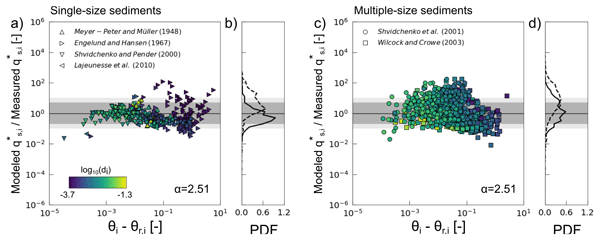
In natural rivers, flow variability and sediment heterogeneity affect how sediment grains are transported. A unique law that predicts the total amount of sediment transportable by a river for a wide range of sediment mixtures and flow conditions exists, but unclear trends remain. Two improvements to this law – a standardized onset of sediment transport and a common reference transport height across all sizes – appear to be critical to having a functional multi-grain-size total sediment load.
Thomas Geffroy, Philippe Yamato, Philippe Steer, Benjamin Guillaume, and Thibault Duretz
Solid Earth, 16, 1289–1306, https://doi.org/10.5194/se-16-1289-2025, https://doi.org/10.5194/se-16-1289-2025, 2025
Short summary
Short summary
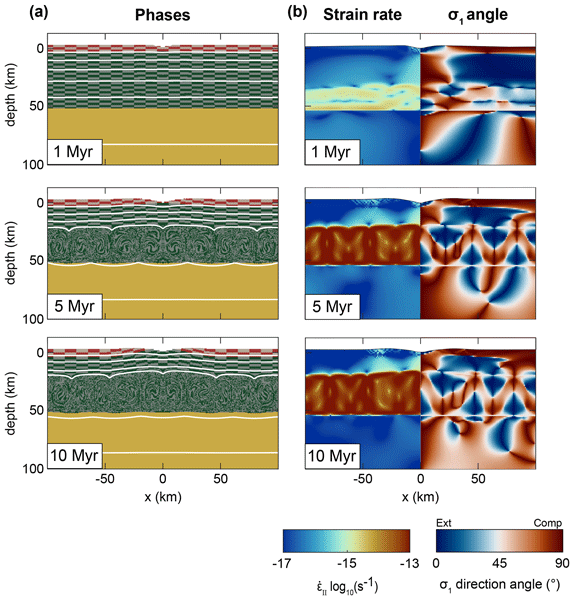
While erosion's role in mountain building is well known, deformation from valley incision in inactive regions is less understood. Using our numerical models, we show that incision alone can cause significant crustal deformation and drive lower crust exhumation. This is favored in areas with thick crust, weak lower crust, and high plateaux. Our results show surface processes can reshape Earth's surface over time.
Coline Ariagno, Philippe Steer, Pierre G. Valla, and Benjamin Campforts
Earth Surf. Dynam., 13, 1109–1132, https://doi.org/10.5194/esurf-13-1109-2025, https://doi.org/10.5194/esurf-13-1109-2025, 2025
Short summary
Short summary
This study explore the impact of landslides on Alpine terrain using a landscape evolution model called
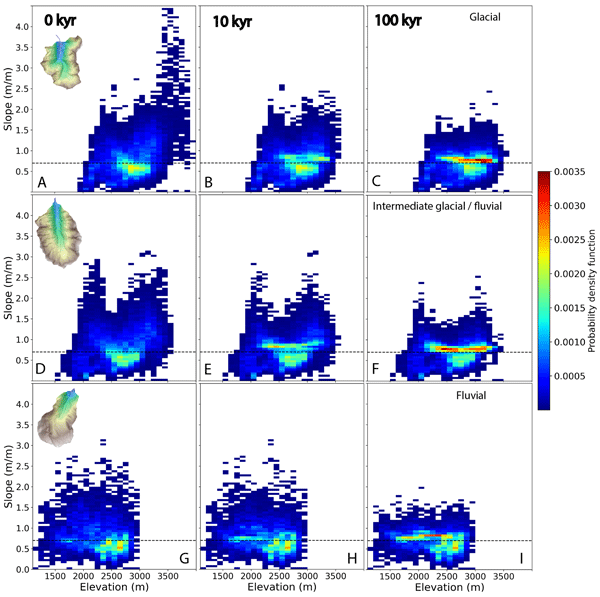
Hyland, which enables long-term topographical analysis. Our finding reveal that landslides are concentrated at two specific elevations over time and predominantly affect the highest and steepest slopes, particularly along ridges and crests. This study is part of a broader question concerning the origin of accelerated erosion during the Quaternary period.
Juliette Godet, Pierre Nicolle, Nabil Hocini, Eric Gaume, Philippe Davy, Frederic Pons, Pierre Javelle, Pierre-André Garambois, Dimitri Lague, and Olivier Payrastre
Earth Syst. Sci. Data, 17, 2963–2983, https://doi.org/10.5194/essd-17-2963-2025, https://doi.org/10.5194/essd-17-2963-2025, 2025
Short summary
Short summary
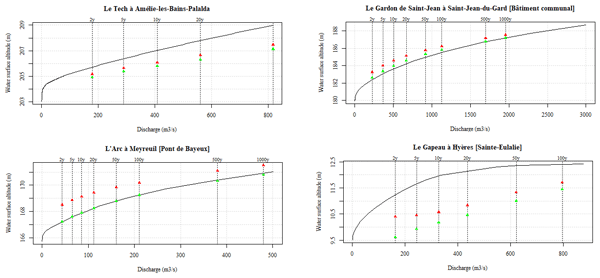
This paper describes a dataset that includes input, output, and validation data for the simulation of flash flood hazards and three specific flash flood events in the French Mediterranean region. This dataset is particularly valuable as flood mapping methods often lack sufficient benchmark data. Additionally, we demonstrate how the hydraulic method we used, named Floodos, produces highly satisfactory results.
Boris Gailleton, Philippe Steer, Philippe Davy, Wolfgang Schwanghart, and Thomas Bernard
Earth Surf. Dynam., 12, 1295–1313, https://doi.org/10.5194/esurf-12-1295-2024, https://doi.org/10.5194/esurf-12-1295-2024, 2024
Short summary
Short summary
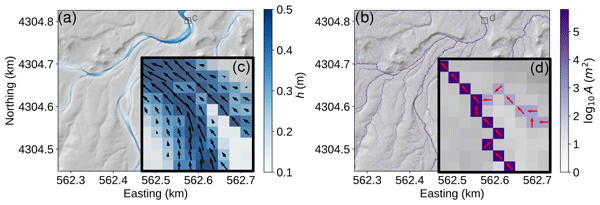
We use cutting-edge algorithms and conceptual simplifications to solve the equations that describe surface water flow. Using quantitative data on rainfall and elevation, GraphFlood calculates river width and depth and approximates erosive power, making it a suitable tool for large-scale hazard management and understanding the relationship between rivers and mountains.
Philippe Steer, Laure Guerit, Dimitri Lague, Alain Crave, and Aurélie Gourdon
Earth Surf. Dynam., 10, 1211–1232, https://doi.org/10.5194/esurf-10-1211-2022, https://doi.org/10.5194/esurf-10-1211-2022, 2022
Short summary
Short summary
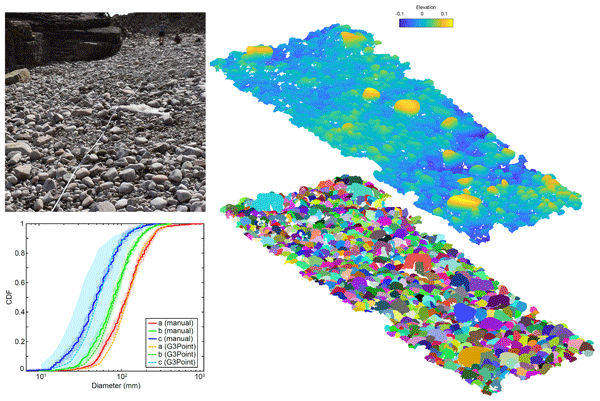
The morphology and size of sediments influence erosion efficiency, sediment transport and the quality of aquatic ecosystem. In turn, the spatial evolution of sediment size provides information on the past dynamics of erosion and sediment transport. We have developed a new software which semi-automatically identifies and measures sediments based on 3D point clouds. This software is fast and efficient, offering a new avenue to measure the geometrical properties of large numbers of sediment grains.
Lucas Pelascini, Philippe Steer, Maxime Mouyen, and Laurent Longuevergne
Nat. Hazards Earth Syst. Sci., 22, 3125–3141, https://doi.org/10.5194/nhess-22-3125-2022, https://doi.org/10.5194/nhess-22-3125-2022, 2022
Short summary
Short summary
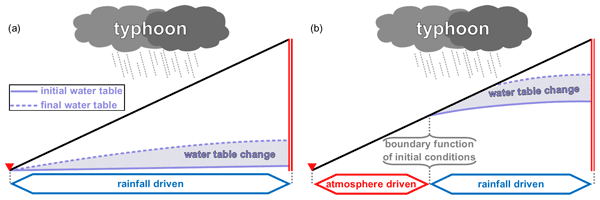
Landslides represent a major natural hazard and are often triggered by typhoons. We present a new 2D model computing the respective role of rainfall infiltration, atmospheric depression and groundwater in slope stability during typhoons. The results show rainfall is the strongest factor of destabilisation. However, if the slope is fully saturated, near the toe of the slope or during the wet season, rainfall infiltration is limited and atmospheric pressure change can become the dominant factor.
Benjamin Guillaume, Guido M. Gianni, Jean-Jacques Kermarrec, and Khaled Bock
Solid Earth, 13, 1393–1414, https://doi.org/10.5194/se-13-1393-2022, https://doi.org/10.5194/se-13-1393-2022, 2022
Short summary
Short summary
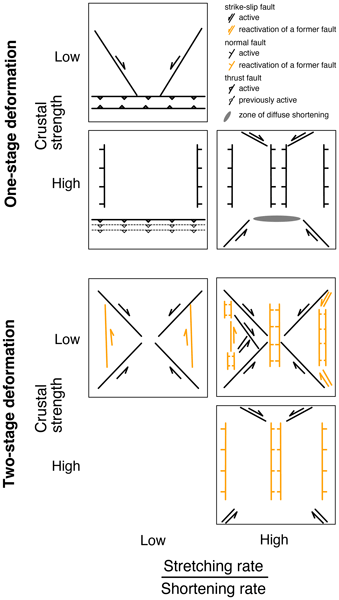
Under tectonic forces, the upper part of the crust can break along different types of faults, depending on the orientation of the applied stresses. Using scaled analogue models, we show that the relative magnitude of compressional and extensional forces as well as the presence of inherited structures resulting from previous stages of deformation control the location and type of faults. Our results gives insights into the tectonic evolution of areas showing complex patterns of deformation.
Clément Desormeaux, Vincent Godard, Dimitri Lague, Guillaume Duclaux, Jules Fleury, Lucilla Benedetti, Olivier Bellier, and the ASTER Team
Earth Surf. Dynam., 10, 473–492, https://doi.org/10.5194/esurf-10-473-2022, https://doi.org/10.5194/esurf-10-473-2022, 2022
Short summary
Short summary
Landscape evolution is highly dependent on climatic parameters, and the occurrence of intense precipitation events is considered to be an important driver of river incision. We compare the rate of erosion with the variability of river discharge in a mountainous landscape of SE France where high-magnitude floods regularly occur. Our study highlights the importance of the hypotheses made regarding the threshold that river discharge needs to exceed in order to effectively cut down into the bedrock.
M. Letard, A. Collin, D. Lague, T. Corpetti, Y. Pastol, and A. Ekelund
Int. Arch. Photogramm. Remote Sens. Spatial Inf. Sci., XLIII-B3-2022, 463–470, https://doi.org/10.5194/isprs-archives-XLIII-B3-2022-463-2022, https://doi.org/10.5194/isprs-archives-XLIII-B3-2022-463-2022, 2022
Cited articles
AFNOR: NF EN 196-1: Methods of testing cement – Part 1: determination of strength, AFNOR Éditions, https://www.boutique.afnor.org/en-gb/standard/nf-en-1961/methods-of-testing-cement-part-1-determination-of-strength/fa184622/57803, 2016.
Anderson, R. S. and Anderson, S. P.: Geomorphology: The Mechanics and Chemistry of Landscapes, Cambridge University Press, ISBN-13 978-0521519786, ISBN-10 0521519780, 2010.
Attal, M., Lavé, J., and Masson, J.-P.: New Facility to Study River Abrasion Processes, J. Hydraul. Eng., 132, 624–628, https://doi.org/10.1061/(ASCE)0733-9429(2006)132:6(624), 2006.
Beer, A. R. and Lamb, M. P.: Abrasion regimes in fluvial bedrock incision, Geology, 49, 682–386, https://doi.org/10.1130/G48466.1, 2021.
Beer, A. R. and Turowski, J. M.: Bedload transport controls bedrock erosion under sediment-starved conditions, Earth Surf. Dynam., 3, 291–309, https://doi.org/10.5194/esurf-3-291-2015, 2015.
Beer, Alexander. R., Turowski, J. M., and Kirchner, J. W.: Spatial patterns of erosion in a bedrock gorge, J. Geophys. Res.-Earth, 122, 191–214, https://doi.org/10.1002/2016JF003850, 2017.
Bonnet, E., Bour, O., Odling, N. E., Davy, P., Main, I., Cowie, P., and Berkowitz, B.: Scaling of fracture systems in geological media, Rev. Geophys., 39, 347–383, https://doi.org/10.1029/1999RG000074, 2001.
Brodu, N. and Lague, D.: 3D terrestrial lidar data classification of complex natural scenes using a multi-scale dimensionality criterion: Applications in geomorphology, ISPRS Journal of Photogramm., 68, 121–134, https://doi.org/10.1016/j.isprsjprs.2012.01.006, 2012.
Bulletin du ciment: Le durcissement du béton, Bulletin du Ciment, Service de Recherches et Conseils Techniques de l'Industrie Suisse du Ciment (TFB AG), 18–19, 13, https://doi.org/10.5169/seals-145354%E2%80%8B%E2%80%8B, 1950–1951.
Chatanantavet, P. and Parker, G.: Physically based modeling of bedrock incision by abrasion, plucking, and macroabrasion, J. Geophys. Res., 114, https://doi.org/10.1029/2008JF001044, 2009.
Chatanantavet, P. and Parker, G.: Quantitative Testing of Model of Bedrock Channel Incision by Plucking and Macroabrasion, J. Hydraul. Eng., 137, 1311–1317, https://doi.org/10.1061/(ASCE)HY.1943-7900.0000421, 2011.
Chilton, K. D., Zedan, M., Strom, K., and Shobe, C. M.: Dip angle controls on plucking susceptibility and knickpoint evolution in bedrock rivers, Geology, 53, 780–784, https://doi.org/10.1130/g53413.1, 2025.
Collins, B. D., Stock, G. M., Eppes, M.-C., Lewis, S. W., Corbett, S. C., and Smith, J. B.: Thermal influences on spontaneous rock dome exfoliation, Nat. Commun., 9, 762, https://doi.org/10.1038/s41467-017-02728-1, 2018.
Dershowitz, W. S. and Herda, H. H.: Interpretation of fracture spacing and intensity, in: The 33rd U.S. Symposium on Rock Mechanics, https://doi.org/10.1016/0148-9062(93)91769-f, 1992.
Dubinski, I. M. and Wohl, E.: Relationships between block quarrying, bed shear stress, and stream power: A physical model of block quarrying of a jointed bedrock channel, Geomorphology, 180–181, 66–81, https://doi.org/10.1016/j.geomorph.2012.09.007, 2013.
Ehlen, J. and Wohl, E.: Joints and landform evolution in bedrock canyons, Trans. Jpn. Geomorphol. Union, 23, 237–255, 2002.
Eppes, M. C., Rinehart, A., Aldred, J., Berberich, S., Dahlquist, M. P., Evans, S. G., Keanini, R., Laubach, S. E., Moser, F., Morovati, M., Porson, S., Rasmussen, M., and Shaanan, U.: Introducing standardized field methods for fracture-focused surface process research, Earth Surf. Dynam., 12, 35–66, https://doi.org/10.5194/esurf-12-35-2024, 2024.
Fournereau, M.: Dataset used in the study “New experiments to probe the role of fractures in bedrock on river erosion rate and processes”, Zenodo [data set], https://doi.org/10.5281/zenodo.17607654, 2025.
Hallet, B.: Glacial quarrying: a simple theoretical model, Ann. Glaciol., 22, 1–8, https://doi.org/10.3189/1996AoG22-1-1-8, 1996.
Hallet, B., Walder, J. S., and Stubbs, C. W.: Weathering by segregation ice growth in microcracks at sustained subzero temperatures: Verification from an experimental study using acoustic emissions, Permafrost Periglac., 2, 283–300, https://doi.org/10.1002/ppp.3430020404, 1991.
Hancock, G. S., Anderson, R. S., and Whipple, K. X.: Beyond power: Bedrock river incision process and form, in: Rivers Over Rock: Fluvial Processes in Bedrock Channels, vol. 107, edited by: Tinkler, K. J. and Wohl, E. E., Blackwell Publishing Ltd, 35–60, https://doi.org/10.1029/GM107p0035, 1998.
Hartshorn, K., Hovius, N., Dade, W. B., and Slingerland, R. L.: Climate-Driven Bedrock Incision in an Active Mountain Belt, Science, 297, 2036–2038, https://doi.org/10.1126/science.1075078, 2002.
Hurst, A. A., Anderson, R. S., and Crimaldi, J. P.: Toward Entrainment Thresholds in Fluvial Plucking, J. Geophys. Res.-Earth, 126, e2020JF005944, https://doi.org/10.1029/2020JF005944, 2021.
Jarzyna, A., Bąbel, M., Vladi, F., and Ługowski, D.: Hydration caves and cavities from the recent weathering zone of anhydrites at Dingwall (Nova Scotia, Canada), Geomorphology, 433, 108667, https://doi.org/10.1016/j.geomorph.2023.108667, 2023.
Lague, D.: Reduction of long-term bedrock incision efficiency by short-term alluvial cover intermittency, J. Geophys. Res.-Earth, 115, https://doi.org/10.1029/2008JF001210, 2010.
Lague, D.: The stream power river incision model: evidence, theory and beyond, Earth Surf. Proc. Land., 39, 38–61, https://doi.org/10.1002/esp.3462, 2014.
Lague, D., Brodu, N., and Leroux, J.: Accurate 3D comparison of complex topography with terrestrial laser scanner: Application to the Rangitikei canyon (N-Z), ISPRS J. Photogramm., 82, https://doi.org/10.1016/j.isprsjprs.2013.04.009, 2013.
Lamb, M. P. and Dietrich, W. E.: The persistence of waterfalls in fractured rock, GSA Bulletin, 121, 1123–1134, https://doi.org/10.1130/B26482.1, 2009.
Le Goc, R., Pinier, B., Darcel, C., Lavoine, E., Doolaeghe, D., de Simone, S., De Dreuzy, J.-R., and Davy, P.: DFN. lab: software platform for Discrete Fracture Network models, AGU Fall Meeting 2019, https://ui.adsabs.harvard.edu/abs/2019AGUFM.H41H1778L, 2019.
Lima, A. G., Pelegrina, M. A., Pontarolo, M., Gonçalves Lima, A., Pelegrina, M. A., and Pontarolo, M.: Fracture variability in basalts and its effect on river erosion: a case study in the Paraná volcanic province, Earth Sci. Res. J., 25, 13–19, https://doi.org/10.15446/esrj.v25n1.85098, 2021.
Molnar, P., Anderson, R. S., and Anderson, S. P.: Tectonics, fracturing of rock, and erosion, J. Geophys. Res., 112, https://doi.org/10.1029/2005JF000433, 2007.
Paola, C., Straub, K., Mohrig, D., and Reinhardt, L.: The “unreasonable effectiveness” of stratigraphic and geomorphic experiments, Earth-Sci. Rev., 97, 1–43, https://doi.org/10.1016/j.earscirev.2009.05.003, 2009.
Saha, R., Lee, J. S., and Hong, S. H.: The impact of lateral flow contraction on the rock plucking process under sub-critical flow conditions, Earth Surf. Proc. Land., 46, 2902–2915, https://doi.org/10.1002/esp.5220, 2021.
Scheingross, J., Brun, F., Lo, D., Omerdin, K., and Lamb, M.: Experimental evidence for fluvial bedrock incision by suspended and bedload sediment, Geology, 42, 523–526, https://doi.org/10.1130/G35432.1, 2014.
Scott, D. N. and Wohl, E. E.: Bedrock fracture influences on geomorphic process and form across process domains and scales, Earth Surf. Proc. Land., 44, 27–45, https://doi.org/10.1002/esp.4473, 2019.
Sklar, L. and Dietrich, W.: Sediment and rock strength control on river incision into bedrock, Geology, 29, 1087–1090, https://doi.org/10.1130/0091-7613(2001)029<1087:SARSCO>2.0.CO;2, 2001.
Sklar, L. and Dietrich, W. E.: River Longitudinal Profiles and Bedrock Incision Models: Stream Power and the Influence of Sediment Supply, in: Rivers Over Rock: Fluvial Processes in Bedrock Channels, vol. 107, American Geophysical Union (AGU), 237–260, https://doi.org/10.1029/GM107p0237, 1998.
Sklar, L. S. and Dietrich, W. E.: A mechanistic model for river incision into bedrock by saltating bed load, Water Resour. Res., 40, https://doi.org/10.1029/2003WR002496, 2004.
Slim, M., Perron, J. T., Martel, S. J., and Singha, K.: Topographic stress and rock fracture: a two-dimensional numerical model for arbitrary topography and preliminary comparison with borehole observations, Earth Surf. Proc. Land., 40, 512–529, https://doi.org/10.1002/esp.3646, 2015.
Small, E. E., Blom, T., Hancock, G. S., Hynek, B. M., and Wobus, C. W.: Variability of rock erodibility in bedrock-floored stream channels based on abrasion mill experiments, J. Geophys. Res.-Earth, 120, 1455–1469, https://doi.org/10.1002/2015JF003506, 2015.
Snyder, N. P., Whipple, K. X., Tucker, G. E., and Merritts, D. J.: Importance of a stochastic distribution of floods and erosion thresholds in the bedrock river incision problem, J. Geophys. Res.-Sol. Ea., 108, https://doi.org/10.1029/2001JB001655, 2003.
Thuro, K.: Drillability prediction: geological influences in hard rock drill and blast tunnelling, Geol. Rundsch., 86, 426–438, https://doi.org/10.1007/s005310050151, 1997.
Turowski, J. M., Lague, D., and Hovius, N.: Cover effect in bedrock abrasion: A new derivation and its implications for the modeling of bedrock channel morphology, J. Geophys. Res.-Earth, 112, https://doi.org/10.1029/2006JF000697, 2007.
Turowski, J. M., Hovius, N., Wilson, A., and Horng, M.-J.: Hydraulic geometry, river sediment and the definition of bedrock channels, Geomorphology, 99, 26–38, https://doi.org/10.1016/j.geomorph.2007.10.001, 2008.
Turowski, J. M., Pruß, G., Voigtländer, A., Ludwig, A., Landgraf, A., Kober, F., and Bonnelye, A.: Geotechnical controls on erodibility in fluvial impact erosion, Earth Surf. Dynam., 11, 979–994, https://doi.org/10.5194/esurf-11-979-2023, 2023.
Whipple, K. X.: Bedrock Rivers and the Geomorphology of Active Orogens, Annu. Rev. Earth Pl. Sc., 32, 151–185, https://doi.org/10.1146/annurev.earth.32.101802.120356, 2004.
Whipple, K. X., Snyder, N. P., and Dollenmayer, K.: Rates and processes of bedrock incision by the Upper Ukak River since the 1912 Novarupta ash flow in the Valley of Ten Thousand Smokes, Alaska, Geology, 28, 835–838, https://doi.org/10.1130/0091-7613(2000)28<835:RAPOBI>2.0.CO;2, 2000a.
Whipple, K. X., Hancock, G. S., and Anderson, R.: River incision into bedrock: Mechanics and relative efficacy of plucking, abrasion, and cavitation, GSA Bulletin, 112, 490–503, https://doi.org/10.1130/0016-7606(2000)112<490:RIIBMA>2.0.CO;2, 2000b.
Whipple, K. X., DiBiase, R. A., Crosby, B., and Johnson, J. P. L.: 6.40 Bedrock Rivers, in: Treatise on Geomorphology, Second Edition, edited by: Shroder, J. (Jack) F., Academic Press, Oxford, 865–903, https://doi.org/10.1016/B978-0-12-818234-5.00101-2, 2022.
Wilkinson, C., Harbor, D. J., Helgans, E., and Kuehner, J. P.: Plucking phenomena in nonuniform flow, Geosphere, 14, 2157–2170, https://doi.org/10.1130/GES01623.1, 2018.
Wilson, A. and Lavé, J.: Convergent evolution of abrading flow obstacles: Insights from analogue modelling of fluvial bedrock abrasion by coarse bedload, Geomorphology, 208, 207–224, https://doi.org/10.1016/j.geomorph.2013.11.024, 2014.
Wohl, E.: The effect of bedrock jointing on the formation of straths in the Cache la Poudre River drainage, Colorado Front Range, J. Geophys. Res.-Earth, 113, https://doi.org/10.1029/2007JF000817, 2008.
Wohl, E. E.: Substrate Influences on Step-Pool Sequences in the Christopher Creek Drainage, Arizona, J. Geol., 108, 121–129, https://doi.org/10.1086/314385, 2000.
Yanites, B. J.: The Dynamics of Channel Slope, Width, and Sediment in Actively Eroding Bedrock River Systems, J. Geophys. Res.-Earth, 123, 1504–1527, https://doi.org/10.1029/2017JF004405, 2018.
Short summary
River bedrock erosion can occur by abrasion and by the removal of entire blocks. We observe that when there is no or few fractures most erosion occurs by abrasion, whereas with more fractures, blocks can be removed at once leading to different patterns of erosion and riverbed morphology. Fractures affect barely mean erosion rate but change the location and occurrence of block removal. Our results highlight how river bedrock properties influence erosion processes and thus landscape evolution.
River bedrock erosion can occur by abrasion and by the removal of entire blocks. We observe that...


