
Articles | Volume 14, issue 5
https://doi.org/10.5194/esurf-14-763-2026
© Author(s) 2026. This work is distributed under
the Creative Commons Attribution 4.0 License.
the Creative Commons Attribution 4.0 License.
https://doi.org/10.5194/esurf-14-763-2026
© Author(s) 2026. This work is distributed under
the Creative Commons Attribution 4.0 License.
the Creative Commons Attribution 4.0 License.
Research article
| 
05 Oct 2026
Research article |
| 05 Oct 2026
| 05 Oct 2026
Long-term peat thickness from cosmogenic 26Al and 10Be, Hautes Fagnes, Belgian Ardennes
Angus Moore
CORRESPONDING AUTHOR

Earth and Life Institute, Université catholique de Louvain, 1348 Louvain-la-Neuve, Belgium
Institute of Geophysics, Czech Academy of Sciences, 141 00 Prague, Czechia
Maud Henrion
Earth and Life Institute, Université catholique de Louvain, 1348 Louvain-la-Neuve, Belgium
Yanfei Li
Earth and Life Institute, Université catholique de Louvain, 1348 Louvain-la-Neuve, Belgium
Earth Observation and Ecosystem Modelling Laboratory, Université de Liège, 4000 Liège, Belgium
Eléonore du Bois d'Aische
Earth and Life Institute, Université catholique de Louvain, 1348 Louvain-la-Neuve, Belgium
Earth Observation and Ecosystem Modelling Laboratory, Université de Liège, 4000 Liège, Belgium
Philip Gautschi
Laboratory of Ion Beam Physics, ETH Zürich, 8093 Zürich, Switzerland
Marcus Christl
Laboratory of Ion Beam Physics, ETH Zürich, 8093 Zürich, Switzerland
François Jonard
Earth Observation and Ecosystem Modelling Laboratory, Université de Liège, 4000 Liège, Belgium
Sébastien Lambot
Earth and Life Institute, Université catholique de Louvain, 1348 Louvain-la-Neuve, Belgium
Kristof Van Oost
Earth and Life Institute, Université catholique de Louvain, 1348 Louvain-la-Neuve, Belgium
Sophie Opfergelt
Earth and Life Institute, Université catholique de Louvain, 1348 Louvain-la-Neuve, Belgium
Veerle Vanacker
Earth and Life Institute, Université catholique de Louvain, 1348 Louvain-la-Neuve, Belgium
Soil Geography & Landscape Group, Wageningen University, 6700 AA Wageningen, the Netherlands
Related authors
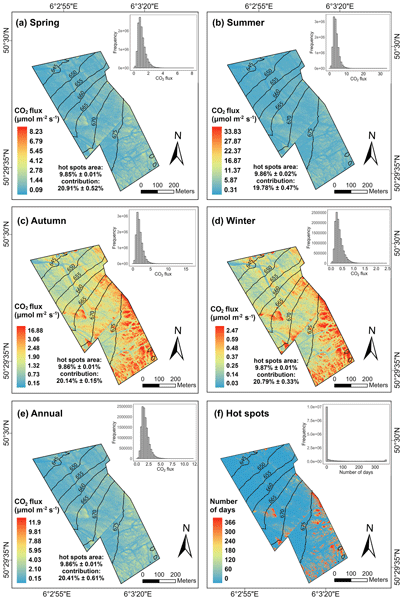
Yanfei Li, Maud Henrion, Angus Moore, Sébastien Lambot, Sophie Opfergelt, Veerle Vanacker, François Jonard, and Kristof Van Oost
Biogeosciences, 22, 6369–6392, https://doi.org/10.5194/bg-22-6369-2025, https://doi.org/10.5194/bg-22-6369-2025, 2025
Short summary
Short summary
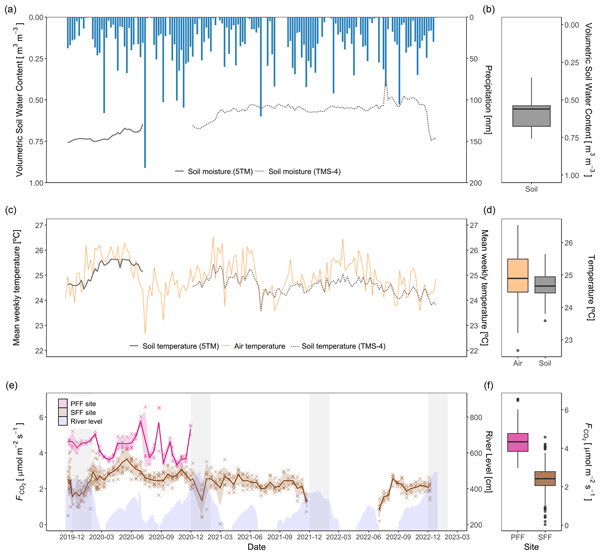
Combining Unmanned Aerial Vehicle (UAV) remote sensing with in-situ monitoring provides high spatial-temporal insights into CO2 fluxes from temperate peatlands. Dynamic factors (soil temperature and moisture) are the primary drivers contributing to 29 % of the spatial and 43 % of the seasonal variation. UAVs are effective tools for mapping daily soil respiration. CO2 fluxes from hot spots & moments contribute 20 % and 30 % of total CO2 fluxes, despite representing only 10 % of the area and time.
Angus K. Moore and Darryl E. Granger
Geochronology, 6, 541–552, https://doi.org/10.5194/gchron-6-541-2024, https://doi.org/10.5194/gchron-6-541-2024, 2024
Short summary
Short summary
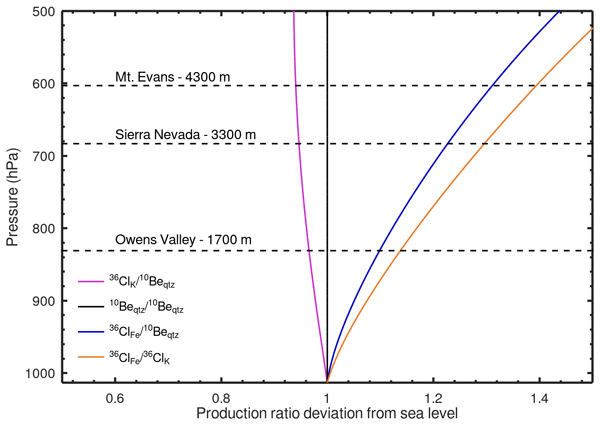
Cosmogenic nuclide geochronology requires accurately scaling production rates with altitude. The energy spectrum of cosmic radiation changes with altitude, and reactions that are sensitive to different energies may have different scaling behavior. Here, we model the altitude scaling of 36Cl production from Fe and evaluate this model against calibration data. The data are broadly consistent with the prediction of larger-altitude scaling factors for 36Cl from Fe than for other reactions.
Maëlle Villani, Louise M. Farquharson, Vladimir E. Romanovsky, and Sophie Opfergelt
EGUsphere, https://doi.org/10.5194/egusphere-2026-5453, https://doi.org/10.5194/egusphere-2026-5453, 2026
This preprint is open for discussion and under review for Biogeosciences (BG).
Short summary
Short summary
Taliks, unfrozen ground within permafrost, sustain year-round biogeochemical processes, mobilizing carbon, nutrients, and contaminants through lateral and open taliks, while closed and isolated taliks confine reactions locally. In this manuscript, we argue that taliks represent a critical and overlooked driver of Arctic and sub-Arctic biogeochemical processes. We put forward three testable hypotheses to advance the study of talik biogeochemical functioning and we propose a related road map.
Maxime Thomas, Thomas Moenaert, Julien Radoux, Baptiste Delhez, Eléonore du Bois d'Aische, Maëlle Villani, Catherine Hirst, Erik Lundin, François Jonard, Sébastien Lambot, Kristof Van Oost, Veerle Vanacker, Matthias B. Siewert, Carl-Magnus Mörth, Michael W. Palace, Ruth K. Varner, Franklin B. Sullivan, Christina Herrick, and Sophie Opfergelt
The Cryosphere, 20, 5271–5301, https://doi.org/10.5194/tc-20-5271-2026, https://doi.org/10.5194/tc-20-5271-2026, 2026
Short summary
Short summary
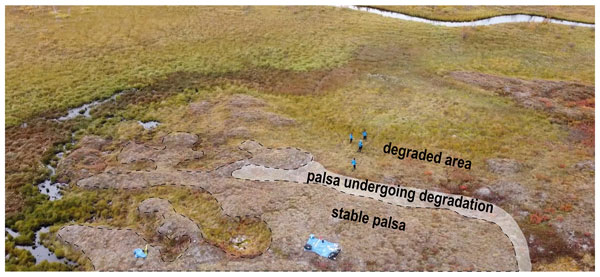
This study examines the rate of permafrost degradation, in the form of the transition from intact well-drained palsa to fully thawed and inundated fen at the Stordalen mire, Abisko, Sweden. Across the 14 hectares of the palsa mire, we demonstrate a 10-fold acceleration of the degradation in 2019–2021 compared to previous periods (1970–2014) which might lead to a pool of 12 × 10³ kg of organic carbon exposed annually for the topsoil (23 cm depth).
Alessandro Fabrizi, Peter Fiener, Kristof Van Oost, and Florian Wilken
SOIL, 12, 715–731, https://doi.org/10.5194/soil-12-715-2026, https://doi.org/10.5194/soil-12-715-2026, 2026
Short summary
Short summary
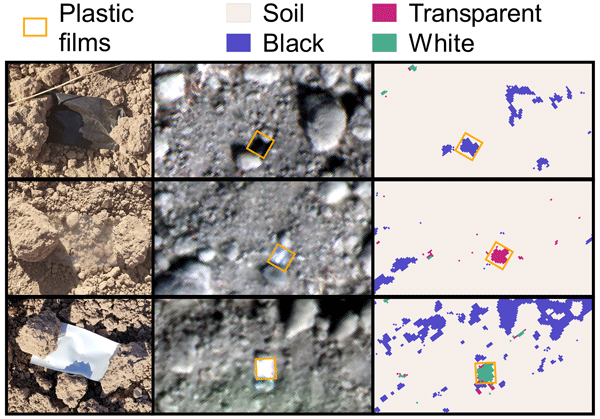
Drones can be used to identify the presence of macroplastic residues after plastic film use, allowing sustainable management practices and assessing the risk of soil plastic contamination. We highlight the potential and the limitations of current technologies, providing practical strategies to overcome them. We demonstrate the possibility of building cameras tailored to plastic detection and point the way towards necessary technological development.
Maxime Thomas, Julien Fouché, Hugues Titeux, Charlotte Morelle, Nathan Bemelmans, Melissa J. Lafrenière, Joanne K. Heslop, and Sophie Opfergelt
SOIL, 12, 633–664, https://doi.org/10.5194/soil-12-633-2026, https://doi.org/10.5194/soil-12-633-2026, 2026
Short summary
Short summary
This study examines organic carbon (OC)–mineral interactions in permafrost soils undergoing thermokarst degradation in Cape Bounty (Melville Island, Canada). Chemically stabilized OC accounts for 13 ± 5 % as organo-metallic complexes and 6 ± 2 % as associations with iron oxides. Including physical protection, up to 64 ± 10 % of OC is mineral-protected. Deeper layers show a sharp decline in mineral-bound OC, suggesting increased vulnerability to degradation when exposed by deep thaw features.
Gabrielle K. F. Hatten, Steven V. Kokelj, Sophie Opfergelt, Duane G. Froese, Alejandro Alvarez, Joseph M. Young, and Suzanne E. Tank
EGUsphere, https://doi.org/10.5194/egusphere-2026-1844, https://doi.org/10.5194/egusphere-2026-1844, 2026
Short summary
Short summary
Sorption of organic matter (OM) to recently thawed permafrost sediments can critically alter OM fate. Using 32 sediment samples from a suite of diverse permafrost landscapes, we show that organo-mineral interactions “sort” dissolved OM, enriching the aquatic matrix in labile compounds and increasing biodegradation via shifts in OM composition and nutrient release. Sorption potential varied across and within regions and was tied to sediment characteristics, dictated by landscape history.
Niklas Kappelt, Piers Larkman, Pascal Bohleber, Florian Adolphi, Marcus Christl, Christof Vockenhuber, Philip Gautschi, Eric Wolff, and Raimund Muscheler
EGUsphere, https://doi.org/10.5194/egusphere-2026-790, https://doi.org/10.5194/egusphere-2026-790, 2026
This preprint is open for discussion and under review for The Cryosphere (TC).
Short summary
Short summary
10Be is a radionuclide often measured in ice cores to reconstruct the solar magnetic field and geomagnetic field, as well as to date ice based on its half-life of 1.387 million years. Previous measurements in deep ice from Antarctica showed a decrease in concentrations with age. We analysed the influence of the sample preparation procedure and were able to show that the use of ion exchange columns can lead to decreasing concentrations, an effect which is amplified at greater depths and ages.
Nathan Carlier, Matti Barthel, Antoine de Clippele, Lissie Willemijn de Groot, Travis William Drake, Jordon Dennis Hemingway, Yi Hou, José Nlandu Wabakanghanzi, Joseph Zambo Mandea, Pengzhi Zhao, Johan Six, and Kristof Van Oost
EGUsphere, https://doi.org/10.5194/egusphere-2026-247, https://doi.org/10.5194/egusphere-2026-247, 2026
Short summary
Short summary
The Congo River Basin, a region of global significance, is undergoing a strong increase in population, which will in turn increase soil erosion, impacting soil fertility and the carbon cycle. We examined river sediment (eroded soil) transport, whereby we provided information on the main contributors of sediment to the Congo River. We also highlighted the role of a swampy region which removes large amounts of sediment from the water, acting as a regulator sediment transport to the Congo River.

Luisa I. Minich, Dylan Geissbühler, Stefan Tobler, Annegret Udke, Alexander S. Brunmayr, Margaux Moreno Duborgel, Ciriaco McMackin, Lukas Wacker, Philip Gautschi, Negar Haghipour, Markus Egli, Ansgar Kahmen, Jens Leifeld, Timothy I. Eglinton, and Frank Hagedorn
Biogeosciences, 23, 811–829, https://doi.org/10.5194/bg-23-811-2026, https://doi.org/10.5194/bg-23-811-2026, 2026
Short summary
Short summary
We developed a conceptual framework using rates and 14C-derived ages of soil-respired CO2 and its sources (autotrophic, heterotrophic) to identify carbon cycling pathways in different land-use types. Rates, ages and sources of respired CO2 varied across forests, grasslands, croplands, and managed peatlands. Our results suggest that the relationship between rates and ages of respired CO2 serves as a robust indicator of carbon retention and loss from natural to disturbed systems.
Chantal Schmidt, David Mair, Naki Akçar, Marcus Christl, Negar Haghipour, Christof Vockenhuber, Philip Gautschi, Brian McArdell, and Fritz Schlunegger
Earth Surf. Dynam., 14, 33–53, https://doi.org/10.5194/esurf-14-33-2026, https://doi.org/10.5194/esurf-14-33-2026, 2026
Short summary
Short summary
Our study examines erosion in a small, pre-Alpine basin by using cosmogenic nuclides in river sediments. Based on a dense measuring network we were able to distinguish two main zones: an upper zone with slow erosion of surface material, and a steeper, lower zone where faster erosion is driven by landslides. The data suggests that sediment has been constantly produced over thousands of years, indicating a stable, long-term balance between contrasting erosion processes.
Anne-Marie Wefing, Annabel Payne, Marcel Scheiwiller, Christof Vockenhuber, Marcus Christl, Toste Tanhua, and Núria Casacuberta
Ocean Sci., 21, 3311–3340, https://doi.org/10.5194/os-21-3311-2025, https://doi.org/10.5194/os-21-3311-2025, 2025
Short summary
Short summary
Here we used the anthropogenic radionuclides I-129 and U-236 as tracers for Atlantic Water circulation in the Arctic Ocean. New data collected in 2021 allowed to assess the distribution of Atlantic Water and mixing with Pacific-origin water in the surface layer in that year. By using historical tracer data from 2011 to 2021, we looked into temporal changes of the circulation and found slightly older waters in the central Arctic Ocean in 2021 compared to 2015.
Yanfei Li, Maud Henrion, Angus Moore, Sébastien Lambot, Sophie Opfergelt, Veerle Vanacker, François Jonard, and Kristof Van Oost
Biogeosciences, 22, 6369–6392, https://doi.org/10.5194/bg-22-6369-2025, https://doi.org/10.5194/bg-22-6369-2025, 2025
Short summary
Short summary
Combining Unmanned Aerial Vehicle (UAV) remote sensing with in-situ monitoring provides high spatial-temporal insights into CO2 fluxes from temperate peatlands. Dynamic factors (soil temperature and moisture) are the primary drivers contributing to 29 % of the spatial and 43 % of the seasonal variation. UAVs are effective tools for mapping daily soil respiration. CO2 fluxes from hot spots & moments contribute 20 % and 30 % of total CO2 fluxes, despite representing only 10 % of the area and time.
Maud Henrion, Sophie Opfergelt, Maëlle Villani, Philippe Roux, Djim Verleene, Eléonore du Bois d'Aische, Maxime Thomas, Gilles Denis, Edward A. G. Schuur, François Jonard, Veerle Vanacker, Kristof Van Oost, and Sébastien Lambot
EGUsphere, https://doi.org/10.5194/egusphere-2025-4667, https://doi.org/10.5194/egusphere-2025-4667, 2025
Preprint archived
Short summary
Short summary
Taliks play an important role in permafrost degradation. This study used Ground-penetrating radar to map taliks in Alaska, focusing on water tracks. The method successfully detected taliks and determined their upper depth. These were more frequent, shallower, and thicker under water tracks. This study showed that water tracks are hotspots for talik formation, with major implications for winter water flow in permafrost landscapes.
Lukas Rettig, Sandro Rossato, Sarah Kamleitner, Paolo Mozzi, Susan Ivy-Ochs, Enrico Marcato, Marcus Christl, Silvana Martin, and Giovanni Monegato
E&G Quaternary Sci. J., 74, 151–168, https://doi.org/10.5194/egqsj-74-151-2025, https://doi.org/10.5194/egqsj-74-151-2025, 2025
Short summary
Short summary
The work shows detailed reconstructions of the glaciers in the Valsugana area (south-eastern Alps) during the Last Glacial Maximum (LGM) and is supported by robust evidence and new exposure datings. These are the first ages for the internal sector of the south-eastern Alps. Local glaciers not connected with the major ice network were used for the calculation of their equilibrium line altitude. This let us estimate LGM palaeoprecipitation and compare it to Alpine palaeoclimatological models.
Niklas Kappelt, Eric Wolff, Marcus Christl, Christof Vockenhuber, Philip Gautschi, and Raimund Muscheler
Clim. Past, 21, 1585–1594, https://doi.org/10.5194/cp-21-1585-2025, https://doi.org/10.5194/cp-21-1585-2025, 2025
Short summary
Short summary
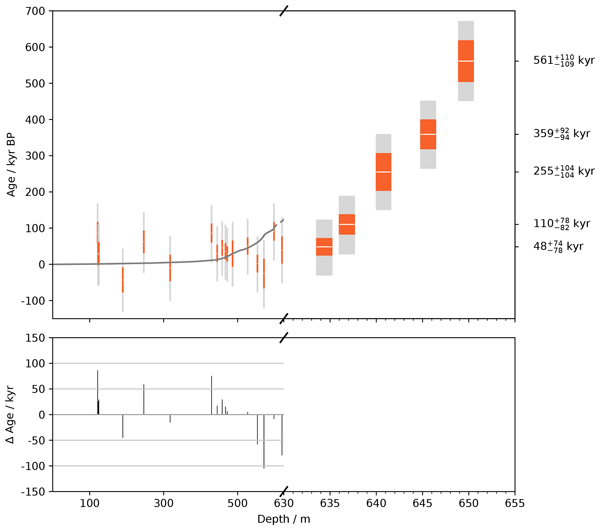
By measuring the radioactive decay of atmospherically produced 36Cl and 10Be in an ice core drilled in West Antarctica, we were able to determine the age of the deepest sample close to bedrock to be about 550 thousand years old. This means that the ice in this location, known as Skytrain Ice Rise, has survived several warm periods in the past, at least since marine isotope stage 11.
Cécile Osy, Sophie Opfergelt, Arsène Druel, and François Massonnet
EGUsphere, https://doi.org/10.5194/egusphere-2025-3680, https://doi.org/10.5194/egusphere-2025-3680, 2025
Preprint archived
Short summary
Short summary
The refreezing period of the active layer (the layer on top of the permafrost that freezes and thaws each year) is changing, with a delay of about five days over a large area in Siberia from 1950 to 2020 in the ERA5-Land reanalysis data. We investigate the drivers of this delay, and find that 2 m air temperature is the main driver of these changes at the large scale, which contrasts with field results in which snow cover is the main driver of changes in refreezing dynamics.
Antoine de Clippele, Astrid C. H. Jaeger, Simon Baumgartner, Marijn Bauters, Pascal Boeckx, Clement Botefa, Glenn Bush, Jessica Carilli, Travis W. Drake, Christian Ekamba, Gode Lompoko, Nivens Bey Mukwiele, Kristof Van Oost, Roland A. Werner, Joseph Zambo, Johan Six, and Matti Barthel
Biogeosciences, 22, 3011–3027, https://doi.org/10.5194/bg-22-3011-2025, https://doi.org/10.5194/bg-22-3011-2025, 2025
Short summary
Short summary
Tropical forest soils as a large terrestrial source of carbon dioxide (CO2) contribute to the global greenhouse gas budget. Despite this, carbon flux data from forested wetlands are scarce in tropical Africa. The study presents 3 years of semi-continuous measurements of surface CO2 fluxes within the Congo Basin. Although no seasonal patterns were evident, our results show a positive effect of soil temperature and moisture, while a quadratic relationship was observed with the water table.
Janet C. Richardson, Veerle Vanacker, David M. Hodgson, Marcus Christl, and Andreas Lang
Earth Surf. Dynam., 13, 315–339, https://doi.org/10.5194/esurf-13-315-2025, https://doi.org/10.5194/esurf-13-315-2025, 2025
Short summary
Short summary
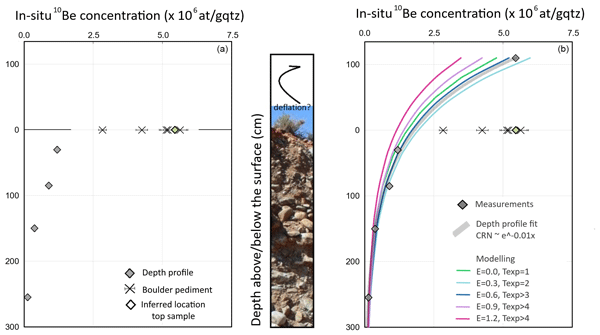
Pediments are long flat surfaces that extend outwards from the foot of mountains; within South Africa they are regarded as ancient landforms that can give key insights into landscape and mantle dynamics. Cosmogenic nuclide dating has been incorporated with geological (soil formation) and geomorphological (river incision) evidence, which shows that the pediments are long-lived features beyond the ages reported by cosmogenic nuclide dating.
Louis Delval, Jordan Bates, François Jonard, and Mathieu Javaux
Biogeosciences, 22, 513–534, https://doi.org/10.5194/bg-22-513-2025, https://doi.org/10.5194/bg-22-513-2025, 2025
Short summary
Short summary
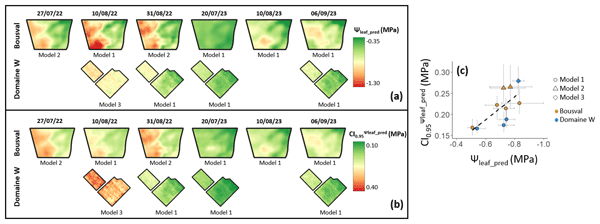
The accurate quantification of grapevine water status is crucial for winemakers as it significantly impacts wine quality. It is acknowledged that within a single vineyard, the variability of grapevine water status can be significant. The within-field spatial distribution of soil hydraulic conductance and weather conditions are the primary factors governing the leaf water potential spatial heterogeneity and extent observed in non-irrigated vineyards, and their effects are concomitant.
Giulia Zazzeri, Lukas Wacker, Negar Haghipour, Philip Gautschi, Thomas Laemmel, Sönke Szidat, and Heather Graven
Atmos. Meas. Tech., 18, 319–325, https://doi.org/10.5194/amt-18-319-2025, https://doi.org/10.5194/amt-18-319-2025, 2025
Short summary
Short summary
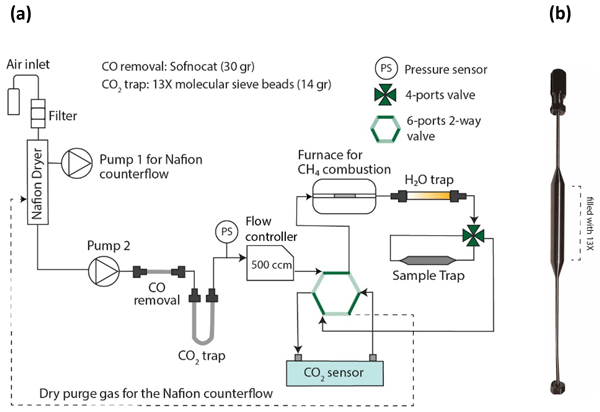
Radiocarbon (14C) is an optimal tracer of methane (CH4) emissions, as 14C measurements enable distinguishing between fossil methane and biogenic methane. However, these measurements are particularly challenging, mainly due to technical difficulties in the sampling procedure. We made the sample extraction much simpler and time efficient, providing a new technology that can be used by any research group, with the goal of expanding 14C measurements for an improved understanding of methane sources.
Bennet Juhls, Anne Morgenstern, Jens Hölemann, Antje Eulenburg, Birgit Heim, Frederieke Miesner, Hendrik Grotheer, Gesine Mollenhauer, Hanno Meyer, Ephraim Erkens, Felica Yara Gehde, Sofia Antonova, Sergey Chalov, Maria Tereshina, Oxana Erina, Evgeniya Fingert, Ekaterina Abramova, Tina Sanders, Liudmila Lebedeva, Nikolai Torgovkin, Georgii Maksimov, Vasily Povazhnyi, Rafael Gonçalves-Araujo, Urban Wünsch, Antonina Chetverova, Sophie Opfergelt, and Pier Paul Overduin
Earth Syst. Sci. Data, 17, 1–28, https://doi.org/10.5194/essd-17-1-2025, https://doi.org/10.5194/essd-17-1-2025, 2025
Short summary
Short summary
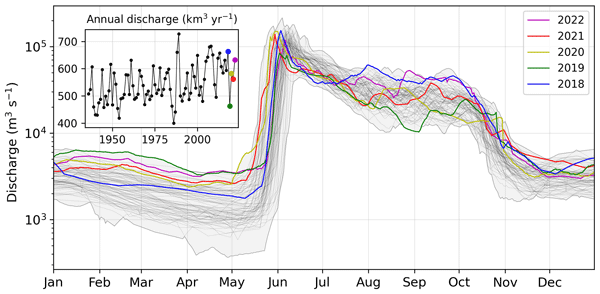
The Siberian Arctic is warming fast: permafrost is thawing, river chemistry is changing, and coastal ecosystems are affected. We aimed to understand changes in the Lena River, a major Arctic river flowing to the Arctic Ocean, by collecting 4.5 years of detailed water data, including temperature and carbon and nutrient contents. This dataset records current conditions and helps us to detect future changes. Explore it at https://doi.org/10.1594/PANGAEA.913197 and https://lena-monitoring.awi.de/.
Angus K. Moore and Darryl E. Granger
Geochronology, 6, 541–552, https://doi.org/10.5194/gchron-6-541-2024, https://doi.org/10.5194/gchron-6-541-2024, 2024
Short summary
Short summary
Cosmogenic nuclide geochronology requires accurately scaling production rates with altitude. The energy spectrum of cosmic radiation changes with altitude, and reactions that are sensitive to different energies may have different scaling behavior. Here, we model the altitude scaling of 36Cl production from Fe and evaluate this model against calibration data. The data are broadly consistent with the prediction of larger-altitude scaling factors for 36Cl from Fe than for other reactions.
Armando Molina, Veerle Vanacker, Oliver Chadwick, Santiago Zhiminaicela, Marife Corre, and Edzo Veldkamp
Biogeosciences, 21, 3075–3091, https://doi.org/10.5194/bg-21-3075-2024, https://doi.org/10.5194/bg-21-3075-2024, 2024
Short summary
Short summary
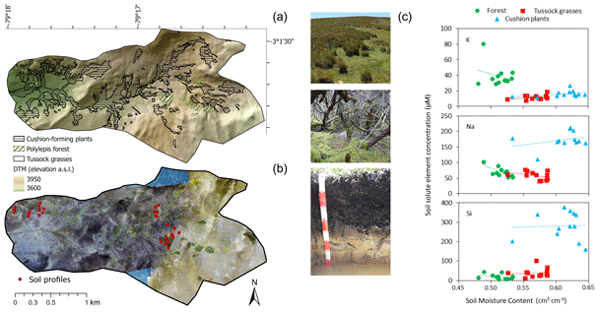
The tropical Andes contains unique landscapes where forest patches are surrounded by tussock grasses and cushion-forming plants. The aboveground vegetation composition informs us about belowground nutrient availability: patterns in plant-available nutrients resulted from strong biocycling of cations and removal of soil nutrients by plant uptake or leaching. Future changes in vegetation distribution will affect soil water and solute fluxes and the aquatic ecology of Andean rivers and lakes.
Chiara I. Paleari, Florian Mekhaldi, Tobias Erhardt, Minjie Zheng, Marcus Christl, Florian Adolphi, Maria Hörhold, and Raimund Muscheler
Clim. Past, 19, 2409–2422, https://doi.org/10.5194/cp-19-2409-2023, https://doi.org/10.5194/cp-19-2409-2023, 2023
Short summary
Short summary
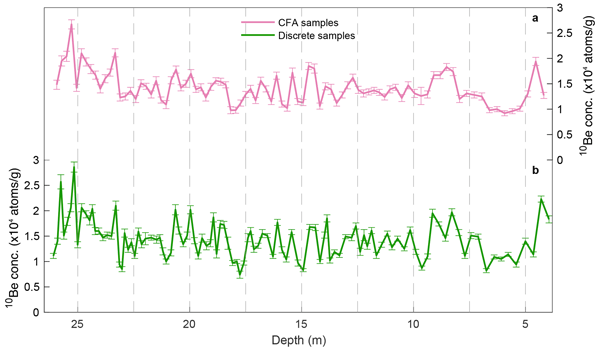
In this study, we test the use of excess meltwater from continuous flow analysis from a firn core from Greenland for the measurement of 10Be for solar activity reconstructions. We show that the quality of results is similar to the measurements on clean firn, which opens the possibility to obtain continuous 10Be records without requiring large amounts of clean ice. Furthermore, we investigate the possibility of identifying solar storm signals in 10Be records from Greenland and Antarctica.
Elisabeth Mauclet, Maëlle Villani, Arthur Monhonval, Catherine Hirst, Edward A. G. Schuur, and Sophie Opfergelt
Earth Syst. Sci. Data, 15, 3891–3904, https://doi.org/10.5194/essd-15-3891-2023, https://doi.org/10.5194/essd-15-3891-2023, 2023
Short summary
Short summary
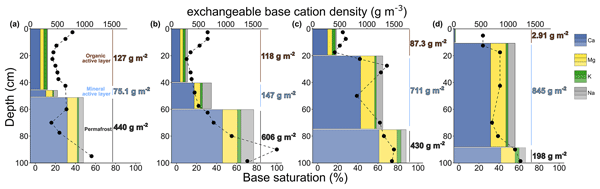
Permafrost ecosystems are limited in nutrients for vegetation development and constrain the biological activity to the active layer. Upon Arctic warming, permafrost degradation exposes organic and mineral soil material that may directly influence the capacity of the soil to retain key nutrients for vegetation growth and development. Here, we demonstrate that the average total exchangeable nutrient density (Ca, K, Mg, and Na) is more than 2 times higher in the permafrost than in the active layer.
Catharina Dieleman, Philip Deline, Susan Ivy Ochs, Patricia Hug, Jordan Aaron, Marcus Christl, and Naki Akçar
EGUsphere, https://doi.org/10.5194/egusphere-2023-1873, https://doi.org/10.5194/egusphere-2023-1873, 2023
Preprint withdrawn
Short summary
Short summary
Valleys in the Alps are shaped by glaciers, rivers, mass movements, and slope processes. An understanding of such processes is of great importance in hazard mitigation. We focused on the evolution of the Frébouge cone, which is composed of glacial, debris flow, rock avalanche, and snow avalanche deposits. Debris flows started to form the cone prior to ca. 2 ka ago. In addition, the cone was overrun by a 10 Mm3 large rock avalanche at 1.3 ± 0.1 ka and by the Frébouge glacier at 300 ± 40 a.
Giulia Sinnl, Florian Adolphi, Marcus Christl, Kees C. Welten, Thomas Woodruff, Marc Caffee, Anders Svensson, Raimund Muscheler, and Sune Olander Rasmussen
Clim. Past, 19, 1153–1175, https://doi.org/10.5194/cp-19-1153-2023, https://doi.org/10.5194/cp-19-1153-2023, 2023
Short summary
Short summary
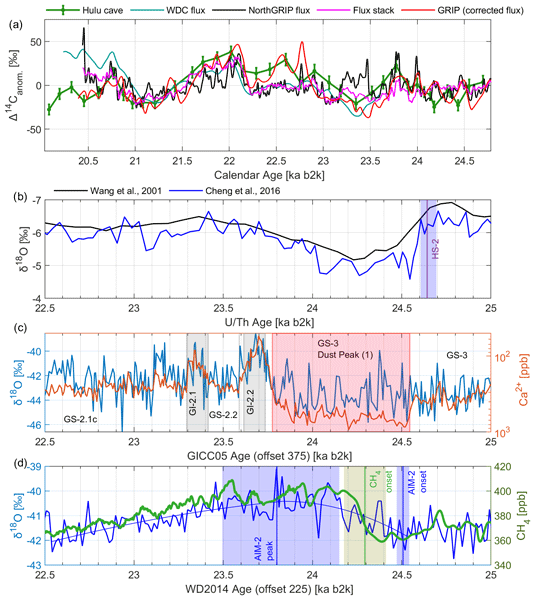
The record of past climate is preserved by several archives from different regions, such as ice cores from Greenland or Antarctica or speleothems from caves such as the Hulu Cave in China. In this study, these archives are aligned by taking advantage of the globally synchronous production of cosmogenic radionuclides. This produces a new perspective on the global climate in the period between 20 000 and 25 000 years ago.
Robert Mulvaney, Eric W. Wolff, Mackenzie M. Grieman, Helene H. Hoffmann, Jack D. Humby, Christoph Nehrbass-Ahles, Rachael H. Rhodes, Isobel F. Rowell, Frédéric Parrenin, Loïc Schmidely, Hubertus Fischer, Thomas F. Stocker, Marcus Christl, Raimund Muscheler, Amaelle Landais, and Frédéric Prié
Clim. Past, 19, 851–864, https://doi.org/10.5194/cp-19-851-2023, https://doi.org/10.5194/cp-19-851-2023, 2023
Short summary
Short summary
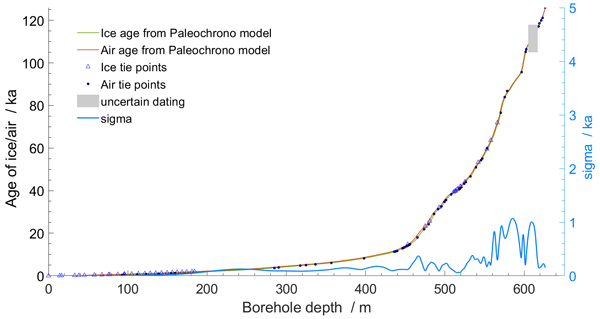
We present an age scale for a new ice core drilled at Skytrain Ice Rise, an ice rise facing the Ronne Ice Shelf in Antarctica. Various measurements in the ice and air phases are used to match the ice core to other Antarctic cores that have already been dated, and a new age scale is constructed. The 651 m ice core includes ice that is confidently dated to 117 000–126 000 years ago, in the last interglacial. Older ice is found deeper down, but there are flow disturbances in the deeper ice.

Sebastián Páez-Bimos, Armando Molina, Marlon Calispa, Pierre Delmelle, Braulio Lahuatte, Marcos Villacís, Teresa Muñoz, and Veerle Vanacker
Hydrol. Earth Syst. Sci., 27, 1507–1529, https://doi.org/10.5194/hess-27-1507-2023, https://doi.org/10.5194/hess-27-1507-2023, 2023
Short summary
Short summary
This study analyzes how vegetation influences soil hydrology, water fluxes, and chemical weathering rates in the high Andes. There are clear differences in the A horizon. The extent of soil chemical weathering varies depending on vegetation type. This difference is attributed mainly to the water fluxes. Our findings reveal that vegetation can modify soil properties in the uppermost horizon, altering the water balance, solutes, and chemical weathering throughout the entire soil profile.
Kristof Van Oost and Johan Six
Biogeosciences, 20, 635–646, https://doi.org/10.5194/bg-20-635-2023, https://doi.org/10.5194/bg-20-635-2023, 2023
Short summary
Short summary
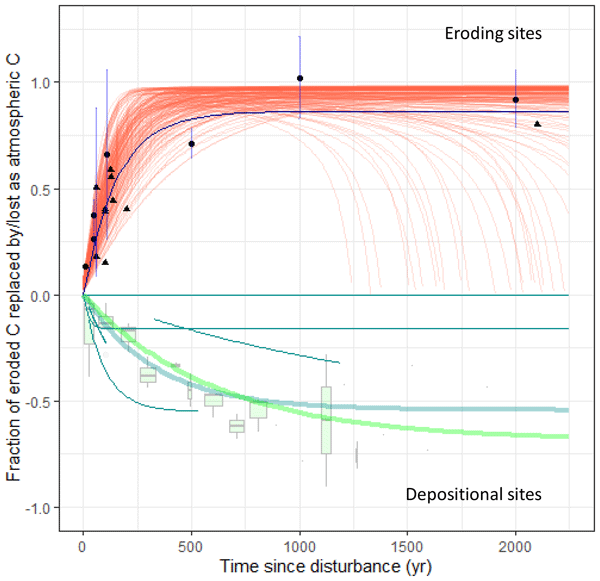
The direction and magnitude of the net erosion-induced land–atmosphere C exchange have been the topic of a big scientific debate for more than a decade now. Many have assumed that erosion leads to a loss of soil carbon to the atmosphere, whereas others have shown that erosion ultimately leads to a carbon sink. Here, we show that the soil carbon erosion source–sink paradox is reconciled when the broad range of temporal and spatial scales at which the underlying processes operate are considered.
Nathan Vandermaelen, Koen Beerten, François Clapuyt, Marcus Christl, and Veerle Vanacker
Geochronology, 4, 713–730, https://doi.org/10.5194/gchron-4-713-2022, https://doi.org/10.5194/gchron-4-713-2022, 2022
Short summary
Short summary
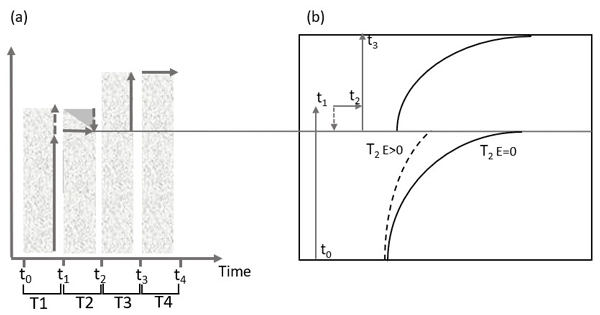
We constrained deposition phases of fluvial sediments (NE Belgium) over the last 1 Myr with analysis and modelling of rare isotopes accumulation within sediments, occurring as a function of time and inverse function of depth. They allowed the determination of three superposed deposition phases and intercalated non-deposition periods of ~ 40 kyr each. These phases correspond to 20 % of the sediment age, which highlights the importance of considering deposition phase when dating fluvial sediments.

Joanne Elkadi, Benjamin Lehmann, Georgina E. King, Olivia Steinemann, Susan Ivy-Ochs, Marcus Christl, and Frédéric Herman
Earth Surf. Dynam., 10, 909–928, https://doi.org/10.5194/esurf-10-909-2022, https://doi.org/10.5194/esurf-10-909-2022, 2022
Short summary
Short summary
Glacial and non-glacial processes have left a strong imprint on the landscape of the European Alps, but further research is needed to better understand their long-term effects. We apply a new technique combining two methods for bedrock surface dating to calculate post-glacier erosion rates next to a Swiss glacier. Interestingly, the results suggest non-glacial erosion rates are higher than previously thought, but glacial erosion remains the most influential on landscape evolution.
Haicheng Zhang, Ronny Lauerwald, Pierre Regnier, Philippe Ciais, Kristof Van Oost, Victoria Naipal, Bertrand Guenet, and Wenping Yuan
Earth Syst. Dynam., 13, 1119–1144, https://doi.org/10.5194/esd-13-1119-2022, https://doi.org/10.5194/esd-13-1119-2022, 2022
Short summary
Short summary
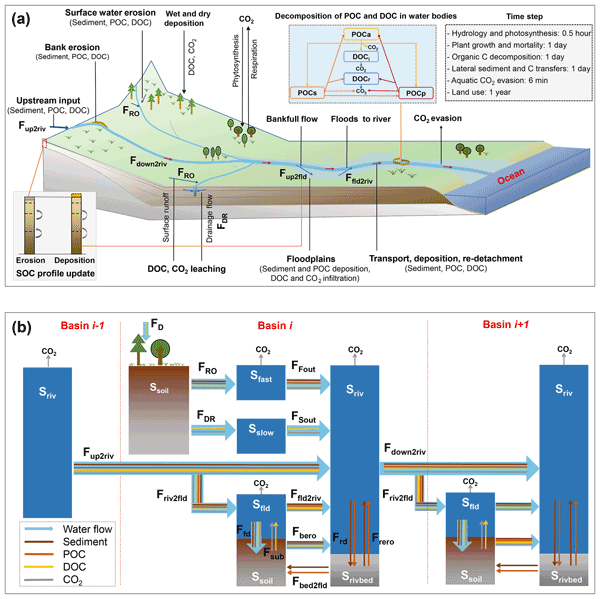
We present a land surface model which can simulate the complete lateral transfer of sediment and carbon from land to ocean through rivers. Our model captures the water, sediment, and organic carbon discharges in European rivers well. Application of our model in Europe indicates that lateral carbon transfer can strongly change regional land carbon budgets by affecting organic carbon distribution and soil moisture.
Elena Serra, Pierre G. Valla, Romain Delunel, Natacha Gribenski, Marcus Christl, and Naki Akçar
Earth Surf. Dynam., 10, 493–512, https://doi.org/10.5194/esurf-10-493-2022, https://doi.org/10.5194/esurf-10-493-2022, 2022
Short summary
Short summary
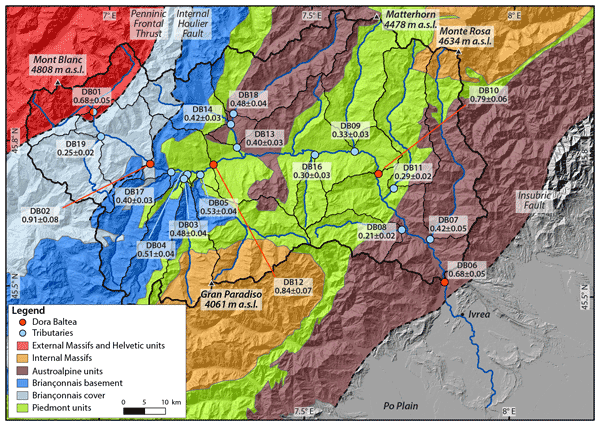
Alpine landscapes are transformed by several erosion processes. 10Be concentrations measured in river sediments at the outlet of a basin represent a powerful tool to quantify how fast the catchment erodes. We measured erosion rates within the Dora Baltea catchments (western Italian Alps). Our results show that erosion is governed by topography, bedrock resistance and glacial imprint. The Mont Blanc massif has the highest erosion and therefore dominates the sediment flux of the Dora Baltea river.
Elisabeth Mauclet, Yannick Agnan, Catherine Hirst, Arthur Monhonval, Benoît Pereira, Aubry Vandeuren, Maëlle Villani, Justin Ledman, Meghan Taylor, Briana L. Jasinski, Edward A. G. Schuur, and Sophie Opfergelt
Biogeosciences, 19, 2333–2351, https://doi.org/10.5194/bg-19-2333-2022, https://doi.org/10.5194/bg-19-2333-2022, 2022
Short summary
Short summary
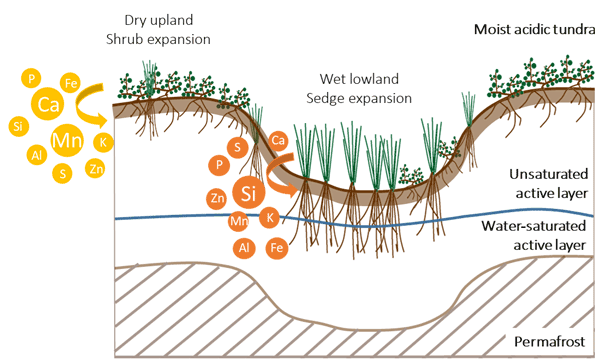
Arctic warming and permafrost degradation largely affect tundra vegetation. Wetter lowlands show an increase in sedges, whereas drier uplands favor shrub expansion. Here, we demonstrate that the difference in the foliar elemental composition of typical tundra vegetation species controls the change in local foliar elemental stock and potential mineral element cycling through litter production upon a shift in tundra vegetation.
Thomas Jagdhuber, François Jonard, Anke Fluhrer, David Chaparro, Martin J. Baur, Thomas Meyer, and María Piles
Biogeosciences, 19, 2273–2294, https://doi.org/10.5194/bg-19-2273-2022, https://doi.org/10.5194/bg-19-2273-2022, 2022
Short summary
Short summary
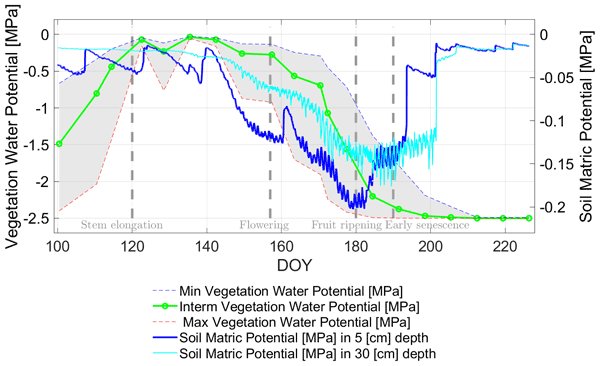
This is a concept study of water dynamics across winter wheat starting from ground-based L-band radiometry in combination with on-site measurements of soil and atmosphere. We research the feasibility of estimating water potentials and seasonal flux rates of water (water uptake from soil and transpiration rates into the atmosphere) within the soil-plant-atmosphere system (SPAS) of a winter wheat field. The main finding is that L-band radiometry can be integrated into field-based SPAS assessment.
Veerle Vanacker, Armando Molina, Miluska A. Rosas, Vivien Bonnesoeur, Francisco Román-Dañobeytia, Boris F. Ochoa-Tocachi, and Wouter Buytaert
SOIL, 8, 133–147, https://doi.org/10.5194/soil-8-133-2022, https://doi.org/10.5194/soil-8-133-2022, 2022
Short summary
Short summary
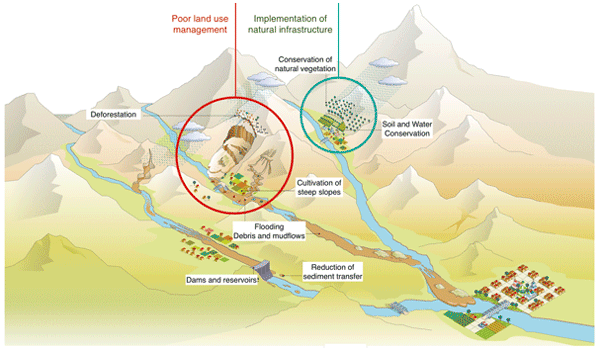
The Andes region is prone to natural hazards due to its steep topography and climatic variability. Anthropogenic activities further exacerbate environmental hazards and risks. This systematic review synthesizes the knowledge on the effectiveness of nature-based solutions. Conservation of natural vegetation and implementation of soil and water conservation measures had significant and positive effects on soil erosion mitigation and topsoil organic carbon concentrations.
Pengzhi Zhao, Daniel Joseph Fallu, Sara Cucchiaro, Paolo Tarolli, Clive Waddington, David Cockcroft, Lisa Snape, Andreas Lang, Sebastian Doetterl, Antony G. Brown, and Kristof Van Oost
Biogeosciences, 18, 6301–6312, https://doi.org/10.5194/bg-18-6301-2021, https://doi.org/10.5194/bg-18-6301-2021, 2021
Short summary
Short summary
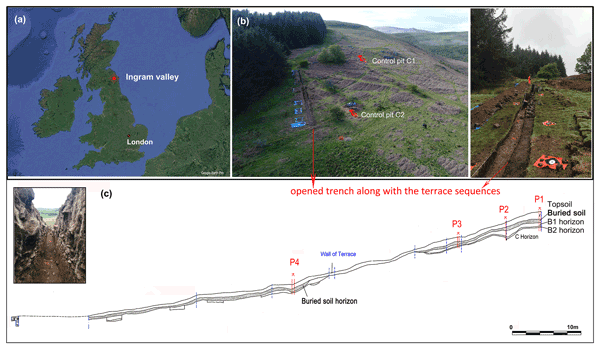
We investigate the factors controlling the soil organic carbon (SOC) stability and temperature sensitivity of abandoned prehistoric agricultural terrace soils. Results suggest that the burial of former topsoil due to terracing provided an SOC stabilization mechanism. Both the soil C : N ratio and SOC mineral protection regulate soil SOC temperature sensitivity. However, which mechanism predominantly controls SOC temperature sensitivity depends on the age of the buried terrace soils.
Laura Summerauer, Philipp Baumann, Leonardo Ramirez-Lopez, Matti Barthel, Marijn Bauters, Benjamin Bukombe, Mario Reichenbach, Pascal Boeckx, Elizabeth Kearsley, Kristof Van Oost, Bernard Vanlauwe, Dieudonné Chiragaga, Aimé Bisimwa Heri-Kazi, Pieter Moonen, Andrew Sila, Keith Shepherd, Basile Bazirake Mujinya, Eric Van Ranst, Geert Baert, Sebastian Doetterl, and Johan Six
SOIL, 7, 693–715, https://doi.org/10.5194/soil-7-693-2021, https://doi.org/10.5194/soil-7-693-2021, 2021
Short summary
Short summary
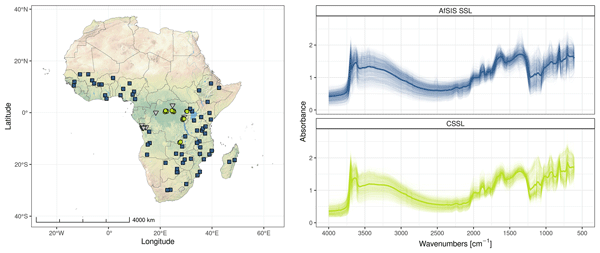
We present a soil mid-infrared library with over 1800 samples from central Africa in order to facilitate soil analyses of this highly understudied yet critical area. Together with an existing continental library, we demonstrate a regional analysis and geographical extrapolation to predict total carbon and nitrogen. Our results show accurate predictions and highlight the value that the data contribute to existing libraries. Our library is openly available for public use and for expansion.
Cited articles
Abdalla, M., Hastings, A., Truu, J., Espenberg, M., Mander, Ü., and Smith, P.: Emissions of methane from northern peatlands: a review of management impacts and implications for future management options, Ecol. Evol., 6, 7080–7102, https://doi.org/10.1002/ece3.2469, 2016.
Adetsu, D. V., Koganti, T., Petersen, R. J., Zak, D., Nilsson, I.-E. F., Hoffman, C. C., Beucher, A., and Greve, M. H.: Estimating the soil subsidence and carbon losses from long-term anthropogenic use of peatlands: a case study on a Danish raised bog, Mires Peat, 31, 10, https://doi.org/10.19189/MaP.2023.OMB.Sc.2328103, 2024.
Allan, M., Le Roux, G., Piotrowska, N., Beghin, J., Javaux, E., Court-Picon, M., Mattielli, N., Verheyden, S., and Fagel, N.: Mid- and late Holocene dust deposition in western Europe: the Misten peat bog (Hautes Fagnes – Belgium), Clim. Past, 9, 2285–2298, https://doi.org/10.5194/cp-9-2285-2013, 2013.
Andersen, J. L., Newall, J. C., Fredin, O., Glasser, N. F., Lifton, N. A., Stuart, F. M., Fabel, D., Caffee, M., Pedersen, V. K., Koester, A. J., Suganuma, Y., Harbor, J. M., and Stroeven, A. P.: A topographic hinge-zone divides coastal and inland ice dynamic regimes in East Antarctica, Communications Earth & Environment, 4, 1–12, https://doi.org/10.1038/s43247-022-00673-6, 2023.
Balco, G.: Production rate calculations for cosmic-ray-muon-produced 10Be and 26Al benchmarked against geological calibration data, Quat. Geochronol., 39, 150–173, https://doi.org/10.1016/j.quageo.2017.02.001, 2017.
Beckers, A., Bovy, B., Hallot, E., and Demoulin, A.: Controls on knickpoint migration in a drainage network of the moderately uplifted Ardennes Plateau, Western Europe, Earth Surf. Proc. Land., 40, 357–374, https://doi.org/10.1002/esp.3638, 2015.
Belyea, L. R. and Baird, A. J.: Beyond “the limits to peat bog growth”: cross-scale feedback in peatland development, Ecol. Monogr., 76, 299–322, https://doi.org/10.1890/0012-9615(2006)076[0299:BTLTPB]2.0.CO;2, 2006.
Borchers, B., Marrero, S., Balco, G., Caffee, M., Goehring, B., Lifton, N., Nishiizumi, K., Phillips, F., Schaefer, J., and Stone, J.: Geological calibration of spallation production rates in the CRONUS-Earth project, Quat. Geochronol., 31, 188–198, https://doi.org/10.1016/j.quageo.2015.01.009, 2016.
Christl, M., Vockenhuber, C., Kubik, P. W., Wacker, L., Lachner, J., Alfimov, V., and Synal, H.-A.: The ETH Zurich AMS facilities: performance parameters and reference materials, Nucl. Instrum. Meth. B, 294, 29–38, https://doi.org/10.1016/j.nimb.2012.03.004, 2013.
Clymo, R. S.: The limits to peat bog growth, Philos. T. Roy. Soc. Lon. B, 303, 605–654, 1984.
Cobb, A. R., Dommain, R., Yeap, K., Hannan, C., Dadap, N. C., Bookhagen, B., Glaser, P. H., and Harvey, C. F.: A unified explanation for the morphology of raised peatlands, Nature, 625, 79–84, https://doi.org/10.1038/s41586-023-06807-w, 2024.
Corbett, L. B., Bierman, P. R., Rood, D. H., Caffee, M. W., Lifton, N. A., and Woodruff, T. E.: Cosmogenic 26Al
Damblon, F.: Les dépôts tourbeux et l'histoire de la végétation sur le plateau des Hautes-Fagnes (Belgique), Annals of the Geological Society of Belgium, 117, 259–276, 1996.
da Silva Guimarães, E., Busschers, F. S., Kasse, C., Van Haren, T., Menkovic, A., and Van Balen, R. T.: Quaternary tectonic and climatic forcing on the spatio-temporal evolution of the Meuse fluvial terrace staircase, Geomorphology, 459, 109270, https://doi.org/10.1016/j.geomorph.2024.109270, 2024.
da Silva Guimarães, E., Busschers, F., Roda-Boluda, D., Akçar, N., Schlunegger, F., Kasse, C., Demoulin, A., Vockenhuber, C., Christl, M., and Van Balen, R.: Mid-Pleistocene uplift-induced acceleration of incision in the lower Meuse valley constrained by cosmogenic burial ages, Quaternary Sci. Rev., 383, 109978, https://doi.org/10.1016/j.quascirev.2026.109978, 2026.
Demoulin, A. and Hallot, E.: Shape and amount of the Quaternary uplift of the western Rhenish shield and the Ardennes (western Europe), Tectonophysics, 474, 696–708, https://doi.org/10.1016/j.tecto.2009.05.015, 2009.
Demoulin, A., Quesnel, F., Dupuis, C., Gerrienne, P., and Yans, J.: Cenomanian sands and clays north of the Vesdre valley: the oldest known Cretaceous deposits in eastern Belgium, Geol. Belg., 13, 241–256, https://popups.uliege.be/1374-8505/index.php?id=3003 (last access: 2 January 2026), 2010.
Demoulin, A., Juvigné, E., and Houbrechts, G.: The periglacial ramparted depressions of the Hautes Fagnes Plateau: traces of Late Weichselian lithalsas, in: Landscapes and Landforms of Belgium and Luxembourg, edited by: Demoulin, A., Springer International Publishing, Cham, 101–113, https://doi.org/10.1007/978-3-319-58239-9_7, 2018a.
Demoulin, A., Barbier, F., Dekoninck, A., Verhaert, M., Ruffet, G., Dupuis, C., and Yans, J.: Erosion surfaces in the Ardenne–Oesling and their associated kaolinic weathering mantle, in: Landscapes and Landforms of Belgium and Luxembourg, edited by: Demoulin, A., Springer International Publishing, Cham, 63–84, https://doi.org/10.1007/978-3-319-58239-9_5, 2018b.
De Vleeschouwer, F., Pazdur, A., Luthers, C., Streel, M., Mauquoy, D., Wastiaux, C., Le Roux, G., Moschen, R., Blaauw, M., Pawlyta, J., Sikorski, J., and Piotrowska, N.: A millennial record of environmental change in peat deposits from the Misten bog (East Belgium), Quatern. Int., 268, 44–57, https://doi.org/10.1016/j.quaint.2011.12.010, 2012.
Flatley, A., May, J.-H., Fujioka, T., Rutherfurd, I., and Fink, D.: Investigating sediment dynamics and landscape change processes in the semi-arid Pilbara, Western Australia – insights using paired cosmogenic 26Al
Froment, A.: L'ancienne économie rurale de l'Ardenne et son incidence sur la végétation des Hautes Fagnes, Bull. Soc. Géogr. Liège, 4, https://popups.uliege.be/0770-7576/index.php?id=4833 (last access: 26 August 2025), 1968.
Gallego-Sala, A. V. and Prentice, I.: Blanket peat biome endangered by climate change, Nat. Clim. Change, 3, 152–155, https://doi.org/10.1038/nclimate1672, 2013.
Gautschi, P.: Accelerator mass spectrometry below 300 kV, Doctoral thesis, ETH Zurich, https://doi.org/10.3929/ethz-b-000671466, 2024.
Goemaere, E., Demarque, S., Dreesen, R., and Declercq, P.-Y.: The geological and cultural heritage of the Caledonian Stavelot-Venn Massif, Belgium, Geoheritage, 8, 211–233, https://doi.org/10.1007/s12371-015-0155-y, 2016.
Gorham, E.: Northern peatlands: role in the carbon cycle and probable responses to climatic warming, Ecol. Appl., 1, 182–195, https://doi.org/10.2307/1941811, 1991.
Granger, D. E., Kirchner, J. W., and Finkel, R.: Spatially averaged long-term erosion rates measured from in situ-produced cosmogenic nuclides in alluvial sediment, J. Geol., 104, 249–257, https://doi.org/10.1086/629823, 1996.
Haase, D., Fink, J., Haase, G., Ruske, R., Pécsi, M., Richter, H., Altermann, M., and Jäger, K.-D.: Loess in Europe – its spatial distribution based on a European Loess Map, scale 1:2,500,000, Quaternary Sci. Rev., 26, 1301–1312, https://doi.org/10.1016/j.quascirev.2007.02.003, 2007.
Halsted, C. T., Bierman, P. R., and Balco, G.: Empirical evidence for latitude and altitude variation of the in situ cosmogenic 26Al
Henrion, M., Li, Y., Koganti, T., Bechtold, M., Jonard, F., Opfergelt, S., Vanacker, V., Van Oost, K., and Lambot, S.: Mapping and monitoring peatlands in the Belgian Hautes Fagnes: insights from ground-penetrating radar and electromagnetic induction characterization, Geoderma Reg., 37, e00795, https://doi.org/10.1016/j.geodrs.2024.e00795, 2024.
Henrion, M., Li, Y., Wu, K., Jonard, F., Opfergelt, S., Vanacker, V., Van Oost, K., and Lambot, S.: Drone-borne ground-penetrating radar reveals spatiotemporal moisture dynamics in peatland root zones, Sci. Remote Sens., 12, 100311, https://doi.org/10.1016/j.srs.2025.100311, 2025.
Hippe, K., Jansen, J. D., Skov, D. S., Lupker, M., Ivy-Ochs, S., Kober, F., Zeilinger, G., Capriles, J. M., Christl, M., Maden, C., Vockenhuber, C., and Egholm, D. L.: Cosmogenic in situ 14C-10Be reveals abrupt Late Holocene soil loss in the Andean Altiplano, Nat. Commun., 12, 2546, https://doi.org/10.1038/s41467-021-22825-6, 2021.
Holden, N. M. and Connolly, J.: Estimating the carbon stock of a blanket peat region using a peat depth inference model, CATENA, 86, 75–85, https://doi.org/10.1016/j.catena.2011.02.002, 2011.
Hugelius, G., Bockheim, J. G., Camill, P., Elberling, B., Grosse, G., Harden, J. W., Johnson, K., Jorgenson, T., Koven, C. D., Kuhry, P., Michaelson, G., Mishra, U., Palmtag, J., Ping, C.-L., O'Donnell, J., Schirrmeister, L., Schuur, E. A. G., Sheng, Y., Smith, L. C., Strauss, J., and Yu, Z.: A new data set for estimating organic carbon storage to 3 m depth in soils of the northern circumpolar permafrost region, Earth Syst. Sci. Data, 5, 393–402, https://doi.org/10.5194/essd-5-393-2013, 2013.
Ingram, H.: Size and shape in raised mire ecosystems: a geophysical model, Nature, 297, 300–303, https://doi.org/10.1038/297300a0, 1982.
Jautzy, T., Rixhon, G., Braucher, R., Delunel, R., Valla, P. G., Schmitt, L., and ASTER Team: Cosmogenic (un-)steadiness revealed by paired-nuclide catchment-wide denudation rates in the formerly half-glaciated Vosges Mountains (NE France), Earth Planet. Sc. Lett., 625, 118490, https://doi.org/10.1016/j.epsl.2023.118490, 2024.
Joosten, H. and Couwenberg, J.: Peatlands and carbon, in: Assessment on Peatlands, Biodiversity and Climate Change, 99–117, ISBN 978-983-43751-0-2, 2008.
Kjellström, E., Brandefelt, J., Näslund, J.-O., Smith, B., Strandberg, G., Voelker, A. H. L., and Wohlfarth, B.: Simulated climate conditions in Europe during the Marine Isotope Stage 3 stadial, Boreas, 39, 436–456, https://doi.org/10.1111/j.1502-3885.2010.00143.x, 2010.
Kleinen, T., Brovkin, V., and Munhoven, G.: Modelled interglacial carbon cycle dynamics during the Holocene, the Eemian and Marine Isotope Stage (MIS) 11, Clim. Past, 12, 2145–2160, https://doi.org/10.5194/cp-12-2145-2016, 2016.
Lal, D.: Cosmic ray labeling of erosion surfaces: in situ nuclide production rates and erosion models, Earth Planet. Sc. Lett., 104, 424–439, https://doi.org/10.1016/0012-821X(91)90220-C, 1991.
Lal, R. and Shukla, M. K.: Principles of Soil Physics, CRC Press, https://doi.org/10.4324/9780203021231, 2004.
Lehmkuhl, F., Nett, J. J., Pötter, S., Schulte, P., Sprafke, T., Jary, Z., Antoine, P., Wacha, L., Wolf, D., Zerboni, A., Hošek, J., Marković, S. B., Obreht, I., Sümegi, P., Veres, D., Zeeden, C., Boemke, B., Schaubert, V., Viehweger, J., and Hambach, U.: Loess landscapes of Europe – mapping, geomorphology, and zonal differentiation, Earth Sci. Rev., 215, 103496, https://doi.org/10.1016/j.earscirev.2020.103496, 2021.
Li, Y., Henrion, M., Moore, A., Lambot, S., Opfergelt, S., Vanacker, V., Jonard, F., and Van Oost, K.: Factors controlling peat soil thickness and carbon storage in temperate peatlands based on UAV high-resolution remote sensing, Geoderma, 449, 117009, https://doi.org/10.1016/j.geoderma.2024.117009, 2024.
Lifton, N., Sato, T., and Dunai, T. J.: Scaling in situ cosmogenic nuclide production rates using analytical approximations to atmospheric cosmic-ray fluxes, Earth Planet. Sc. Lett., 386, 149–160, https://doi.org/10.1016/j.epsl.2013.10.052, 2014.
Lindgren, A., Hugelius, G., Kuhry, P., Christensen, T. R., and Vandenberghe, J.: GIS-based maps and area estimates of Northern Hemisphere permafrost extent during the Last Glacial Maximum, Permafrost Periglac., 27, 6–16, https://doi.org/10.1002/ppp.1851, 2016.
Loisel, J., Gallego-Sala, A. V., Amesbury, M. J., Magnan, G., Anshari, G., Beilman, D. W., Benavides, J. C., Blewett, J., Camill, P., Charman, D. J., Chawchai, S., Hedgpeth, A., Kleinen, T., Korhola, A., Large, D., Mansilla, C. A., Müller, J., van Bellen, S., West, J. B., Yu, Z., Bubier, J. L., Garneau, M., Moore, T., Sannel, A. B. K., Page, S., Väliranta, M., Bechtold, M., Brovkin, V., Cole, L. E. S., Chanton, J. P., Christensen, T. R., Davies, M. A., De Vleeschouwer, F., Finkelstein, S. A., Frolking, S., Gałka, M., Gandois, L., Girkin, N., Harris, L. I., Heinemeyer, A., Hoyt, A. M., Jones, M. C., Joos, F., Juutinen, S., Kaiser, K., Lacourse, T., Lamentowicz, M., Larmola, T., Leifeld, J., Lohila, A., Milner, A. M., Minkkinen, K., Moss, P., Naafs, B. D. A., Nichols, J., O'Donnell, J., Payne, R., Philben, M., Piilo, S., Quillet, A., Ratnayake, A. S., Roland, T. P., Sjögersten, S., Sonnentag, O., Swindles, G. T., Swinnen, W., Talbot, J., Treat, C., Valach, A. C., West, J. B., and Wu, J.: Expert assessment of future vulnerability of the global peatland carbon sink, Nat. Clim. Change, 11, 70–77, https://doi.org/10.1038/s41558-020-00944-0, 2021.
MacDonald, G. M., Beilman, D. W., Kremenetski, K. V., Sheng, Y., Smith, L. C., and Velichko, A. A.: Rapid early development of circumarctic peatlands and atmospheric CH4 and CO2 variations, Science, 314, 285–288, https://doi.org/10.1126/science.1131722, 2006.
Marion, J.-M., Geukens, F., and Lamberty, P.: Sart-Xhoffraix. Carte géologique de Wallonie. 50/1-2, Notice explicative, SPW/Editions, Jambes (Namur), Belgium, University of Liège repository, 93 pp., https://hdl.handle.net/2268/219313 (last access: 27 June 2026), 2018.
Marrero, S. M., Phillips, F. M., Borchers, B., Lifton, N., Aumer, R., and Balco, G.: Cosmogenic nuclide systematics and the CRONUScalc program, Quat. Geochronol., 31, 160–187, https://doi.org/10.1016/j.quageo.2015.09.005, 2016.
Meyer, W. and Stets, J.: Pleistocene to Recent tectonics in the Rhenish Massif (Germany), Neth. J. Geosci., 81, 217–221, https://doi.org/10.1017/S0016774600022460, 2002.
Moore, A.: Geochemistry data from the Hautes Fagnes, Belgian Ardennes (Version 1.3), Zenodo [data set] and [code], https://doi.org/10.5281/zenodo.21630161, 2026.
Moore, A. K. and Granger, D. E.: Technical note: Altitude scaling of 36Cl production from Fe, Geochronology, 6, 541–552, https://doi.org/10.5194/gchron-6-541-2024, 2024.
Mormal, P. and Tricot, C.: Aperçu climatique des Hautes-Fagnes, Publication scientifique et technique, no. 36, Institut Royal Météorologique de Belgique, https://www.sshf.uliege.be/upload/docs/application/pdf/2024-02/tricot_-_apercu_climatique_des_hautes_fagnes.pdf (last access: 10 October 2025), 2004.
Nichols, J. E. and Peteet, D. M.: Rapid expansion of northern peatlands and doubled estimate of carbon storage, Nat. Geosci., 12, 917–921, https://doi.org/10.1038/s41561-019-0454-z, 2019.
Nishiizumi, K.: Preparation of new 10Be and 26Al AMS standard reference materials, Nucl. Instrum. Meth. B, 530, 43–47, https://doi.org/10.1016/j.nimb.2022.09.014, 2022.
Oleszczuk, R., Zając, E., Urbański, J., and Jadczyszyn, J.: Rate of fen-peat soil subsidence near drainage ditches (central Poland), Land, 10, 1287, https://doi.org/10.3390/land10121287, 2021.
Paulissen, M., van Beek, R., Nekrassoff, S., Huijbens, E. H., and Spek, T.: Dire necessity or mere opportunity? Recurrent peat commercialisation from raised bog commons in the early modern Low Countries, Int. J. Commons, 15, 100–118, https://doi.org/10.5334/ijc.1054, 2021.
Pissart, A., Calmels, F., and Wastiaux, C.: The potential lateral growth of lithalsas, Quaternary Res., 75, 371–377, https://doi.org/10.1016/j.yqres.2011.01.001, 2011.
Richardson, J. C., Vanacker, V., Hodgson, D. M., Christl, M., and Lang, A.: Constraining the timing and processes of pediment formation and dissection: implications for long-term evolution in the Western Cape, South Africa, Earth Surf. Dynam., 13, 315–339, https://doi.org/10.5194/esurf-13-315-2025, 2025.
Riebe, C. S. and Granger, D. E.: Quantifying effects of deep and near-surface chemical erosion on cosmogenic nuclides in soils, saprolite, and sediment: effects of chemical erosion on cosmogenic nuclide buildup, Earth Surf. Proc. Land., 38, 523–533, https://doi.org/10.1002/esp.3339, 2013.
Riebe, C. S., Kirchner, J. W., and Finkel, R. C.: Erosional and climatic effects on long-term chemical weathering rates in granitic landscapes spanning diverse climate regimes, Earth Planet. Sc. Lett., 224, 547–562, https://doi.org/10.1016/j.epsl.2004.05.019, 2004.
Rixhon, G., Braucher, R., Bourlès, D. L., Peeters, A., Demoulin, A., and Leanni, L.: Plio-Quaternary landscape evolution in the uplifted Ardennes: new insights from 26Al
Rixhon, G., Braucher, R., Bourlès, D., Siame, L., Bovy, B., and Demoulin, A.: Quaternary river incision in NE Ardennes (Belgium) – insights from 10Be/26Al dating of river terraces, Quat. Geochronol., 6, 273–284, https://doi.org/10.1016/j.quageo.2010.11.001, 2011.
Rixhon, G. and Demoulin, A.: The picturesque Ardennian valleys: Plio-Quaternary incision of the drainage system in the uplifting Ardenne, in: Landscapes and Landforms of Belgium and Luxembourg, edited by: Demoulin, A., Springer International Publishing, Cham, 159–175, https://doi.org/10.1007/978-3-319-58239-9_10, 2018.
Rixhon, G. and Juvigné, É.: Periglacial deposits and correlated processes in the Ninglinspo Valley (Ardenne massif, Belgium), Geol. Belg., 13, 49–60, https://popups.uliege.be/1374-8505/index.php?file=1&id=2860&pid=2853 (last access: 26 June 2026), 2010.
Shotbolt, L., Anderson, A. R., and Towned, J.: Changes to blanket bog adjoining forest plots at Bad a' Cheo, Rumster Forest, Caithness, Forestry, 71, 311–324, https://doi.org/10.1093/forestry/71.4.311, 1998.
Shuster, D. L., Farley, K. A., Vasconcelos, P. M., Balco, G., Monteiro, H. S., Waltenberg, K., and Stone, J. O.: Cosmogenic 3He in hematite and goethite from Brazilian “canga” duricrust demonstrates the extreme stability of these surfaces, Earth Planet. Sc. Lett., 329–330, 41–50, https://doi.org/10.1016/j.epsl.2012.02.017, 2012.
Sougnez, N. and Vanacker, V.: The topographic signature of Quaternary tectonic uplift in the Ardennes massif (Western Europe), Hydrol. Earth Syst. Sci., 15, 1095–1107, https://doi.org/10.5194/hess-15-1095-2011, 2011.
Stone, J. O.: Air pressure and cosmogenic isotope production, J. Geophys. Res., 105, 23753–23759, https://doi.org/10.1029/2000JB900181, 2000.
Strandberg, G., Brandefelt, J., Kjellström, E., and Smith, B.: High-resolution regional simulation of last glacial maximum climate in Europe, Tellus A, 63, 107–125, https://doi.org/10.1111/j.1600-0870.2010.00485.x, 2011.
Struck, M., Jansen, J. D., Fujioka, T., Codilean, A. T., Fink, D., Fülöp, R.-H., Wilcken, K. M., Price, D. M., Kotevski, S., Fifield, L. K., and Chappell, J.: Tracking the 10Be–26Al source-area signal in sediment-routing systems of arid central Australia, Earth Surf. Dynam., 6, 329–349, https://doi.org/10.5194/esurf-6-329-2018, 2018.
Terraza, M., Wolff, R., Hetzel, R., Ritter-Prinz, B., Binnie, S. A., Preuss, J., Hoselmann, C., Weidenfeller, M., and Heinze, S.: Accelerated uplift of the Rhenish Massif (central Europe) since 700–800 ka revealed by isochron-burial dating of strath terraces, Geomorphology, 110334, https://doi.org/10.1016/j.geomorph.2026.110334, 2026.
Treat, C. C., Kleinen, T., Broothaerts, N., Dalton, A. S., Dommain, R., Douglas, T. A., Drexler, J. Z., Finkelstein, S. A., Grosse, G., Hope, G., Hutchings, J., Jones, M. C., Kuhry, P., Lacourse, T., Lähteenoja, O., Loisel, J., Notebaert, B., Payne, R. J., Peteet, D. M., Sannel, A. B. K., Stelling, J. M., Strauss, J., Swindles, G. T., Talbot, J., Tarnocai, C., Verstraeten, G., Williams, C. J., Xia, Z., Yu, Z., Väliranta, M., Hättestrand, M., Alexanderson, H., and Brovkin, V.: Widespread global peatland establishment and persistence over the last 130,000 years, P. Natl. Acad. Sci. USA, 116, 4822–4827, https://doi.org/10.1073/pnas.1813305116, 2019.
van Balen, R. T., Houtgast, R. F., van der Wateren, F. M., Vandenberghe, J., and Bogaart, P. W.: Sediment budget and tectonic evolution of the Meuse catchment in the Ardennes and the Roer Valley Rift System, Global Planet. Change, 27, 113–129, https://doi.org/10.1016/S0921-8181(01)00062-5, 2000.
Vasconcelos, P. M., Farley, K. A., Stone, J., Piacentini, T., and Fifield, L. K.: Stranded landscapes in the humid tropics: Earth's oldest land surfaces, Earth Planet. Sc. Lett., 519, 152–164, https://doi.org/10.1016/j.epsl.2019.04.014, 2019.
Wittmann, H., Oelze, M., Gaillardet, J., Garzanti, E., and von Blanckenburg, F.: A global rate of denudation from cosmogenic nuclides in the Earth's largest rivers, Earth Sci. Rev., 204, 103147, https://doi.org/10.1016/j.earscirev.2020.103147, 2020.
Woillard, G. M.: Grande Pile peat bog: a continuous pollen record for the last 140,000 years, Quaternary Res., 9, 1–21, https://doi.org/10.1016/0033-5894(78)90079-0, 1978.
Yu, Z., Beilman, D. W., Frolking, S., MacDonald, G. M., Roulet, N. T., Camill, P., and Charman, D. J.: Peatlands and their role in the global carbon cycle, EOS T. Am. Geophys. Un., 92, 97–98, https://doi.org/10.1029/2011EO120001, 2011.
Yu, Z., Loisel, J., Brosseau, D. P., Beilman, D. W., and Hunt, S. J.: Global peatland dynamics since the Last Glacial Maximum, Geophys. Res. Lett., 37, L13402, https://doi.org/10.1029/2010GL043584, 2010.
Zweck, C., Zreda, M., and Desilets, D.: Snow shielding factors for cosmogenic nuclide dating inferred from Monte Carlo neutron transport simulations, Earth Planet. Sc. Lett., 379, 64–71, https://doi.org/10.1016/j.epsl.2013.07.023, 2013.
Short summary
Studying peatland dynamics over long timescales requires a proxy for past peat cover. In this paper, we explore using cosmogenic nuclides to infer peat thicknesses averaged over 100 kyr timescales. We find that long-term peat thicknesses inferred from cosmogenic nuclides at an upland peatland site in the Belgian Ardennes are consistent with independent constraints, but exceed modern peat thicknesses. We attribute this discrepancy to peat degradation associated with historical land use.
Studying peatland dynamics over long timescales requires a proxy for past peat cover. In this...


