Articles | Volume 3, issue 1
https://doi.org/10.5194/esurf-3-87-2015
© Author(s) 2015. This work is distributed under
the Creative Commons Attribution 3.0 License.
https://doi.org/10.5194/esurf-3-87-2015
© Author(s) 2015. This work is distributed under
the Creative Commons Attribution 3.0 License.
A reduced-complexity model for river delta formation – Part 2: Assessment of the flow routing scheme
M. Liang
CORRESPONDING AUTHOR
Department of Civil, Architectural and Environmental Engineering and Center for Research in Water Resources, The University of Texas at Austin, Austin, Texas, USA
Department of Geological Sciences, The University of Texas at Austin, Austin, Texas, USA
N. Geleynse
Department of Geological Sciences, The University of Texas at Austin, Austin, Texas, USA
now at: ARCADIS, Water and Environment Division, Zwolle, the Netherlands
D. A. Edmonds
Department of Geological Sciences, Indiana University, Bloomington, Indiana, USA
P. Passalacqua
Department of Civil, Architectural and Environmental Engineering and Center for Research in Water Resources, The University of Texas at Austin, Austin, Texas, USA
Related authors
No articles found.
Jayaram Hariharan, Kyle Wright, Andrew Moodie, Nelson Tull, and Paola Passalacqua
Earth Surf. Dynam., 11, 405–427, https://doi.org/10.5194/esurf-11-405-2023, https://doi.org/10.5194/esurf-11-405-2023, 2023
Short summary
Short summary
We simulate the transport of material through numerically simulated river deltas under natural and human-modified (embankment construction and channel dredging) scenarios to understand their impacts on material transport. Human modifications reduce the total area visited by passive particles and alter the amount of time spent within the delta relative to natural conditions. This work can help us understand how future construction may impact land building or ecosystem restoration projects.
Matthew Preisser, Paola Passalacqua, R. Patrick Bixler, and Julian Hofmann
Hydrol. Earth Syst. Sci., 26, 3941–3964, https://doi.org/10.5194/hess-26-3941-2022, https://doi.org/10.5194/hess-26-3941-2022, 2022
Short summary
Short summary
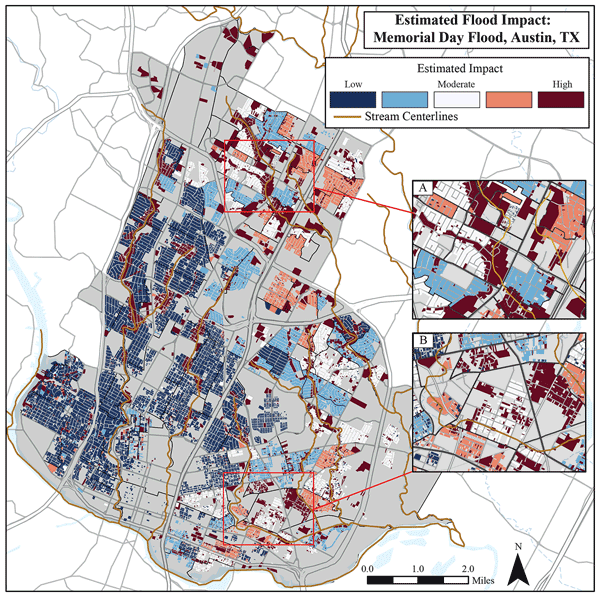
There is rising concern in numerous fields regarding the inequitable distribution of human risk to floods. The co-occurrence of river and surface flooding is largely excluded from leading flood hazard mapping services, therefore underestimating hazards. Using high-resolution elevation data and a region-specific social vulnerability index, we developed a method to estimate flood impacts at the household level in near-real time.
Short summary
In this work we assess the flow-routing component (FlowRCM) of our delta formation model, DeltaRCM. We found that with the level of complexity reduction, FlowRCM is able to produce channel network-scale hydrodynamic details, which provide further insights into the connection between delta flow structures and the morphodynamic outcome.
In this work we assess the flow-routing component (FlowRCM) of our delta formation model,...