
Articles | Volume 14, issue 3
https://doi.org/10.5194/esurf-14-361-2026
© Author(s) 2026. This work is distributed under
the Creative Commons Attribution 4.0 License.
the Creative Commons Attribution 4.0 License.
https://doi.org/10.5194/esurf-14-361-2026
© Author(s) 2026. This work is distributed under
the Creative Commons Attribution 4.0 License.
the Creative Commons Attribution 4.0 License.
Research article
| Highlight paper
| 
08 May 2026
Research article | Highlight paper |
| 08 May 2026
| 08 May 2026
First Alps-wide reconstruction of LGM glacial sediment transport enabled by GPU-accelerated particle tracking

Institute of Earth Surface Dynamics, University of Lausanne, Lausanne, Switzerland
Guillaume Jouvet
Institute of Earth Surface Dynamics, University of Lausanne, Lausanne, Switzerland
Sarah Kamleitner
Institute of Earth Surface Dynamics, University of Lausanne, Lausanne, Switzerland
Department of Geography, University of Zürich, Zürich, Switzerland
Brandon D. Finley
Institute of Earth Surface Dynamics, University of Lausanne, Lausanne, Switzerland
Maxime Bernard
Institute of Earth Surface Dynamics, University of Lausanne, Lausanne, Switzerland
Balthazar Allegri
Institute of Earth Surface Dynamics, University of Lausanne, Lausanne, Switzerland
Frédéric Herman
Institute of Earth Surface Dynamics, University of Lausanne, Lausanne, Switzerland
Andreas Vieli
Department of Geography, University of Zürich, Zürich, Switzerland
Andreas Henz
Department of Geography, University of Zürich, Zürich, Switzerland
Samuel U. Nussbaumer
Department of Geography, University of Zürich, Zürich, Switzerland
Related authors
Sjur Barndon, Augusto Lima, David M. Chandler, Abe T. Wiersma, Tancrède P. M. Leger, Raúl Pérez Prats, Eline S. Rentier, and Suzette G.A. Flantua
Earth Syst. Sci. Data Discuss., https://doi.org/10.5194/essd-2026-404, https://doi.org/10.5194/essd-2026-404, 2026
Preprint under review for ESSD
Short summary
Short summary
Mountain glacier history is hard to trace because field evidence is patchy and often erased by later ice advances. We used a fast computer model to simulate how glaciers grew and shrank over the last 130,000 years in nine mountain regions, and compared the results with mapped past and modern glaciers. By combining many plausible simulations, we map where glacier changes are reliable and where they are uncertain. The results provide a new baseline for studies of water, landscapes, and ecosystems.
Helen Werner, Dirk Scherler, Tancrède P. M. Leger, Guillaume Jouvet, and Ricarda Winkelmann
The Cryosphere, 20, 2469–2484, https://doi.org/10.5194/tc-20-2469-2026, https://doi.org/10.5194/tc-20-2469-2026, 2026
Short summary
Short summary
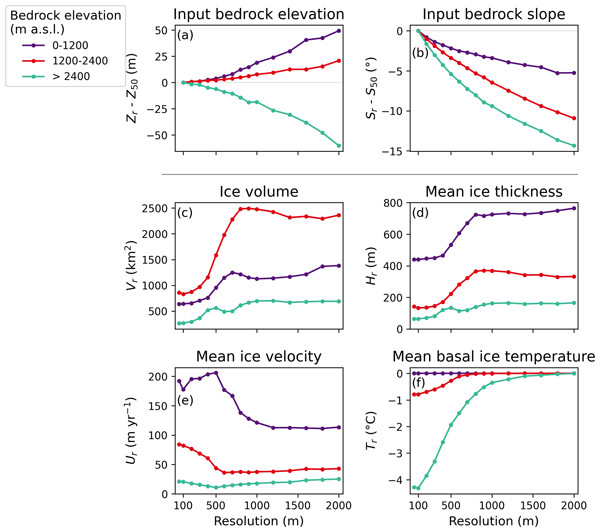
Coarse spatial resolutions reduce computational costs but poorly resolve complex topographies. Our simulations of an alpine ice field at 50 m to 2 km resolution show similar ice areas, yet much higher volumes at coarser resolutions. Resolutions of 300 m and finer accurately capture topographically constrained flow, while coarse resolutions flatten mountain slopes and peaks, affecting ice velocities, thickness, and thermal regimes which emphasizes the need for sufficiently high-resolution models.
Andreas Henz, Johannes Reinthaler, Samuel U. Nussbaumer, Tancrède P. M. Leger, Sarah Kamleitner, Guillaume Jouvet, and Andreas Vieli
The Cryosphere, 19, 5913–5937, https://doi.org/10.5194/tc-19-5913-2025, https://doi.org/10.5194/tc-19-5913-2025, 2025
Short summary
Short summary
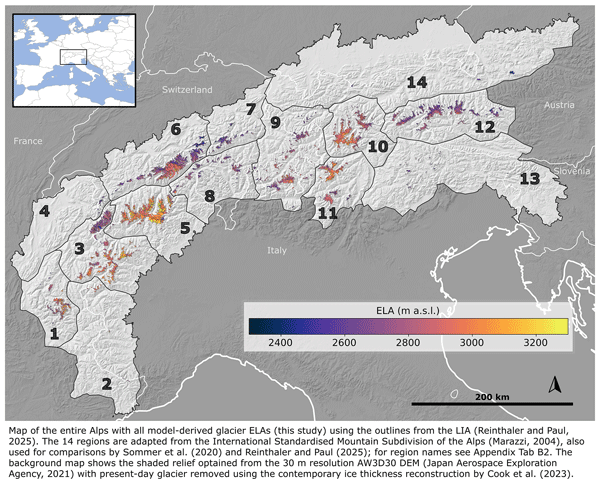
Glaciers are key to understanding climate change, reflecting historical variability. Using glacier models on the computer, we reconstructed European Alps glaciers during the Little Ice Age, with a total ice volume of 283 ± 42 cubic kilometres. Also, the study determines equilibrium line altitudes (ELAs) for over 4000 glaciers, showing patterns influenced by temperature, precipitation, and solar radiation. After all, we introduce a new ELA correction approach based on solar incidence.
Tancrède P. M. Leger, Jeremy C. Ely, Christopher D. Clark, Sarah L. Bradley, Rosie E. Archer, and Jiang Zhu
The Cryosphere, 19, 5719–5761, https://doi.org/10.5194/tc-19-5719-2025, https://doi.org/10.5194/tc-19-5719-2025, 2025
Short summary
Short summary
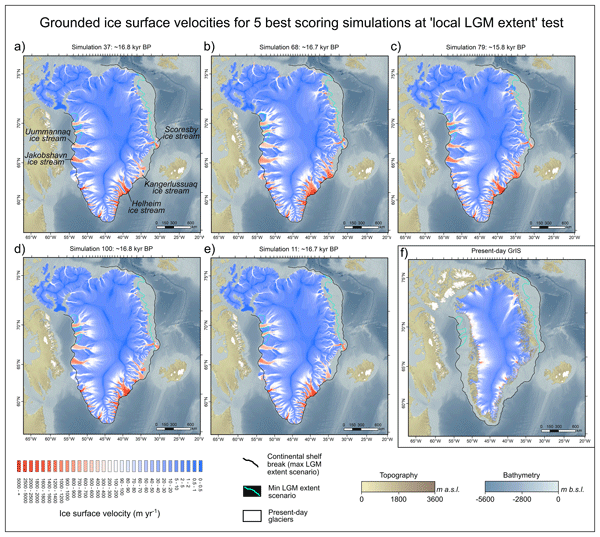
This study uses state-of-the-art computer simulations to better constrain the Greenland-Ice-Sheet's evolution over the past 24,000 years. By comparing model results with geological data, it reveals when and why the ice sheet grew and shrank, helping to improve future predictions of sea level rise and climate change.
Sjur Barndon, Augusto Lima, David M. Chandler, Abe T. Wiersma, Tancrède P. M. Leger, Raúl Pérez Prats, Eline S. Rentier, and Suzette G.A. Flantua
Earth Syst. Sci. Data Discuss., https://doi.org/10.5194/essd-2026-404, https://doi.org/10.5194/essd-2026-404, 2026
Preprint under review for ESSD
Short summary
Short summary
Mountain glacier history is hard to trace because field evidence is patchy and often erased by later ice advances. We used a fast computer model to simulate how glaciers grew and shrank over the last 130,000 years in nine mountain regions, and compared the results with mapped past and modern glaciers. By combining many plausible simulations, we map where glacier changes are reliable and where they are uncertain. The results provide a new baseline for studies of water, landscapes, and ecosystems.
Sebastian H. R. Rosier, Thomas Gregov, Guillaume Jouvet, and Andreas Vieli
EGUsphere, https://doi.org/10.5194/egusphere-2026-5523, https://doi.org/10.5194/egusphere-2026-5523, 2026
This preprint is open for discussion and under review for The Cryosphere (TC).
Short summary
Short summary
Mountain glacier projections usually rely on flowline models or simplified ice flow, because higher order models are too slow to run many times or at high resolution. We built a training set of 350,000 flow solutions across tens of thousands of synthetic glaciers, far larger than anything before, and trained a neural network on both these solutions and the flow physics itself. It matches the original solver on glaciers it has never seen, and is cheap enough to make large ensembles affordable.
Florian Hardmeier, James C. Ferguson, and Andreas Vieli
The Cryosphere, 20, 5365–5392, https://doi.org/10.5194/tc-20-5365-2026, https://doi.org/10.5194/tc-20-5365-2026, 2026
Short summary
Short summary
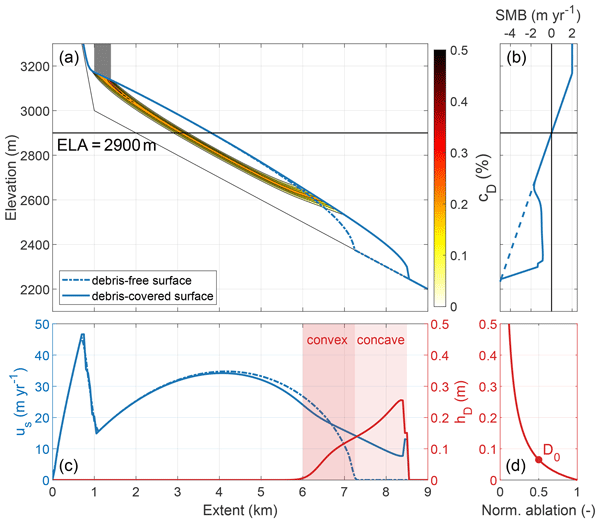
As mountain glaciers are retreating, they are becoming increasingly debris-covered. We want to better understand how these glaciers respond to a changing climate. Here, we present an improved model that simulates transport of debris within and on the glacier. We find that short-term changes have a low impact due to long response times. However, long-term warming can lead to fast collapse of the glacier tongue after a phase of thinning, where debris cover expands and thickens.
Giulio Saibene, Isabelle Gärtner-Roer, Jan Beutel, and Andreas Vieli
The Cryosphere, 20, 3511–3532, https://doi.org/10.5194/tc-20-3511-2026, https://doi.org/10.5194/tc-20-3511-2026, 2026
Short summary
Short summary
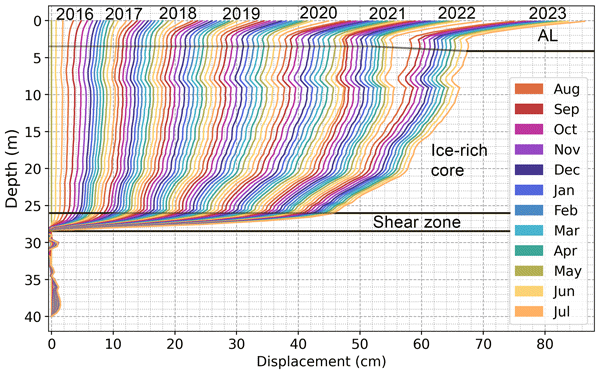
Rock glaciers are bodies of frozen ground found in mountain regions. They move downslope and are mainly studied at the surface. Here, we analyze deformation data from a borehole, providing continuous data for almost eight years. The data shows that the acceleration in the summer movement happens in the uppermost layer, while long-term movement is mostly occurring in a deeper layer. This is important for the interpretation of surface movements, which are used as climate indicators.
Ilaria Santin, Huw J. Horgan, Raphael Moser, Nanna Bjørnholt Karlsson, Faezeh M. Nick, Andreas Vieli, Anja Rutishauser, Hansruedi Maurer, and Daniel Farinotti
The Cryosphere, 20, 3435–3441, https://doi.org/10.5194/tc-20-3435-2026, https://doi.org/10.5194/tc-20-3435-2026, 2026
Short summary
Short summary
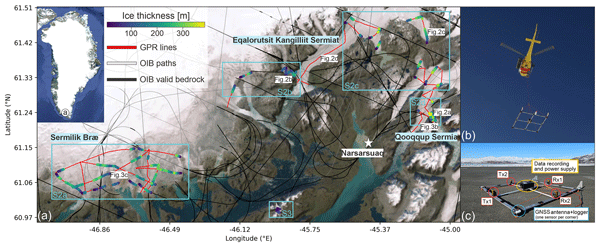
Ice thickness near Greenland’s coast is still poorly measured, yet it is vital for predicting sea level rise. We flew a helicopter ice-penetrating radar over three outlet glaciers in southern Greenland and mapped the glacier bed where basal reflections were clear. We measured ice up to about 340 meters thick, with reliable penetration typically to about 300 meters, providing new constraints that can improve regional bed maps.
Fien De Doncker, Frédéric Herman, Bruno Belotti, and Thierry Adatte
Earth Surf. Dynam., 14, 443–467, https://doi.org/10.5194/esurf-14-443-2026, https://doi.org/10.5194/esurf-14-443-2026, 2026
Short summary
Short summary
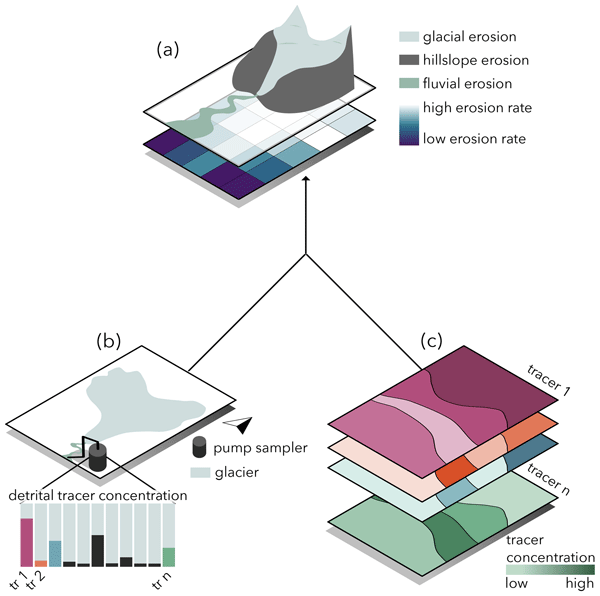
Sediments carried by rivers can damage infrastructure, affect ecosystems, and alter landscapes, yet it is often unclear where these sediments come from, especially in regions hidden beneath ice. We developed a simple way to trace their origins by shining X-rays on crushed rocks and sediments. The resulting X-ray signals act like fingerprints that can be matched to source rocks, revealing where sediments come from and allowing us to map erosion across landscapes.
Maxime Bernard, Pieter van der Beek, Cody Colleps, Xavier Robert, Kerry Gallagher, William Guenthner, Julien Amalberti, and Georgina E. King
EGUsphere, https://doi.org/10.5194/egusphere-2026-2286, https://doi.org/10.5194/egusphere-2026-2286, 2026
Short summary
Short summary
Pecube, a 3D thermal-kinematic software that predicts thermochronometer data, has been widely used to constrain the past evolution of mountain belts, but its accessibility and application is still limited. This work overcomes this limitation by offering a graphical user interface to Pecube, PecubeGUI, and by broadening its application to a wider range of tectonic settings through the implementation thermochronometer prediction models in line with the most recent research developments.
Maxime Bernard, Georgina E. King, Pieter van der Beek, Isabel Wapenhans, Lingxiao Gong, and Xavier Robert
EGUsphere, https://doi.org/10.5194/egusphere-2026-2508, https://doi.org/10.5194/egusphere-2026-2508, 2026
Short summary
Short summary
Thermochronometry data inversions using the Pecube software are useful to constrain the past evolution of mountain belts. However, configuring the neighbourhood algorithm for Pecube inversions remains challenging for new Pecube users. This contribution aims to provide intuition and guidelines for setting up NA-Pecube inversions to support informed decision-making. It forms part of a broader effort to improve the accessibility of Pecube to new users.
Léa Rodari, Audrey Margirier, Ann V. Rowan, Christoph Schmidt, Remy Veness, Charlotte S. Curry, Alex C. Scoffield, Christiaan R. Diemont, Faye Perchanok, Guillaume Jouvet, Vivi Pedersen, Derek Fabel, and Georgina E. King
EGUsphere, https://doi.org/10.5194/egusphere-2026-1536, https://doi.org/10.5194/egusphere-2026-1536, 2026
Short summary
Short summary
By combining innovative dating techniques and glacier modelling, we studied how sediment is produced, transported, and stored within the Mer de Glace catchment in the French Alps. We show that whilst sediment is transported through the glacier in less than a millennium, some sediment can be stored for many thousands of years before being re-entrained into glacial transport. This long-term storage affects how landscapes evolve and how climate signals are preserved during deglaciation.
Helen Werner, Dirk Scherler, Tancrède P. M. Leger, Guillaume Jouvet, and Ricarda Winkelmann
The Cryosphere, 20, 2469–2484, https://doi.org/10.5194/tc-20-2469-2026, https://doi.org/10.5194/tc-20-2469-2026, 2026
Short summary
Short summary
Coarse spatial resolutions reduce computational costs but poorly resolve complex topographies. Our simulations of an alpine ice field at 50 m to 2 km resolution show similar ice areas, yet much higher volumes at coarser resolutions. Resolutions of 300 m and finer accurately capture topographically constrained flow, while coarse resolutions flatten mountain slopes and peaks, affecting ice velocities, thickness, and thermal regimes which emphasizes the need for sufficiently high-resolution models.
Georgina E. King, Lily Bossin, Maxime Bernard, Melanie Kranz-Bartz, Xiaoxia Wen, Christoph Schmidt, Benny Guralnik, Frédéric Herman, Manabu Ogata, and Shigeru Sueoka
EGUsphere, https://doi.org/10.5194/egusphere-2026-2204, https://doi.org/10.5194/egusphere-2026-2204, 2026
Short summary
Short summary
Electron spin resonance (ESR) thermochronometry can be used to determine rock temperature changes, which occur as rocks move towards Earth's surface in response to uplift and surface erosion. We use samples from a known-temperature borehole to validate the method, by constraining the thermal sensitivity of quartz ESR signals in the laboratory. Whilst we are able to recover temperature successfully with the Al-centre signals, the Ti-centre signals overestimate the borehole temperature.
Armin Dachauer, Andrea Kneib-Walter, Dominik Gräff, and Andreas Vieli
The Cryosphere, 20, 2099–2125, https://doi.org/10.5194/tc-20-2099-2026, https://doi.org/10.5194/tc-20-2099-2026, 2026
Short summary
Short summary
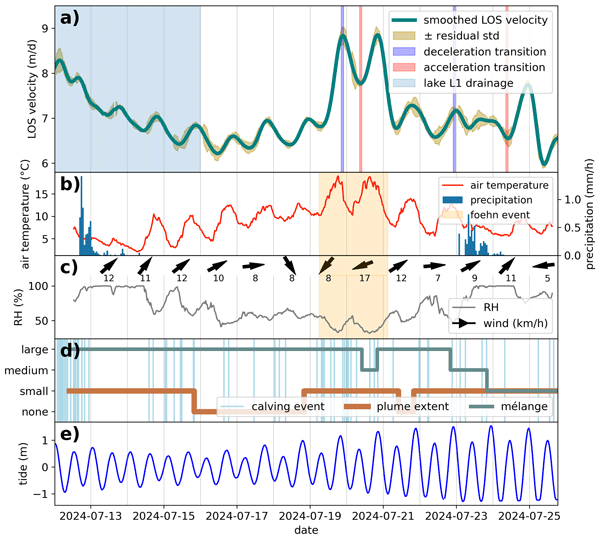
Terrestrial radar observations were used to investigate flow speed changes at Eqalorutsit Kangilliit Sermiat, a marine-terminating glacier in Greenland. The velocity varied on both daily and multi-day timescales, showing that the glacier speeds up markedly when meltwater or lake drainage increases basal water pressure. Usually speed changes move downstream with time towards the glacier front, but during multi-day speed-up events they start at the front and travel upstream.
Gillian M. A. Smith, Daniel N. Goldberg, Guillaume Jouvet, James R. Maddison, and Hamish D. Pritchard
EGUsphere, https://doi.org/10.5194/egusphere-2026-788, https://doi.org/10.5194/egusphere-2026-788, 2026
Short summary
Short summary
We estimate the thickness of a large glacier in the Himalaya, using recently available thickness measurements and a computational model which uses higher-order physics to match estimated thickness with satellite-observed velocity. Our velocity inversion achieves similar accuracy to leading thickness estimates, while thickness-constrained inversions show increased accuracy, but limited interpolative power. We make recommendations for future measurement locations and for choosing model parameters.
Veena Prasad, Oskar Herrmann, Ilaria Tabone, Mamta K C, Alexander R. Groos, Guillaume Jouvet, James R. Jordan, and Johannes J. Fürst
EGUsphere, https://doi.org/10.5194/egusphere-2026-508, https://doi.org/10.5194/egusphere-2026-508, 2026
Short summary
Short summary
We present the testing and implementation of a calving framework for simulating the evolution of glacier fronts in grounded glacier tongues. The approach is coupled with a level set method to track changes in the glacier front over time and with an eigen-calving law that allows calving to respond to ice flow and stress conditions. The framework is evaluated using a synthetic glacier domain and, when applied to marine-terminating glaciers in Svalbard, reproduces observed calving front patterns.
Samuel Weber, Andreas Vieli, Marcia Phillips, and Alessandro Cicoira
The Cryosphere, 19, 6727–6748, https://doi.org/10.5194/tc-19-6727-2025, https://doi.org/10.5194/tc-19-6727-2025, 2025
Short summary
Short summary
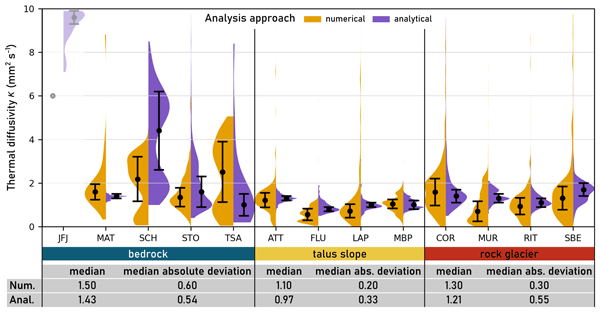
The properties of the permafrost ground depend on its temperature and composition. We used temperature data from 29 boreholes in Switzerland to study how heat moves through different types of mountain permafrost landforms, supporting a physically meaningful interpretation of thermal properties in terms of ice content, water saturation, and porosity. Understanding changes is important because they can affect how stable mountain slopes are and how easy it is to build things in mountain areas.
Andreas Henz, Johannes Reinthaler, Samuel U. Nussbaumer, Tancrède P. M. Leger, Sarah Kamleitner, Guillaume Jouvet, and Andreas Vieli
The Cryosphere, 19, 5913–5937, https://doi.org/10.5194/tc-19-5913-2025, https://doi.org/10.5194/tc-19-5913-2025, 2025
Short summary
Short summary
Glaciers are key to understanding climate change, reflecting historical variability. Using glacier models on the computer, we reconstructed European Alps glaciers during the Little Ice Age, with a total ice volume of 283 ± 42 cubic kilometres. Also, the study determines equilibrium line altitudes (ELAs) for over 4000 glaciers, showing patterns influenced by temperature, precipitation, and solar radiation. After all, we introduce a new ELA correction approach based on solar incidence.
Chloé Bouscary, Georgina E. King, Melanie Kranz-Bartz, Maxime Bernard, Rabiul H. Biswas, Lily Bossin, Arnaud Duverger, Benny Guralnik, Frédéric Herman, Ugo Nanni, Nadja Stalder, Pierre G. Valla, Vjeran Visnjevic, and Xiaoxia Wen
EGUsphere, https://doi.org/10.5194/egusphere-2025-5474, https://doi.org/10.5194/egusphere-2025-5474, 2025
Short summary
Short summary
The OSLThermo and ESRThermo MATLAB libraries simulate how luminescence signals in feldspar and electron spin resonance signals in quartz minerals accumulate and fade over time, enabling reconstruction of recent rock cooling and surface temperature changes. By sharing these tools openly, we hope to promote collaboration, reproducibility, and broader use and development of these ultra-low-temperature thermochronology methods.
Tancrède P. M. Leger, Jeremy C. Ely, Christopher D. Clark, Sarah L. Bradley, Rosie E. Archer, and Jiang Zhu
The Cryosphere, 19, 5719–5761, https://doi.org/10.5194/tc-19-5719-2025, https://doi.org/10.5194/tc-19-5719-2025, 2025
Short summary
Short summary
This study uses state-of-the-art computer simulations to better constrain the Greenland-Ice-Sheet's evolution over the past 24,000 years. By comparing model results with geological data, it reveals when and why the ice sheet grew and shrank, helping to improve future predictions of sea level rise and climate change.
Lukas Rettig, Sandro Rossato, Sarah Kamleitner, Paolo Mozzi, Susan Ivy-Ochs, Enrico Marcato, Marcus Christl, Silvana Martin, and Giovanni Monegato
E&G Quaternary Sci. J., 74, 151–168, https://doi.org/10.5194/egqsj-74-151-2025, https://doi.org/10.5194/egqsj-74-151-2025, 2025
Short summary
Short summary
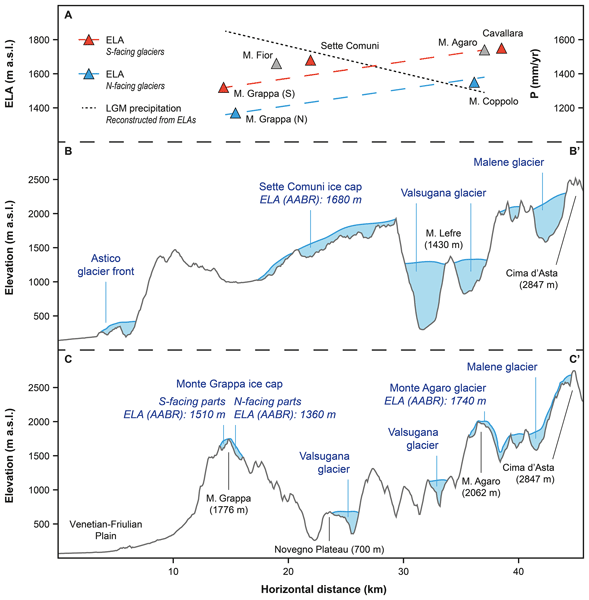
The work shows detailed reconstructions of the glaciers in the Valsugana area (south-eastern Alps) during the Last Glacial Maximum (LGM) and is supported by robust evidence and new exposure datings. These are the first ages for the internal sector of the south-eastern Alps. Local glaciers not connected with the major ice network were used for the calculation of their equilibrium line altitude. This let us estimate LGM palaeoprecipitation and compare it to Alpine palaeoclimatological models.
Josep Bonsoms, Marc Oliva, Juan Ignacio López-Moreno, and Guillaume Jouvet
The Cryosphere, 19, 1973–1993, https://doi.org/10.5194/tc-19-1973-2025, https://doi.org/10.5194/tc-19-1973-2025, 2025
Short summary
Short summary
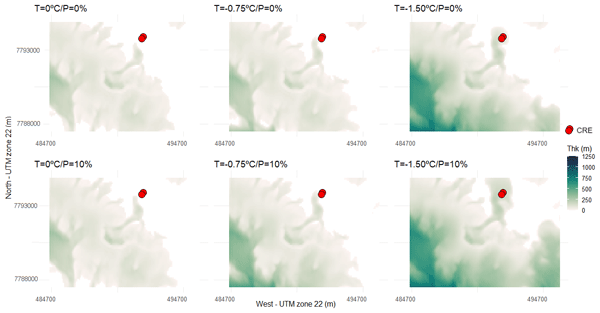
The extent to which Greenland's peripheral glaciers and ice caps current and future ice loss rates are unprecedented within the Holocene is poorly understood. This study connects the maximum ice extent of the Late Holocene with present and future glacier evolution in the Nuussuaq Peninsula (central western Greenland). By > 2050 glacier mass loss may have doubled in rate compared to the Late Holocene to the present, highlighting significant impacts of anthropogenic climate change.
Shin Sugiyama, Shun Tsutaki, Daiki Sakakibara, Izumi Asaji, Ken Kondo, Yefan Wang, Evgeny Podolskiy, Guillaume Jouvet, and Martin Funk
The Cryosphere, 19, 525–540, https://doi.org/10.5194/tc-19-525-2025, https://doi.org/10.5194/tc-19-525-2025, 2025
Short summary
Short summary
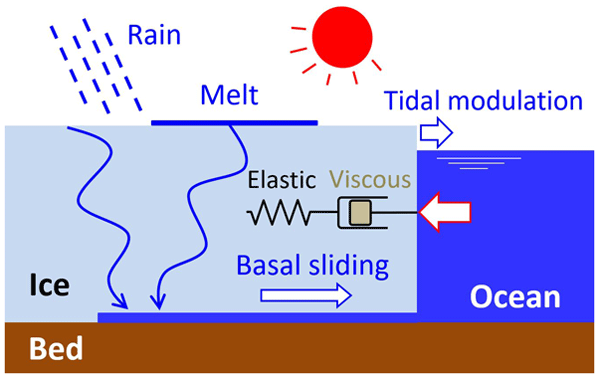
We report flow speed variations near the front of a tidewater glacier in Greenland. Ice flow near the glacier front is crucial for the mass loss of the Greenland ice sheet, but in situ data are hard to obtain. Our unique in situ GPS data revealed fine details of short-term speed variations associated with melting, ocean tides, and rain. The results are important for understanding the response of tidewater glaciers to changing environments, such as warming, more frequent rain, and ice thinning.
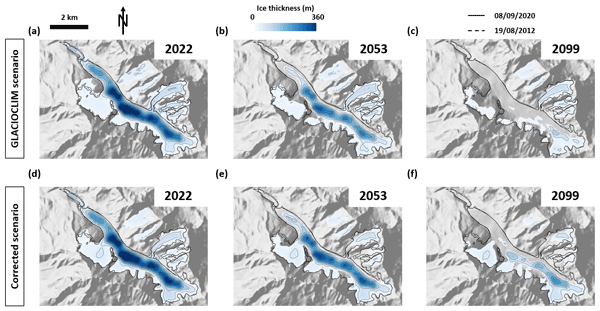
Marin Kneib, Amaury Dehecq, Adrien Gilbert, Auguste Basset, Evan S. Miles, Guillaume Jouvet, Bruno Jourdain, Etienne Ducasse, Luc Beraud, Antoine Rabatel, Jérémie Mouginot, Guillem Carcanade, Olivier Laarman, Fanny Brun, and Delphine Six
The Cryosphere, 18, 5965–5983, https://doi.org/10.5194/tc-18-5965-2024, https://doi.org/10.5194/tc-18-5965-2024, 2024
Short summary
Short summary
Avalanches contribute to increasing the accumulation on mountain glaciers by redistributing snow from surrounding mountains slopes. Here we quantified the contribution of avalanches to the mass balance of Argentière Glacier in the French Alps, by combining satellite and field observations to model the glacier dynamics. We show that the contribution of avalanches locally increases the accumulation by 60–70 % and that accounting for this effect results in less ice loss by the end of the century.
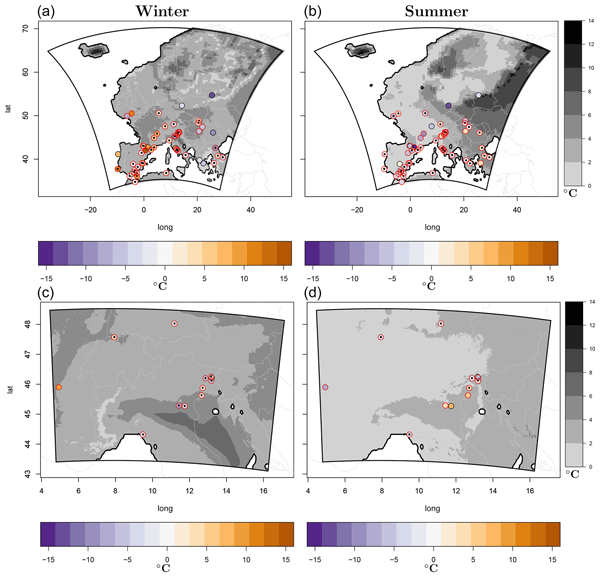
Emmanuele Russo, Jonathan Buzan, Sebastian Lienert, Guillaume Jouvet, Patricio Velasquez Alvarez, Basil Davis, Patrick Ludwig, Fortunat Joos, and Christoph C. Raible
Clim. Past, 20, 449–465, https://doi.org/10.5194/cp-20-449-2024, https://doi.org/10.5194/cp-20-449-2024, 2024
Short summary
Short summary
We present a series of experiments conducted for the Last Glacial Maximum (~21 ka) over Europe using the regional climate Weather Research and Forecasting model (WRF) at convection-permitting resolutions. The model, with new developments better suited to paleo-studies, agrees well with pollen-based climate reconstructions. This agreement is improved when considering different sources of uncertainty. The effect of convection-permitting resolutions is also assessed.
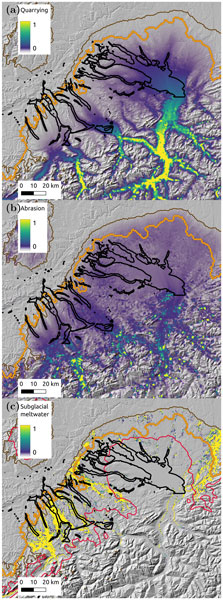
Denis Cohen, Guillaume Jouvet, Thomas Zwinger, Angela Landgraf, and Urs H. Fischer
E&G Quaternary Sci. J., 72, 189–201, https://doi.org/10.5194/egqsj-72-189-2023, https://doi.org/10.5194/egqsj-72-189-2023, 2023
Short summary
Short summary
During glacial times in Switzerland, glaciers of the Alps excavated valleys in low-lying regions that were later filled with sediment or water. How glaciers eroded these valleys is not well understood because erosion occurred near ice margins where ice moved slowly and was present for short times. Erosion is linked to the speed of ice and to water flowing under it. Here we present a model that estimates the location of water channels beneath the ice and links these locations to zones of erosion.
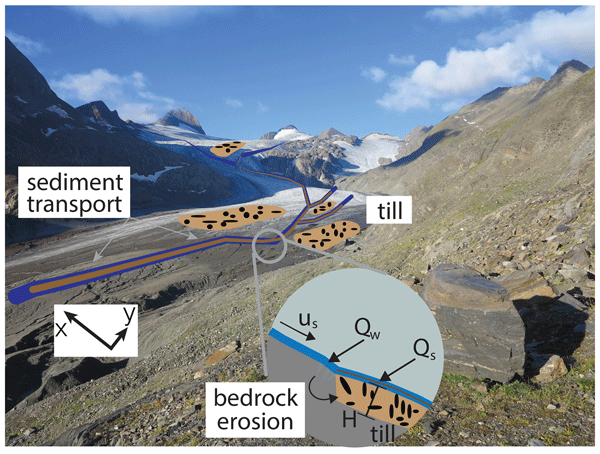
Ian Delaney, Leif Anderson, and Frédéric Herman
Earth Surf. Dynam., 11, 663–680, https://doi.org/10.5194/esurf-11-663-2023, https://doi.org/10.5194/esurf-11-663-2023, 2023
Short summary
Short summary
This paper presents a two-dimensional subglacial sediment transport model that evolves a sediment layer in response to subglacial sediment transport conditions. The model captures sediment transport in supply- and transport-limited regimes across a glacier's bed and considers both the creation and transport of sediment. Model outputs show how the spatial distribution of sediment and water below a glacier can impact the glacier's discharge of sediment and erosion of bedrock.
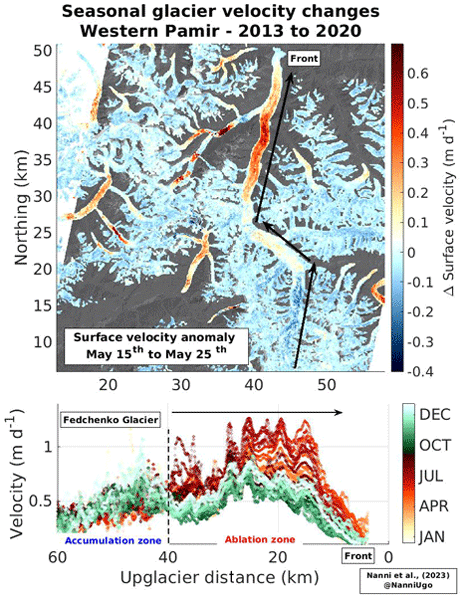
Ugo Nanni, Dirk Scherler, Francois Ayoub, Romain Millan, Frederic Herman, and Jean-Philippe Avouac
The Cryosphere, 17, 1567–1583, https://doi.org/10.5194/tc-17-1567-2023, https://doi.org/10.5194/tc-17-1567-2023, 2023
Short summary
Short summary
Surface melt is a major factor driving glacier movement. Using satellite images, we have tracked the movements of 38 glaciers in the Pamirs over 7 years, capturing their responses to rapid meteorological changes with unprecedented resolution. We show that in spring, glacier accelerations propagate upglacier, while in autumn, they propagate downglacier – all resulting from changes in meltwater input. This provides critical insights into the interplay between surface melt and glacier movement.
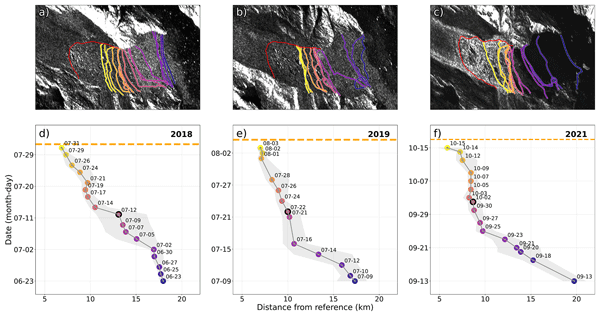
Adrien Wehrlé, Martin P. Lüthi, and Andreas Vieli
The Cryosphere, 17, 309–326, https://doi.org/10.5194/tc-17-309-2023, https://doi.org/10.5194/tc-17-309-2023, 2023
Short summary
Short summary
We characterized short-lived episodes of ice mélange weakening (IMW) at the front of three major Greenland outlet glaciers. Through a continuous detection at the front of Kangerdlugssuaq Glacier during the June-to-September period from 2018 to 2021, we found that 87 % of the IMW episodes occurred prior to a large-scale calving event. Using a simple model for ice mélange motion, we further characterized the IMW process as self-sustained through the existence of an IMW–calving feedback.
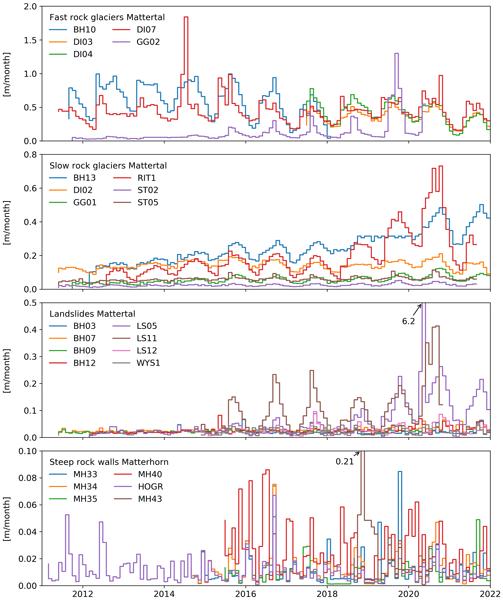
Alessandro Cicoira, Samuel Weber, Andreas Biri, Ben Buchli, Reynald Delaloye, Reto Da Forno, Isabelle Gärtner-Roer, Stephan Gruber, Tonio Gsell, Andreas Hasler, Roman Lim, Philippe Limpach, Raphael Mayoraz, Matthias Meyer, Jeannette Noetzli, Marcia Phillips, Eric Pointner, Hugo Raetzo, Cristian Scapozza, Tazio Strozzi, Lothar Thiele, Andreas Vieli, Daniel Vonder Mühll, Vanessa Wirz, and Jan Beutel
Earth Syst. Sci. Data, 14, 5061–5091, https://doi.org/10.5194/essd-14-5061-2022, https://doi.org/10.5194/essd-14-5061-2022, 2022
Short summary
Short summary
This paper documents a monitoring network of 54 positions, located on different periglacial landforms in the Swiss Alps: rock glaciers, landslides, and steep rock walls. The data serve basic research but also decision-making and mitigation of natural hazards. It is the largest dataset of its kind, comprising over 209 000 daily positions and additional weather data.

Joanne Elkadi, Benjamin Lehmann, Georgina E. King, Olivia Steinemann, Susan Ivy-Ochs, Marcus Christl, and Frédéric Herman
Earth Surf. Dynam., 10, 909–928, https://doi.org/10.5194/esurf-10-909-2022, https://doi.org/10.5194/esurf-10-909-2022, 2022
Short summary
Short summary
Glacial and non-glacial processes have left a strong imprint on the landscape of the European Alps, but further research is needed to better understand their long-term effects. We apply a new technique combining two methods for bedrock surface dating to calculate post-glacier erosion rates next to a Swiss glacier. Interestingly, the results suggest non-glacial erosion rates are higher than previously thought, but glacial erosion remains the most influential on landscape evolution.
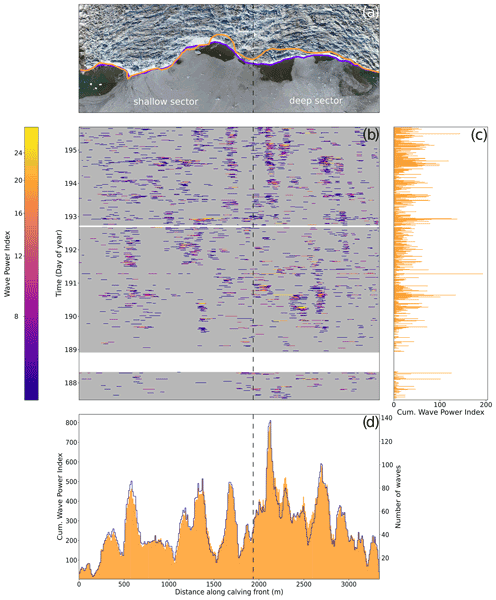
Adrien Wehrlé, Martin P. Lüthi, Andrea Walter, Guillaume Jouvet, and Andreas Vieli
The Cryosphere, 15, 5659–5674, https://doi.org/10.5194/tc-15-5659-2021, https://doi.org/10.5194/tc-15-5659-2021, 2021
Short summary
Short summary
We developed a novel automated method for the detection and the quantification of ocean waves generated by glacier calving. This method was applied to data recorded with a terrestrial radar interferometer at Eqip Sermia, Greenland. Results show a high calving activity at the glacier front sector ending in deep water linked with more frequent meltwater plumes. This suggests that rising subglacial meltwater plumes strongly affect glacier calving in deep water, but weakly in shallow water.
Cited articles
Aaron, J.: ORIN-3D – A new model for efficient simulation of landslide motion on a GPU using CUDA, Comput. Geotech., 153, 105078, https://doi.org/10.1016/j.compgeo.2022.105078, 2023.
Agassiz, L.: Études sur les glaciers, Aux frais de l'auteur. En commission chez Jent et Gassmann, libraires., Soleure, https://doi.org/10.1017/CBO9781139235877, 1840.
Alley, R. B., Cuffey, K. M., Evenson, E. B., Strasser, J. C., Lawson, D. E., and Larson, G. J.: How glaciers entrain and transport basal sediment: Physical constraints, Quat. Sci. Rev., 16, 1017–1038, https://doi.org/10.1016/S0277-3791(97)00034-6, 1997.
Alley, R. B., Lawson, D. E., Evenson, E. B., Strasser, J. C., and Larson, G. J.: Glaciohydraulic supercooling: a freeze-on mechanism to create stratified, debris-rich basal ice: II. Theory, J. Glaciol., 44, 563–569, https://doi.org/10.3189/S0022143000002070, 1998.
Archer, R. E., Ely, J. C., Heaton, T. J., Butcher, F. E. G., Hughes, A. L. C., and Clark, C. D.: Assessing ice sheet models against the landform record: The Likelihood of Accordant Lineations Analysis (LALA) tool, Earth Surf. Process. Landf., 48, 2754–2771, https://doi.org/10.1002/esp.5658, 2023.
Aschwanden, A., Bueler, E., Khroulev, C., and Blatter, H.: An enthalpy formulation for glaciers and ice sheets, J. Glaciol., 58, 441–457, https://doi.org/10.3189/2012JoG11J088, 2012.
Benn, D. I., Bolch, T., Hands, K., Gulley, J., Luckman, A., Nicholson, L. I., Quincey, D., Thompson, S., Toumi, R., and Wiseman, S.: Response of debris-covered glaciers in the Mount Everest region to recent warming, and implications for outburst flood hazards, Earth. Sci. Rev., 114, 156–174, https://doi.org/10.1016/j.earscirev.2012.03.008, 2012.
Bernard, M., Steer, P., Gallagher, K., and Lundbek Egholm, D.: Modelling the effects of ice transport and sediment sources on the form of detrital thermochronological age probability distributions from glacial settings, Earth Surface Dynamics, 8, 931–953, https://doi.org/10.5194/esurf-8-931-2020, 2020.
Bernard, M., van der Beek, P. A., Pedersen, V. K., and Colleps, C.: Production and Preservation of Elevated Low-Relief Surfaces in Mountainous Landscapes by Pliocene-Quaternary Glaciations, AGU Advances, 6, https://doi.org/10.1029/2024AV001610, 2025.
Bichler, M. G., Reindl, M., Reitner, J. M., Drescher-Schneider, R., Wirsig, C., Christl, M., Hajdas, I., and Ivy-Ochs, S.: Landslide deposits as stratigraphical markers for a sequence-based glacial stratigraphy: a case study of a Younger Dryas system in the Eastern Alps, Boreas, 45, 537–551, https://doi.org/10.1111/bor.12173, 2016.
Bigi, G., Castellarin, A., Coli, M., Dal Piaz, G. V., Sartori, R., Scandone, P., and Vai, G.: Structural Model of Italy scale 1:500,000, sheet 1, Florence, 1990a.
Bigi, G., Castellarin, A., Coli, M., Dal Piaz, G. V., and Vai, G.: Structural Model of Italy scale 1:500,000, sheet 2, Florence, 1990b.
Blatter, H.: Velocity and stress fields in grounded glaciers: a simple algorithm for including deviatoric stress gradients, J. Glaciol., 41, 333–344, https://doi.org/10.3189/S002214300001621X, 1995.
Boulton, G. S.: Boulder shapes and grain-size distributions of debris as indicators of transport paths through a glacier and till genesis, Sedimentology, 25, 773–799, https://doi.org/10.1111/j.1365-3091.1978.tb00329.x, 1978.
Boulton, G. S.: Processes of Glacier Erosion on Different Substrata, J. Glaciol., 23, 15–38, https://doi.org/10.3189/S0022143000029713, 1979.
Boulton, G. S.: Theory of glacial erosion, transport and deposition as a consequence of subglacial sediment deformation, J. Glaciol., 42, 43–62, https://doi.org/10.3189/S0022143000030525, 1996.
Boxleitner, M., Ivy-Ochs, S., Egli, M., Brandova, D., Christl, M., and Maisch, M.: Lateglacial and Early Holocene glacier stages – New dating evidence from the Meiental in central Switzerland, Geomorphology, 340, 15–31, https://doi.org/10.1016/j.geomorph.2019.04.004, 2019.
Braakhekke, J., Ivy-Ochs, S., Monegato, G., Gianotti, F., Martin, S., Casale, S., and Christl, M.: Timing and flow pattern of the Orta Glacier (European Alps) during the Last Glacial Maximum, Boreas, 49, 315–332, https://doi.org/10.1111/bor.12427, 2020.
Bueler, E. and van Pelt, W.: Mass-conserving subglacial hydrology in the Parallel Ice Sheet Model version 0.6, Geosci. Model Dev., 8, 1613–1635, https://doi.org/10.5194/gmd-8-1613-2015, 2015.
Buoncristiani, J.-F. and Campy, M.: Quaternary Glaciations in the French Alps and Jura, in: Quaternary Glaciations – Extent and Chronology - a closer look, vol. 15, edited by: Ehlers, J., Gibbard, P. L., and Hughes, P. D., 117–126, https://doi.org/10.1016/B978-0-444-53447-7.00010-6, 2011.
Bussien Grosjean, D., Meisser, N., May-Leresche, S., Ulianov, A., and Vonlanthen, P.: The Morcles microgranite (Aiguilles Rouges, Swiss Alps): geochronological and geochemical evidences for a common origin with the Vallorcine intrusion, Swiss J. Geosci., 111, 35–49, https://doi.org/10.1007/s00015-017-0282-3, 2018.
Byers, J., Cohen, D., and Iverson, N. R.: Subglacial clast/bed contact forces, J. Glaciol., 58, 89–98, https://doi.org/10.3189/2012JoG11J126, 2012.
Calov, R. and Greve, R.: A semi-analytical solution for the positive degree-day model with stochastic temperature variations, J. Glaciol., 51, 173–175, https://doi.org/10.3189/172756505781829601, 2005.
Campy, M.: Palaeogeographical relationships between Alpine and Jura glaciers during the two last Pleistocene glaciations, Palaeogeogr. Palaeoclimatol. Palaeoecol., 93, 1–12, https://doi.org/10.1016/0031-0182(92)90180-D, 1992.
Capuzzo, N., Handler, R., Neubauer, F., and Wetzel, A.: Post-collisional rapid exhumation and erosion during continental sedimentation: the example of the late Variscan Salvan-Dorénaz basin (Western Alps), Int. J. Earth Sci., 92, 364–379, https://doi.org/10.1007/s00531-003-0332-0, 2003.
Champel, B., van der Beek, P., Mugnier, J., and Leturmy, P.: Growth and lateral propagation of fault-related folds in the Siwaliks of western Nepal: Rates, mechanisms, and geomorphic signature, J. Geophys. Res.-Solid Earth, 107, https://doi.org/10.1029/2001JB000578, 2002.
Clark, C. D., Ely, J. C., Greenwood, S. L., Hughes, A. L. C., Meehan, R., Barr, I. D., Bateman, M. D., Bradwell, T., Doole, J., Evans, D. J. A., Jordan, C. J., Monteys, X., Pellicer, X. M., and Sheehy, M.: BRITICE Glacial Map, version 2: a map and GIS database of glacial landforms of the last British–Irish Ice Sheet, Boreas, 47, 11-e8, https://doi.org/10.1111/bor.12273, 2018.
Clark, C. D., Ely, J. C., Hindmarsh, R. C. A., Bradley, S., Ignéczi, A., Fabel, D., Ó Cofaigh, C., Chiverrell, R. C., Scourse, J., Benetti, S., Bradwell, T., Evans, D. J. A., Roberts, D. H., Burke, M., Callard, S. L., Medialdea, A., Saher, M., Small, D., Smedley, R. K., Gasson, E., Gregoire, L., Gandy, N., Hughes, A. L. C., Ballantyne, C., Bateman, M. D., Bigg, G. R., Doole, J., Dove, D., Duller, G. A. T., Jenkins, G. T. H., Livingstone, S. L., McCarron, S., Moreton, S., Pollard, D., Praeg, D., Sejrup, H. P., Van Landeghem, K. J. J., and Wilson, P.: Growth and retreat of the last British–Irish Ice Sheet, 31 000 to 15 000 years ago: the BRITICE-CHRONO reconstruction, Boreas, 51, 699–758, https://doi.org/10.1111/bor.12594, 2022.
Cogez, A., Herman, F., Pelt, É., Reuschlé, T., Morvan, G., Darvill, C. M., Norton, K. P., Christl, M., Märki, L., and Chabaux, F.: U–Th and 10Be constraints on sediment recycling in proglacial settings, Lago Buenos Aires, Patagonia, Earth Surf. Dynam., 6, 121–140, https://doi.org/10.5194/esurf-6-121-2018, 2018.
Cook, S. J., Swift, D. A., Kirkbride, M. P., Knight, P. G., and Waller, R. I.: The empirical basis for modelling glacial erosion rates, Nat. Commun., 11, 1–7, https://doi.org/10.1038/s41467-020-14583-8, 2020.
Cordonnier, G., Jouvet, G., Peytavie, A., Braun, J., Cani, M.-P., Benes, B., Galin, E., Guérin, E., and Gain, J.: Forming Terrains by Glacial Erosion, ACM Trans. Graph., 42, 1–14, https://doi.org/10.1145/3592422, 2023.
Coutterand, S.: Étude géomophologique des flux glaciaires dans les Alpes nord-occidentales au Pléistocène récent. Du maximum de la dernière glaciation aux premières étapes de la déglaciation., PhD thesis, Université de Savoie, Le Bourget du Lac, 1–468 pp., 2010.
Coutterand, S.: Origines des blocs erratiques du Salève, Arch. Sci., 70, 51–56, 2018.
Cuffey, K. M. and Patterson, W. S. B.: The physics of glaciers, Academic Press, 1–704 pp., 2010.
Davies, B. J., Roberts, D. H., Bridgland, D. R., Ó Cofaigh, C., Riding, J. B., Demarchi, B., Penkman, K. E. H., and Pawley, S. M.: Timing and depositional environments of a Middle Pleistocene glaciation of northeast England: New evidence from Warren House Gill, County Durham, Quat. Sci. Rev., 44, 180–212, https://doi.org/10.1016/j.quascirev.2010.02.003, 2012.
Davies, B. J., Darvill, C. M., Lovell, H., Bendle, J. M., Dowdeswell, J. A., Fabel, D., García, J.-L., Geiger, A., Glasser, N. F., Gheorghiu, D. M., Harrison, S., Hein, A. S., Kaplan, M. R., Martin, J. R. V., Mendelova, M., Palmer, A., Pelto, M., Rodés, Á., Sagredo, E. A., Smedley, R. K., Smellie, J. L., and Thorndycraft, V. R.: The evolution of the Patagonian Ice Sheet from 35 ka to the present day (PATICE), Earth. Sci. Rev., 204, 103152, https://doi.org/10.1016/j.earscirev.2020.103152, 2020.
Delaney, I. and Anderson, L. S.: Debris Cover Limits Subglacial Erosion and Promotes Till Accumulation, Geophys. Res. Lett., 49, https://doi.org/10.1029/2022GL099049, 2022.
Delaney, I., Anderson, L., and Herman, F.: Modeling the spatially distributed nature of subglacial sediment transport and erosion, Earth Surf. Dynam., 11, 663–680, https://doi.org/10.5194/esurf-11-663-2023, 2023.
Delaney, I., Margirier, A., Gevers, M., Jenkin, M., Leger, T., Vergara, I., Seguinot, J., Jouvet, G., Alexander Aitken, A. R., Lane, S., Herman, F., and King, G. E.: Increased Glacier Melt Across Millennia to Hours Enhances Erosion and Sediment Export Processes, J. Geophys. Res.-Earth Surf., 131, https://doi.org/10.1029/2025JF008614, 2026.
Dielforder, A. and Hetzel, R.: The deglaciation history of the Simplon region (southern Swiss Alps) constrained by 10Be exposure dating of ice-molded bedrock surfaces, Quat. Sci. Rev., 84, 26–38, https://doi.org/10.1016/j.quascirev.2013.11.008, 2014.
Duprat-Oualid, F., Rius, D., Bégeot, C., Magny, M., Millet, L., Wulf, S., and Appelt, O.: Vegetation response to abrupt climate changes in Western Europe from 45 to 14.7 k cal a BP: the Bergsee lacustrine record (Black Forest, Germany), J. Quat. Sci., 32, 1008–1021, https://doi.org/10.1002/jqs.2972, 2017.
Egholm, D. L., Knudsen, M. F., Clark, C. D., and Lesemann, J. E.: Modeling the flow of glaciers in steep terrains: The integrated second-order shallow ice approximation (iSOSIA), J. Geophys. Res.-Earth Surf., 116, https://doi.org/10.1029/2010JF001900, 2011.
Ehlers, J., Gibbard, P. L., and Hughes, P. D.: Developments in quaternary sciences: quaternary glaciations-extent and chronology: a closer look, 1st edn., edited by: Ehlers, J., Gibbard, P. L., and Hughes, P. D., Elsevier, Amsterdam, 2–1118 pp., 2011.
Ely, J. C., Clark, C. D., Small, D., and Hindmarsh, R. C. A.: ATAT 1.1, the Automated Timing Accordance Tool for comparing ice-sheet model output with geochronological data, Geosci. Model Dev., 12, 933–953, https://doi.org/10.5194/gmd-12-933-2019, 2019.
Enkelmann, E. and Ehlers, T. A.: Evaluation of detrital thermochronology for quantification of glacial catchment denudation and sediment mixing, Chem. Geol., 411, 299–309, https://doi.org/10.1016/j.chemgeo.2015.07.018, 2015.
Esmark, J.: Bidrag til vor Jordklodes Historie, Magazin for Naturvidenskaberne, Anden Aargangs förste Bind, Förste Hefte, 28–49, 1824.
Evans, D. J. A. and Benn, D. I.: A Practical Guide to the Study of Glacial Sediments, Routledge, ISBN-10 0340759593, https://www.qra.org.uk/bookshop/a-practical-guide-to-the-study-of-glacial-sediments/ (last access: 5 May 2026), 2004.
Evans, D. J. A., Phillips, E. R., Hiemstra, J. F., and Auton, C. A.: Subglacial till: Formation, sedimentary characteristics and classification, Earth. Sci. Rev., 78, 115–176, https://doi.org/10.1016/j.earscirev.2006.04.001, 2006.
Federici, P. R., Ribolini, A., and Spagnolo, M.: Glacial history of the Maritime Alps from the Last Glacial Maximum to the Little Ice Age, Geological Society, London, Special Publications, 433, 137–159, https://doi.org/10.1144/SP433.9, 2017.
Fedotova, A. and Magnani, M. B.: Glacial Erosion Rates Since the Last Glacial Maximum for the Former Argentino Glacier and Present-Day Upsala Glacier, Patagonia, J. Geophys. Res.-Earth Surf., 129, https://doi.org/10.1029/2024JF007960, 2024.
Fischer, L., Purves, R. S., Huggel, C., Noetzli, J., and Haeberli, W.: On the influence of topographic, geological and cryospheric factors on rock avalanches and rockfalls in high-mountain areas, Nat. Hazards Earth Syst. Sci., 12, 241–254, https://doi.org/10.5194/nhess-12-241-2012, 2012.
Fischer, U. H., Bebiolka, A., Brandefelt, J., Follin, S., Hirschorn, S., Jensen, M., Keller, S., Kennell, L., Näslund, J.-O., Normani, S., Selroos, J.-O., and Vidstrand, P.: Radioactive Waste Under Conditions of Future Ice Ages, in: Snow and Ice-Related Hazards, Risks, and Disasters, edited by: Shroder, J. F., Haeberli, W., and Whiteman, C., Elsevier, Boston, 345–393, https://doi.org/10.1016/B978-0-12-394849-6.00011-1, 2015.
Fischer, U. H., Bebiolka, A., Brandefelt, J., Cohen, D., Harper, J., Hirschorn, S., Jensen, M., Kennell, L., Liakka, J., Näslund, J.-O., Normani, S., Stück, H., and Weitkamp, A.: Radioactive waste under conditions of future ice ages, in: Snow and Ice-Related Hazards, Risks, and Disasters, edited by: Haeberli, W. and Whiteman, C., Elsevier, 323–375, https://doi.org/10.1016/B978-0-12-817129-5.00005-6, 2021.
Florineth, D. and Schlüchter, C.: Reconstructing the Last Glacial Maximum (LGM) ice surface geometry and flowlines in the Central Swiss Alps, Eclogae Geologicae Helvetiae, 91, https://doi.org/10.5169/seals-168431, 1998.
Gallach, X., Perrette, Y., Lafon, D., Chalmin, É., Deline, P., Ravanel, L., Carcaillet, J., and Wallet, T.: A new method for dating the surface exposure age of granite rock walls in the Mont Blanc massif by reflectance spectroscopy, Quat. Geochronol., 64, 101–156, https://doi.org/10.1016/j.quageo.2021.101156, 2021.
Geikie, J.: The Alps during the Glacial Period, B. Am. Geogr. Soc., 42, 192, https://doi.org/10.2307/200422, 1910.
Geologische Bundesanstalt Österreich: Geodaten – Blatt 197 Kötschach (1:50.000), Tethys RDR, Geologische Bundesanstalt (GBA), Wien, https://doi.org/10.24341/tethys.90, 2021a.
Geologische Bundesanstalt Österreich: Geodaten – Blatt 198 Weißbriach (1:50.000), Tethys RDR, Geologische Bundesanstalt (GBA), Wien, https://doi.org/10.24341/tethys.88, 2021b.
Gianotti, F., Forno, M. G., Ivy-Ochs, S., and Kubik, P. W.: New chronological and stratigraphical data on the Ivrea amphitheatre (Piedmont, NW Italy), Quaternary Int., 190, 123–135, https://doi.org/10.1016/j.quaint.2008.03.001, 2008.
Gianotti, F., Forno, M. G., Ajassa, R., Cámara, F., Costa, E., Ferrando, S., Giardino, M., Lucchesi, S., Motta, L., Motta, M., Perotti, L., and Rossetti, P.: The Ivrea Morainic Amphitheatre as a Well Preserved Record of the Quaternary Climate Variability (PROGEO-Piemonte Project, NW Italy), in: Engineering Geology for Society and Territory – Volume 8, edited by: Lollino, G., Giordan, D., Marunteanu, C., Christaras, B., Yoshinori, I., and Margottini, C., Springer, Cham, https://doi.org/10.1007/978-3-319-09408-3_39, 2015.
Gibbons, A. B., Megeath, Joe. D., and Pierce, K. L.: Probability of moraine survival in a succession of glacial advances, Geology, 12, 327, https://doi.org/10.1130/0091-7613(1984)12<327:POMSIA>2.0.CO;2, 1984.
Glasser, N. and Jansson, K.: The Glacial map of southern South America, J. Maps, 4, 175–196, https://doi.org/10.4113/jom.2008.1020, 2008.
Graf, A., Akçar, N., Ivy-Ochs, S., Strasky, S., Kubik, P. W., Christl, M., Burkhard, M., Wieler, R., and Schlüchter, C.: Multiple advances of Alpine glaciers into the Jura Mountains in the Northwestern Switzerland, Swiss J. Geosci., 108, 225–238, https://doi.org/10.1007/s00015-015-0195-y, 2015.
Guillon, H., Mugnier, J., Buoncristiani, J., Carcaillet, J., Godon, C., Prud'homme, C., van der Beek, P., and Vassallo, R.: Improved discrimination of subglacial and periglacial erosion using 10Be concentration measurements in subglacial and supraglacial sediment load of the Bossons glacier (Mont Blanc massif, France), Earth Surf. Process. Landf., 40, 1202–1215, https://doi.org/10.1002/esp.3713, 2015.
Hallet, B.: Glacial Abrasion and Sliding: their Dependence on the Debris Concentration in Basal Ice, Ann. Glaciol., 2, 23–28, https://doi.org/10.3189/172756481794352487, 1981.
Herman, F., Beyssac, O., Brughelli, M., Lane, S. N., Leprince, S., Adatte, T., Lin, J. Y. Y., Avouac, J.-P., and Cox, S. C.: Erosion by an Alpine glacier, Science (1979), 350, 193–195, https://doi.org/10.1126/science.aab2386, 2015.
Herman, F., De Doncker, F., Delaney, I., Prasicek, G., and Koppes, M.: The impact of glaciers on mountain erosion, Nat. Rev. Earth Environ., 2, 422–435, https://doi.org/10.1038/s43017-021-00165-9, 2021.
Heyman, J., Stroeven, A. P., Harbor, J. M., and Caffee, M. W.: Too young or too old: Evaluating cosmogenic exposure dating based on an analysis of compiled boulder exposure ages, Earth Planet. Sci. Lett., 302, 71–80, https://doi.org/10.1016/j.epsl.2010.11.040, 2011.
Hippe, K., Ivy-Ochs, S., Kober, F., Zasadni, J., Wieler, R., Wacker, L., Kubik, P. W., and Schlüchter, C.: Chronology of Lateglacial ice flow reorganization and deglaciation in the Gotthard Pass area, Central Swiss Alps, based on cosmogenic 10Be and in situ 14C, Quat. Geochronol., 19, 14–26, https://doi.org/10.1016/j.quageo.2013.03.003, 2014.
Hooke, R. LeB. and Iverson, N. R.: Grain-size distribution in deforming subglacial tills: Role of grain fracture, Geology, 23, 57, https://doi.org/10.1130/0091-7613(1995)023<0057:GSDIDS>2.3.CO;2, 1995.
Hubbard, B., Sharp, M., and Lawson, W. J.: On the sedimentological character of Alpine basal ice facies, Ann. Glaciol., 22, 187–193, https://doi.org/10.3189/1996AoG22-1-187-193, 1996.
Hughes, A. L. C., Clark, C. D., and Jordan, C. J.: Subglacial bedforms of the last British Ice sheet, J. Maps, 6, 543–563, https://doi.org/10.4113/jom.2010.1111, 2010.
Humlum, O.: Changes in Texture and Fabric of Particles in Glacial Traction with Distance from Source, M?rdalsjökull, Iceland, J. Glaciol., 31, 150–156, https://doi.org/10.3189/S0022143000006390, 1985.
Humphrey, N. F. and Raymond, C. F.: Hydrology, erosion and sediment production in a surging glacier: Variegated Glacier, Alaska, 1982–83, J. Glaciol., 40, 539–552, https://doi.org/10.3189/S0022143000012429, 1994.
Iverson, N. R., Hanson, B., Hooke, R. LeB., and Jansson, P.: Flow Mechanism of Glaciers on Soft Beds, Science (1979), 267, 80–81, https://doi.org/10.1126/science.267.5194.80, 1995.
Iverson, N. R., Cohen, D., Hooyer, T. S., Fischer, U. H., Jackson, M., Moore, P. L., Lappegard, G., and Kohler, J.: Effects of Basal Debris on Glacier Flow, Science (1979), 301, 81–84, https://doi.org/10.1126/science.1083086, 2003.
Ivy-Ochs, S.: Glacier variations in the European Alps at the end of the last glaciation, Cuadernos de Investigación Geográfica, 41, 295–315, https://doi.org/10.18172/cig.2750, 2015.
Ivy-Ochs, S., Schäfer, J., Kubik, P. W., Synal, H. A., and Schlüchter, C.: Timing of deglaciation on the northern Alpine foreland (Switzerland), Eclogae Geol. Helv., 97, 47–55, https://doi.org/10.1007/s00015-004-1110-0, 2004.
Ivy-Ochs, S., Lucchesi, S., Baggio, P., Fioraso, G., Gianotti, F., Monegato, G., Graf, A. A., Akçar, N., Christl, M., Carraro, F., Forno, M. G., and Schlüchter, C.: New geomorphological and chronological constraints for glacial deposits in the Rivoli-Avigliana end-moraine system and the lower Susa Valley (Western Alps, NW Italy), J. Quat. Sci., 33, 550–562, https://doi.org/10.1002/jqs.3034, 2018.
Ivy-Ochs, S., Monegato, G., and Reitner, J. M.: The Alps: glacial landforms from the Last Glacial Maximum, in: European Glacial Landscapes, edited by: Palacios, D., Hughes, P. D., García-Ruiz, J. M., and Andrés, N., Elsevier, 449–460, https://doi.org/10.1016/B978-0-12-823498-3.00030-3, 2022.
Jain, A., Kerbl, B., Gain, J., Finley, B., and Cordonnier, G.: FastFlow: GPU Acceleration of Flow and Depression Routing for Landscape Simulation, Computer Graphics Forum, 43, https://doi.org/10.1111/cgf.15243, 2024.
Jouvet, G. and Cordonnier, G.: Ice-flow model emulator based on physics-informed deep learning, Journal of Glaciology, 1–15, https://doi.org/10.1017/jog.2023.73, 2023.
Jouvet, G., Seguinot, J., Ivy-ochs, S., and Funk, M.: Modelling the diversion of erratic boulders by the Valais Glacier during the last glacial maximum, J. Glaciol., 63, 487–498, https://doi.org/10.1017/jog.2017.7, 2017.
Jouvet, G., Cordonnier, G., Kim, B., Lüthi, M., Vieli, A., and Aschwanden, A.: Deep learning speeds up ice flow modelling by several orders of magnitude, J. Glaciol., 68, 651–664, https://doi.org/10.1017/jog.2021.120, 2021.
Jouvet, G., Cohen, D., Russo, E., Buzan, J., Raible, C. C., Haeberli, W., Kamleitner, S., Ivy-Ochs, S., Imhof, M. A., Becker, J. K., Landgraf, A., and Fischer, U. H.: Coupled climate-glacier modelling of the last glaciation in the Alps, J. Glaciol., 1–15, https://doi.org/10.1017/jog.2023.74, 2023.
Jouvet, G., Cook, S., Cordonnier, G., Finley, B., Henz, A., Herrmann, O., Maussion, F., Mey, J., Scherler, D., and Welty, E.: Concepts and capabilities of the Instructed Glacier Model, https://doi.org/10.31223/X5T99C, 7 April 2024.
Kamleitner, S., Ivy-Ochs, S., Monegato, G., Gianotti, F., Akçar, N., Vockenhuber, C., Christl, M., and Synal, H.-A.: The Ticino-Toce glacier system (Swiss-Italian Alps) in the framework of the Alpine Last Glacial Maximum, Quat. Sci. Rev., 279, 107400, https://doi.org/10.1016/j.quascirev.2022.107400, 2022.
Kamleitner, S., Ivy-Ochs, S., Manatschal, L., Akçar, N., Christl, M., Vockenhuber, C., Hajdas, I., and Synal, H.-A.: Last Glacial Maximum glacier fluctuations on the northern Alpine foreland: Geomorphological and chronological reconstructions from the Rhine and Reuss glacier systems, Geomorphology, 423, 108548, https://doi.org/10.1016/j.geomorph.2022.108548, 2023.
Kamleitner, S., Leger, T. P. M., Ivy-Ochs, S., Nussbaumer, S. U., Vieli, A., and Jouvet, G.: AlpIce - Towards an Alps-wide database of empirical geo(morpho)logical and geochronological data constraining Last Glacial Maximum to Holocene glacier fluctuations, EGU General Assembly 2024, Vienna, Austria, 14–19 Apr 2024, EGU24-9282, https://doi.org/10.5194/egusphere-egu24-9282, 2024a.
Kamleitner, S., Ivy-Ochs, S., Salcher, B., and Reitner, J. M.: Reconstructing basal ice flow patterns of the Last Glacial Maximum Rhine glacier (northern Alpine foreland) based on streamlined subglacial landforms, Earth Surf. Process. Landf., 49, 746–769, https://doi.org/10.1002/esp.5733, 2024b.
Keller, O. and Krayss, E.: Mittel- und spätpleistozäne Stratigraphie und Morphogenese in Schlüsselregionen der Nordschweiz, E&G, Quaternary Sci. J., 59, 88–119, https://doi.org/10.3285/eg.59.1-2.08, 2011.
Kelly, M. A., Buoncristiani, J.-F., and Schlüchter, C.: A reconstruction of the last glacial maximum (LGM) ice-surface geometry in the western Swiss Alps and contiguous Alpine regions in Italy and France, Eclogae Geol. Helv., 97, 57–75, https://doi.org/10.1007/s00015-004-1109-6, 2004.
Koppes, M., Hallet, B., Rignot, E., Mouginot, J., Wellner, J. S., and Boldt, K.: Observed latitudinal variations in erosion as a function of glacier dynamics, Nature, 526, 100–103, https://doi.org/10.1038/nature15385, 2015.
Kühni, A. and Pfiffner, O. A.: The relief of the Swiss Alps and adjacent areas and its relation to lithology and structure: topographic analysis from a 250-m DEM, Geomorphology, 41, 285–307, https://doi.org/10.1016/S0169-555X(01)00060-5, 2001.
Lane, S. N., Bakker, M., Gabbud, C., Micheletti, N., and Saugy, J.-N.: Sediment export, transient landscape response and catchment-scale connectivity following rapid climate warming and Alpine glacier recession, Geomorphology, 277, 210–227, https://doi.org/10.1016/j.geomorph.2016.02.015, 2017.
Leger, T. P. M., Jouvet, G., Kamleitner, S., Mey, J., Herman, F., Finley, B. D., Ivy-Ochs, S., Vieli, A., Henz, A., and Nussbaumer, S. U.: A data-consistent model of the last glaciation in the Alps achieved with physics-driven AI, Nat. Commun., 16, 848, https://doi.org/10.1038/s41467-025-56168-3, 2025.
Leger, T. P. M., Jouvet G., Kamleitner, S., Finley, B. D., Bernard, M., Allegri, B., Herman, F., Vieli, A., Henz, A., and Nussbaumer, S. U.: First Alps-wide reconstruction of LGM glacial sediment transport enabled by GPU-accelerated particle tracking – Supplementary Data, Zenodo [data set], https://doi.org/10.5281/zenodo.18374156, 2026.
Lehner, B. and Grill, G.: Global river hydrography and network routing: baseline data and new approaches to study the world's large river systems, Hydrol. Process., 27, 2171–2186, https://doi.org/10.1002/hyp.9740, 2013.
Letsch, D., Winkler, W., von Quadt, A., and Gallhofer, D.: The volcano-sedimentary evolution of a post-Variscan intramontane basin in the Swiss Alps (Glarus Verrucano) as revealed by zircon U–Pb age dating and Hf isotope geochemistry, Int. J. Earth Sci., 104, 123–145, https://doi.org/10.1007/s00531-014-1055-0, 2015.
Linton, D. L.: Watershed Breaching by Ice in Scotland, Transactions and Papers (Institute of British Geographers), 1, https://doi.org/10.2307/621028, 1949.
Luetscher, M., Boch, R., Sodemann, H., Spötl, C., Cheng, H., Edwards, R. L., Frisia, S., Hof, F., and Müller, W.: North Atlantic storm track changes during the Last Glacial Maximum recorded by Alpine speleothems, Nat. Commun., 6, 6344, https://doi.org/10.1038/ncomms7344, 2015.
Lyell, C.: On the geological evidence of the former existence of glaciers in Forfarshire, Proc. Geol. Soc. London, 3, 337–345, 1840.
Manzotti, P.: Petro-structural map of the Dent Blanche tectonic system between Valpelline and Valtournenche valleys, Western Italian Alps, J. Maps, 7, 340–352, https://doi.org/10.4113/jom.2011.1179, 2011.
Margirier, A., Brondex, J., Rowan, A. V., Schmidt, C., Pedersen, V. K., Lehmann, B., Anderson, L. S., Veness, R., Watson, C. S., Swift, D., and King, G. E.: Tracking Sediment Transport Through Miage Glacier, Italy, Using a Lagrangian Approach With Luminescence Rock Surface Burial Dating of Englacial Clasts, J. Geophys. Res.-Earth Surf., 130, https://doi.org/10.1029/2024JF007773, 2025.
Mathes, N., Luetscher, M., Ivy-Ochs, S., Dieleman, C., Christl, M., Vockenhuber, C., and Akçar, N.: An extensive MIS 12 Alpine glaciation in the Jura Mountains: insights from cave sediments and burial dating, Quat. Sci. Rev., 376, 109818, https://doi.org/10.1016/j.quascirev.2026.109818, 2026.
Matthews, J. A., Shakesby, R. A., and Fabel, D.: Very low inheritance in cosmogenic surface exposure ages of glacial deposits: A field experiment from two Norwegian glacier forelands, Holocene, 27, 1406–1414, https://doi.org/10.1177/0959683616687387, 2017.
Mey, J., Scherler, D., Wickert, A. D., Egholm, D. L., Tesauro, M., Schildgen, T. F., and Strecker, M. R.: Glacial isostatic uplift of the European Alps, Nat. Commun., 7, 13382, https://doi.org/10.1038/ncomms13382, 2016.
Mohammadi, M., McMackin, C., and Egli, M.: Source identification of morainic materials in soils of the Three Lakes region (Switzerland) using the fingerprinting technique, Catena (Amst)., 234, 107619, https://doi.org/10.1016/j.catena.2023.107619, 2024.
Monegato, G., Scardia, G., Hajdas, I., Rizzini, F., and Piccin, A.: The Alpine LGM in the boreal ice-sheets game, Sci. Rep., 7, 2078, https://doi.org/10.1038/s41598-017-02148-7, 2017.
Monegato, G., Kamleitner, S., Gianotti, F., Martin, S., Scapozza, C., and Ivy-Ochs, S.: The Ticino-Toce Ice Conveyor Belts During The Last Glacial Maximum, Alpine and Mediterranean Quaternary, 35, 119–134, https://doi.org/10.26382/AMQ.2022.07, 2022.
Moosdorf, N., Cohen, S., and von Hagke, C.: A global erodibility index to represent sediment production potential of different rock types, Appl. Geogr., 101, 36–44, https://doi.org/10.1016/j.apgeog.2018.10.010, 2018.
Overeem, I., Hudson, B. D., Syvitski, J. P. M., Mikkelsen, A. B., Hasholt, B., van den Broeke, M. R., Noël, B. P. Y., and Morlighem, M.: Substantial export of suspended sediment to the global oceans from glacial erosion in Greenland, Nat. Geosci., 10, 859–863, https://doi.org/10.1038/ngeo3046, 2017.
Penck, A. and Brückner, E.: Die Alpen im Eiszeitalter, Tauchnitz, Geographische Zeitschrift, Vol. 17, no. 8, 1911, pp. 451–462, JSTOR, http://www.jstor.org/stable/27807644 (last access: 5 May 2026), 1909.
Preusser, F., Reitner, J. M., and Schlüchter, C.: Distribution, geometry, age and origin of overdeepened valleys and basins in the Alps and their foreland, Swiss J. Geosci., 103, 407–426, https://doi.org/10.1007/s00015-010-0044-y, 2010.
Preusser, F., Graf, H. R., Keller, O., Krayss, E., and Schlüchter, C.: Quaternary glaciation history of northern Switzerland, E&G Quaternary Sci. J., 60, 282–305, https://doi.org/10.3285/eg.60.2-3.06, 2011.
Prud'homme, C., Vassallo, R., Crouzet, C., Carcaillet, J., Mugnier, J., and Cortés-Aranda, J.: Paired 10Be sampling of polished bedrock and erratic boulders to improve dating of glacial landforms: an example from the Western Alps, Earth Surf. Process. Landf., 45, 1168–1180, https://doi.org/10.1002/esp.4790, 2020.
Ravazzi, C., Badino, F., Marsetti, D., Patera, G., and Reimer, P. J.: Glacial to paraglacial history and forest recovery in the Oglio glacier system (Italian Alps) between 26 and 15 ka cal BP, Quat. Sci. Rev., 58, 146–161, https://doi.org/10.1016/j.quascirev.2012.10.017, 2012.
Reber, R., Akçar, N., Ivy-Ochs, S., Tikhomirov, D., Burkhalter, R., Zahno, C., Lüthold, A., Kubik, P. W., Vockenhuber, C., and Schlüchter, C.: Timing of retreat of the Reuss Glacier (Switzerland) at the end of the Last Glacial Maximum, Swiss J. Geosci., 107, 293–307, https://doi.org/10.1007/s00015-014-0169-5, 2014.
Reitner, J. M.: Glacial dynamics at the beginning of Termination I in the Eastern Alps and their stratigraphic implications, Quaternary Int., 164–165, 64–84, https://doi.org/10.1016/j.quaint.2006.12.016, 2007.
Reitner, J. M., Gruber, W., Römer, A., and Morawetz, R.: Alpine overdeepenings and paleo-ice flow changes: an integrated geophysical-sedimentological case study from Tyrol (Austria), Swiss J. Geosci., 103, 385–405, https://doi.org/10.1007/s00015-010-0046-9, 2010.
Reynard, E.: Protecting stones: conservation of erratic blocks in Switzerland, in: Dimension stone, Taylor and Francis, London, 3–7, https://iris.unil.ch/handle/iris/71494 (last access: 5 May 2026), 2004.
Ribolini, A., Spagnolo, M., Cyr, A. J., and Federici, P. R.: Last Glacial Maximum and early deglaciation in the Stura Valley, southwestern European Alps, Quat. Sci. Rev., 295, 107770, https://doi.org/10.1016/j.quascirev.2022.107770, 2022.
Roattino, T., Crouzet, C., Vassallo, R., Buoncristiani, J. F., Carcaillet, J., Gribenski, N., and Valla, P. G.: Paleogeographical reconstruction of the western French Alps foreland during the last glacial maximum using cosmogenic exposure dating, Quaternary Res. (United States), 111, 68–83, https://doi.org/10.1017/qua.2022.25, 2023.
Rowan, A. V., Egholm, D. L., Quincey, D. J., and Glasser, N. F.: Modelling the feedbacks between mass balance, ice flow and debris transport to predict the response to climate change of debris-covered glaciers in the Himalaya, Earth Planet. Sci. Lett., 430, 427–438, https://doi.org/10.1016/j.epsl.2015.09.004, 2015.
Russo, E., Buzan, J., Lienert, S., Jouvet, G., Velasquez Alvarez, P., Davis, B., Ludwig, P., Joos, F., and Raible, C. C.: High-resolution LGM climate of Europe and the Alpine region using the regional climate model WRF, Clim. Past, 20, 449–465, https://doi.org/10.5194/cp-20-449-2024, 2024.
Rybak, O. and Huybrechts, P.: A comparison of Eulerian and Lagrangian methods for dating in numerical ice-sheet models, Ann. Glaciol., 37, 150–158, https://doi.org/10.3189/172756403781815393, 2003.
Scherler, D. and Egholm, D. L.: Production and Transport of Supraglacial Debris: Insights From Cosmogenic 10Be and Numerical Modeling, Chhota Shigri Glacier, Indian Himalaya, J. Geophys. Res.-Earth Surf., 125, https://doi.org/10.1029/2020JF005586, 2020.
Schoof, C. and Hewitt, I.: Ice-Sheet Dynamics, Annu. Rev. Fluid Mech., 45, 217–239, https://doi.org/10.1146/annurev-fluid-011212-140632, 2013.
Seguinot, J. and Delaney, I.: Last-glacial-cycle glacier erosion potential in the Alps, Earth Surf. Dynam., 9, 923–935, https://doi.org/10.5194/esurf-9-923-2021, 2021.
Seguinot, J., Ivy-Ochs, S., Jouvet, G., Huss, M., Funk, M., and Preusser, F.: Modelling last glacial cycle ice dynamics in the Alps, The Cryosphere, 12, 3265–3285, https://doi.org/10.5194/tc-12-3265-2018, 2018.
Small, R. J., Clark, M. J., and Cawse, T. J. P.: The Formation of Medial Moraines on Alpine Glaciers, J. Glaciol., 22, 43–52, https://doi.org/10.3189/S0022143000014040, 1979.
Sugden, David. E. and John, Brian. S.: Glaciers and Landscape: A Geomorphological Approach, 1st edn., Edward Arnold, London, 1–376 pp., https://archive.org/details/glacierslandscap00sugd (last access: 5 May 2026), 1976.
Tadono, T., Ishida, H., Oda, F., Naito, S., Minakawa, K., and Iwamoto, H.: Precise Global DEM Generation by ALOS PRISM, ISPRS Annals of the Photogrammetry, Remote Sensing and Spatial Information Sciences, II–4, 71–76, https://doi.org/10.5194/isprsannals-II-4-71-2014, 2014.
Valla, P. G., Shuster, D. L., and van der Beek, P. A.: Significant increase in relief of the European Alps during mid-Pleistocene glaciations, Nat. Geosci., 4, 688–692, https://doi.org/10.1038/ngeo1242, 2011.
van Husen, D.: LGM and late-glacial fluctuations in the Eastern Alps, Quaternary Int., 38–39, 109–118, https://doi.org/10.1016/S1040-6182(96)00017-1, 1997.
Veness, R. L., Clark, C. D., Ely, J. C., Knight, J. L., Igneczi, A., and Bradley, S. L.: Modelling erratic dispersal accounting for shifting ice flow geometries: A new method and explanations of erratic dispersal of the British–Irish Ice Sheet, J. Quat. Sci., https://doi.org/10.1002/jqs.3720, 2025.
Venetz, I.: Sur l'ancienne extension des glaciers et sur leur retraite dans leur limites actuelles, in: Actes de la Société Helvétique des Sciences Naturelles, Quinzieme Réunion Annuelle à l'Hospice du Grand-Saint-Bernard, 21–22, 1830.
Walder, J. S. and Fowler, A.: Channelized subglacial drainage over a deformable bed, J. Glaciol., 40, 3–15, https://doi.org/10.3189/S0022143000003750, 1994.
Wang, B., Wald, I., Morrical, N., Usher, W., Mu, L., Thompson, K., and Hughes, R.: An GPU-accelerated particle tracking method for Eulerian–Lagrangian simulations using hardware ray tracing cores, Comput. Phys. Commun., 271, 108221, https://doi.org/10.1016/j.cpc.2021.108221, 2022.
Wickert, A. D.: Open-source modular solutions for flexural isostasy: gFlex v1.0, Geosci. Model Dev., 9, 997–1017, https://doi.org/10.5194/gmd-9-997-2016, 2016.
Wüthrich, L., Morabito, E. G., Zech, J., Trauerstein, M., Veit, H., Gnägi, C., Merchel, S., Scharf, A., Rugel, G., Christl, M., and Zech, R.: 10Be surface exposure dating of the last deglaciation in the Aare Valley, Switzerland, Swiss J. Geosci., 111, 295–303, https://doi.org/10.1007/s00015-018-0298-3, 2018.
Zhang, T., Li, D., East, A. E., Walling, D. E., Lane, S., Overeem, I., Beylich, A. A., Koppes, M., and Lu, X.: Warming-driven erosion and sediment transport in cold regions, Nat. Rev. Earth Environ., 3, 832–851, https://doi.org/10.1038/s43017-022-00362-0, 2022.
Editorial statement
The paper by Leger et al. presents a large-scale reconstruction of glacial sediment transport in the Alps, offering both novel insights and a versatile computational framework for investigating glacial processes at Quaternary time scales. The study's relevance spans paleo-glacier dynamics, sediment transport, and landscape evolution in alpine environments, making it highly valuable to geomorphologists, glacial geologists, and sedimentologists, as well as applied sectors. The developed model has the potential to unlock numerous key research questions relating to past and present glacier behavior.
The paper by Leger et al. presents a large-scale reconstruction of glacial sediment transport in...
Short summary
This study reconstructs for the first time the transport-pathways of sediments by glaciers during the last glaciation of the European Alps, 24000 years ago. This helps us understand how the European Alps were shaped by past glaciations and helps us better constrain the mechanisms of iceflow, glacier erosion and the movement of large sediment masses by ice. This breakthrough is achieved by coupling a smart particle-tracking algorithm to a machine-learning-enhanced glacier evolution model.
This study reconstructs for the first time the transport-pathways of sediments by glaciers...


