Articles | Volume 14, issue 5
https://doi.org/10.5194/esurf-14-821-2026
© Author(s) 2026. This work is distributed under
the Creative Commons Attribution 4.0 License.
https://doi.org/10.5194/esurf-14-821-2026
© Author(s) 2026. This work is distributed under
the Creative Commons Attribution 4.0 License.
Integrating smartrock and seismic monitoring to investigate bedload transport dynamics during rapid increase of stages in ephemeral streams

Matanya Hamawi
CORRESPONDING AUTHOR
Department of Earth and Environmental Science, Ben Gurion University of the Negev, Beer-Sheva, 8410501, Israel
Joel P. L. Johnson
Department of Earth and Planetary Sciences, University of Texas, Austin, 78712, USA
Susan L. Bilek
New Mexico Institute of Mining and Technology, Socorro, 78712, USA
Jens M. Turowski
GFZ Helmholtz Centre for Geosciences, 14473 Telegrafenberg, Germany
Jonathan B. Laronne
Department of Earth and Environmental Science, Ben Gurion University of the Negev, Beer-Sheva, 8410501, Israel
Dead Sea and Arava Science Center, Masada National Park, 8691000, Israel
Related authors
No articles found.
Christian M. Erikson and Jens M. Turowski
Earth Surf. Dynam., 14, 653–659, https://doi.org/10.5194/esurf-14-653-2026, https://doi.org/10.5194/esurf-14-653-2026, 2026
Short summary
Short summary
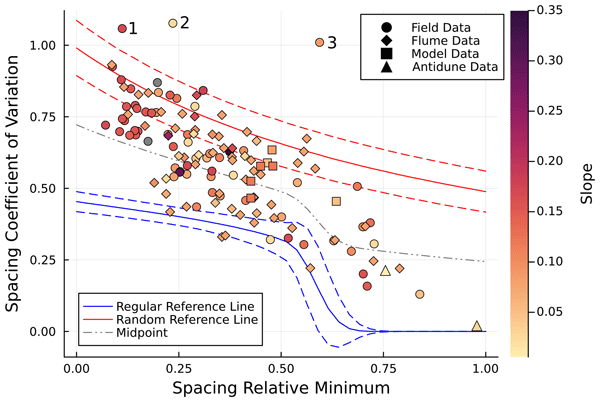
The expected spacing of step-pool sequences has long been mired in debate, hampering stream restoration efforts. We define a continuum to evaluate the degree of regularity and randomness across step-pools from field observations, flume experiments, and numerical simulations and show that the full range is occupied without one formation mechanism dominating. Bounds related to channel hydraulics provide a way to track dynamic step spacing without assuming a mechanism.
David Puhl, Jens M. Turowski, Christoff Andermann, Michael Dietze, Kristen L. Cook, Gen K. Li, and Basanta R. Adhikari
EGUsphere, https://doi.org/10.5194/egusphere-2026-4202, https://doi.org/10.5194/egusphere-2026-4202, 2026
Short summary
Short summary
Large earthquakes trigger widespread landslides that increase the amount of sediment delivered to rivers. We studied suspended sediment grain sizes in a major Himalayan river basin following the 2015 Gorkha Earthquake in Nepal. We found coarser suspended sediments near heavily affected areas during the first year after the earthquake, with the signal disappearing downstream. These findings improve our understanding of how far and for how long earthquakes influence river sediment transport.
Jun Zhang, Yong Li, Xiaojun Guo, Dongri Song, and Jens M. Turowski
EGUsphere, https://doi.org/10.5194/egusphere-2026-3226, https://doi.org/10.5194/egusphere-2026-3226, 2026
This preprint is open for discussion and under review for Natural Hazards and Earth System Sciences (NHESS).
Short summary
Short summary
Debris flows often move as multiple surges, like pulses of muddy water. Scientists have struggled to predict their overall behavior. By analyzing global data, we discovered hidden statistical laws governing how surges evolve and organize. We used these rules to build a computer model that recreates real surge sequences and predicts their size and frequency. This work provides a powerful new tool for assessing debris-flow hazards and improving early warning systems.
Fergus McNab, Taylor F. Schildgen, Jens M. Turowski, and Andrew D. Wickert
Earth Surf. Dynam., 13, 1059–1092, https://doi.org/10.5194/esurf-13-1059-2025, https://doi.org/10.5194/esurf-13-1059-2025, 2025
Short summary
Short summary
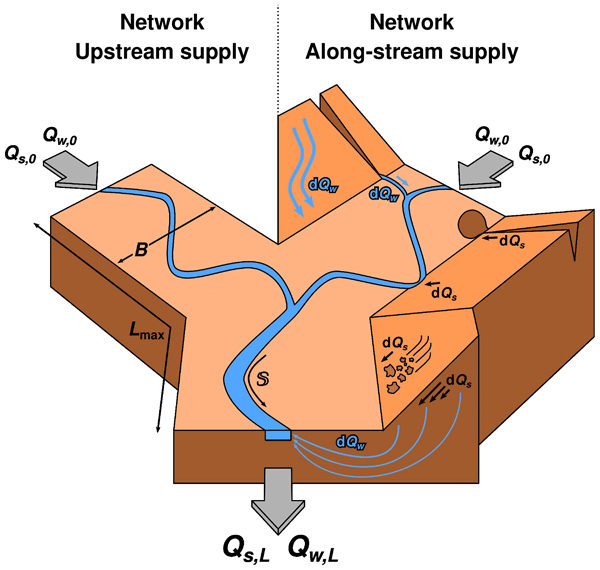
Alluvial rivers form networks, but many concepts we use to analyse their long-term evolution derive from models that treat them as single streams. We develop a model including tributary interactions and show that, while patterns of sediment output can be similar for network and single-segment models, complex signal propagation affects aggradation and incision within networks. We argue that understanding a specific catchment's evolution requires a model with its specific network structure.
Claire C. Masteller, Joel P. L. Johnson, Dieter Rickenmann, and Jens M. Turowski
Earth Surf. Dynam., 13, 593–605, https://doi.org/10.5194/esurf-13-593-2025, https://doi.org/10.5194/esurf-13-593-2025, 2025
Short summary
Short summary
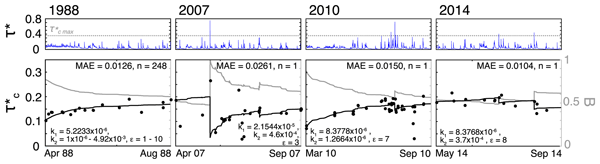
This paper presents a novel model that predicts how gravel riverbeds may evolve in response to differences in the frequency and severity of flood events. We test our model using a 23-year-long record of river flow and gravel transport from the Swiss Prealps. We find that our model reliably captures yearly patterns in gravel transport in this setting. Our new model is a major advance towards better predictions of river erosion that account for the flood history of a gravel-bed river.
Jens M. Turowski, Fergus McNab, Aaron Bufe, and Stefanie Tofelde
Earth Surf. Dynam., 13, 97–117, https://doi.org/10.5194/esurf-13-97-2025, https://doi.org/10.5194/esurf-13-97-2025, 2025
Short summary
Short summary
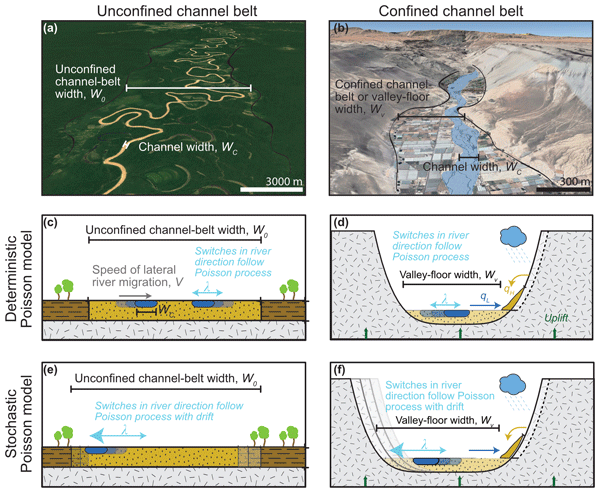
Channel belts comprise the area affected by a river due to lateral migration and floods. As a landform, they affect water resources and flood hazard, and they often host unique ecological communities. We develop a model describing the evolution of channel-belt area over time. The model connects the behaviour of the river to the evolution of the channel belt over a timescale of centuries. A comparison to selected data from experiments and real river systems verifies the random walk approach.
Sophia Dosch, Niels Hovius, Marisa Repasch, Joel Scheingross, Jens M. Turowski, Stefanie Tofelde, Oliver Rach, and Dirk Sachse
Earth Surf. Dynam., 12, 907–927, https://doi.org/10.5194/esurf-12-907-2024, https://doi.org/10.5194/esurf-12-907-2024, 2024
Short summary
Short summary
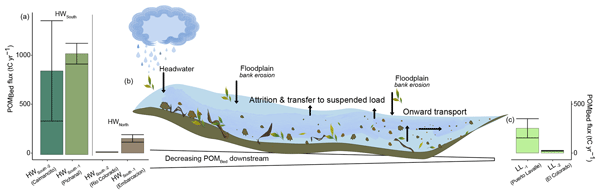
The transport of plant debris in rivers is an important part of the global carbon cycle and influences atmospheric carbon levels through time. We sampled plant debris at the bed of a lowland river and determined the sources as it is transported hundreds of kilometers. Plant debris can persist at the riverbed, but mechanical breakdown reduces its amount, and it is only a small fraction compared to the suspended load. This plant debris and transport patterns need further investigation globally.
Jens Martin Turowski, Aaron Bufe, and Stefanie Tofelde
Earth Surf. Dynam., 12, 493–514, https://doi.org/10.5194/esurf-12-493-2024, https://doi.org/10.5194/esurf-12-493-2024, 2024
Short summary
Short summary
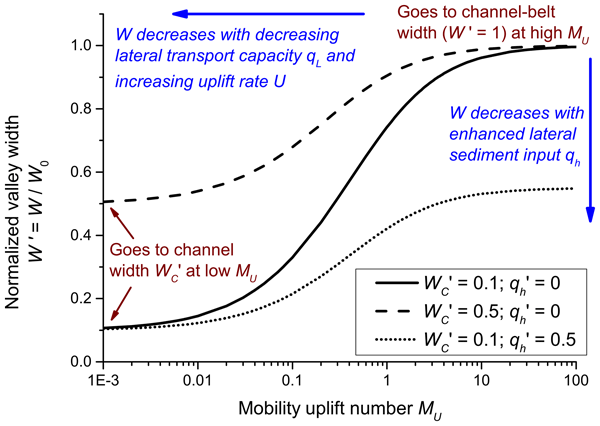
Fluvial valleys are ubiquitous landforms, and understanding their formation and evolution affects a wide range of disciplines from archaeology and geology to fish biology. Here, we develop a model to predict the width of fluvial valleys for a wide range of geographic conditions. In the model, fluvial valley width is controlled by the two competing factors of lateral channel mobility and uplift. The model complies with available data and yields a broad range of quantitative predictions.
Chuanqi He, Ci-Jian Yang, Jens M. Turowski, Richard F. Ott, Jean Braun, Hui Tang, Shadi Ghantous, Xiaoping Yuan, and Gaia Stucky de Quay
Earth Syst. Sci. Data, 16, 1151–1166, https://doi.org/10.5194/essd-16-1151-2024, https://doi.org/10.5194/essd-16-1151-2024, 2024
Short summary
Short summary
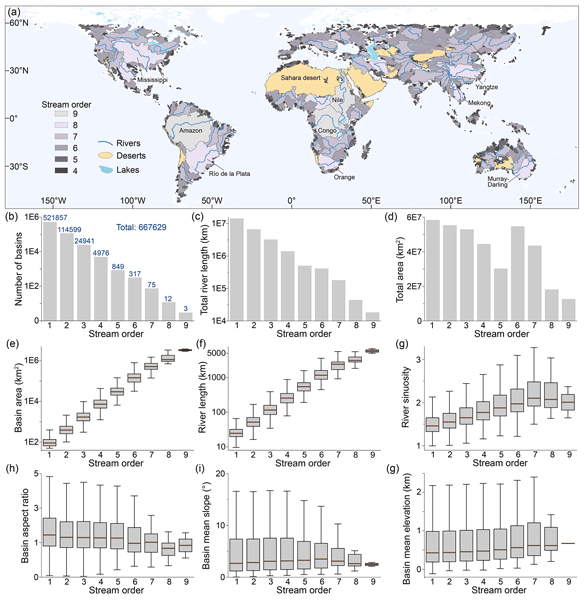
The shape of drainage basins and rivers holds significant implications for landscape evolution processes and dynamics. We used a global 90 m resolution topography to obtain ~0.7 million drainage basins with sizes over 50 km2. Our dataset contains the spatial distribution of drainage systems and their morphological parameters, supporting fields such as geomorphology, climatology, biology, ecology, hydrology, and natural hazards.
Sam Anderson, Nicole Gasparini, and Joel Johnson
Earth Surf. Dynam., 11, 995–1011, https://doi.org/10.5194/esurf-11-995-2023, https://doi.org/10.5194/esurf-11-995-2023, 2023
Short summary
Short summary
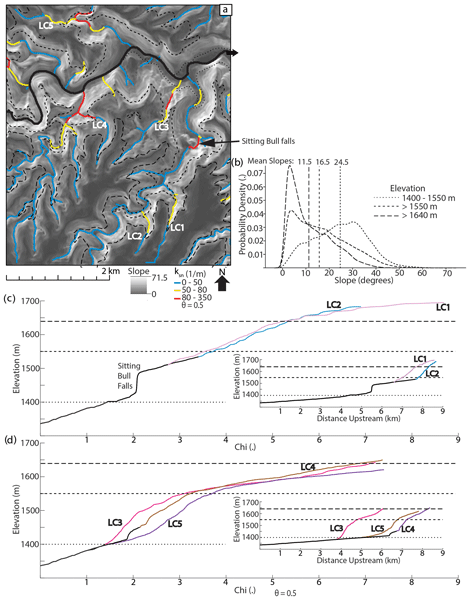
We measured rock strength and amount of fracturing in the two different rock types, sandstones and carbonates, in Last Chance Canyon, New Mexico, USA. Where there is more carbonate bedrock, hills and channels steepen in Last Chance Canyon. This is because the carbonate-type bedrock tends to be more thickly bedded, is less fractured, and is stronger. The carbonate bedrock produces larger boulders than the sandstone bedrock, which can protect the more fractured sandstone bedrock from erosion.
Jens M. Turowski, Gunnar Pruß, Anne Voigtländer, Andreas Ludwig, Angela Landgraf, Florian Kober, and Audrey Bonnelye
Earth Surf. Dynam., 11, 979–994, https://doi.org/10.5194/esurf-11-979-2023, https://doi.org/10.5194/esurf-11-979-2023, 2023
Short summary
Short summary
Rivers can cut into rocks, and their strength modulates the river's erosion rates. Yet, which properties of the rock control its response to erosive action is poorly understood. Here, we describe parallel experiments to measure rock erosion rates under fluvial impact erosion and the rock's geotechnical properties such as fracture strength, elasticity, and density. Erosion rates vary over a factor of a million between different rock types. We use the data to improve current theory.
Ci-Jian Yang, Pei-Hao Chen, Erica D. Erlanger, Jens M. Turowski, Sen Xu, Tse-Yang Teng, Jiun-Chuan Lin, and Jr-Chuang Huang
Earth Surf. Dynam., 11, 475–486, https://doi.org/10.5194/esurf-11-475-2023, https://doi.org/10.5194/esurf-11-475-2023, 2023
Short summary
Short summary
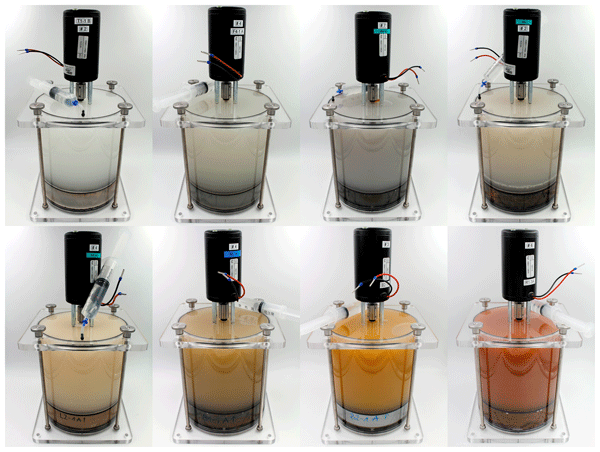
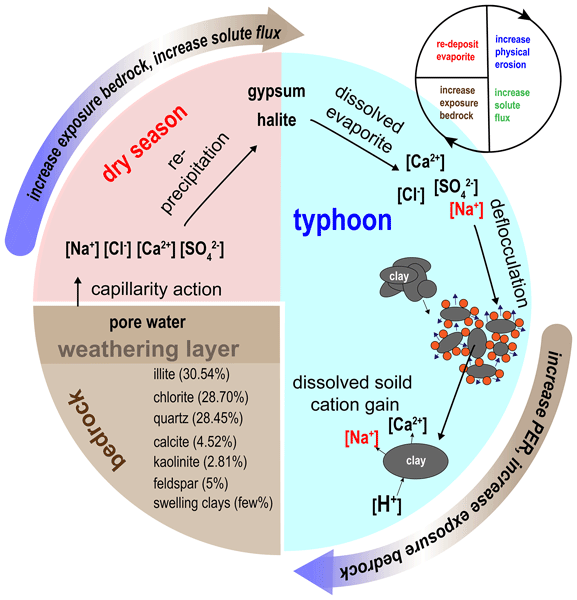
Observations of the interaction between extreme physical erosion and chemical weathering dynamics are limited. We presented major elements of stream water in the badland catchment at 3 h intervals during a 3 d typhoon. The excess sodium in the evaporite deposits causes material dispersion through deflocculation, which enhances the suspended sediment flux. Moreover, we observed a shift from predominantly evaporite weathering at peak precipitation to silicate weathering at peak discharge.
Cited articles
Al-Obaidi, K. and Valyrakis, M.: A Sensory Instrumented Particle for Environmental Monitoring Applications: Development and Calibration, IEEE Sens. J., 21, 10153–10166, https://doi.org/10.1109/JSEN.2021.3056041, 2021a.
Al-Obaidi, K. and Valyrakis, M.: Linking the explicit probability of entrainment of instrumented particles to flow hydrodynamics, Earth Surf. Proc. Land., 46, 2448–2465, https://doi.org/10.1002/esp.5188, 2021b.
Alhusban, Z. and Valyrakis, M.: Assessing and modelling the interactions of instrumented particles with bed surface at low transport conditions, Appl. Sci., 11, 7306, https://doi.org/10.3390/app11167306, 2021.
Ancey, C.: Bedload transport: a walk between randomness and determinism. Part 1. The state of the art, J. Hydraul. Res., 58, 1–17, https://doi.org/10.1080/00221686.2019.1702594, 2020.
Antoniazza, G., Dietze, M., Mancini, D., Turowski, J. M., Rickenmann, D., Nicollier, T., Boss, S., and Lane, S. N.: Anatomy of an alpine bedload transport event: a watershed-scale seismic-network perspective, J. Geophys. Res.-Earth, 128, e2022JF007000, https://doi.org/10.1029/2022JF007000, 2023.
Aureli, F., Maranzoni, A., Petaccia, G., and Soares-Frazão, S.: Review of experimental investigations of dam-break flows over fixed bottom, Water, 15, 1229, https://doi.org/10.3390/w15061229, 2023.
Bakker, M., Gimbert, F., Geay, T., Misset, C., Zanker, S., and Recking, A.: Field application and validation of a seismic bedload transport model, J. Geophys. Res.-Earth, 125, e2019JF005416, https://doi.org/10.1029/2019JF005416, 2020.
Beyreuther, M., Barsch, R., Krischer, L., Megies, T., Behr, Y., and Wassermann, J.: ObsPy: A Python toolbox for seismology, Seismol. Res. Lett., 81, 530–533, https://doi.org/10.1785/gssrl.81.3.530, 2010.
Bilek, S.: Bedload Monitoring – Israel component, EarthScope Data Center (IRISDMC) [data set], https://doi.org/10.7914/SN/1F_2019, 2019.
Burtin, A., Cattin, R., Bollinger, L., Vergne, J., Steer, P., Robert, A., Findling, N., and Tiberi, C.: Towards the hydrologic and bed load monitoring from high-frequency seismic noise in a braided river: The “torrent de St Pierre”, French Alps, J. Hydrol., 408, 43–53, https://doi.org/10.1016/j.jhydrol.2011.07.014, 2011.
Burtin, A., Hovius, N., and Turowski, J. M.: Seismic monitoring of torrential and fluvial processes, Earth Surf. Dynam., 4, 285–307, https://doi.org/10.5194/esurf-4-285-2016, 2016.
Castro-Orgaz, O. and Chanson, H.: Undular and broken surges in dam-break flows: a review of wave breaking strategies in a Boussinesq-type framework, Environ. Fluid. Mech., 20, 1383–1416, https://doi.org/10.1007/s10652-020-09749-3, 2020.
Chanson, H., Reungoat, D., Simon, B., and Lubin, P.: High-frequency turbulence and suspended sediment concentration measurements in the Garonne River tidal bore, Estuar. Coast. Shelf S., 95, 298–306, https://doi.org/10.1016/j.ecss.2011.09.012, 2011.
Chao, W.-A., Wu, Y.-M., Zhao, L., Tsai, V. C., and Chen, C.-H.: Seismologically determined bedload flux during the typhoon season, Sci. Rep., 5, 8261, https://doi.org/10.1038/srep08261, 2015.
Clague, J.: A review of catastrophic drainage of moraine-dammed lakes in British Columbia, Quaternary Sci. Rev., 19, 1763–1783, https://doi.org/10.1016/S0277-3791(00)00090-1, 2000.
Cohen, H., Laronne, J. B., and Reid, I.: Simplicity and complexity of bed load response during flash floods in a gravel bed ephemeral river: A 10 year field study, Water Resour. Res., 46, W11542, https://doi.org/10.1029/2010WR009160, 2010.
Cook, K. L. and Dietze, M.: Seismic advances in process geomorphology, Annu. Rev. Earth Planet. Sci., 50, 183–204, https://doi.org/10.1146/annurev-earth-032320-085133, 2022.
Cook, K. L., Andermann, C., Gimbert, F., Adhikari, B. R., and Hovius, N.: Glacial lake outburst floods as drivers of fluvial erosion in the Himalaya, Science, 362, 53–57, https://doi.org/10.1126/science.aat4981, 2018.
Dietze, M., Lagarde, S., Halfi, E., Laronne, J. B., and Turowski, J. M.: Joint sensing of bedload flux and water depth by seismic data inversion, Water Resour. Res., 55, 9892–9904, https://doi.org/10.1029/2019WR026072, 2019.
Halfi, E., Deshpande, V., Johnson, J. P. L., Katoshevski, D., Reid, I., Storz-Peretz, Y., and Laronne, J. B.: Characterization of bedload discharge in bores and very unsteady flows in an ephemeral channel, E3S Web Conf., 40, https://doi.org/10.1051/e3sconf/20184002036, 2018.
Halfi, E., Thappeta, S. K., Johnson, J. P. L., Reid, I., and Laronne, J. B.: Transient bedload transport during flashflood bores in a desert gravel-bed channel, Water Resour. Res., 59, e2022WR033754, https://doi.org/10.1029/2022WR033754, 2023.
Hsu, L., Finnegan, N. J., and Brodsky, E. E.: A seismic signature of river bedload transport during storm events, Geophys. Res. Lett., 38, L13407, https://doi.org/10.1029/2011GL047759, 2011.
Khezri, N. and Chanson, H.: Inception of bed load motion beneath a bore, Geomorphology, 153–154, 39–47, https://doi.org/10.1016/j.geomorph.2012.02.006, 2012.
Kihara, N., Niida, Y., Takabatake, D., Kaida, H., Shibayama, A., and Miyagawa, Y.: Large-scale experiments on tsunami-induced pressure on a vertical tide wall, Coast. Eng., 99, 46–63, https://doi.org/10.1016/j.coastaleng.2015.02.009, 2015.
Lagarde, S., Dietze, M., Gimbert, F., Laronne, J. B., Turowski, J. M., and Halfi, E.: Grain-size distribution and propagation effects on seismic signals generated by bedload transport, Water Resour. Res., 57, e2020WR028700, https://doi.org/10.1029/2020WR028700, 2021.
Lamb, M. P., Dietrich, W. E., and Venditti, J. G.: Is the critical Shields stress for incipient sediment motion dependent on channel-bed slope?, J. Geophys. Res.-Earth, 113, https://doi.org/10.1029/2007JF000831, 2008.
Lee, K. T., Liu, Y.-L., and Cheng, K.-H.: Experimental investigation of bedload transport processes under unsteady flow conditions, Hydrol. Process., 18, 2439–2454, https://doi.org/10.1002/hyp.1473, 2004.
Luong, L., Cadol, D., Bilek, S., McLaughlin, J. M., Laronne, J. B., and Turowski, J. M.: Seismic modeling of bedload transport in a gravel-bed alluvial channel, J. Geophys. Res.-Earth, 129, e2024JF007761, https://doi.org/10.1029/2024JF007761, 2024.
Fernandez Luque, R. and Van Beek, R.: Erosion and transport of bed-load sediment, J. Hydraul. Res., 14, 127–144, https://doi.org/10.1080/00221687609499677, 1976.
Maniatis, G.: On the use of IMU (inertial measurement unit) sensors in geomorphology, Earth Surf. Proc. Land., 46, 2136–2140, https://doi.org/10.1002/esp.5197, 2021.
Maniatis, G., Hoey, T., Hodge, R., Rickenmann, D., and Badoux, A.: Inertial drag and lift forces for coarse grains on rough alluvial beds measured using in-grain accelerometers, Earth Surf. Dynam., 8, 1067–1099, https://doi.org/10.5194/esurf-8-1067-2020, 2020.
Matthews, B., Naylor, M., Sinclair, H., Black, A., Williams, R., Cuthill, C., Gervais, M., Dietze, M., and Smith, A.: Sounding out the river: seismic and hydroacoustic monitoring of bedload transport, Earth Surf. Proc. Land., 49, 3840–3854, https://doi.org/10.1002/esp.5940, 2024.
Meirovich, L., Laronne, J. B., and Reid, I.: The variation of water-surface slope and its significance for bedload transport during floods in gravel-bed streams, J. Hydraul. Res., 36, 147–157, https://doi.org/10.1080/00221689809498630, 1998.
Meyer-Peter, E. and Müller, R.: Formulas for bed-load transport, in: IAHSR 2nd meeting, Stockholm, appendix 2, https://resolver.tudelft.nl/uuid:4fda9b61-be28-4703-ab06-43cdc2a21bd7 (17 September 2026), 1948.
Nativ, R., Turowski, J. M., Chang., J. M., Hovius, N., Yang, C. J., Chen, W. S., Chang, W. Y., and Laronne, J. B.: Stationary boulders increase river seismic frequency via turbulence, Geophys. Res. Lett., https://doi.org/10.1029/2024GL113784, 2025.
Nicollier, T., Antoniazza, G., Ammann, L., Rickenmann, D., and Kirchner, J. W.: Toward a general calibration of the Swiss plate geophone system for fractional bedload transport, Earth Surf. Dynam., 10, 929–951, https://doi.org/10.5194/esurf-10-929-2022, 2022.
Olinde, L. and Johnson, J. P. L.: Using RFID and accelerometer-embedded tracers to measure probabilities of bed load transport, step lengths, and rest times in a mountain stream, Water Resour. Res., 51, 7572–7589, https://doi.org/10.1002/2014WR016120, 2015.
Parker, G., Dhamotharan, S., and Stefan, H.: Model experiments on mobile, paved gravel bed streams, Water Resour. Res., 18, 1395–1408, https://doi.org/10.1029/WR018i005p01395, 1982.
Pretzlav, K. L. G., Johnson, J. P. L., and Bradley, D. N.: Smartrock transport in a mountain stream: bedload hysteresis and changing thresholds of motion, Water Resour. Res., 56, e2020WR028150, https://doi.org/10.1029/2020WR028150, 2020.
Pretzlav, K. L. G., Johnson, J. P. L., and Bradley, D. N.: Smartrock transport from seconds to seasons: shear stress controls on gravel diffusion inferred from hop and rest scaling, Geophys. Res. Lett., 48, e2020GL091991, https://doi.org/10.1029/2020GL091991, 2021.
Roth, D. L., Finnegan, N. J., Brodsky, E. E., Cook, K. L., Stark, C. P., and Wang, H. W.: Migration of a coarse fluvial sediment pulse detected by hysteresis in bedload generated seismic waves, Earth Planet. Sc. Lett., 404, 144–153, https://doi.org/10.1016/j.epsl.2014.07.019, 2014.
Roth, D. L., Brodsky, E. E., Finnegan, N. J., Rickenmann, D., Turowski, J. M., and Badoux, A.: Bed load sediment transport inferred from seismic signals near a river, J. Geophys. Res.-Earth, 121, 725–747, https://doi.org/10.1002/2015JF003782, 2016.
Schmandt, B., Gaeuman, D., Stewart, R., Hansen, S. M., Tsai, V. C., and Smith, J.: Seismic array constraints on reach-scale bedload transport, Geology, 45, 299–302, https://doi.org/10.1130/G38639.1, 2017.
Shafiei, S., Melville, B. W., and Shamseldin, A. Y.: Experimental investigation of tsunami bore impact force and pressure on a square prism, Coast. Eng., 110, 1–16, https://doi.org/10.1016/j.coastaleng.2015.12.006, 2016.
Sky, M. and Chaudhry, M. H.: Dam-break flows in curved channel, J. Hydraul. Eng., 115, 1465–1478, https://doi.org/10.1061/(ASCE)0733-9429(1989)115:11(1465), 1989.
Stark, K., Cadol, D., Varyu, D., and Laronne, J. B.: Direct, continuous measurements of ultra-high sediment fluxes in a sandy gravel-bed ephemeral river, Geomorphology, 382, 107682, https://doi.org/10.1016/j.geomorph.2021.107682, 2021.
Sumer, B. M., Chua, L. H. C., Cheng, N. S., and Fredsøe, J.: Influence of turbulence on bed load sediment transport, J. Hydraul. Eng., 129, 585–596, https://doi.org/10.1061/(ASCE)0733-9429(2003)129:8(585), 2003.
Thappeta, S. K., Johnson, J. P. L., Halfi, E., Storz-Peretz, Y., and Laronne, J. B.: Bed shear stress in experimental flash flood bores over dry beds and over flowing water: A comparison of methods, J. Hydraul. Eng., 149, 4023001, https://doi.org/10.1061/JHEND8.HYENG-13029, 2023.
Tsai, V. C., Minchew, B., Lamb, M. P., and Ampuero, J.-P.: A physical model for seismic noise generation from sediment transport in rivers, Geophys. Res. Lett., 39, L02404, https://doi.org/10.1029/2011GL050255, 2012.
Wang, P., Yuan, J., Wang, M., and Wang, M.: Sediment vibration characteristics based on accelerometer measurements, Sci. Rep., 13, 1205, https://doi.org/10.1038/s41598-023-28209-8, 2023.
Welch, P.: The use of fast Fourier transform for the estimation of power spectra: A method based on time averaging over short, modified periodograms, IEEE Trans. Audio Electroacoust., 15, 70–73, https://doi.org/10.1109/TAU.1967.1161901, 1967.
Wilcock, P. and Crowe., J.: Surface-based transport model for mixed-size sediment, J. Hydraul. Eng., 129, 120–128, https://doi.org/10.1061/(ASCE)0733-9429(2003)129:2(120), 2003.
Short summary
Water level suddenly rises during flash floods in dry regions having a distinct impact on bedload – large sediment rolling and saltating on the riverbed. Using sensor-equipped pebbles and seismic monitoring in a field setting, we demonstrate that bedload activity is very high in both shallow and deep sudden flows. These findings can help improve bedload transport models, particularly when using seismic sensors, by providing new insights into bedload dynamics.
Water level suddenly rises during flash floods in dry regions having a distinct impact on...