Articles | Volume 13, issue 4
https://doi.org/10.5194/esurf-13-607-2025
© Author(s) 2025. This work is distributed under
the Creative Commons Attribution 4.0 License.
https://doi.org/10.5194/esurf-13-607-2025
© Author(s) 2025. This work is distributed under
the Creative Commons Attribution 4.0 License.
Surface grain-size mapping of braided channels from SfM photogrammetry

Université Grenoble Alpes, INRAE, CNRS, IRD, Grenoble INP, IGE, 38000 Grenoble, France
Frédéric Liébault
Université Grenoble Alpes, INRAE, CNRS, IRD, Grenoble INP, IGE, 38000 Grenoble, France
Laurent Borgniet
Université Grenoble Alpes, INRAE, LESSEM, 38000 Grenoble, France
Michaël Deschâtres
Université Grenoble Alpes, INRAE, CNRS, IRD, Grenoble INP, IGE, 38000 Grenoble, France
Gabriel Melun
Office Français de la Biodiversité, 94080 Vincennes, France
Related authors
No articles found.
Jean Emmanuel Sicart, Victor Ramseyer, Ghislain Picard, Laurent Arnaud, Catherine Coulaud, Guilhem Freche, Damien Soubeyrand, Yves Lejeune, Marie Dumont, Isabelle Gouttevin, Erwan Le Gac, Frédéric Berger, Jean-Matthieu Monnet, Laurent Borgniet, Éric Mermin, Nick Rutter, Clare Webster, and Richard Essery
Earth Syst. Sci. Data, 15, 5121–5133, https://doi.org/10.5194/essd-15-5121-2023, https://doi.org/10.5194/essd-15-5121-2023, 2023
Short summary
Short summary
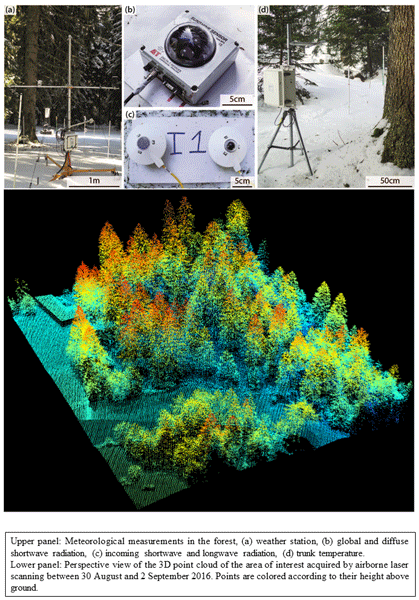
Forests strongly modify the accumulation, metamorphism and melting of snow in midlatitude and high-latitude regions. Two field campaigns during the winters 2016–17 and 2017–18 were conducted in a coniferous forest in the French Alps to study interactions between snow and vegetation. This paper presents the field site, instrumentation and collection methods. The observations include forest characteristics, meteorology, snow cover and snow interception by the canopy during precipitation events.
Sebastien Klotz, Caroline Le Bouteiller, Nicolle Mathys, Firmin Fontaine, Xavier Ravanat, Jean-Emmanuel Olivier, Frédéric Liébault, Hugo Jantzi, Patrick Coulmeau, Didier Richard, Jean-Pierre Cambon, and Maurice Meunier
Earth Syst. Sci. Data, 15, 4371–4388, https://doi.org/10.5194/essd-15-4371-2023, https://doi.org/10.5194/essd-15-4371-2023, 2023
Short summary
Short summary
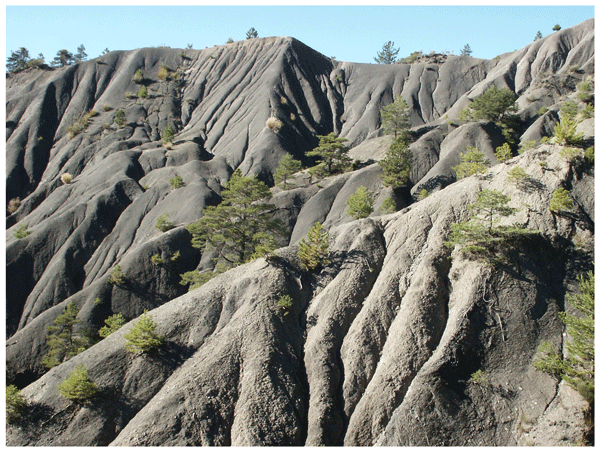
Mountain badlands are places of intense erosion. They deliver large amounts of sediment to river systems, with consequences for hydropower sustainability, habitat quality and biodiversity, and flood hazard and river management. Draix-Bleone Observatory was created in 1983 to understand and quantify sediment delivery from such badland areas. Our paper describes how water and sediment fluxes have been monitored for almost 40 years in the small mountain catchments of this observatory.
Cécile Duvillier, Nicolas Eckert, Guillaume Evin, and Michael Deschâtres
Nat. Hazards Earth Syst. Sci., 23, 1383–1408, https://doi.org/10.5194/nhess-23-1383-2023, https://doi.org/10.5194/nhess-23-1383-2023, 2023
Short summary
Short summary
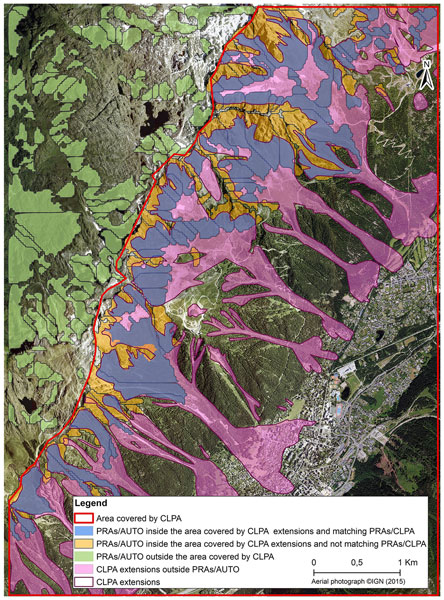
This study develops a method that identifies individual potential release areas (PRAs) of snow avalanches based on terrain analysis and watershed delineation and demonstrates its efficiency in the French Alps context using an extensive cadastre of past avalanche limits. Results may contribute to better understanding local avalanche hazard. The work may also foster the development of more efficient PRA detection methods based on a rigorous evaluation scheme.
Suzanne Lapillonne, Firmin Fontaine, Frédéric Liebault, Vincent Richefeu, and Guillaume Piton
Nat. Hazards Earth Syst. Sci., 23, 1241–1256, https://doi.org/10.5194/nhess-23-1241-2023, https://doi.org/10.5194/nhess-23-1241-2023, 2023
Short summary
Short summary
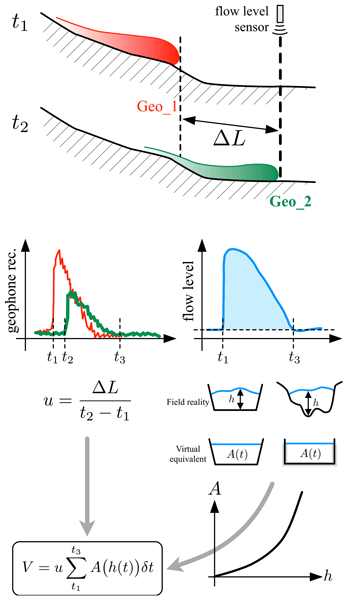
Debris flows are fast flows most often found in torrential watersheds. They are composed of two phases: a liquid phase which can be mud-like and a granular phase, including large boulders, transported along with the flow. Due to their destructive nature, accessing features of the flow, such as velocity and flow height, is difficult. We present a protocol to analyse debris flow data and results of the Réal torrent in France. These results will help experts in designing models.
Hippolyte Kern, Nicolas Eckert, Vincent Jomelli, Delphine Grancher, Michael Deschatres, and Gilles Arnaud-Fassetta
The Cryosphere, 15, 4845–4852, https://doi.org/10.5194/tc-15-4845-2021, https://doi.org/10.5194/tc-15-4845-2021, 2021
Short summary
Short summary
Snow avalanches are a major component of the mountain cryosphere that often put people, settlements, and infrastructures at risk. This study investigated avalanche path morphological factors controlling snow deposit volumes, a critical aspect of snow avalanche dynamics that remains poorly known. Different statistical techniques show a slight but significant link between deposit volumes and avalanche path morphology.
Cited articles
Adams, J.: Gravel Size Analysis from Photographs, J. Hydraul. Div., 105, 1247–1255, https://doi.org/10.1061/JYCEAJ.0005283, 1979.
Ashmore, P.: 9.17 Morphology and Dynamics of Braided Rivers, in: Treatise on Geomorphology, edited by: Shroder, J. F. and Wohl, E., Elsevier, 289–312, https://doi.org/10.1016/B978-0-12-374739-6.00242-6, 2013.
Ashmore, P. E.: Laboratory modelling of gravel braided stream morphology, Earth Surf. Proc. Land., 7, 201–225, https://doi.org/10.1002/esp.3290070301, 1982.
Barnard, P. L., Rubin, D. M., Harney, J., and Mustain, N.: Field test comparison of an autocorrelation technique for determining grain size using a digital 'beachball' camera versus traditional methods, Sediment. Geol., 201, 180–195, https://doi.org/10.1016/j.sedgeo.2007.05.016, 2007.
Bluck, B. J.: 18.–Sedimentation in some Scottish Rivers of Low Sinuosity, Earth Env. Sci. T. R. So., 69, 425–456, https://doi.org/10.1017/S0080456800015416, 1976.
Bluck, B. J.: Structure of coarse grained braided stream alluvium, Earth Env. Sci. T. R. So., 70, 181–221, https://doi.org/10.1017/S0080456800012795, 1979.
Brasington, J., Vericat, D., and Rychkov, I.: Modeling river bed morphology, roughness, and surface sedimentology using high resolution terrestrial laser scanning, Water Resour. Res., 48, W11519, https://doi.org/10.1029/2012WR012223, 2012.
Bunte, K. and Abt, S. R.: Sampling surface and subsurface particle-size distributions in wadable gravel-and cobble-bed streams for analyses in sediment transport, hydraulics, and streambed monitoring, U. S. Department of Agriculture, Forest Service, Rocky Mountain Research Station, Ft. Collins, CO, https://doi.org/10.2737/RMRS-GTR-74, 2001.
Buscombe, D.: Transferable wavelet method for grain-size distribution from images of sediment surfaces and thin sections, and other natural granular patterns, Sedimentology, 60, 1709–1732, https://doi.org/10.1111/sed.12049, 2013.
Buscombe, D.: SediNet: a configurable deep learning model for mixed qualitative and quantitative optical granulometry, Earth Surf. Proc. Land., 45, 638–651, https://doi.org/10.1002/esp.4760, 2020.
Carbonneau, P. E., Lane, S. N., and Bergeron, N. E.: Catchment-scale mapping of surface grain size in gravel bed rivers using airborne digital imagery, Water Resour. Res., 40, W07202, https://doi.org/10.1029/2003WR002759, 2004.
Carbonneau, P. E., Bergeron, N., and Lane, S. N.: Automated grain size measurements from airborne remote sensing for long profile measurements of fluvial grain sizes:, Water Resour. Res., 41, W11426, https://doi.org/10.1029/2005WR003994, 2005.
Carbonneau, P. E., Bizzi, S., and Marchetti, G.: Robotic photosieving from low-cost multirotor sUAS: a proof-of-concept: Robotic photosieving, Earth Surf. Proc. Land., 43, 1160–1166, https://doi.org/10.1002/esp.4298, 2018.
Chardon, V., Schmitt, L., Piégay, H., and Lague, D.: Use of terrestrial photosieving and airborne topographic LiDAR to assess bed grain size in large rivers: a study on the Rhine River, Earth Surf. Proc. Land., 45, 2314–2330, https://doi.org/10.1002/esp.4882, 2020.
Chardon, V., Piasny, G., and Schmitt, L.: Comparison of software accuracy to estimate the bed grain size distribution from digital images: A test performed along the Rhine River, River Res. Appl., 38, 358–367, https://doi.org/10.1002/rra.3910, 2022.
Chudley, T. R., Christoffersen, P., Doyle, S. H., Abellan, A., and Snooke, N.: High-accuracy UAV photogrammetry of ice sheet dynamics with no ground control, The Cryosphere, 13, 955–968, https://doi.org/10.5194/tc-13-955-2019, 2019.
CLEDA: Rapport d'évènements provisoire des crues d'automne 2023, Communauté Locale de l'Eau du Drac Amont, Saint-Bonnet-en-Champsaur, 2023.
CloudCompare: User manual, EDF R&D, 2021.
Detert, M. and Weitbrecht, V.: Automatic object detection to analyze the geometry of gravel grains – a free stand-alone tool, River Flow 2012, edited by: Muños, R. M., Taylor & Francis Group, London, 595–600, ISBN 978-0-415-62129-8, 2012.
Díaz Gómez, R., Pasternack, G. B., Guillon, H., Byrne, C. F., Schwindt, S., Larrieu, K. G., and Solis, S. S.: Mapping subaerial sand-gravel-cobble fluvial sediment facies using airborne lidar and machine learning, Geomorphology, 401, 108106, https://doi.org/10.1016/j.geomorph.2021.108106, 2022.
Dufour, S., Barsoum, N., Muller, E., and Piégay, H.: Effects of channel confinement on pioneer woody vegetation structure, composition and diversity along the River Drôme (SE France), Earth Surf. Proc. Land., 32, 1244–1256, https://doi.org/10.1002/esp.1556, 2007.
Dugdale, S. J., Carbonneau, P. E., and Campbell, D.: Aerial photosieving of exposed gravel bars for the rapid calibration of airborne grain size maps, Earth Surf. Proc. Land., 35, 627–639, https://doi.org/10.1002/esp.1936, 2010.
Eaton, B. C., Moore, R. D., and MacKenzie, L. G.: Percentile-based grain size distribution analysis tools (GSDtools) – estimating confidence limits and hypothesis tests for comparing two samples, Earth Surf. Dynam., 7, 789–806, https://doi.org/10.5194/esurf-7-789-2019, 2019.
Eltner, A., Kaiser, A., Castillo, C., Rock, G., Neugirg, F., and Abellán, A.: Image-based surface reconstruction in geomorphometry – merits, limits and developments, Earth Surf. Dynam., 4, 359–389, https://doi.org/10.5194/esurf-4-359-2016, 2016.
Gardner, T., Ashmore, P., and Leduc, P.: Morpho-sedimentary characteristics of proximal gravel braided river deposits in a Froude-scaled physical model, Sedimentology, 65, 877–896, https://doi.org/10.1111/sed.12409, 2018.
Graham, D. J., Rice, S. P., and Reid, I.: A transferable method for the automated grain sizing of river gravels, Water Resour. Res., 41, 2004WR003868, https://doi.org/10.1029/2004WR003868, 2005a.
Graham, D. J., Reid, I., and Rice, S. P.: Automated Sizing of Coarse-Grained Sediments: Image-Processing Procedures, Math. Geol., 37, 1–28, https://doi.org/10.1007/s11004-005-8745-x, 2005b.
Gray, D. and Harding, J. S.: Braided river ecology, A literature review of physical habitats and aquatic invertebrate communities. New Zealand Department of Conservation, Science for Conservation 279, Wellington NZ, 50 pp., 2007.
Grayson, B., Penna, N. T., Mills, J. P., and Grant, D. S.: GPS precise point positioning for UAV photogrammetry, Photogramm. Rec., 33, 427–447, https://doi.org/10.1111/phor.12259, 2018.
Guerit, L., Barrier, L., Narteau, C., Métivier, F., Liu, Y., Lajeunesse, E., Gayer, E., Meunier, P., Malverti, L., and Ye, B.: The Grain-size Patchiness of Braided Gravel-Bed Streams – example of the Urumqi River (northeast Tian Shan, China), Adv. Geosci., 37, 27–39, https://doi.org/10.5194/adgeo-37-27-2014, 2014.
Heritage, G. L. and Milan, D. J.: Terrestrial Laser Scanning of grain roughness in a gravel-bed river, Geomorphology, 113, 4–11, https://doi.org/10.1016/j.geomorph.2009.03.021, 2009.
Hodge, R., Brasington, J., and Richards, K.: Analysing laser-scanned digital terrain models of gravel bed surfaces: linking morphology to sediment transport processes and hydraulics, Sedimentology, 56, 2024–2043, https://doi.org/10.1111/j.1365-3091.2009.01068.x, 2009.
Hugenholtz, C., Brown, O., Walker, J., Barchyn, T., Nesbit, P., Kucharczyk, M., and Myshak, S.: Spatial Accuracy of UAV-Derived Orthoimagery and Topography: Comparing Photogrammetric Models Processed with Direct Geo-Referencing and Ground Control Points, GEOMATICA, 70, 21–30, https://doi.org/10.5623/cig2016-102, 2016.
James, M. R. and Robson, S.: Straightforward reconstruction of 3D surfaces and topography with a camera: Accuracy and geoscience application, J. Geophys. Res.-Earth, 117, F03017, https://doi.org/10.1029/2011JF002289, 2012.
James, M. R., Antoniazza, G., Robson, S., and Lane, S. N.: Mitigating systematic error in topographic models for geomorphic change detection: accuracy, precision and considerations beyond off-nadir imagery, Earth Surf. Proc. Land., 45, 2251–2271, https://doi.org/10.1002/esp.4878, 2020.
Lang, N., Irniger, A., Rozniak, A., Hunziker, R., Wegner, J. D., and Schindler, K.: GRAINet: mapping grain size distributions in river beds from UAV images with convolutional neural networks, Hydrol. Earth Syst. Sci., 25, 2567–2597, https://doi.org/10.5194/hess-25-2567-2021, 2021.
Levenson, E. S. and Fonstad, M. A.: Characterizing coarse sediment grain size variability along the upper Sandy River, Oregon, via UAV remote sensing, Geomorphology, 417, 108447, https://doi.org/10.1016/j.geomorph.2022.108447, 2022.
Liébault, F., Lallias-Tacon, S., Cassel, M., and Talaska, N.: Long profile responses of alpine braided rivers in SE France, River Res. Appl., 29, 1253–1266, https://doi.org/10.1002/rra.2615, 2013.
Lisle, T. E. and Madej, M. A.: Spatial Variation in Armouring in a Channel with High Sediment Supply, in: Dynamics of gravel-bed rivers, edited by: Billi, P., Hey, R. D., Thorne, C. R., and Tacconi, P., John Wiley and Sons, Chichester, London, 277–293, ISBN 047192976X, 9780471929765, 1993.
Mair, D., Do Prado, A. H., Garefalakis, P., Lechmann, A., Whittaker, A., and Schlunegger, F.: Grain size of fluvial gravel bars from close-range UAV imagery – uncertainty in segmentation-based data, Earth Surf. Dynam., 10, 953–973, https://doi.org/10.5194/esurf-10-953-2022, 2022.
Miall, A. D.: The geology of fluvial deposits: sedimentary facies, basin analysis, and petroleum geology, 4th corr. printing., Springer, Berlin Heidelberg, 582 pp., ISBN 978-3-540-59186-3 978-0-387-59186-5, 2006.
Mosley, M. P. and Tindale, D. S.: Sediment variability and bed material sampling in gravel-bed rivers, Earth Surf. Proc. Land., 10, 465–482, https://doi.org/10.1002/esp.3290100506, 1985.
Muggeo, V. M. R.: segmented: An R package to Fit Regression Models with Broken-Line Relationships, R NEWS, 8, 20–25, 2008.
Neverman, A. J., Fuller, I. C., Procter, J. N., and Death, R. G.: Terrestrial laser scanning and structure-from-motion photogrammetry concordance analysis for describing the surface layer of gravel beds, Prog. Phys. Geogr. Earth Environ., 43, 260–281, https://doi.org/10.1177/0309133318822966, 2019.
Núñez-Andrés, M., Prades, A., and Buill, F.: Vegetation Filtering using Colour for Monitoring Applications from Photogrammetric Data, in: Proceedings of the 7th International Conference on Geographical Information Systems Theory, Applications and Management, 2021, Online Streaming, 98–104, https://doi.org/10.5220/0010523300980104, 2021.
Over, J.-S., Ritchie, A., Kranenburg, C., Brown, J., Buscombe, D., Noble, T., Sherwood, C., Warrick, J., and Wernette, P.: Processing Coastal Imagery With Agisoft Metashape Professional Edition, Version 1.6 – Structure From Motion Workflow Documentation, USGS, 2021.
Pearson, E., Smith, M. W., Klaar, M. J., and Brown, L. E.: Can high resolution 3D topographic surveys provide reliable grain size estimates in gravel bed rivers?, Geomorphology, 293, 143–155, https://doi.org/10.1016/j.geomorph.2017.05.015, 2017.
Piégay, H., Alber, A., Slater, L., and Bourdin, L.: Census and typology of braided rivers in the French Alps, Aquat. Sci., 71, 371–388, https://doi.org/10.1007/s00027-009-9220-4, 2009.
Piégay, H., Arnaud, F., Belletti, B., Bertrand, M., Bizzi, S., Carbonneau, P., Dufour, S., Liébault, F., Ruiz-Villanueva, V., and Slater, L.: Remotely sensed rivers in the Anthropocene: state of the art and prospects, Earth Surf. Proc. Land., 45, 157–188, https://doi.org/10.1002/esp.4787, 2020.
Quenouille, M. H.: Notes on Bias in Estimation, Biometrika, 43, 353, https://doi.org/10.2307/2332914, 1956.
Reid, H. E., Williams, R. D., Brierley, G. J., Coleman, S. E., Lamb, R., Rennie, C. D., and Tancock, M. J.: Geomorphological effectiveness of floods to rework gravel bars: Insight from hyperscale topography and hydraulic modelling, Earth Surf. Proc. Land., 44, 595–613, https://doi.org/10.1002/esp.4521, 2019.
Rice, S. P. and Church, M.: Grain-size sorting within river bars in relation to downstream fining along a wandering channel: Scales of variability in river grain size, Sedimentology, 57, 232–251, https://doi.org/10.1111/j.1365-3091.2009.01108.x, 2010.
Rychkov, I., Brasington, J., and Vericat, D.: Computational and methodological aspects of terrestrial surface analysis based on point clouds, Comput. Geosci., 42, 64–70, https://doi.org/10.1016/j.cageo.2012.02.011, 2012.
Storz-Peretz, Y. and Laronne, J. B.: Morphotextural characterization of dryland braided channels, Geol. Soc. Am. Bull., 125, 1599–1617, https://doi.org/10.1130/B30773.1, 2013.
Storz-Peretz, Y., Laronne, J. B., Surian, N., and Lucía, A.: Flow recession as a driver of the morpho-texture of braided streams: Flow Recession as a Driver to the Morpho-Texture of Braided Streams, Earth Surf. Proc. Land., 41, 754–770, https://doi.org/10.1002/esp.3861, 2016.
Stott, E., Williams, R. D., and Hoey, T. B.: Ground Control Point Distribution for Accurate Kilometre-Scale Topographic Mapping Using an RTK-GNSS Unmanned Aerial Vehicle and SfM Photogrammetry, Drones, 4, 55, https://doi.org/10.3390/drones4030055, 2020.
Tamminga, A., Hugenholtz, C., Eaton, B., and Lapointe, M.: Hyperspatial Remote Sensing of Channel Reach Morphology and Hydraulic Fish Habitat Using an Unmanned Aerial Vehicle (UAV): A First Assessment in the Context of River Research and Management, River Res. Appl., 31, 379–391, https://doi.org/10.1002/rra.2743, 2015.
Tockner, K., Ward, J. V., Arscott, D. B., Edwards, P. J., Kollmann, J., Gurnell, A. M., Petts, G. E., and Maiolini, B.: The Tagliamento River: A model ecosystem of European importance, Aquat. Sci., 65, 239–253, https://doi.org/10.1007/s00027-003-0699-9, 2003.
Vázquez-Tarrío, D., Borgniet, L., Liébault, F., and Recking, A.: Using UAS optical imagery and SfM photogrammetry to characterize the surface grain size of gravel bars in a braided river (Vénéon River, French Alps), Geomorphology, 285, 94–105, https://doi.org/10.1016/j.geomorph.2017.01.039, 2017.
Verdú, J. M., Batalla, R. J., and Martínez-Casasnovas, J. A.: High-resolution grain-size characterisation of gravel bars using imagery analysis and geo-statistics, Geomorphology, 72, 73–93, https://doi.org/10.1016/j.geomorph.2005.04.015, 2005.
Ward, J. V., Tockner, K., Edwards, P. J., Kollmann, J., Bretschko, G., Gurnell, A. M., Petts, G. E., and Rossaro, B.: A reference river system for the Alps: the `Fiume Tagliamento', Regul. River., 15, 63–75, https://doi.org/10.1002/(SICI)1099-1646(199901/06)15:1/3<63::AID-RRR538>3.0.CO;2-F, 1999.
Wentworth, C. K.: A Scale of Grade and Class Terms for Clastic Sediments, J. Geol., 30, 377–392, https://doi.org/10.1086/622910, 1922.
Westoby, M. J., Brasington, J., Glasser, N. F., Hambrey, M. J., and Reynolds, J. M.: `Structure-from-Motion' photogrammetry: A low-cost, effective tool for geoscience applications, Geomorphology, 179, 300–314, https://doi.org/10.1016/j.geomorph.2012.08.021, 2012.
Westoby, M. J., Dunning, S. A., Woodward, J., Hein, A. S., Marrero, S. M., Winter, K., and Sugden, D. E.: Sedimentological characterization of Antarctic moraines using UAVs and Structure-from-Motion photogrammetry, J. Glaciol., 61, 1088–1102, https://doi.org/10.3189/2015JoG15J086, 2015.
Williams, R. D., Lamy, M., Maniatis, G., and Stott, E.: Three-dimensional reconstruction of fluvial surface sedimentology and topography using personal mobile laser scanning, Earth Surf. Proc. Land., 45, 251–261, https://doi.org/10.1002/esp.4747, 2020.
Woebbecke, D. M., Meyer, G. E., Von Bargen, K. , and Mortensen, D. A.: Color Indices for Weed Identification Under Various Soil, Residue, and Lighting Conditions, T. ASAE, 38, 259–269, https://doi.org/10.13031/2013.27838, 1995.
Wolman, M. G.: A method of sampling coarse river-bed material, T. Am. Geophys. Un., 35, 951, https://doi.org/10.1029/TR035i006p00951, 1954.
Wong, T., Khanal, S., Zhao, K., and Lyon, S. W.: Grain size estimation in fluvial gravel bars using uncrewed aerial vehicles: A comparison between methods based on imagery and topography, Earth Surf. Proc. Land., 49, esp.5709, https://doi.org/10.1002/esp.5709, 2024.
Woodget, A. S. and Austrums, R.: Subaerial gravel size measurement using topographic data derived from a UAV-SfM approach: Subaerial gravel size measurement using topographic UAV-SfM data, Earth Surf. Proc. Land., 42, 1434–1443, https://doi.org/10.1002/esp.4139, 2017.
Woodget, A. S., Fyffe, C., and Carbonneau, P. E.: From manned to unmanned aircraft: Adapting airborne particle size mapping methodologies to the characteristics of sUAS and SfM, Earth Surf. Proc. Land., 43, 857–870, https://doi.org/10.1002/esp.4285, 2018.
Short summary
This work presents a protocol and a model to obtain the sizes of the pebbles in mountain rivers from uncrewed aerial vehicle images. A total of 12 rivers located in southeastern France were photographed to build the model. The results show that the model has little error and should be usable for similar rivers. The grain size of mountain rivers is an important parameter for environmental diagnostics by mapping the aquatic habitats and for flood management by estimating the pebble fluxes during floods.
This work presents a protocol and a model to obtain the sizes of the pebbles in mountain rivers...