
Articles | Volume 14, issue 1
https://doi.org/10.5194/esurf-14-33-2026
© Author(s) 2026. This work is distributed under
the Creative Commons Attribution 4.0 License.
the Creative Commons Attribution 4.0 License.
https://doi.org/10.5194/esurf-14-33-2026
© Author(s) 2026. This work is distributed under
the Creative Commons Attribution 4.0 License.
the Creative Commons Attribution 4.0 License.
Research article
| 
13 Jan 2026
Research article |
| 13 Jan 2026
| 13 Jan 2026
Quantifying erosion in a pre-Alpine catchment at high resolution with concentrations of cosmogenic 10Be, 26Al, and 14C

Institute of Geology, University of Bern, Bern, 3012, Switzerland
Swiss Federal Research Institute WSL, Birmensdorf, 8903, Switzerland
David Mair
Institute of Geology, University of Bern, Bern, 3012, Switzerland
Naki Akçar
Institute of Geology, University of Bern, Bern, 3012, Switzerland
Marcus Christl
Laboratory of Ion Beam Physics, ETH Zurich, Zürich, 8093, Switzerland
Negar Haghipour
Laboratory of Ion Beam Physics, ETH Zurich, Zürich, 8093, Switzerland
Christof Vockenhuber
Laboratory of Ion Beam Physics, ETH Zurich, Zürich, 8093, Switzerland
Philip Gautschi
Laboratory of Ion Beam Physics, ETH Zurich, Zürich, 8093, Switzerland
Brian McArdell
Swiss Federal Research Institute WSL, Birmensdorf, 8903, Switzerland
Fritz Schlunegger
Institute of Geology, University of Bern, Bern, 3012, Switzerland
Related authors
Ariel Henrique do Prado, David Mair, Philippos Garefalakis, Chantal Schmidt, Alexander Whittaker, Sebastien Castelltort, and Fritz Schlunegger
Hydrol. Earth Syst. Sci., 28, 1173–1190, https://doi.org/10.5194/hess-28-1173-2024, https://doi.org/10.5194/hess-28-1173-2024, 2024
Short summary
Short summary
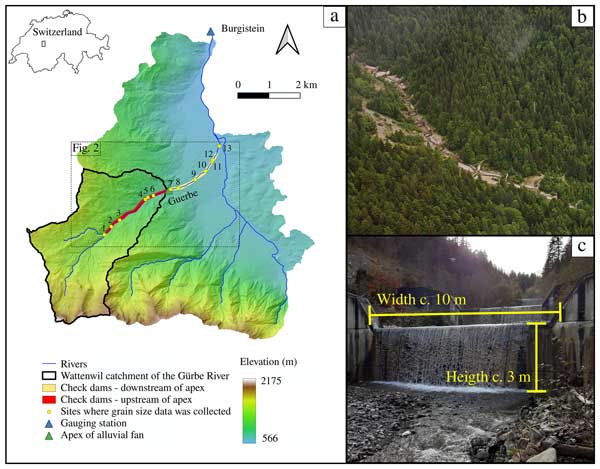
Engineering structures known as check dams are built with the intention of managing streams. The effectiveness of such structures can be expressed by quantifying the reduction of the sediment flux after their implementation. In this contribution, we estimate and compare the volumes of sediment transported in a mountain stream for engineered and non-engineered conditions. We found that without check dams the mean sediment flux would be ca. 10 times larger in comparison with the current situation.
Sarah Rowan, Marc Luetscher, Negar Haghipour, Heather M. Stoll, Laura Endres, Sönke Szidat, and Franziska A. Lechleitner
EGUsphere, https://doi.org/10.5194/egusphere-2026-5813, https://doi.org/10.5194/egusphere-2026-5813, 2026
This preprint is open for discussion and under review for Biogeosciences (BG).
Short summary
Short summary
Soils and plants store three times as much carbon as the atmosphere but how carbon is lost to inland water bodies remains uncertain. We present two years of data from a cave system, revealing contrasting sources and ages of dissolved carbon pools, as well as strong seasonal dynamics. A speleothem (secondary cave carbonate deposit) allows us to trace these signatures back in time. Our findings highlight the complexity of belowground transport and transformation of carbon.
Angus Moore, Maud Henrion, Yanfei Li, Eléonore du Bois d'Aische, Philip Gautschi, Marcus Christl, François Jonard, Sébastien Lambot, Kristof Van Oost, Sophie Opfergelt, and Veerle Vanacker
Earth Surf. Dynam., 14, 763–780, https://doi.org/10.5194/esurf-14-763-2026, https://doi.org/10.5194/esurf-14-763-2026, 2026
Short summary
Short summary
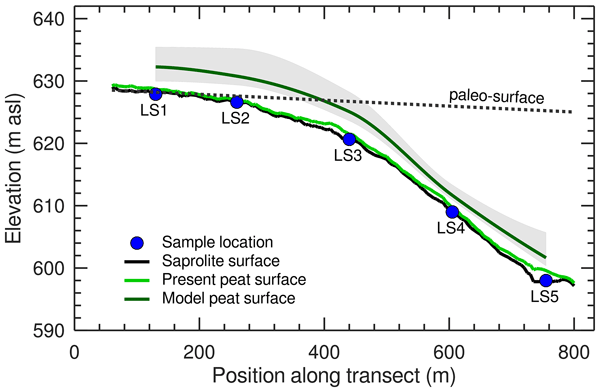
Studying peatland dynamics over long timescales requires a proxy for past peat cover. In this paper, we explore using cosmogenic nuclides to infer peat thicknesses averaged over 100 kyr timescales. We find that long-term peat thicknesses inferred from cosmogenic nuclides at an upland peatland site in the Belgian Ardennes are consistent with independent constraints, but exceed modern peat thicknesses. We attribute this discrepancy to peat degradation associated with historical land use.

Marcel Scheiwiller, Anne-Marie Wefing, Habacuc Pérez-Tribouillier, Christof Vockenhuber, Paul A. Dodd, Justin P. Gwynn, and Núria Casacuberta
Ocean Sci., 22, 2779–2808, https://doi.org/10.5194/os-22-2779-2026, https://doi.org/10.5194/os-22-2779-2026, 2026
Short summary
Short summary
We used man-made chemical markers to study how warm Atlantic origin water moves through the Arctic Ocean. Comparing Fram Strait observations from 2016 to 2021, we found stronger mixing in 2020 and longer transit times in 2021. This variability matters because these waters carry heat into the Arctic Ocean, intensifying its warming. Our findings help improve predictions of the Arctic Ocean climate response and its wider effects on ocean circulation.

David Mair, Guillaume Witz, Ariel Do Prado, Philippos Garefalakis, Amanda Wild, Fanny Ville, Bennet Schuster, Michael Horn, Jürgen Österle, Stefano C. Fabbri, Camille Litty, Stefan Achleitner, Sebastian Leistner, Clemens Hiller, and Fritz Schlunegger
Earth Surf. Dynam., 14, 527–551, https://doi.org/10.5194/esurf-14-527-2026, https://doi.org/10.5194/esurf-14-527-2026, 2026
Short summary
Short summary
This study introduces an updated image analysis framework for automatically identifying and measuring sediment grains in various types of images and scans. We employ a high-performing segmentation approach for a wide range of geoscientific data, using carefully curated ground truth data. The method achieves higher accuracy and more consistent measurements than existing approaches. The data and algorithm are openly available and provided in a user-friendly way.
Marco A. Bolandini, Jordon D. Hemingway, Negar Haghipour, Kirsi H. Keskitalo, Jorien E. Vonk, Timothy I. Eglinton, and Lisa Bröder
Biogeosciences, 23, 4447–4462, https://doi.org/10.5194/bg-23-4447-2026, https://doi.org/10.5194/bg-23-4447-2026, 2026
Short summary
Short summary
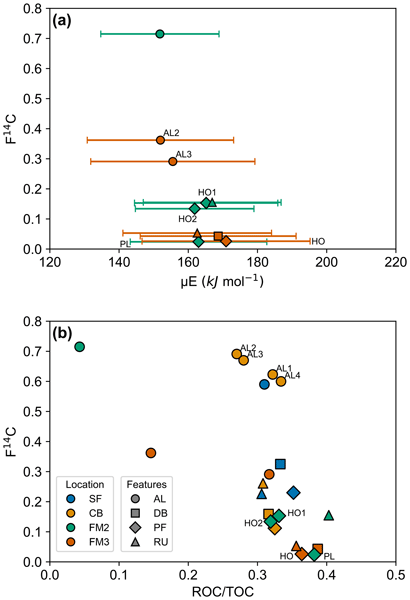
Abrupt permafrost thaw mobilizes ancient organic matter, which could fuel further warming, yet its fate remains uncertain. We studied thaw slumps in Arctic Canada using thermal, radiocarbon, and molecular analyses. Recently thawed debris and runoff exiting the slumps contained old, thermally stable organic matter, compositionally similar to surrounding permafrost. This suggests that much of the thaw-mobilised carbon survives initial transport and may be processed or sequestered downstream.
Lisa G. T. Leist, Maxi Castrillejo, Kumiko Azetsu-Scott, Craig Lee, Jed Lenetsky, Marc Ringuette, Christof Vockenhuber, Habacuc Pérez-Tribouillier, Catherine Jeandel, Jean-Éric Tremblay, and Núria Casacuberta
Ocean Sci., 22, 1835–1860, https://doi.org/10.5194/os-22-1835-2026, https://doi.org/10.5194/os-22-1835-2026, 2026
Short summary
Short summary
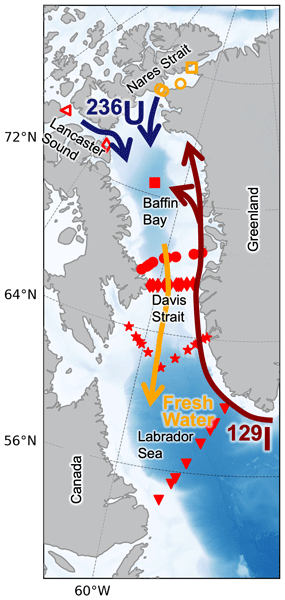
The Arctic and Atlantic Oceans are connected by narrow passages, and the exchange of waters affect global climate. Using artificial radionuclides from nuclear reprocessing discharges, we traced the origin of water masses from the Arctic to the Labrador Sea. Results show that waters from Canadian Arctic origin entering via Lancaster Sound are a key freshwater source to the Labrador Sea. These flows strongly influence the formation of deep waters in the Atlantic, vital for the global circulation.
Georg Nagl, Maximilian Ender, Felix Klein, Brian McArdell, Stefan Boss, Jordan Aaron, Friedrich Zott, Johannes Hübl, and Roland Kaitna
Nat. Hazards Earth Syst. Sci., 26, 1883–1888, https://doi.org/10.5194/nhess-26-1883-2026, https://doi.org/10.5194/nhess-26-1883-2026, 2026
Short summary
Short summary
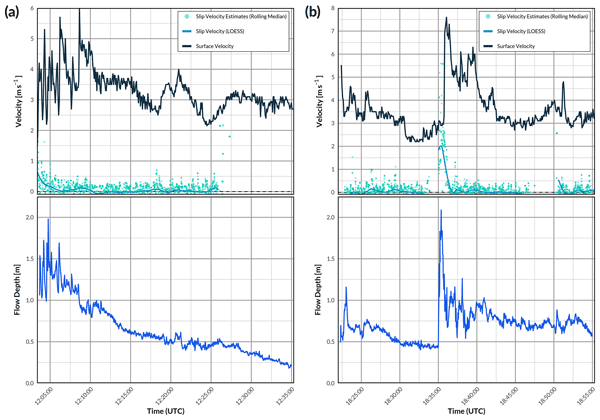
Debris flows are fast-moving mixtures of rocks, sediment, and water that threaten mountain communities. Their speed is controlled partly by sliding at the flow base, but this has never been directly measured in nature. We built a novel sensor setup in Tyrol, Austria, to close this gap. Two events showed signs of partial occurrence of base sliding, strongest at the flow front. Future work will study more events and refine the approach to improve hazard prediction.
Niklas Kappelt, Piers Larkman, Pascal Bohleber, Florian Adolphi, Marcus Christl, Christof Vockenhuber, Philip Gautschi, Eric Wolff, and Raimund Muscheler
EGUsphere, https://doi.org/10.5194/egusphere-2026-790, https://doi.org/10.5194/egusphere-2026-790, 2026
This preprint is open for discussion and under review for The Cryosphere (TC).
Short summary
Short summary
10Be is a radionuclide often measured in ice cores to reconstruct the solar magnetic field and geomagnetic field, as well as to date ice based on its half-life of 1.387 million years. Previous measurements in deep ice from Antarctica showed a decrease in concentrations with age. We analysed the influence of the sample preparation procedure and were able to show that the use of ion exchange columns can lead to decreasing concentrations, an effect which is amplified at greater depths and ages.

Luisa I. Minich, Dylan Geissbühler, Stefan Tobler, Annegret Udke, Alexander S. Brunmayr, Margaux Moreno Duborgel, Ciriaco McMackin, Lukas Wacker, Philip Gautschi, Negar Haghipour, Markus Egli, Ansgar Kahmen, Jens Leifeld, Timothy I. Eglinton, and Frank Hagedorn
Biogeosciences, 23, 811–829, https://doi.org/10.5194/bg-23-811-2026, https://doi.org/10.5194/bg-23-811-2026, 2026
Short summary
Short summary
We developed a conceptual framework using rates and 14C-derived ages of soil-respired CO2 and its sources (autotrophic, heterotrophic) to identify carbon cycling pathways in different land-use types. Rates, ages and sources of respired CO2 varied across forests, grasslands, croplands, and managed peatlands. Our results suggest that the relationship between rates and ages of respired CO2 serves as a robust indicator of carbon retention and loss from natural to disturbed systems.
Madeleine Santos, Lisa Bröder, Matt O'Regan, Iván Hernández-Almeida, Tommaso Tesi, Lukas Bigler, Negar Haghipour, Daniel B. Nelson, Michael Fritz, and Julie Lattaud
Clim. Past, 22, 187–203, https://doi.org/10.5194/cp-22-187-2026, https://doi.org/10.5194/cp-22-187-2026, 2026
Short summary
Short summary
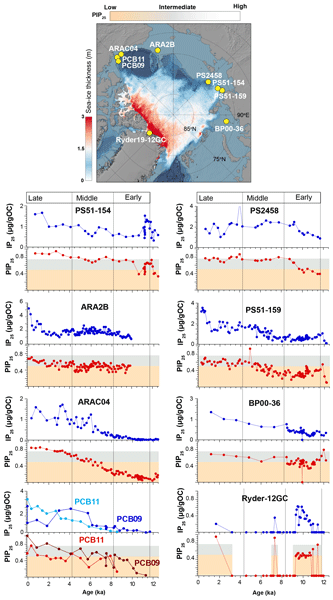
Our study examined how sea ice in the Beaufort Sea has changed over the past 13 000 years to better understand today's rapid losses. By analyzing chemical tracers preserved in seafloor sediments, we found that the Early Holocene was largely ice-free, with warmer waters and lower salinity. Seasonal ice began forming about 7000 years ago and expanded as the climate cooled. These long-term patterns show that continued warming could return the region to mostly ice-free conditions.
Johanne Lebrun Thauront, Philippa Ascough, Sebastian Doetterl, Negar Haghipour, Pierre Barré, Christian Walter, and Samuel Abiven
Biogeosciences, 23, 155–179, https://doi.org/10.5194/bg-23-155-2026, https://doi.org/10.5194/bg-23-155-2026, 2026
Short summary
Short summary
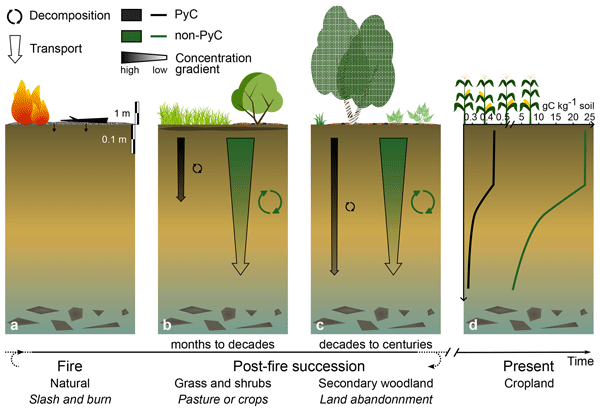
Fire-derived carbon is a form of organic carbon that has a long persistence in soils. However, its persistence at the landscape scale may be underestimated due to lateral and vertical redistribution. We measured fire-derived carbon in soils of a hilly agricultural watershed to identify the result of transport processes on the centennial time-scale. We show that the subsoil stores a large amount of fire-derived carbon and that erosion can redistribute it to localized accumulation zones.
Anne-Marie Wefing, Annabel Payne, Marcel Scheiwiller, Christof Vockenhuber, Marcus Christl, Toste Tanhua, and Núria Casacuberta
Ocean Sci., 21, 3311–3340, https://doi.org/10.5194/os-21-3311-2025, https://doi.org/10.5194/os-21-3311-2025, 2025
Short summary
Short summary
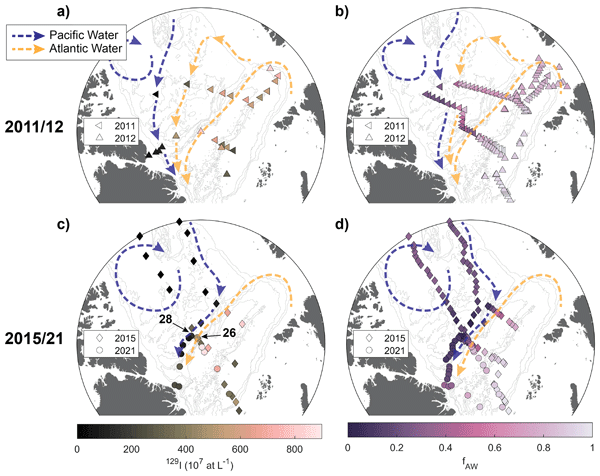
Here we used the anthropogenic radionuclides I-129 and U-236 as tracers for Atlantic Water circulation in the Arctic Ocean. New data collected in 2021 allowed to assess the distribution of Atlantic Water and mixing with Pacific-origin water in the surface layer in that year. By using historical tracer data from 2011 to 2021, we looked into temporal changes of the circulation and found slightly older waters in the central Arctic Ocean in 2021 compared to 2015.
Benedict V. A. Mittelbach, Margot E. White, Timo M. Y. Rhyner, Negar Haghipour, Marie-Elodie Perga, Nathalie Dubois, and Timothy I. Eglinton
Biogeosciences, 22, 6749–6763, https://doi.org/10.5194/bg-22-6749-2025, https://doi.org/10.5194/bg-22-6749-2025, 2025
Short summary
Short summary
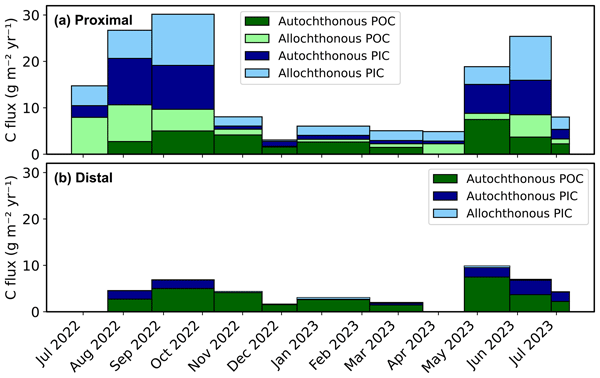
Lakes can emit carbon dioxide but also store carbon in their sediments. In hardwater lakes like Lake Geneva, calcite precipitates in the water column, releasing CO2 to the atmosphere, but upon sinking these particles also transport carbon to the sediment. Using sediment traps and radiocarbon isotopes, we show that much of the precipitated calcite is buried, highlighting an overlooked carbon sink that partly offsets the CO2 outgassing and should be included in lake carbon budgets.
Nahin Rezwan, David Mair, Alexander C. Whittaker, Fritz Schlunegger, Ariel Henrique do Prado, and Sadia Hossain Setu
EGUsphere, https://doi.org/10.5194/egusphere-2025-5145, https://doi.org/10.5194/egusphere-2025-5145, 2025
Short summary
Short summary
We used drone imagery and machine learning to track how floods reshape gravel bars in a Swiss river. By analysing over a million grains, we found that even moderate floods can move large areas of sediment and reshape riverbeds. The study shows how detailed mapping helps explain how frequent floods influence river change under future climate scenarios.
Sarah Paradis, Hannah Gies, Davide Moccia, Julie Lattaud, Lisa Bröder, Negar Haghipour, Antonio Pusceddu, Albert Palanques, Pere Puig, Claudio Lo Iacono, and Timothy I. Eglinton
Biogeosciences, 22, 5921–5941, https://doi.org/10.5194/bg-22-5921-2025, https://doi.org/10.5194/bg-22-5921-2025, 2025
Short summary
Short summary
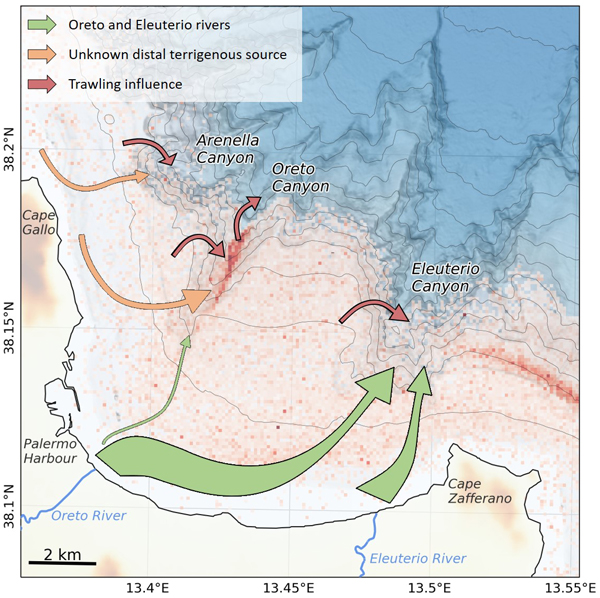
The Gulf of Palermo features several submarine canyons, where 50–70 % of the organic carbon deposited in them is terrigenous (OC-terr). The contribution of OC-terr generally decreases offshore and across canyons. Rivers deliver OC-terr, which is redistributed by regional currents and intercepted by the farthest down-current canyon, while the other submarine canyons receive terrigenous organic carbon from more distal sources. Bottom trawling also contributes to the transfer of OC-terr down-canyon.
Lukas Rettig, Sandro Rossato, Sarah Kamleitner, Paolo Mozzi, Susan Ivy-Ochs, Enrico Marcato, Marcus Christl, Silvana Martin, and Giovanni Monegato
E&G Quaternary Sci. J., 74, 151–168, https://doi.org/10.5194/egqsj-74-151-2025, https://doi.org/10.5194/egqsj-74-151-2025, 2025
Short summary
Short summary
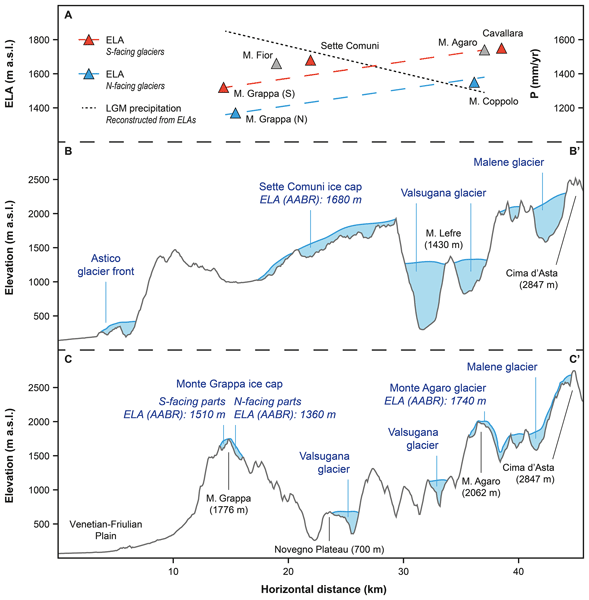
The work shows detailed reconstructions of the glaciers in the Valsugana area (south-eastern Alps) during the Last Glacial Maximum (LGM) and is supported by robust evidence and new exposure datings. These are the first ages for the internal sector of the south-eastern Alps. Local glaciers not connected with the major ice network were used for the calculation of their equilibrium line altitude. This let us estimate LGM palaeoprecipitation and compare it to Alpine palaeoclimatological models.
Niklas Kappelt, Eric Wolff, Marcus Christl, Christof Vockenhuber, Philip Gautschi, and Raimund Muscheler
Clim. Past, 21, 1585–1594, https://doi.org/10.5194/cp-21-1585-2025, https://doi.org/10.5194/cp-21-1585-2025, 2025
Short summary
Short summary
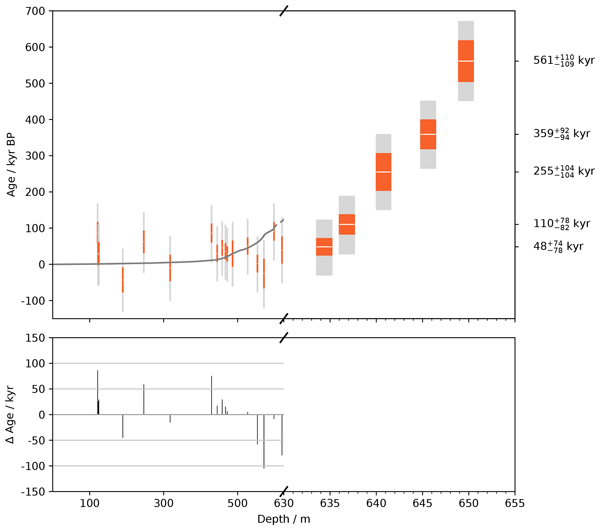
By measuring the radioactive decay of atmospherically produced 36Cl and 10Be in an ice core drilled in West Antarctica, we were able to determine the age of the deepest sample close to bedrock to be about 550 thousand years old. This means that the ice in this location, known as Skytrain Ice Rise, has survived several warm periods in the past, at least since marine isotope stage 11.
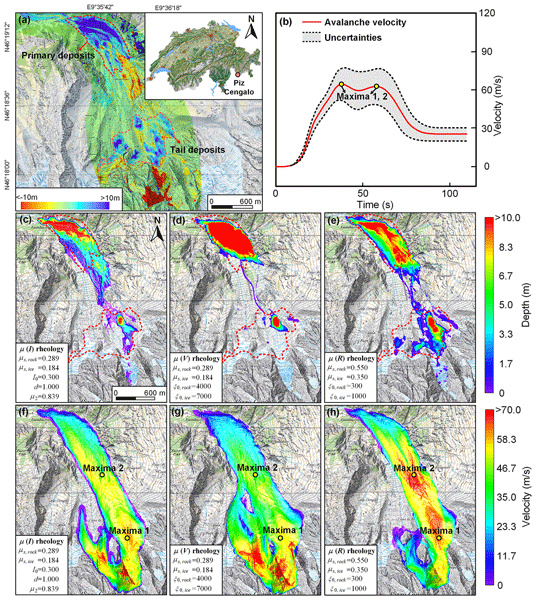
Yu Zhuang, Brian W. McArdell, and Perry Bartelt
Nat. Hazards Earth Syst. Sci., 25, 1901–1912, https://doi.org/10.5194/nhess-25-1901-2025, https://doi.org/10.5194/nhess-25-1901-2025, 2025
Short summary
Short summary
The experimentally based μ(I) rheology, widely used for gravitational mass flows, is reinterpreted as a Voellmy-type relationship to highlight its link to grain flow theory. Through block modeling and case studies, we establish its equivalence to μ(R) rheology. μ(I) models shear thinning but fails to capture acceleration and deceleration processes and deposit structure. Incorporating fluctuation energy in μ(R) improves accuracy, refining mass flow modeling and revealing practical challenges.
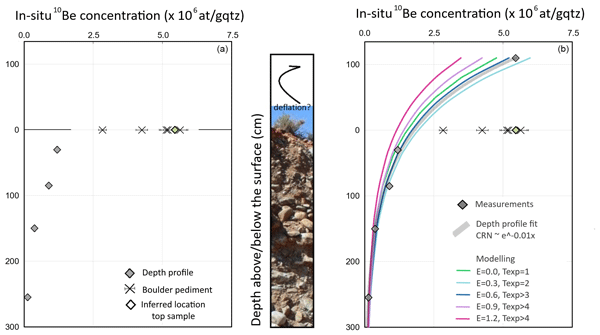
Janet C. Richardson, Veerle Vanacker, David M. Hodgson, Marcus Christl, and Andreas Lang
Earth Surf. Dynam., 13, 315–339, https://doi.org/10.5194/esurf-13-315-2025, https://doi.org/10.5194/esurf-13-315-2025, 2025
Short summary
Short summary
Pediments are long flat surfaces that extend outwards from the foot of mountains; within South Africa they are regarded as ancient landforms that can give key insights into landscape and mantle dynamics. Cosmogenic nuclide dating has been incorporated with geological (soil formation) and geomorphological (river incision) evidence, which shows that the pediments are long-lived features beyond the ages reported by cosmogenic nuclide dating.
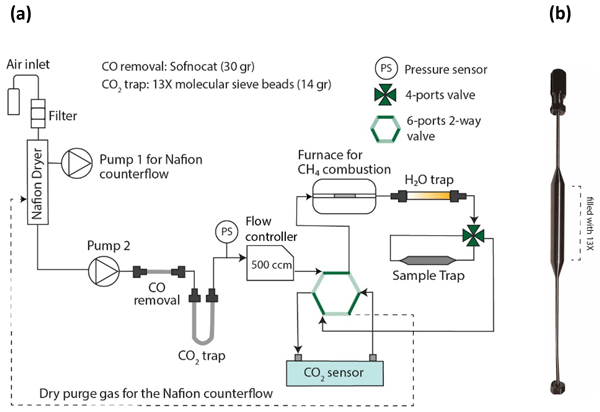
Giulia Zazzeri, Lukas Wacker, Negar Haghipour, Philip Gautschi, Thomas Laemmel, Sönke Szidat, and Heather Graven
Atmos. Meas. Tech., 18, 319–325, https://doi.org/10.5194/amt-18-319-2025, https://doi.org/10.5194/amt-18-319-2025, 2025
Short summary
Short summary
Radiocarbon (14C) is an optimal tracer of methane (CH4) emissions, as 14C measurements enable distinguishing between fossil methane and biogenic methane. However, these measurements are particularly challenging, mainly due to technical difficulties in the sampling procedure. We made the sample extraction much simpler and time efficient, providing a new technology that can be used by any research group, with the goal of expanding 14C measurements for an improved understanding of methane sources.
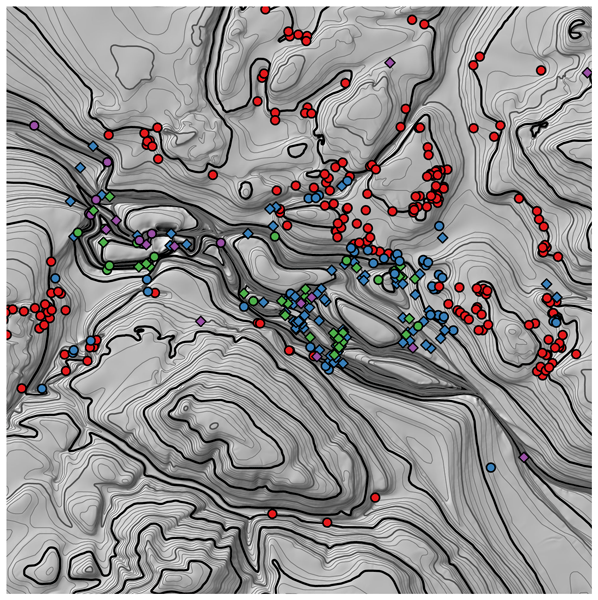
Fritz Schlunegger, Edi Kissling, Dimitri Tibo Bandou, Guilhem Amin Douillet, David Mair, Urs Marti, Regina Reber, Patrick Schläfli, and Michael Alfred Schwenk
Earth Surf. Dynam., 12, 1371–1389, https://doi.org/10.5194/esurf-12-1371-2024, https://doi.org/10.5194/esurf-12-1371-2024, 2024
Short summary
Short summary
Overdeepenings are bedrock depressions filled with sediment. We combine the results of a gravity survey with drilling data to explore the morphology of such a depression beneath the city of Bern. We find that the target overdeepening comprises two basins >200 m deep. They are separated by a bedrock riegel that itself is cut by narrow canyons up to 150 m deep. We postulate that these structures formed underneath a glacier, where erosion by subglacial meltwater caused the formation of the canyons.
Renas I. Koshnaw, Jonas Kley, and Fritz Schlunegger
Solid Earth, 15, 1365–1383, https://doi.org/10.5194/se-15-1365-2024, https://doi.org/10.5194/se-15-1365-2024, 2024
Short summary
Short summary
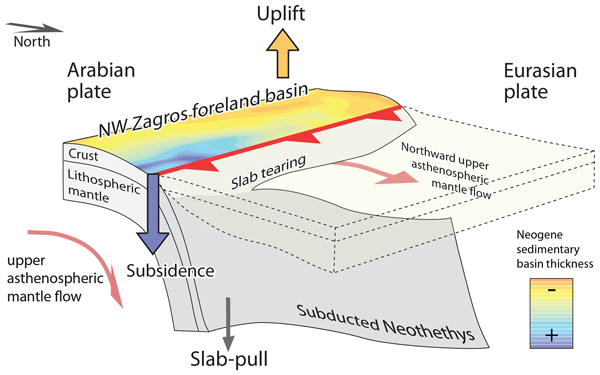
This study investigates how Earth's geodynamic processes shaped the NW Zagros mountain belt in the Middle East. The Neogene foreland basin underwent subsidence due to the load of the surface and the subducting slab and was later influenced by the Neotethys horizontal slab tearing and the associated asthenospheric mantle flow during the Late Miocene and onward.
Hoda Moradi, Gerhard Furrer, Michael Margreth, David Mair, and Christoph Wanner
The Cryosphere, 18, 5153–5171, https://doi.org/10.5194/tc-18-5153-2024, https://doi.org/10.5194/tc-18-5153-2024, 2024
Short summary
Short summary
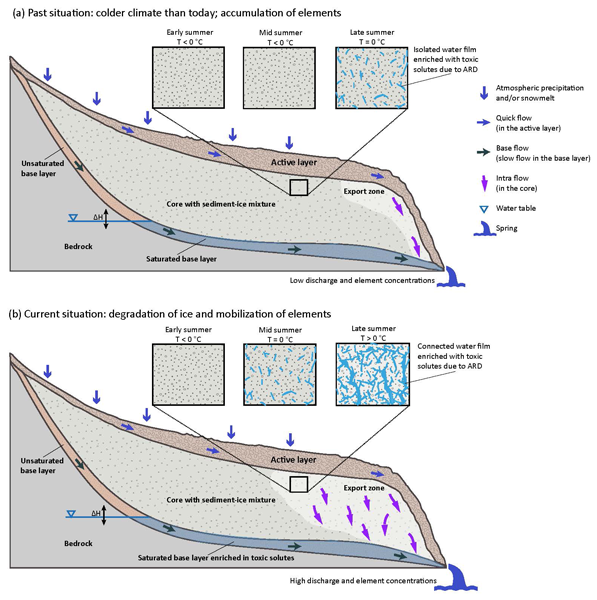
Detailed monitoring of a rock glacier spring in the Eastern Alps showed that more than 1 tonne of toxic solutes, such as aluminum, nickel, and manganese, is mobilized each year from a small permafrost area. The strong mobilization is caused by rock weathering and long-term accumulation of toxic solutes in permafrost ice. Today, climate-change-induced permafrost degradation leads to a quick and focused export in summer. This forms an unexpected, novel hazard for alpine and high-latitude areas.
Michael Margreth, Florian Lustenberger, Dorothea Hug Peter, Fritz Schlunegger, and Massimiliano Zappa
Nat. Hazards Earth Syst. Sci. Discuss., https://doi.org/10.5194/nhess-2024-78, https://doi.org/10.5194/nhess-2024-78, 2024
Publication in NHESS not foreseen
Short summary
Short summary
Recession models (RM) are crucial for observing the low flow behavior of a catchment. We developed two novel RM, which are designed to represent slowly draining catchment conditions. With a newly designed low flow prediction procedure we tested the prediction capability of these two models and three others from literature. One of our novel products delivered the best results, because it best represents the slowly draining catchment conditions.
Daniel Bolliger, Fritz Schlunegger, and Brian W. McArdell
Nat. Hazards Earth Syst. Sci., 24, 1035–1049, https://doi.org/10.5194/nhess-24-1035-2024, https://doi.org/10.5194/nhess-24-1035-2024, 2024
Short summary
Short summary
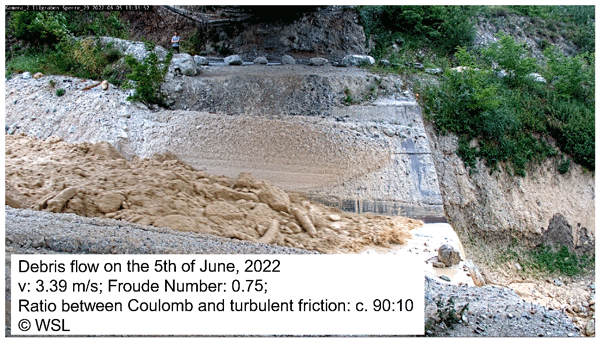
We analysed data from the Illgraben debris flow monitoring station, Switzerland, and we modelled these flows with a debris flow runout model. We found that no correlation exists between the grain size distribution, the mineralogical composition of the matrix, and the debris flow properties. The flow properties rather appear to be determined by the flow volume, from which most other parameters can be derived.
Ariel Henrique do Prado, David Mair, Philippos Garefalakis, Chantal Schmidt, Alexander Whittaker, Sebastien Castelltort, and Fritz Schlunegger
Hydrol. Earth Syst. Sci., 28, 1173–1190, https://doi.org/10.5194/hess-28-1173-2024, https://doi.org/10.5194/hess-28-1173-2024, 2024
Short summary
Short summary
Engineering structures known as check dams are built with the intention of managing streams. The effectiveness of such structures can be expressed by quantifying the reduction of the sediment flux after their implementation. In this contribution, we estimate and compare the volumes of sediment transported in a mountain stream for engineered and non-engineered conditions. We found that without check dams the mean sediment flux would be ca. 10 times larger in comparison with the current situation.
Chiara I. Paleari, Florian Mekhaldi, Tobias Erhardt, Minjie Zheng, Marcus Christl, Florian Adolphi, Maria Hörhold, and Raimund Muscheler
Clim. Past, 19, 2409–2422, https://doi.org/10.5194/cp-19-2409-2023, https://doi.org/10.5194/cp-19-2409-2023, 2023
Short summary
Short summary
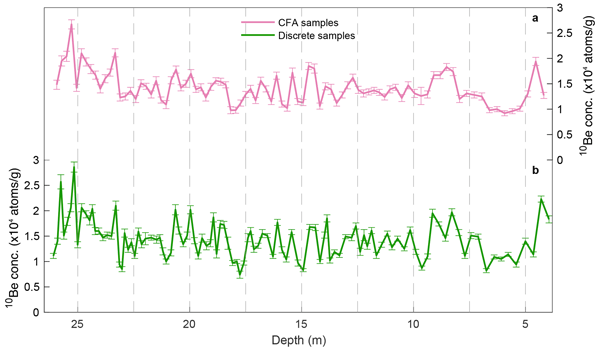
In this study, we test the use of excess meltwater from continuous flow analysis from a firn core from Greenland for the measurement of 10Be for solar activity reconstructions. We show that the quality of results is similar to the measurements on clean firn, which opens the possibility to obtain continuous 10Be records without requiring large amounts of clean ice. Furthermore, we investigate the possibility of identifying solar storm signals in 10Be records from Greenland and Antarctica.
Catharina Dieleman, Philip Deline, Susan Ivy Ochs, Patricia Hug, Jordan Aaron, Marcus Christl, and Naki Akçar
EGUsphere, https://doi.org/10.5194/egusphere-2023-1873, https://doi.org/10.5194/egusphere-2023-1873, 2023
Preprint withdrawn
Short summary
Short summary
Valleys in the Alps are shaped by glaciers, rivers, mass movements, and slope processes. An understanding of such processes is of great importance in hazard mitigation. We focused on the evolution of the Frébouge cone, which is composed of glacial, debris flow, rock avalanche, and snow avalanche deposits. Debris flows started to form the cone prior to ca. 2 ka ago. In addition, the cone was overrun by a 10 Mm3 large rock avalanche at 1.3 ± 0.1 ka and by the Frébouge glacier at 300 ± 40 a.
Giulia Sinnl, Florian Adolphi, Marcus Christl, Kees C. Welten, Thomas Woodruff, Marc Caffee, Anders Svensson, Raimund Muscheler, and Sune Olander Rasmussen
Clim. Past, 19, 1153–1175, https://doi.org/10.5194/cp-19-1153-2023, https://doi.org/10.5194/cp-19-1153-2023, 2023
Short summary
Short summary
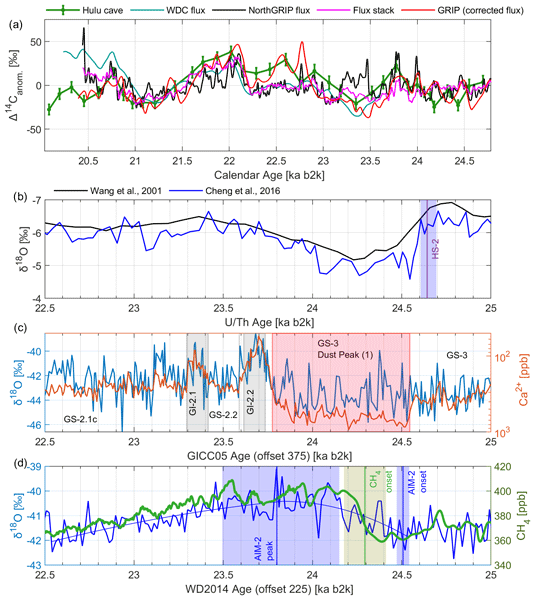
The record of past climate is preserved by several archives from different regions, such as ice cores from Greenland or Antarctica or speleothems from caves such as the Hulu Cave in China. In this study, these archives are aligned by taking advantage of the globally synchronous production of cosmogenic radionuclides. This produces a new perspective on the global climate in the period between 20 000 and 25 000 years ago.
Robert Mulvaney, Eric W. Wolff, Mackenzie M. Grieman, Helene H. Hoffmann, Jack D. Humby, Christoph Nehrbass-Ahles, Rachael H. Rhodes, Isobel F. Rowell, Frédéric Parrenin, Loïc Schmidely, Hubertus Fischer, Thomas F. Stocker, Marcus Christl, Raimund Muscheler, Amaelle Landais, and Frédéric Prié
Clim. Past, 19, 851–864, https://doi.org/10.5194/cp-19-851-2023, https://doi.org/10.5194/cp-19-851-2023, 2023
Short summary
Short summary
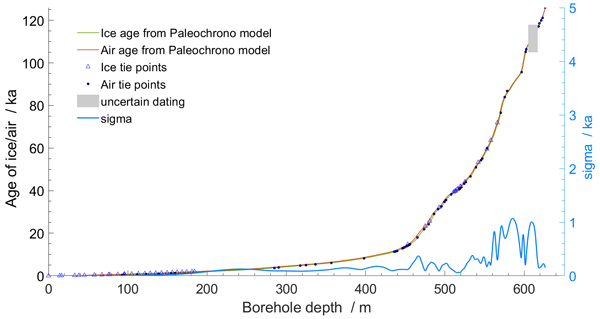
We present an age scale for a new ice core drilled at Skytrain Ice Rise, an ice rise facing the Ronne Ice Shelf in Antarctica. Various measurements in the ice and air phases are used to match the ice core to other Antarctic cores that have already been dated, and a new age scale is constructed. The 651 m ice core includes ice that is confidently dated to 117 000–126 000 years ago, in the last interglacial. Older ice is found deeper down, but there are flow disturbances in the deeper ice.

Fabian Walter, Elias Hodel, Erik S. Mannerfelt, Kristen Cook, Michael Dietze, Livia Estermann, Michaela Wenner, Daniel Farinotti, Martin Fengler, Lukas Hammerschmidt, Flavia Hänsli, Jacob Hirschberg, Brian McArdell, and Peter Molnar
Nat. Hazards Earth Syst. Sci., 22, 4011–4018, https://doi.org/10.5194/nhess-22-4011-2022, https://doi.org/10.5194/nhess-22-4011-2022, 2022
Short summary
Short summary
Debris flows are dangerous sediment–water mixtures in steep terrain. Their formation takes place in poorly accessible terrain where instrumentation cannot be installed. Here we propose to monitor such source terrain with an autonomous drone for mapping sediments which were left behind by debris flows or may contribute to future events. Short flight intervals elucidate changes of such sediments, providing important information for landscape evolution and the likelihood of future debris flows.
Nathan Vandermaelen, Koen Beerten, François Clapuyt, Marcus Christl, and Veerle Vanacker
Geochronology, 4, 713–730, https://doi.org/10.5194/gchron-4-713-2022, https://doi.org/10.5194/gchron-4-713-2022, 2022
Short summary
Short summary
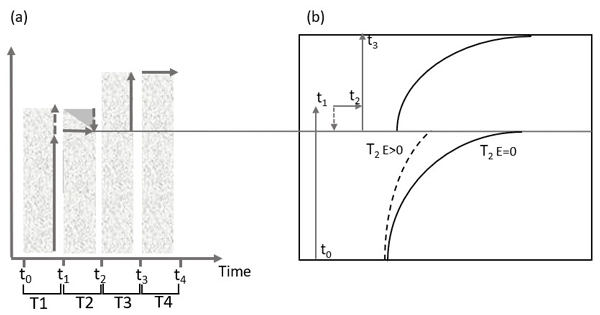
We constrained deposition phases of fluvial sediments (NE Belgium) over the last 1 Myr with analysis and modelling of rare isotopes accumulation within sediments, occurring as a function of time and inverse function of depth. They allowed the determination of three superposed deposition phases and intercalated non-deposition periods of ~ 40 kyr each. These phases correspond to 20 % of the sediment age, which highlights the importance of considering deposition phase when dating fluvial sediments.

David Mair, Ariel Henrique Do Prado, Philippos Garefalakis, Alessandro Lechmann, Alexander Whittaker, and Fritz Schlunegger
Earth Surf. Dynam., 10, 953–973, https://doi.org/10.5194/esurf-10-953-2022, https://doi.org/10.5194/esurf-10-953-2022, 2022
Short summary
Short summary
Grain size data are important for studying and managing rivers, but they are difficult to obtain in the field. Therefore, methods have been developed that use images from small and remotely piloted aircraft. However, uncertainty in grain size data from such image-based products is understudied. Here we present a new way of uncertainty estimation that includes fully modeled errors. We use this technique to assess the effect of several image acquisition aspects on grain size uncertainty.

Joanne Elkadi, Benjamin Lehmann, Georgina E. King, Olivia Steinemann, Susan Ivy-Ochs, Marcus Christl, and Frédéric Herman
Earth Surf. Dynam., 10, 909–928, https://doi.org/10.5194/esurf-10-909-2022, https://doi.org/10.5194/esurf-10-909-2022, 2022
Short summary
Short summary
Glacial and non-glacial processes have left a strong imprint on the landscape of the European Alps, but further research is needed to better understand their long-term effects. We apply a new technique combining two methods for bedrock surface dating to calculate post-glacier erosion rates next to a Swiss glacier. Interestingly, the results suggest non-glacial erosion rates are higher than previously thought, but glacial erosion remains the most influential on landscape evolution.
Michael A. Schwenk, Laura Stutenbecker, Patrick Schläfli, Dimitri Bandou, and Fritz Schlunegger
E&G Quaternary Sci. J., 71, 163–190, https://doi.org/10.5194/egqsj-71-163-2022, https://doi.org/10.5194/egqsj-71-163-2022, 2022
Short summary
Short summary
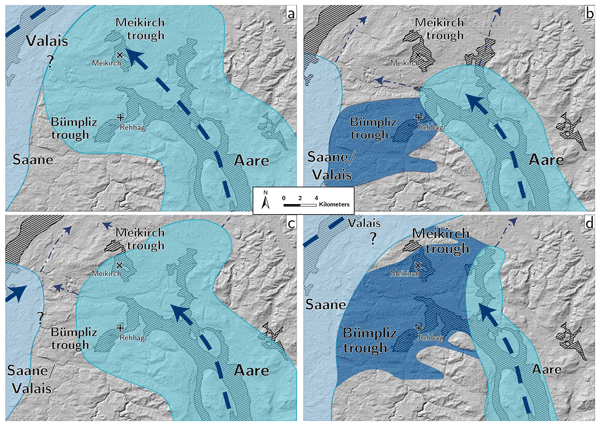
We investigated the origin of glacial sediments in the Bern area to determine their route of transport either with the Aare Glacier or the Valais Glacier. These two ice streams are known to have joined in the Bern area during the last major glaciation (ca. 20 000 years ago). However, little is known about the ice streams prior to this last glaciation. Here we collected evidence that during a glaciation about 250 000 years ago the Aare Glacier dominated the area as documented in the deposits.
Elena Serra, Pierre G. Valla, Romain Delunel, Natacha Gribenski, Marcus Christl, and Naki Akçar
Earth Surf. Dynam., 10, 493–512, https://doi.org/10.5194/esurf-10-493-2022, https://doi.org/10.5194/esurf-10-493-2022, 2022
Short summary
Short summary
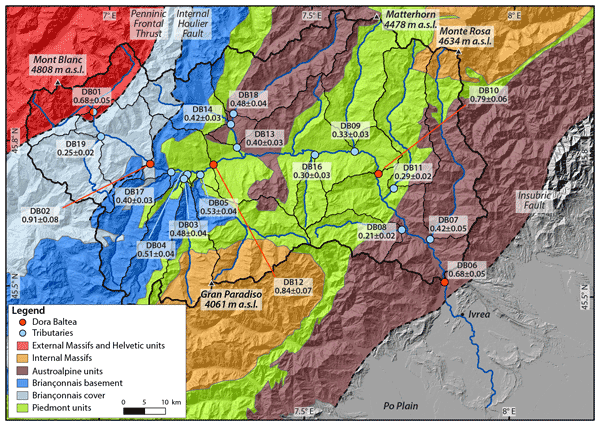
Alpine landscapes are transformed by several erosion processes. 10Be concentrations measured in river sediments at the outlet of a basin represent a powerful tool to quantify how fast the catchment erodes. We measured erosion rates within the Dora Baltea catchments (western Italian Alps). Our results show that erosion is governed by topography, bedrock resistance and glacial imprint. The Mont Blanc massif has the highest erosion and therefore dominates the sediment flux of the Dora Baltea river.
Ariel Henrique do Prado, Renato Paes de Almeida, Cristiano Padalino Galeazzi, Victor Sacek, and Fritz Schlunegger
Earth Surf. Dynam., 10, 457–471, https://doi.org/10.5194/esurf-10-457-2022, https://doi.org/10.5194/esurf-10-457-2022, 2022
Short summary
Short summary
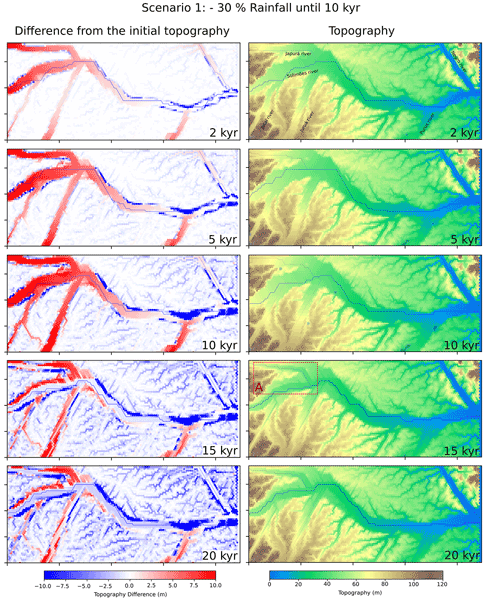
Our work is focused on describing how and why the terrace levels of central Amazonia were formed during the last 100 000 years. We propose to address this question through a landscape evolution numerical model. Our results show that terrace levels at lower elevation were established in response to dry–wet climate changes and the older terrace levels at higher elevations most likely formed in response to a previously higher elevation of the regional base level.
Alessandro Lechmann, David Mair, Akitaka Ariga, Tomoko Ariga, Antonio Ereditato, Ryuichi Nishiyama, Ciro Pistillo, Paola Scampoli, Mykhailo Vladymyrov, and Fritz Schlunegger
Geosci. Model Dev., 15, 2441–2473, https://doi.org/10.5194/gmd-15-2441-2022, https://doi.org/10.5194/gmd-15-2441-2022, 2022
Short summary
Short summary
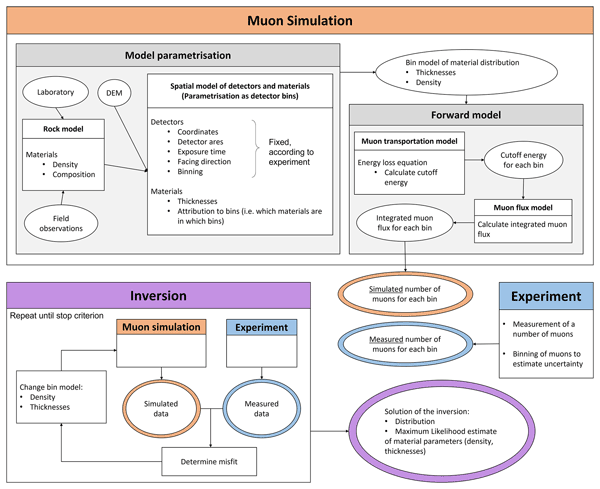
Muon tomography is a technology that is used often in geoscientific research. The know-how of data analysis is, however, still possessed by physicists who developed this technology. This article aims at providing geoscientists with the necessary tools to perform their own analyses. We hope that a lower threshold to enter the field of muon tomography will allow more geoscientists to engage with muon tomography. SMAUG is set up in a modular way to allow for its own modules to work in between.
Michael A. Schwenk, Patrick Schläfli, Dimitri Bandou, Natacha Gribenski, Guilhem A. Douillet, and Fritz Schlunegger
Sci. Dril., 30, 17–42, https://doi.org/10.5194/sd-30-17-2022, https://doi.org/10.5194/sd-30-17-2022, 2022
Short summary
Short summary
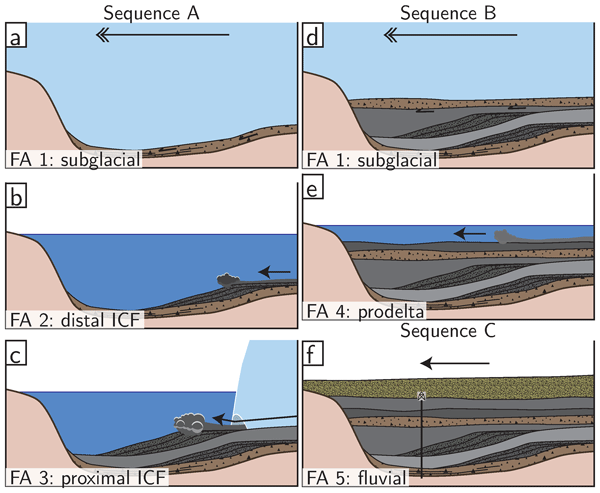
A scientific drilling was conducted into a bedrock trough (overdeepening) in Bern-Bümpliz (Switzerland) in an effort to advance the knowledge of the Quaternary prior to 150 000 years ago. We encountered a 208.5 m-thick succession of loose sediments (gravel, sand and mud) in the retrieved core and identified two major sedimentary sequences (A: lower, B: upper). The sedimentary suite records two glacial advances and the subsequent filling of a lake sometime between 300 000 and 200 000 years ago.
Emilija Krsnik, Katharina Methner, Marion Campani, Svetlana Botsyun, Sebastian G. Mutz, Todd A. Ehlers, Oliver Kempf, Jens Fiebig, Fritz Schlunegger, and Andreas Mulch
Solid Earth, 12, 2615–2631, https://doi.org/10.5194/se-12-2615-2021, https://doi.org/10.5194/se-12-2615-2021, 2021
Short summary
Short summary
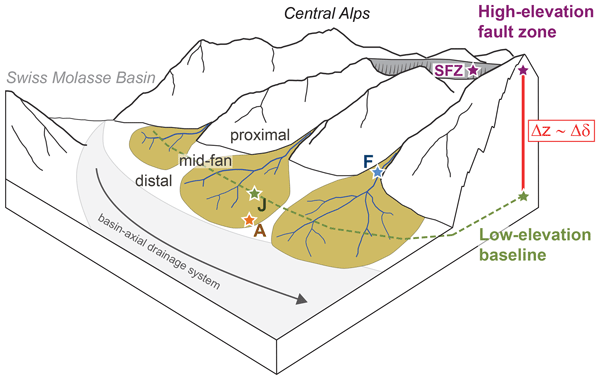
Here we present new surface elevation constraints for the middle Miocene Central Alps based on stable and clumped isotope geochemical analyses. Our reconstructed paleoelevation estimate is supported by isotope-enabled paleoclimate simulations and indicates that the Miocene Central Alps were characterized by a heterogeneous and spatially transient topography with high elevations locally exceeding 4000 m.
Elena Leonarduzzi, Brian W. McArdell, and Peter Molnar
Hydrol. Earth Syst. Sci., 25, 5937–5950, https://doi.org/10.5194/hess-25-5937-2021, https://doi.org/10.5194/hess-25-5937-2021, 2021
Short summary
Short summary
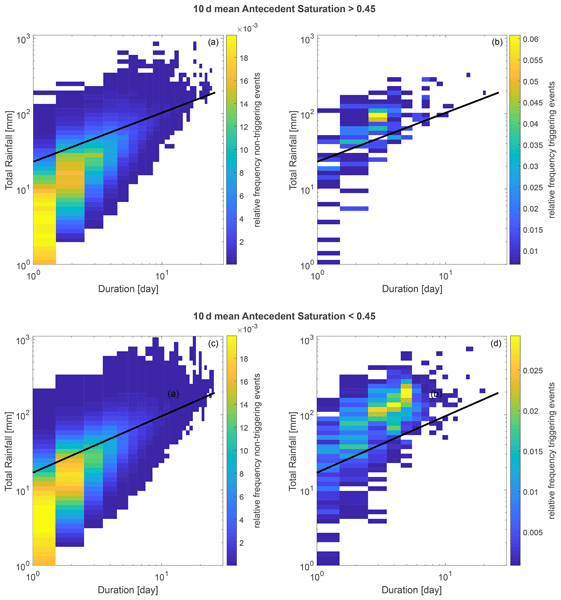
Landslides are a dangerous natural hazard affecting alpine regions, calling for effective warning systems. Here we consider different approaches for the prediction of rainfall-induced shallow landslides at the regional scale, based on open-access datasets and operational hydrological forecasting systems. We find antecedent wetness useful to improve upon the classical rainfall thresholds and the resolution of the hydrological model used for its estimate to be a critical aspect.
Renas I. Koshnaw, Fritz Schlunegger, and Daniel F. Stockli
Solid Earth, 12, 2479–2501, https://doi.org/10.5194/se-12-2479-2021, https://doi.org/10.5194/se-12-2479-2021, 2021
Short summary
Short summary
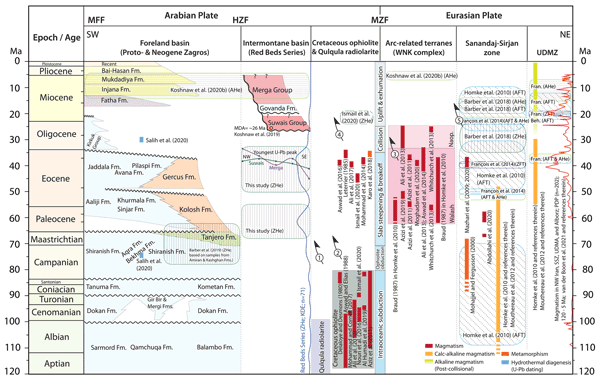
As continental plates collide, mountain belts grow. This study investigated the provenance of rocks from the northwestern segment of the Zagros mountain belt to unravel the convergence history of the Arabian and Eurasian plates. Provenance data synthesis and field relationships suggest that the Zagros Mountains developed as a result of the oceanic crust emplacement on the Arabian continental plate, followed by the Arabia–Eurasia collision and later uplift of the broader region.
Cited articles
Abbühl, L. M., Norton, K. P., Jansen, J. D., Schlunegger, F., Aldahan, A., and Possnert, G.: Erosion rates and mechanisms of knickzone retreat inferred from 10 Be measured across strong climate gradients on the northern and central Andes Western Escarpment, Earth Surf. Process. Landforms, 36, 1464–1473, https://doi.org/10.1002/esp.2164, 2011.
Akçar, N., Ivy-Ochs, S., Alfimov, V., Schlunegger, F., Claude, A., Reber, R., Christl, M., Vockenhuber, C., Dehnert, A., Rahn, M., and Schlüchter, C.: Isochron-burial dating of glaciofluvial deposits: First results from the Swiss Alps, Earth Surf. Process. Landforms, 42, 2414–2425, https://doi.org/10.1002/esp.4201, 2017.
Amt für Wald und Naturgefahren des Kantons Bern: Naturgefahrenkataster (NGKAT), https://www.agi.dij.be.ch/de/start/geoportal/geodaten/detail.html?type=geoproduct&code=NGKAT (last access: 26 May 2025), 2024.
Balco, G., Stone, J. O., Lifton, N. A., and Dunai, T. J.: A complete and easily accessible means of calculating surface exposure ages or erosion rates from 10Be and 26Al measurements, Quaternary Geochronology, 3, 174–195, https://doi.org/10.1016/j.quageo.2007.12.001, 2008.
Battista, G., Schlunegger, F., Burlando, P., and Molnar, P.: Modelling localized sources of sediment in mountain catchments for provenance studies, Earth Surf. Process. Landforms, 45, 3475–3487, https://doi.org/10.1002/esp.4979, 2020.
Bierman, P. and Steig, E.: Estimating rates of denudation using cosmogenic isotope abundances in sediment, Earth Surf. Process. Landforms, 21, 125–139, 1996.
Bini, A., Buonchristiani, J.-F., Couterand, S., Ellwanger, D., Felber, M., Florineth, D., Graf, H. R., Keller, O., Kelly, M., Schlüchter, C., and and Schöneich, P.: Die Schweiz während des letzteiszeitlichen Maximums (LGM), https://www.swisstopo.admin.ch/de (last access: 6 December 2024), 2009.
Binnie, S., Phillips, W., Summerfield, M., and Fifield, K.: Sediment mixing and basin-wide cosmogenic nuclide analysis in rapidly eroding mountainous environments, Quaternary Geochronology, 1, 4–14, https://doi.org/10.1016/j.quageo.2006.06.013, 2006.
Borselli, L., Cassi, P., and Torri, D.: Prolegomena to sediment and flow connectivity in the landscape: A GIS and field numerical assessment, CATENA, 75, 268–277, https://doi.org/10.1016/j.catena.2008.07.006, 2008.
Brardinoni, F., Grischott, R., Kober, F., Morelli, C., and Christl, M.: Evaluating debris-flow and anthropogenic disturbance on 10 Be concentration in mountain drainage basins: implications for functional connectivity and denudation rates across time scales, Earth Surf. Process. Landforms, 45, 3955–3974, https://doi.org/10.1002/esp.5012, 2020.
Bundesamt für Landestopografie swisstopo; Tarquini, S., Isola, I., Favalli, M., Battistini, A., and Dotta, G.: TINITALY, a digital elevation model of Italy with a 10 meters cell size (Version 1.1), Istituto Nazionale di Geofisica e Vulcanologia (INGV), https://doi.org/10.13127/tinitaly/1.1; DGM Österreich, https://www.geoland.at/ (last access: 26 May 2025); DGM1, Bayerische Vermessungsverwaltung – https://www.ldbv.bayern.de/ (last access: 26 May 2025); EU-DEM, provided under COPERNICUS by the European Union and ESA, all rights reserved; RGEAlti, Institut National de l’information géographique et forestière, données originales tétéchargées sur https://geoservices.ign.fr/rgealti#telechargement5m (last access: 26 May 2025), mise à jour du juillet 2023, 2023.
Carr, J. C., DiBiase, R. A., Yeh, E.-C., Fisher, D. M., and Kirby, E.: Rock properties and sediment caliber govern bedrock river morphology across the Taiwan Central Range, Science advances, 9, eadg6794, https://doi.org/10.1126/sciadv.adg6794, 2023.
Cavalli, M., Trevisani, S., Comiti, F., and Marchi, L.: Geomorphometric assessment of spatial sediment connectivity in small Alpine catchments, Geomorphology, 188, 31–41, https://doi.org/10.1016/j.geomorph.2012.05.007, 2013.
Chittenden, H., Delunel, R., Schlunegger, F., Akçar, N., and Kubik, P.: The influence of bedrock orientation on the landscape evolution, surface morphology and denudation (10 Be) at the Niesen, Switzerland, Earth Surf. Process. Landforms, 39, 1153–1166, https://doi.org/10.1002/esp.3511, 2014.
Christl, M., Vockenhuber, C., Kubik, P. W., Wacker, L., Lachner, J., Alfimov, V., and Synal, H.-A.: The ETH Zurich AMS facilities: Performance parameters and reference materials, Nuclear Instruments and Methods in Physics Research Section B: Beam Interactions with Materials and Atoms, 294, 29–38, https://doi.org/10.1016/j.nimb.2012.03.004, 2013.
Clapuyt, F., Vanacker, V., Christl, M., Van Oost, K., and Schlunegger, F.: Spatio-temporal dynamics of sediment transfer systems in landslide-prone Alpine catchments, Solid Earth, 10, 1489–1503, https://doi.org/10.5194/se-10-1489-2019, 2019.
Cruz Nunes, F., Delunel, R., Schlunegger, F., Akçar, N., and Kubik, P. W.: Bedrock bedding, landsliding and erosional budgets in the Central European Alps, Terra Nova, 27, 370–378, https://doi.org/10.1111/ter.12169, 2015.
Da Silva Guimarães, E., Delunel, R., Schlunegger, F., Akçar, N., Stutenbecker, L., and Christl, M.: Cosmogenic and Geological Evidence for the Occurrence of a Ma-Long Feedback between Uplift and Denudation, Chur Region, Swiss Alps, Geosciences, 11, 339, https://doi.org/10.3390/geosciences11080339, 2021.
Delunel, R., van der Beek, P. A., Carcaillet, J., Bourlès, D. L., and Valla, P. G.: Frost-cracking control on catchment denudation rates: Insights from in situ produced 10Be concentrations in stream sediments (Ecrins–Pelvoux massif, French Western Alps), Earth and Planetary Science Letters, 293, 72–83, https://doi.org/10.1016/j.epsl.2010.02.020, 2010.
Delunel, R., Bourlès, D. L., van der Beek, P. A., Schlunegger, F., Leya, I., Masarik, J., and Paquet, E.: Snow shielding factors for cosmogenic nuclide dating inferred from long-term neutron detector monitoring, Quaternary Geochronology, 24, 16–26, https://doi.org/10.1016/j.quageo.2014.07.003, 2014.
Delunel, R., Schlunegger, F., Valla, P. G., Dixon, J., Glotzbach, C., Hippe, K., Kober, F., Molliex, S., Norton, K. P., Salcher, B., Wittmann, H., Akçar, N., and Christl, M.: Late-Pleistocene catchment-wide denudation patterns across the European Alps, Earth-Science Reviews, 211, 103407, https://doi.org/10.1016/j.earscirev.2020.103407, 2020.
DiBiase, R. A.: Short communication: Increasing vertical attenuation length of cosmogenic nuclide production on steep slopes negates topographic shielding corrections for catchment erosion rates, Earth Surf. Dynam., 6, 923–931, https://doi.org/10.5194/esurf-6-923-2018, 2018.
DiBiase, R. A., Whipple, K. X., Heimsath, A. M., and Ouimet, W. B.: Landscape form and millennial erosion rates in the San Gabriel Mountains, CA, Earth and Planetary Science Letters, 289, 134–144, https://doi.org/10.1016/j.epsl.2009.10.036, 2010.
DiBiase, R. A., Neely, A. B., Whipple, K. X., Heimsath, A. M., and Niemi, N. A.: Hillslope Morphology Drives Variability of Detrital 10 Be Erosion Rates in Steep Landscapes, Geophysical Research Letters, 50, https://doi.org/10.1029/2023GL104392, 2023.
Diem, B.: Die Untere Meeresmolasse zwischen der Saane (Westschweiz) und der Ammer (Oberbayern), Exlogae Geol. Helv., 493–559, 1986.
Dingle, E. H., Sinclair, H. D., Attal, M., Rodés, Á., and Singh, V.: Temporal variability in detrital 10Be concentrations in a large Himalayan catchment, Earth Surf. Dynam., 6, 611–635, https://doi.org/10.5194/esurf-6-611-2018, 2018.
do Prado, A. H., Mair, D., Garefalakis, P., Schmidt, C., Whittaker, A., Castelltort, S., and Schlunegger, F.: Check dam impact on sediment loads: example of the Guerbe River in the Swiss Alps – a catchment scale experiment, Hydrol. Earth Syst. Sci., 28, 1173–1190, https://doi.org/10.5194/hess-28-1173-2024, 2024.
Frei, P., Kotlarski, S., Liniger, M. A., and Schär, C.: Future snowfall in the Alps: projections based on the EURO-CORDEX regional climate models, The Cryosphere, 12, 1–24, https://doi.org/10.5194/tc-12-1-2018, 2018.
Glaus, G., Delunel, R., Stutenbecker, L., Akçar, N., Christl, M., and Schlunegger, F.: Differential erosion and sediment fluxes in the Landquart basin and possible relationships to lithology and tectonic controls, Swiss J. Geosci., 112, 453–473, https://doi.org/10.1007/s00015-019-00344-3, 2019.
Granger, D. E., Kirchner, J. W., and Finkel, R.: Spatially Averaged Long-Term Erosion Rates Measured from in Situ-Produced Cosmogenic Nuclides in Alluvial Sediment, The Journal of Geology, 104, 249–257, https://doi.org/10.1086/629823, 1996.
Haldimann, P., Graf, H. R., Jost, J., and Kälin, D. (Eds.): 1071 Bülach, Geologischer Atlas der Schweiz, 151 = Blatt 1071, Bundesamt für Landestopografie swisstopo Geologische Landesaufnahme, Wabern, ISBN 978-3-302-40088-4, 2017.
Halsted, C. T., Bierman, P. R., Codilean, A. T., Corbett, L. B., and Caffee, M. W.: Global analysis of in situ cosmogenic 26Al and 10Be and inferred erosion rate ratios in modern fluvial sediments indicates widespread sediment storage and burial during transport, Geochronology, 7, 213–228, https://doi.org/10.5194/gchron-7-213-2025, 2025.
Heinz, R. A., Blau, R. V., Nicol, G., and Burkhalter, R.: Thun, Geologischer Atlas der Schweiz 1, 177 = Blatt 1207, Bundesamt für Landestopografie swisstopo, Wabern, ISBN 978-3-302-40115-7, 2023.
Hippe, K.: Constraining processes of landscape change with combined in situ cosmogenic 14C-10Be analysis, Quaternary Science Reviews, 173, 1–19, https://doi.org/10.1016/j.quascirev.2017.07.020, 2017.
Hippe, K. and Lifton, N. A.: Calculating Isotope Ratios and Nuclide Concentrations for In Situ Cosmogenic 14 C Analyses, Radiocarbon, 56, 1167–1174, https://doi.org/10.2458/56.17917, 2014.
Hippe, K., Kober, F., Zeilinger, G., Ivy-Ochs, S., Maden, C., Wacker, L., Kubik, P. W., and Wieler, R.: Quantifying denudation rates and sediment storage on the eastern Altiplano, Bolivia, using cosmogenic 10Be, 26Al, and in situ 14C, Geomorphology, 179, 58–70, https://doi.org/10.1016/j.geomorph.2012.07.031, 2012.
Hippe, K., Kober, F., Wacker, L., Fahrni, S. M., Ivy-Ochs, S., Akçar, N., Schlüchter, C., and Wieler, R.: An update on in situ cosmogenic 14C analysis at ETH Zürich, Nuclear Instruments and Methods in Physics Research Section B: Beam Interactions with Materials and Atoms, 294, 81–86, https://doi.org/10.1016/j.nimb.2012.06.020, 2013.
Hippe, K., Gordijn, T., Picotti, V., Hajdas, I., Jansen, J. D., Christl, M., Vockenhuber, C., Maden, C., Akçar, N., and Ivy-Ochs, S.: Fluvial dynamics and 14 C- 10 Be disequilibrium on the Bolivian Altiplano, Earth Surf. Process. Landforms, 44, 766–780, https://doi.org/10.1002/esp.4529, 2019.
Ivy-Ochs, S., Kerschner, H., Maisch, M., Christl, M., Kubik, P. W., and Schlüchter, C.: Latest Pleistocene and Holocene glacier variations in the European Alps, Quaternary Science Reviews, 28, 2137–2149, https://doi.org/10.1016/j.quascirev.2009.03.009, 2009.
Ivy-Ochs, S., Monegato, G., and Reitner, J. M.: The Alps: glacial landforms from the Last Glacial Maximum, European Glacial Landscapes, 449–460, https://doi.org/10.1016/B978-0-12-823498-3.00030-3, 2022.
Jäckle, S.: Hydrologischer atlas der Schweiz. Wildbach Gürbe Gurnigel – Wattenwil, Vol. 6.1, Bern, Switzerland, Bern, https://hydrologischeratlas.ch/produkte/exkursionen/bern/61 (last access: March 2024), 2013.
Jautzy, T., Rixhon, G., Braucher, R., Delunel, R., Valla, P. G., Schmitt, L., and Team, A.: Cosmogenic (un-)steadiness revealed by paired-nuclide catchment-wide denudation rates in the formerly half-glaciated Vosges Mountains (NE France), Earth and Planetary Science Letters, 625, 118490, https://doi.org/10.1016/j.epsl.2023.118490, 2024.
Jonas, T., Marty, C., and Magnusson, J.: Estimating the snow water equivalent from snow depth measurements in the Swiss Alps, Journal of Hydrology, 378, 161–167, https://doi.org/10.1016/j.jhydrol.2009.09.021, 2009.
Knudsen, M. F., Nørgaard, J., Grischott, R., Kober, F., Egholm, D. L., Hansen, T. M., and Jansen, J. D.: New cosmogenic nuclide burial-dating model indicates onset of major glaciations in the Alps during Middle Pleistocene Transition, Earth and Planetary Science Letters, 549, 116491, https://doi.org/10.1016/j.epsl.2020.116491, 2020.
Kober, F., Hippe, K., Salcher, B., Ivy-Ochs, S., Kubik, P. W., Wacker, L., and Hählen, N.: Debris-flow-dependent variation of cosmogenically derived catchment-wide denudation rates, Geology, 2012, 935–938, 2012.
Kubik, P. W. and Christl, M.: 10Be and 26Al measurements at the Zurich 6MV Tandem AMS facility, Nuclear Instruments and Methods in Physics Research Section B: Beam Interactions with Materials and Atoms, 268, 880–883, https://doi.org/10.1016/j.nimb.2009.10.054, 2010.
Lal, D.: Cosmic ray labeling of erosion surfaces: in situ nuclide production rates and erosion models, Earth and Planetary Science Letters, 104, 424–439, https://doi.org/10.1016/0012-821X(91)90220-C, 1991.
Latif, I.: Denudation Rates, Sediment Supply and Grain Size Pattern in an Anthropogenically Influenced Torrent, Central Alps, Switzerland, MS thesis, Institute of Geological Sciences, University of Bern, Bern, upublished, 2019.
Lupker, M., Hippe, K., Wacker, L., Steinemann, O., Tikhomirov, D., Maden, C., Haghipour, N., and Synal, H.-A.: In-situ cosmogenic 14C analysis at ETH Zürich: Characterization and performance of a new extraction system, Nuclear Instruments and Methods in Physics Research Section B: Beam Interactions with Materials and Atoms, 457, 30–36, https://doi.org/10.1016/j.nimb.2019.07.028, 2019.
Marc, O., Behling, R., Andermann, C., Turowski, J. M., Illien, L., Roessner, S., and Hovius, N.: Long-term erosion of the Nepal Himalayas by bedrock landsliding: the role of monsoons, earthquakes and giant landslides, Earth Surf. Dynam., 7, 107–128, https://doi.org/10.5194/esurf-7-107-2019, 2019.
Maxeiner, S., Synal, H.-A., Christl, M., Suter, M., Müller, A., and Vockenhuber, C.: Proof-of-principle of a compact 300 kV multi-isotope AMS facility, Nuclear Instruments and Methods in Physics Research Section B: Beam Interactions with Materials and Atoms, 439, 84–89, https://doi.org/10.1016/j.nimb.2018.11.028, 2019.
MeteoSwiss: MeteoSwiss, Norm values RnormY8110 v1.0: Annual precipitation totals (30-year average), https://www.meteoswiss.admin.ch/climate/the-climate-of-switzerland/climate-normals.html (last access: 6 January 2026), 2014.
Mudd, S. M.: Detection of transience in eroding landscapes, Earth Surf. Process. Landforms, 42, 24–41, https://doi.org/10.1002/esp.3923, 2017.
Niemi, N. A., Oskin, M., Burbank, D. W., Heimsath, A. M., and Gabet, E. J.: Effects of bedrock landslides on cosmogenically determined erosion rates, Earth and Planetary Science Letters, 237, 480–498, https://doi.org/10.1016/j.epsl.2005.07.009, 2005.
Nishiizumi, K., Winterer, E. L., Kohl, C. P., Klein, J., Middleton, R., Lal, D., and Arnold, J. R.: Cosmic ray production rates of 10 Be and 26 Al in quartz from glacially polished rocks, J. Geophys. Res., 94, 17907–17915, https://doi.org/10.1029/JB094iB12p17907, 1989.
Norton, K. P., Abbühl, L. M., and Schlunegger, F.: Glacial conditioning as an erosional driving force in the Central Alps, Geology, 38, 655–658, https://doi.org/10.1130/G31102.1, 2010.
Pedregosa, F., Varoquaux, G., Gramfort, A., Michel, V., Thirion, B., Grisel, O., Blondel, M., Prettenhofer, P., Weiss, R., Dubourg, V., Vanderblas, J., Passos, A., and Cournapeau, D.: Scikit-learn: Machine Learning in Python, Journal of Machine Learning Research, 2825–2830, 2011.
Ramirez, J. A., Mertin, M., Peleg, N., Horton, P., Skinner, C., Zimmermann, M., and Keiler, M.: Modelling the long-term geomorphic response to check dam failures in an alpine channel with CAESAR-Lisflood, International Journal of Sediment Research, 37, 687–700, https://doi.org/10.1016/j.ijsrc.2022.04.005, 2022.
Reber, R., Delunel, R., Schlunegger, F., Litty, C., Madella, A., Akçar, N., and Christl, M.: Environmental controls on 10 Be-based catchment-averaged denudation rates along the western margin of the Peruvian Andes, Terra Nova, 29, 282–293, https://doi.org/10.1111/ter.12274, 2017.
Riley, S. J., DeGloria, S., and Elliot, R.: A Terrain Ruggedness Index that Quantifies Topographic Heterogeneity, Intermountain Journal of Sciences, 23–27, 1999.
Roda-Boluda, D. C., D'Arcy, M., Whittaker, A. C., Gheorghiu, D. M., and Rodés, Á.: 10Be erosion rates controlled by transient response to normal faulting through incision and landsliding, Earth and Planetary Science Letters, 507, 140–153, https://doi.org/10.1016/j.epsl.2018.11.032, 2019.
Salvisberg, M.: Der Hochwasserschutz an der Gürbe: Eine Herausforderung für Generationen (1855-2010), Wirtschafts-, Sozial- und Umweltgeschichte (WSU), Band 7, Schwabe Verlag, Basel, 406 pp., ISBN 978-3-7965-3684-7, 2017.
Salvisberg, M.: Taming the torrent: changes in flood protection at the Gürbe River (Switzerland) from the nineteenth century until today, Water History, 14, 355–377, https://doi.org/10.1007/s12685-022-00312-z, 2022.
Savi, S., Norton, K., Picotti, V., Brardinoni, F., Akçar, N., Kubik, P. W., Delunel, R., and Schlunegger, F.: Effects of sediment mixing on 10Be concentrations in the Zielbach catchment, central-eastern Italian Alps, Quaternary Geochronology, 19, 148–162, https://doi.org/10.1016/j.quageo.2013.01.006, 2014.
Savi, S., Delunel, R., and Schlunegger, F.: Efficiency of frost-cracking processes through space and time: An example from the eastern Italian Alps, Geomorphology, 232, 248–260, https://doi.org/10.1016/j.geomorph.2015.01.009, 2015.
Schlunegger, F. and Garefalakis, P.: Einführung in die Sedimentologie, Schweitzerbart, Stuttgart, 305 pp., ISBN 978-3-510-65539-7, 2023.
Schlunegger, F. and Norton, K. P.: Water versus ice: The competing roles of modern climate and Pleistocene glacial erosion in the Central Alps of Switzerland, Tectonophysics, 602, 370–381, https://doi.org/10.1016/j.tecto.2013.03.027, 2013.
Schwanghart, W. and Scherler, D.: Short Communication: TopoToolbox 2 – MATLAB-based software for topographic analysis and modeling in Earth surface sciences, Earth Surf. Dynam., 2, 1–7, https://doi.org/10.5194/esurf-2-1-2014, 2014.
Sibson, R.: A Brief Description of Natural Neighbor Interpolation, in: Interpolating Multivariate Data, John Wiley & Sons, New York, 21–36, 1981.
Simpson, G. and Schlunegger, F.: Topographic evolution and morphology of surfaces evolving in response to coupled fluvial and hillslope sediment transport, J. Geophys. Res., 108, https://doi.org/10.1029/2002JB002162, 2003.
Skov, D. S., Egholm, D. L., Jansen, J. D., Sandiford, M., and Knudsen, M. F.: Detecting landscape transience with in situ cosmogenic 14C and 10Be, Quaternary Geochronology, 54, 101008, https://doi.org/10.1016/j.quageo.2019.101008, 2019.
Slosson, J. R., Hoke, G. D., and Lifton, N.: Non-Steady-State 14 C- 10 Be and Transient Hillslope Dynamics in Steep High Mountain Catchments, Geophysical Research Letters, 49, https://doi.org/10.1029/2022GL100365, 2022.
Starke, J., Ehlers, T. A., and Schaller, M.: Latitudinal effect of vegetation on erosion rates identified along western South America, Science, 367, 1358–1361, https://doi.org/10.1126/science.aaz0840, 2020.
Stone, J. O.: Air pressure and cosmogenic isotope production, J. Geophys. Res., 105, 23753–23759, https://doi.org/10.1029/2000JB900181, 2000.
Stutenbecker, L., Delunel, R., Schlunegger, F., Silva, T. A., Šegvić, B., Girardclos, S., Bakker, M., Costa, A., Lane, S. N., Loizeau, J.-L., Molnar, P., Akçar, N., and Christl, M.: Reduced sediment supply in a fast eroding landscape? A multi-proxy sediment budget of the upper Rhône basin, Central Alps, Sedimentary Geology, 375, 105–119, https://doi.org/10.1016/j.sedgeo.2017.12.013, 2018.
Swisstopo: GeoCover, Federal Office of Topography swisstopo, https://www.swisstopo.admin.ch/en/geological-model-2d-geocover#GeoCover--Download (last access: 6 January 2026), 2024a.
Swisstopo: GeoMaps 500 Pixel, Federal Office of Topography swisstopo, https://www.swisstopo.admin.ch/en/geomaps-500-pixel (last access: 6 January 2026), 2024b.
Swisstopo: Swiss Map Raster 10, Federal Office of Topography swisstopo, https://www.swisstopo.admin.ch/de/landeskarte-swiss-map-raster-10 (last access: 6 January 2026), 2024c.
Swisstopo: swissALTI3D, Federal Office of Topography swisstopo, https://www.swisstopo.admin.ch/en/height-model-swissalti3d (last access: 6 January 2026), 2024d.
Swisstopo: SWISSIMAGE 10 cm, Federal Office of Topography swisstopo, https://www.swisstopo.admin.ch/de/orthobilder-swissimage-10-cm (last access: 6 January 2026), 2024e.
Swisstopo: SWISSIMAGE HIST, Federal Office of Topography swisstopo, https://www.swisstopo.admin.ch/en/orthoimage-swissimage-hist (last access: 6 January 2026), 2024f.
Synal, H.-A., Stocker, M., and Suter, M.: MICADAS: A new compact radiocarbon AMS system, Nuclear Instruments and Methods in Physics Research Section B: Beam Interactions with Materials and Atoms, 259, 7–13, https://doi.org/10.1016/j.nimb.2007.01.138, 2007.
Tercier, P. J. and Bieri, P.: Gurnigel (AS 348 – 351, Guggisberg – Rüschegg – Plasselb - -Gantrisch), Sans notive explicative (Feuille entoilée, pliée), 1961.
Tucker, G. E. and Slingerland, R.: Drainage basin responses to climate change, Water Resour. Res., 33, 2031–2047, https://doi.org/10.1029/97WR00409, 1997.
Vanacker, V., Blanckenburg, F. von, Govers, G., Molina, A., Campforts, B., and Kubik, P. W.: Transient river response, captured by channel steepness and its concavity, Geomorphology, 228, 234–243, https://doi.org/10.1016/j.geomorph.2014.09.013, 2015.
van den Berg, F., Schlunegger, F., Akçar, N., and Kubik, P.: 10 Be-derived assessment of accelerated erosion in a glacially conditioned inner gorge, Entlebuch, Central Alps of Switzerland, Earth Surf. Process. Landforms, 37, 1176–1188, https://doi.org/10.1002/esp.3237, 2012.
von Blanckenburg, F.: The control mechanisms of erosion and weathering at basin scale from cosmogenic nuclides in river sediment, Earth and Planetary Science Letters, 237, 462–479, https://doi.org/10.1016/j.epsl.2005.06.030, 2005.
West, A. J., Hetzel, R., Li, G., Jin, Z., Zhang, F., Hilton, R. G., and Densmore, A. L.: Dilution of 10Be in detrital quartz by earthquake-induced landslides: Implications for determining denudation rates and potential to provide insights into landslide sediment dynamics, Earth and Planetary Science Letters, 396, 143–153, https://doi.org/10.1016/j.epsl.2014.03.058, 2014.
Winkler, W.: Palaeocurrents and petrography of the Gurnigel-Schlieren flysch: A basin analysis, Sedimentary Geology, 40, 169–189, https://doi.org/10.1016/0037-0738(84)90045-9, 1984.
Wittmann, H. and von Blanckenburg, F.: Cosmogenic nuclide budgeting of floodplain sediment transfer, Geomorphology, 109, 246–256, https://doi.org/10.1016/j.geomorph.2009.03.006, 2009.
Wittmann, H., von Blanckenburg, F., Guyot, J. L., Maurice, L., and Kubik, P. W.: From source to sink: Preserving the cosmogenic 10Be-derived denudation rate signal of the Bolivian Andes in sediment of the Beni and Mamoré foreland basins, Earth and Planetary Science Letters, 288, 463–474, https://doi.org/10.1016/j.epsl.2009.10.008, 2009.
Wittmann, H., Blanckenburg, F. von, Maurice, L., Guyot, J. L., and Kubik, P. W.: Recycling of Amazon floodplain sediment quantified by cosmogenic 26Al and 10Be, Geology, 39, 467–470, https://doi.org/10.1130/G31829.1, 2011.
Wittmann, H., Oelze, M., Gaillardet, J., Garzanti, E., and Blanckenburg, F. von: A global rate of denudation from cosmogenic nuclides in the Earth's largest rivers, Earth-Science Reviews, 204, 103147, https://doi.org/10.1016/j.earscirev.2020.103147, 2020.
Yanites, B. J., Tucker, G. E., and Anderson, R. S.: Numerical and analytical models of cosmogenic radionuclide dynamics in landslide-dominated drainage basins, J. Geophys. Res., 114, https://doi.org/10.1029/2008JF001088, 2009.
Zimmermann, M., Perren, B., and Fehr, S.: Verbau Gürbe im Gebirge, Erneuerung und Unterhalt: Überprüfung der Wirksamkeit und der Wirtschaftlichkeit, IMPULS AG and NDR Consulting GmbH, Thun, 2016.
Short summary
Our study examines erosion in a small, pre-Alpine basin by using cosmogenic nuclides in river sediments. Based on a dense measuring network we were able to distinguish two main zones: an upper zone with slow erosion of surface material, and a steeper, lower zone where faster erosion is driven by landslides. The data suggests that sediment has been constantly produced over thousands of years, indicating a stable, long-term balance between contrasting erosion processes.
Our study examines erosion in a small, pre-Alpine basin by using cosmogenic nuclides in river...


