
Articles | Volume 14, issue 3
https://doi.org/10.5194/esurf-14-443-2026
© Author(s) 2026. This work is distributed under
the Creative Commons Attribution 4.0 License.
the Creative Commons Attribution 4.0 License.
https://doi.org/10.5194/esurf-14-443-2026
© Author(s) 2026. This work is distributed under
the Creative Commons Attribution 4.0 License.
the Creative Commons Attribution 4.0 License.
Research article
| 
10 Jun 2026
Research article |
| 10 Jun 2026
| 10 Jun 2026
From XRD signal to erosion rate maps

Institute of Earth Surface Dynamics, Faculty of Geosciences and Environment, University of Lausanne, Lausanne, Switzerland
Frédéric Herman
Institute of Earth Surface Dynamics, Faculty of Geosciences and Environment, University of Lausanne, Lausanne, Switzerland
Bruno Belotti
Department of Earth and Spatial Sciences, University of Idaho, Moscow, ID, 83844 USA
Thierry Adatte
Institute of Earth Surface Dynamics, Faculty of Geosciences and Environment, University of Lausanne, Lausanne, Switzerland
Related authors
No articles found.
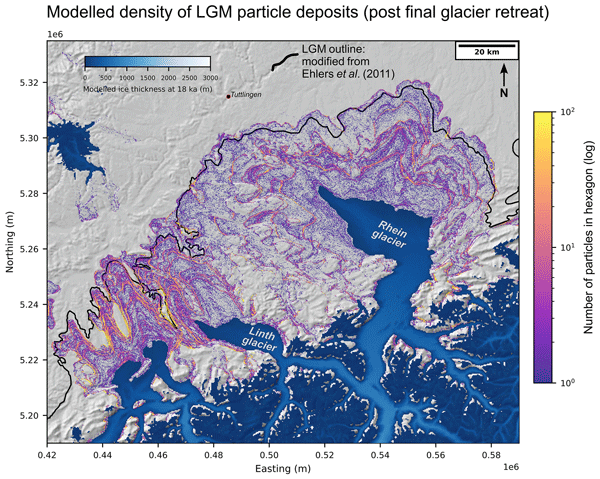
Tancrède P. M. Leger, Guillaume Jouvet, Sarah Kamleitner, Brandon D. Finley, Maxime Bernard, Balthazar Allegri, Frédéric Herman, Andreas Vieli, Andreas Henz, and Samuel U. Nussbaumer
Earth Surf. Dynam., 14, 361–389, https://doi.org/10.5194/esurf-14-361-2026, https://doi.org/10.5194/esurf-14-361-2026, 2026
Short summary
Short summary
This study reconstructs for the first time the transport-pathways of sediments by glaciers during the last glaciation of the European Alps, 24000 years ago. This helps us understand how the European Alps were shaped by past glaciations and helps us better constrain the mechanisms of iceflow, glacier erosion and the movement of large sediment masses by ice. This breakthrough is achieved by coupling a smart particle-tracking algorithm to a machine-learning-enhanced glacier evolution model.
Georgina E. King, Lily Bossin, Maxime Bernard, Melanie Kranz-Bartz, Xiaoxia Wen, Christoph Schmidt, Benny Guralnik, Frédéric Herman, Manabu Ogata, and Shigeru Sueoka
EGUsphere, https://doi.org/10.5194/egusphere-2026-2204, https://doi.org/10.5194/egusphere-2026-2204, 2026
Short summary
Short summary
Electron spin resonance (ESR) thermochronometry can be used to determine rock temperature changes, which occur as rocks move towards Earth's surface in response to uplift and surface erosion. We use samples from a known-temperature borehole to validate the method, by constraining the thermal sensitivity of quartz ESR signals in the laboratory. Whilst we are able to recover temperature successfully with the Al-centre signals, the Ti-centre signals overestimate the borehole temperature.
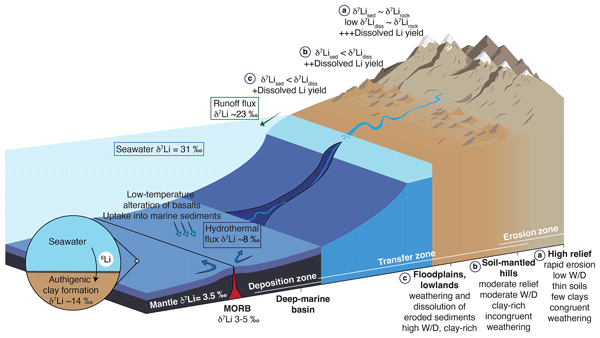
Rocio Jaimes-Gutierrez, Marine Prieur, David J. Wilson, Philip A. E. Pogge von Strandmann, Emmanuelle Pucéat, Thierry Adatte, Jorge E. Spangenberg, and Sébastien Castelltort
Clim. Past, 22, 709–727, https://doi.org/10.5194/cp-22-709-2026, https://doi.org/10.5194/cp-22-709-2026, 2026
Short summary
Short summary
How do semi-arid landscapes respond to rapid global warming? During the Palaeocene-Eocene Thermal Maximum – an extreme warming event 56 Ma ago – global lithium isotope records show a negative δ7Li excursion, suggesting an increase in weathering fluxes. In the Southern Pyrenees, we find the opposite behaviour: clay δ7Li values became ~1‰ heavier, indicating enhanced clay formation. These results suggest that regional hydroclimatic conditions can decouple regional signals from global averages.
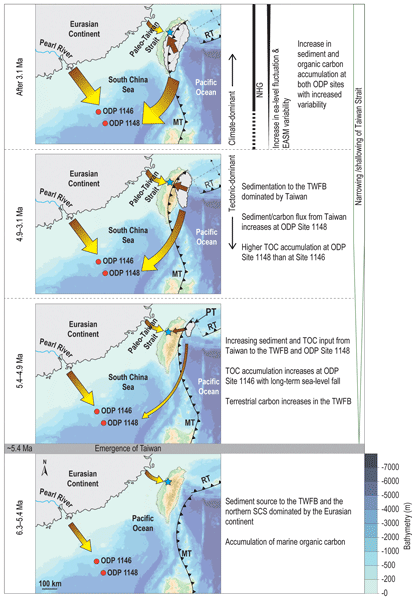
Amy I. Hsieh, Thierry Adatte, Shraddha Band, Li Lo, Romain Vaucher, Brahimsamba Bomou, Laszlo Kocsis, Pei-Ling Wang, and Samuel Jaccard
Clim. Past, 22, 227–246, https://doi.org/10.5194/cp-22-227-2026, https://doi.org/10.5194/cp-22-227-2026, 2026
Short summary
Short summary
Our study of late Miocene–early Pleistocene sedimentary records from the Taiwan Western Foreland Basin and the northern South China Sea found that physical erosion of tropical mountain belts by intense monsoon and tropical cyclone precipitation influences carbon burial by: 1) erosion and burial of organic carbon from land, and 2) supplying nutrients that enhance marine photosynthesis. This work links mountain building and erosion in tropical regions directly to carbon storage in nearby oceans.
Chloé Bouscary, Georgina E. King, Melanie Kranz-Bartz, Maxime Bernard, Rabiul H. Biswas, Lily Bossin, Arnaud Duverger, Benny Guralnik, Frédéric Herman, Ugo Nanni, Nadja Stalder, Pierre G. Valla, Vjeran Visnjevic, and Xiaoxia Wen
EGUsphere, https://doi.org/10.5194/egusphere-2025-5474, https://doi.org/10.5194/egusphere-2025-5474, 2025
Short summary
Short summary
The OSLThermo and ESRThermo MATLAB libraries simulate how luminescence signals in feldspar and electron spin resonance signals in quartz minerals accumulate and fade over time, enabling reconstruction of recent rock cooling and surface temperature changes. By sharing these tools openly, we hope to promote collaboration, reproducibility, and broader use and development of these ultra-low-temperature thermochronology methods.
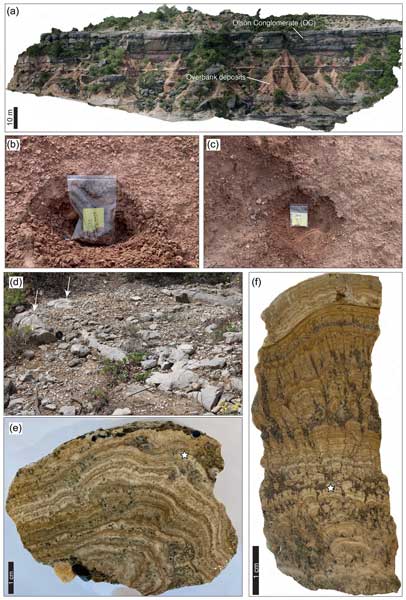
Nikhil Sharma, Jorge E. Spangenberg, Thierry Adatte, Torsten Vennemann, László Kocsis, Jean Vérité, Luis Valero, and Sébastien Castelltort
Clim. Past, 20, 935–949, https://doi.org/10.5194/cp-20-935-2024, https://doi.org/10.5194/cp-20-935-2024, 2024
Short summary
Short summary
The Middle Eocene Climatic Optimum (MECO) is an enigmatic global warming event with scarce terrestrial records. To contribute, this study presents a new comprehensive geochemical record of the MECO in the fluvial Escanilla Formation, Spain. In addition to identifying the regional preservation of the MECO, results demonstrate continental sedimentary successions, as key archives of past climate and stable isotopes, to be a powerful tool in correlating difficult-to-date fluvial successions.
Cécile Charles, Nora Khelidj, Lucia Mottet, Bao Ngan Tu, Thierry Adatte, Brahimsamba Bomou, Micaela Faria, Laetitia Monbaron, Olivier Reubi, Natasha de Vere, Stéphanie Grand, and Gianalberto Losapio
EGUsphere, https://doi.org/10.5194/egusphere-2024-991, https://doi.org/10.5194/egusphere-2024-991, 2024
Preprint archived
Short summary
Short summary
We found that novel ecosystems created by glacier retreat are first characterized by an increase in plant diversity that is driven by a shift in soil texture. Plant diversity in turn increases soil organic matter and nutrient. Soils gradually acidifies and leads to a final stage where a dominance of few plant species reduces plant diversity. Understanding plant–soil interactions is crucial to anticipate how glacier retreat shapes biodiversity and landscapes.
Morgan T. Jones, Ella W. Stokke, Alan D. Rooney, Joost Frieling, Philip A. E. Pogge von Strandmann, David J. Wilson, Henrik H. Svensen, Sverre Planke, Thierry Adatte, Nicolas Thibault, Madeleine L. Vickers, Tamsin A. Mather, Christian Tegner, Valentin Zuchuat, and Bo P. Schultz
Clim. Past, 19, 1623–1652, https://doi.org/10.5194/cp-19-1623-2023, https://doi.org/10.5194/cp-19-1623-2023, 2023
Short summary
Short summary
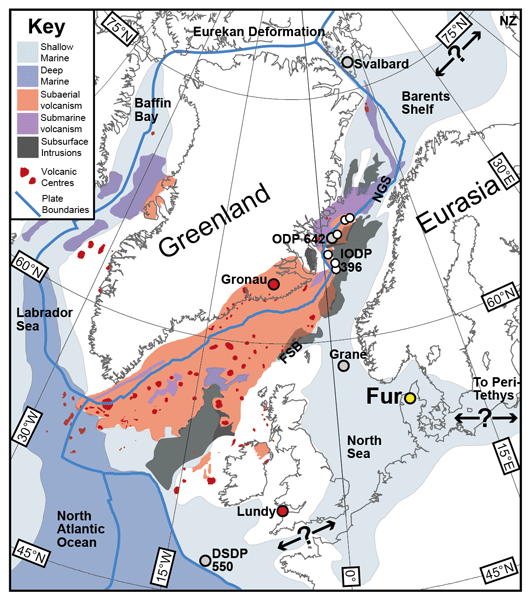
There are periods in Earth’s history when huge volumes of magma are erupted at the Earth’s surface. The gases released from volcanic eruptions and from sediments heated by the magma are believed to have caused severe climate changes in the geological past. We use a variety of volcanic and climatic tracers to assess how the North Atlantic Igneous Province (56–54 Ma) affected the oceans and atmosphere during a period of extreme global warming.
Ian Delaney, Leif Anderson, and Frédéric Herman
Earth Surf. Dynam., 11, 663–680, https://doi.org/10.5194/esurf-11-663-2023, https://doi.org/10.5194/esurf-11-663-2023, 2023
Short summary
Short summary
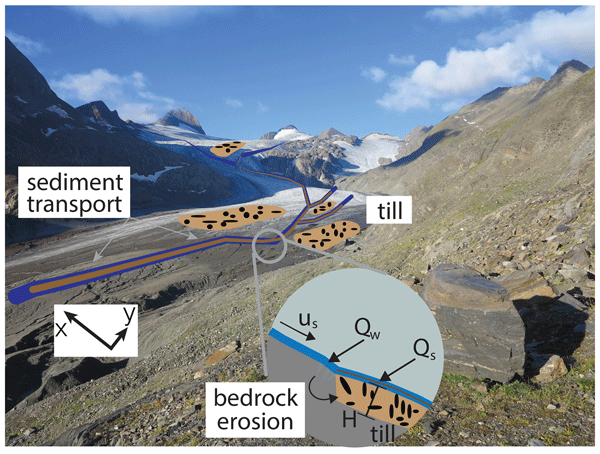
This paper presents a two-dimensional subglacial sediment transport model that evolves a sediment layer in response to subglacial sediment transport conditions. The model captures sediment transport in supply- and transport-limited regimes across a glacier's bed and considers both the creation and transport of sediment. Model outputs show how the spatial distribution of sediment and water below a glacier can impact the glacier's discharge of sediment and erosion of bedrock.
Ugo Nanni, Dirk Scherler, Francois Ayoub, Romain Millan, Frederic Herman, and Jean-Philippe Avouac
The Cryosphere, 17, 1567–1583, https://doi.org/10.5194/tc-17-1567-2023, https://doi.org/10.5194/tc-17-1567-2023, 2023
Short summary
Short summary
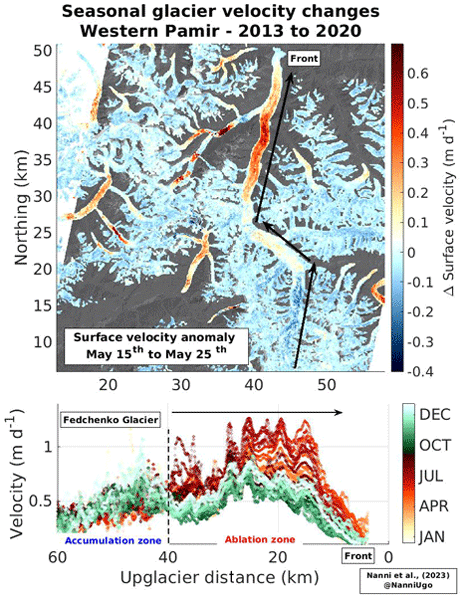
Surface melt is a major factor driving glacier movement. Using satellite images, we have tracked the movements of 38 glaciers in the Pamirs over 7 years, capturing their responses to rapid meteorological changes with unprecedented resolution. We show that in spring, glacier accelerations propagate upglacier, while in autumn, they propagate downglacier – all resulting from changes in meltwater input. This provides critical insights into the interplay between surface melt and glacier movement.
Sabí Peris Cabré, Luis Valero, Jorge E. Spangenberg, Andreu Vinyoles, Jean Verité, Thierry Adatte, Maxime Tremblin, Stephen Watkins, Nikhil Sharma, Miguel Garcés, Cai Puigdefàbregas, and Sébastien Castelltort
Clim. Past, 19, 533–554, https://doi.org/10.5194/cp-19-533-2023, https://doi.org/10.5194/cp-19-533-2023, 2023
Short summary
Short summary
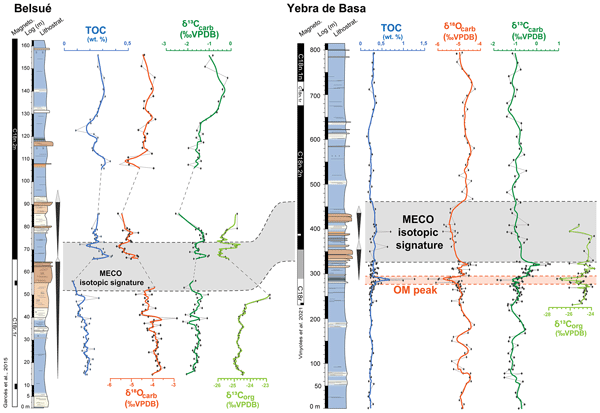
The Middle Eocene Climatic Optimum (MECO) was a global warming event that took place 40 Myr ago and lasted ca. 500 kyr, inducing physical, chemical, and biotic changes on the Earth. We use stable isotopes to identify the MECO in the Eocene deltaic deposits of the Southern Pyrenees. Our findings reveal enhanced deltaic progradation during the MECO, pointing to the important impact of global warming on fluvial sediment transport with implications for the consequences of current climate change.

Joanne Elkadi, Benjamin Lehmann, Georgina E. King, Olivia Steinemann, Susan Ivy-Ochs, Marcus Christl, and Frédéric Herman
Earth Surf. Dynam., 10, 909–928, https://doi.org/10.5194/esurf-10-909-2022, https://doi.org/10.5194/esurf-10-909-2022, 2022
Short summary
Short summary
Glacial and non-glacial processes have left a strong imprint on the landscape of the European Alps, but further research is needed to better understand their long-term effects. We apply a new technique combining two methods for bedrock surface dating to calculate post-glacier erosion rates next to a Swiss glacier. Interestingly, the results suggest non-glacial erosion rates are higher than previously thought, but glacial erosion remains the most influential on landscape evolution.
Robin Fentimen, Eline Feenstra, Andres Rüggeberg, Efraim Hall, Valentin Rime, Torsten Vennemann, Irka Hajdas, Antonietta Rosso, David Van Rooij, Thierry Adatte, Hendrik Vogel, Norbert Frank, and Anneleen Foubert
Clim. Past, 18, 1915–1945, https://doi.org/10.5194/cp-18-1915-2022, https://doi.org/10.5194/cp-18-1915-2022, 2022
Short summary
Short summary
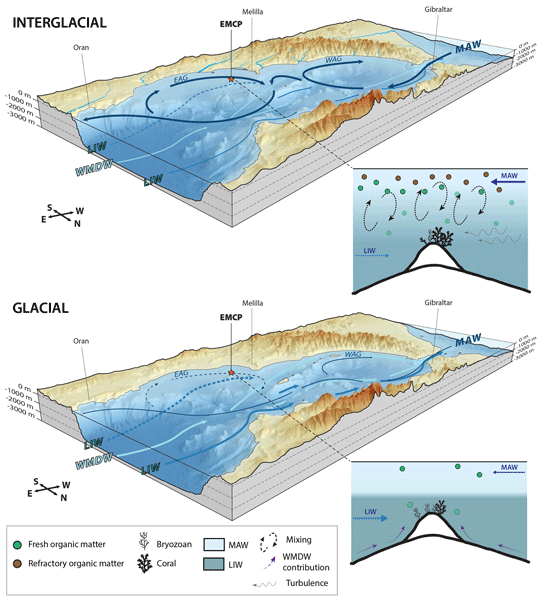
The investigation of a 9 m long sediment core recovered at ca. 300 m water depth demonstrates that cold-water coral mound build-up within the East Melilla Coral Province (southeastern Alboran Sea) took place during both interglacial and glacial periods. Based on the combination of different analytical methods (e.g. radiometric dating, micropaleontology), we propose that corals never thrived but rather developed under stressful environmental conditions.
Moussa Moustapha, Loris Deirmendjian, David Sebag, Jean-Jacques Braun, Stéphane Audry, Henriette Ateba Bessa, Thierry Adatte, Carole Causserand, Ibrahima Adamou, Benjamin Ngounou Ngatcha, and Frédéric Guérin
Biogeosciences, 19, 137–163, https://doi.org/10.5194/bg-19-137-2022, https://doi.org/10.5194/bg-19-137-2022, 2022
Short summary
Short summary
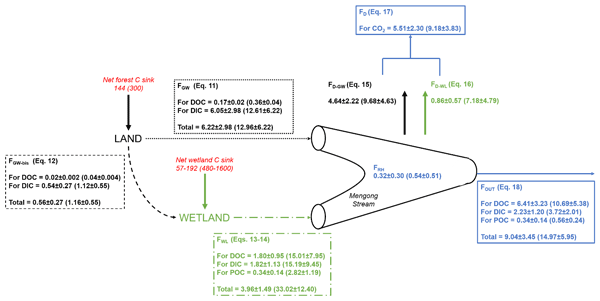
We monitor the spatio-temporal variability of organic and inorganic carbon (C) species in the tropical Nyong River (Cameroon), across groundwater and increasing stream orders. We show the significant contribution of wetland as a C source for tropical rivers. Thus, ignoring the river–wetland connectivity might lead to the misrepresentation of C dynamics in tropical watersheds. Finally, total fluvial carbon losses might offset ~10 % of the net C sink estimated for the whole Nyong watershed.
Cited articles
Abbas, G., Jomaa, S., Fink, P., Brosinsky, A., Nowak, K. M., Kümmel, S., Schkade, U., and Rode, M.: Investigating sediment sources using compound-specific stable isotopes and conventional fingerprinting methods in an agricultural loess catchment, CATENA, 246, 108336, https://doi.org/10.1016/j.catena.2024.108336, 2024. a
Abere, T., Evrard, O., Chalaux-Clergue, T., Adgo, E., Lemma, H., Verleyen, E., and Frankl, A.: Fingerprinting sediment sources using fallout radionuclides demonstrates that subsoil provides the major source of sediment in sub-humid Ethiopia, J. Soil. Sediment., 25, 1008–1021, https://doi.org/10.1007/s11368-025-03964-5, 2025. a
Allan, J. D.: Landscapes and Riverscapes: The Influence of Land Use on Stream Ecosystems, Annu. Rev. Ecol. Evol. S., 35, 257–284, https://doi.org/10.1146/annurev.ecolsys.35.120202.110122, 2004. a
Andrews, J. T., Roth, W. J., and Jennings, A. E.: Grain size and mineral variability of glacial marine sediments, J. Sediment. Res., 93, 37–49, https://doi.org/10.2110/jsr.2022.044, 2023. a
Asadi, H., Ebrahimi, E., Rahmani, M., and Alidoust, E.: Quantifying the contribution of sediment sources upstream of Anzali wetland in north Iran using the fingerprinting technique, Hydrol. Res., 56, 213–232, https://doi.org/10.2166/nh.2025.114, 2025. a
Astakhov, A., Sattarova, V., Xuefa, S., Limin, H., Aksentov, K., Alatortsev, A., Kolesnik, O., and Mariash, A.: Distribution and sources of rare earth elements in sediments of the Chukchi and East Siberian Seas, Polar Sci., 20, 148–159, https://doi.org/10.1016/j.polar.2019.05.005, 2019. a
Aster, R. C., Borchers, B., and Thurber, C. H.: Chapter Ten – Nonlinear Inverse Problems, in: Parameter Estimation and Inverse Problems (Second Edition), edited by: Aster, R. C., Borchers, B., and Thurber, C. H., Academic Press, Boston, ISBN 9780123850485, 239–252, https://doi.org/10.1016/B978-0-12-385048-5.00010-0, 2013. a
Backus, G. and Gilbert, F.: The Resolving Power of Gross Earth Data, Geophys. J. Int., 16, 169–205, https://doi.org/10.1111/j.1365-246X.1968.tb00216.x, 1968. a
Barker, R., Dixon, L., and Hooke, J.: Use of terrestrial photogrammetry for monitoring and measuring bank erosion, Earth Surf. Proc. Land., 22, 1217–1227, https://doi.org/10.1002/(SICI)1096-9837(199724)22:13<1217::AID-ESP819>3.0.CO;2-U, 1997. a
Belotti, B.: Zircon ages from suspended load as tracers for the inversion of subglacial erosion rates, Master's thesis, University of Lausanne, unpublished master's thesis, 2021. a
Bezuidenhout, J.: Investigating naturally occurring radionuclides in sediment by characterizing the catchment basin geology of rivers in South Africa, J. Appl. Geophys., 213, 105037, https://doi.org/10.1016/j.jappgeo.2023.105037, 2023. a
Blaen, P. J., Khamis, K., Lloyd, C. E., Bradley, C., Hannah, D., and Krause, S.: Real-time monitoring of nutrients and dissolved organic matter in rivers: Capturing event dynamics, technological opportunities and future directions, Sci. Total Environ., 569-570, 647–660, https://doi.org/10.1016/j.scitotenv.2016.06.116, 2016. a
Blake, W. H., Ficken, K. J., Taylor, P., Russell, M. A., and Walling, D. E.: Tracing crop-specific sediment sources in agricultural catchments, Geomorphology, 139-140, 322–329, https://doi.org/10.1016/j.geomorph.2011.10.036, 2012. a
Borrelli, P., Alewell, C., Alvarez, P., Anache, J. A. A., Baartman, J., Ballabio, C., Bezak, N., Biddoccu, M., Cerdà, A., Chalise, D., Chen, S., Chen, W., De Girolamo, A. M., Gessesse, G. D., Deumlich, D., Diodato, N., Efthimiou, N., Erpul, G., Fiener, P., Freppaz, M., Gentile, F., Gericke, A., Haregeweyn, N., Hu, B., Jeanneau, A., Kaffas, K., Kiani-Harchegani, M., Villuendas, I. L., Li, C., Lombardo, L., López-Vicente, M., Lucas-Borja, M. E., Märker, M., Matthews, F., Miao, C., Mikoš, M., Modugno, S., Möller, M., Naipal, V., Nearing, M., Owusu, S., Panday, D., Patault, E., Patriche, C. V., Poggio, L., Portes, R., Quijano, L., Rahdari, M. R., Renima, M., Ricci, G. F., Rodrigo-Comino, J., Saia, S., Samani, A. N., Schillaci, C., Syrris, V., Kim, H. S., Spinola, D. N., Oliveira, P. T., Teng, H., Thapa, R., Vantas, K., Vieira, D., Yang, J. E., Yin, S., Zema, D. A., Zhao, G., and Panagos, P.: Soil erosion modelling: A global review and statistical analysis, Sci. Total Environ., 780, 146494, https://doi.org/10.1016/j.scitotenv.2021.146494, 2021. a
Brito, P., Prego, R., Mil-Homens, M., Caçador, I., and Caetano, M.: Sources and distribution of yttrium and rare earth elements in surface sediments from Tagus estuary, Portugal, Sci. Total Environ., 621, 317–325, https://doi.org/10.1016/j.scitotenv.2017.11.245, 2018. a
Brown, A. G.: The potential use of pollen in the identification of suspended sediment sources, Earth Surf. Proc. Land., 10, 27–32, https://doi.org/10.1002/esp.3290100106, 1985. a
Caracciolo, L., Tolosana-Delgado, R., Le Pera, E., Von Eynatten, H., Arribas, J., and Tarquini, S.: Influence of granitoid textural parameters on sediment composition: Implications for sediment generation, Sediment. Geol., 280, 93–107, https://doi.org/10.1016/j.sedgeo.2012.07.005, 2012. a
Collins, A., Pulley, S., Foster, I., Gellis, A., Porto, P., and Horowitz, A.: Sediment source fingerprinting as an aid to catchment management: A review of the current state of knowledge and a methodological decision-tree for end-users, J. Environ. Manage., 194, 86–108, https://doi.org/10.1016/j.jenvman.2016.09.075, 2017. a
Collins, A. L., Blackwell, M., Boeckx, P., Chivers, C.-A., Emelko, M., Evrard, O., Foster, I., Gellis, A., Gholami, H., Granger, S., Harris, P., Horowitz, A. J., Laceby, J. P., Martinez-Carreras, N., Minella, J., Mol, L., Nosrati, K., Pulley, S., Silins, U., da Silva, Y. J., Stone, M., Tiecher, T., Upadhayay, H. R., and Zhang, Y.: Sediment source fingerprinting: benchmarking recent outputs, remaining challenges and emerging themes, J. Soil. Sediment., 20, 4160–4193, https://doi.org/10.1007/s11368-020-02755-4, 2020. a, b, c
Crompton, J. W., Flowers, G. E., and Dyck, B.: Characterization of glacial silt and clay using automated mineralogy, Ann. Glaciol., 60, 49–65, https://doi.org/10.1017/aog.2019.45, 2019. a
Das, A., Remesan, R., Chakraborty, S., Collins, A. L., and Gupta, A. K.: Comparative study using spectroscopic and mineralogical fingerprinting for suspended sediment source apportionment in a river–reservoir system, Earth Surf. Proc. Land., 49, 4355–4370, https://doi.org/10.1002/esp.5972, 2024. a, b, c
Davis, C. M. and Fox, J. F.: Sediment Fingerprinting: Review of the Method and Future Improvements for Allocating Nonpoint Source Pollution, J. Environ. Eng., 135, 490–504, https://doi.org/10.1061/(ASCE)0733-9372(2009)135:7(490), 2009. a
De Doncker, F.: fdedonck/Non-Linear-XRD-Inversion: First public release – From XRD to erosion rate maps (v1.0.0), Zenodo [code], https://doi.org/10.5281/zenodo.17120374, 2025. a
De Doncker, F., Herman, F., and Fox, M.: Inversion of provenance data and sediment load into spatially varying erosion rates, Earth Surf. Proc. Land., 45, 3879–3901, https://doi.org/10.1002/esp.5008, 2020. a, b, c
Delbecque, N., Van Ranst, E., Dondeyne, S., Mouazen, A. M., Vermeir, P., and Verdoodt, A.: Geochemical fingerprinting and magnetic susceptibility to unravel the heterogeneous composition of urban soils, Sci. Total Environ., 847, 157502, https://doi.org/10.1016/j.scitotenv.2022.157502, 2022. a
Domingo, J. P. T., Ngwenya, B. T., Attal, M., David, C. P. C., and Mudd, S. M.: Geochemical fingerprinting to determine sediment source contribution and improve contamination assessment in mining-impacted floodplains in the Philippines, Appl. Geochem., 159, 105808, https://doi.org/10.1016/j.apgeochem.2023.105808, 2023. a
D'Haen, K., Verstraeten, G., and Degryse, P.: Fingerprinting historical fluvial sediment fluxes, Progress in Physical Geography: Earth and Environment, 36, 154–186, https://doi.org/10.1177/0309133311432581, 2012. a
Evrard, O., Laceby, J. P., Ficetola, G. F., Gielly, L., Huon, S., Lefèvre, I., Onda, Y., and Poulenard, J.: Environmental DNA provides information on sediment sources: A study in catchments affected by Fukushima radioactive fallout, Sci. Total Environ., 665, 873–881, https://doi.org/10.1016/j.scitotenv.2019.02.191, 2019. a
Fathabadi, A. and Jansen, J. D.: Quantifying uncertainty of sediment fingerprinting mixing models using frequentist and Bayesian methods: A case study from the Iranian loess Plateau, CATENA, 217, 106474, https://doi.org/10.1016/j.catena.2022.106474, 2022. a
Fox, M., Herman, F., Willett, S. D., and May, D. A.: A linear inversion method to infer exhumation rates in space and time from thermochronometric data, Earth Surf. Dynam., 2, 47–65, https://doi.org/10.5194/esurf-2-47-2014, 2014. a
Fryirs, K. and Gore, D.: Sediment tracing in the upper Hunter catchment using elemental and mineralogical compositions: Implications for catchment-scale suspended sediment (dis) connectivity and management, Geomorphology, 193, 112–121, 2013. a
Garzanti, E.: From static to dynamic provenance analysis – Sedimentary petrology upgraded, Sediment. Geol., 336, 3–13, https://doi.org/10.1016/j.sedgeo.2015.07.010, 2016. a
Garzanti, E., Andò, S., and Vezzoli, G.: Grain-size dependence of sediment composition and environmental bias in provenance studies, Earth Planet. Sc. Lett., 277, 422–432, https://doi.org/10.1016/j.epsl.2008.11.007, 2009. a
Gergel, S. E., Turner, M. G., Miller, J. R., Melack, J. M., and Stanley, E. H.: Landscape indicators of human impacts to riverine systems, Aquat. Sci., 64, 118–128, https://doi.org/10.1007/s00027-002-8060-2, 2002. a
Gholami, H., Jafari TakhtiNajad, E., Collins, A. L., and Fathabadi, A.: Monte Carlo fingerprinting of the terrestrial sources of different particle size fractions of coastal sediment deposits using geochemical tracers: some lessons for the user community, Environ. Sci. Pollut. Res., 26, 13560–13579, https://doi.org/10.1007/s11356-019-04857-0, 2019. a
Grimshaw, D. and Lewin, J.: Source identification for suspended sediments, J. Hydrol., 47, 151–162, https://doi.org/10.1016/0022-1694(80)90053-0, 1980. a
Haddadchi, A., Ryder, D. S., Evrard, O., and Olley, J.: Sediment fingerprinting in fluvial systems: review of tracers, sediment sources and mixing models, Int. J. Sediment Res., 28, 560–578, https://doi.org/10.1016/S1001-6279(14)60013-5, 2013. a
Haldorsen, S.: Grain-size distribution of subglacial till and its realtion to glacial scrushing and abrasion, Boreas, 10, 91–105, https://doi.org/10.1111/j.1502-3885.1981.tb00472.x, 1981. a
Hamel, P., Chaplin-Kramer, R., Sim, S., and Mueller, C.: A new approach to modeling the sediment retention service (InVEST 3.0): Case study of the Cape Fear catchment, North Carolina, USA, Sci. Total Environ., 524–525, 166–177, https://doi.org/10.1016/j.scitotenv.2015.04.027, 2015. a
Hatfield, R. G. and Maher, B. A.: Fingerprinting upland sediment sources: particle size-specific magnetic linkages between soils, lake sediments and suspended sediments, Earth Surf. Proc. Land., 34, 1359–1373, https://doi.org/10.1002/esp.1824, 2009. a
Issaka, S. and Ashraf, M. A.: Impact of soil erosion and degradation on water quality: a review, Geology, Ecology, and Landscapes, 1, 1–11, https://doi.org/10.1080/24749508.2017.1301053, 2017. a
Iverson, N. R., Hooyer, T. S., and Hooke, R. L.: A laboratory study of sediment deformation: stress heterogeneity and grain-size evolution, Ann. Glaciol., 22, 167–175, https://doi.org/10.3189/1996AoG22-1-167-175, 1996. a
Klages, M. G. and Hsieh, Y. P.: Suspended Solids Carried by the Gallatin River of Southwestern Montana: II. Using Mineralogy for Inferring Sources, J. Environ. Qual., 4, 68–73, https://doi.org/10.2134/jeq1975.00472425000400010016x, 1975. a, b, c
Kobe, S. L.: Ubuntu as a spirituality of liberation for black theology of liberation, HTS Teologiese Studies/Theological Studies, 77, https://doi.org/10.4102/hts.v77i3.6176, 2021. a
Laceby, J. P., Evrard, O., Smith, H. G., Blake, W. H., Olley, J. M., Minella, J. P., and Owens, P. N.: The challenges and opportunities of addressing particle size effects in sediment source fingerprinting: A review, Earth-Sci. Rev., 169, 85–103, https://doi.org/10.1016/j.earscirev.2017.04.009, 2017. a
Lafuente, B., Downs, R. T., Yang, H., and Stone, N.: The power of databases: The RRUFF project, Highlights in Mineralogical Crystallography, edited by: Armbruster, T. and Danisi, R. M., De Gruyter (O), Berlin, München, Boston, 1–30, https://doi.org/10.1515/9783110417104-003, 2016. a
Li, T., Sun, G., Yang, C., Liang, K., Ma, S., Huang, L., and Luo, W.: Source apportionment and source-to-sink transport of major and trace elements in coastal sediments: Combining positive matrix factorization and sediment trend analysis, Sci. Total Environ., 651, 344–356, https://doi.org/10.1016/j.scitotenv.2018.09.198, 2019. a
Lipp, A. G., Roberts, G. G., Whittaker, A. C., Gowing, C. J. B., and Fernandes, V. M.: Source Region Geochemistry From Unmixing Downstream Sedimentary Elemental Compositions, Geochem. Geophy., Geosy., 22, e2021GC009838, https://doi.org/10.1029/2021GC009838, 2021. a
Martínez-Carreras, N., Krein, A., Gallart, F., Iffly, J. F., Pfister, L., Hoffmann, L., and Owens, P. N.: Assessment of different colour parameters for discriminating potential suspended sediment sources and provenance: A multi-scale study in Luxembourg, Geomorphology, 118, 118–129, https://doi.org/10.1016/j.geomorph.2009.12.013, 2010. a
Menke, W.: Chapter 9 – Nonlinear Inverse Problems, in: Geophysical Data Analysis: Discrete Inverse Theory (Third Edition), edited by: Menke, W., Academic Press, Boston, ISBN 9780123971609, 163–188, https://doi.org/10.1016/B978-0-12-397160-9.00009-6, 2012. a
Moore, D. and Reynolds, J.: X-ray Diffraction and the Identification and Analysis of Clay Minerals, Oxford University Press, New-York, 378–379, https://doi.org/10.1346/CCMN.1990.0380416, 1990. a
Nibourel, L., Herman, F., Cox, S. C., Beyssac, O., and Lavé, J.: Provenance analysis using Raman spectroscopy of carbonaceous material: A case study in the Southern Alps of New Zealand, J. Geophys. Res.-Earth, 120, 2056–2079, https://doi.org/10.1002/2015JF003541, 2015. a
Niu, B., Zhang, X. J., Qu, J., Liu, B., Homan, J., Tan, L., and An, Z.: Using multiple composite fingerprints to quantify source contributions and uncertainties in an arid region, J. Soil. Sediment., 20, 1097–1111, https://doi.org/10.1007/s11368-019-02424-1, 2020. a, b, c
Nukazawa, K., Itakiyo, T., Ito, K., Sato, S., Oishi, H., and Suzuki, Y.: Mineralogical fingerprinting to characterize spatial distribution of coastal and riverine sediments in southern Japan, CATENA, 203, 105323, https://doi.org/10.1016/j.catena.2021.105323, 2021. a
Olley, J. M., Murray, A. S., Mackenzie, D. H., and Edwards, K.: Identifying sediment sources in a gullied catchment using natural and anthropogenic radioactivity, Water Resour. Res., 29, 1037–1043, https://doi.org/10.1029/92WR02710, 1993. a
Papanicolaou, A. N., Fox, J. F., and Marshall, J.: Soil fingerprinting in the Palouse Basin, USA, using stable carbon and nitrogen isotopes, Int. J. Sediment Res., 18, 278–284, 2003. a
Poesen, J.: Soil erosion in the Anthropocene: Research needs, Earth Surf. Proc. Land., 43, 64–84, https://doi.org/10.1002/esp.4250, 2018. a
Poulenard, J., Perrette, Y., Fanget, B., Quetin, P., Trevisan, D., and Dorioz, J.: Infrared spectroscopy tracing of sediment sources in a small rural watershed (French Alps), Sci. Total Environ., 407, 2808–2819, https://doi.org/10.1016/j.scitotenv.2008.12.049, 2009. a
Saylor, J., Sundell, K., and Sharman, G.: Characterizing sediment sources by non-negative matrix factorization of detrital geochronological data, Earth Planet. Sc. Lett., 512, 46–58, https://doi.org/10.1016/j.epsl.2019.01.044, 2019. a
Torres Astorga, R., Garcias, Y., Borgatello, G., Velasco, H., Padilla, R., Dercon, G., and Mabit, L.: Use of geochemical fingerprints to trace sediment sources in an agricultural catchment of Argentina, International Soil and Water Conservation Research, 8, 410–417, https://doi.org/10.1016/j.iswcr.2020.10.006, 2020. a
Vanden Bygaart, A. J. and Protz, R.: Bomb-fallout 137Cs as a marker of geomorphic stability in dune sands and soils, Pinery Provincial Park, Ontario, Canada, Earth Surf. Proc. Land., 26, 689–700, https://doi.org/10.1002/esp.215, 2001. a
Von Eynatten, H., Tolosana-Delgado, R., and Karius, V.: Sediment generation in modern glacial settings: Grain-size and source-rock control on sediment composition, Sediment. Geol., 280, 80–92, https://doi.org/10.1016/j.sedgeo.2012.03.008, 2012. a
Walden, J., Slattery, M., and Burt, T.: Use of mineral magnetic measurements to fingerprint suspended sediment sources: approaches and techniques for data analysis, J. Hydrol., 202, 353–372, https://doi.org/10.1016/S0022-1694(97)00078-4, 1997. a
Wall, G. J. and Wilding, L. P.: Mineralogy and Related Parameters of Fluvial Suspended Sediments in Northwestern Ohio, J. Environ. Qual., 5, 168–173, https://doi.org/10.2134/jeq1976.00472425000500020012x, 1976. a, b
Walling, D. E.: The Impact of global change on erosion and sediment transport by rivers, UNESCO 2009, ISBN 9789231041358, 2009. a
Walling, D. E., Peart, M. R., Oldfield, F., and Thompson, R.: Suspended sediment sources identified by magnetic measurements, Nature, 281, 110–113, https://doi.org/10.1038/281110a0, 1979. a, b
Weir, A. H., Ormerod, E. C., and El Mansey, I. M. I.: Clay mineralogy of sediments of the western Nile Delta, Clay Miner., 10, 369–386, https://doi.org/10.1180/claymin.1975.010.5.04, 1975. a, b
Wilson, P., Clark, R., McAdam, J. H., and Cooper, E. A.: Soil erosion in the Falkland Islands: an assessment, Appl. Geogr., 13, 329–352, https://doi.org/10.1016/0143-6228(93)90036-Z, 1993. a
Yang, Y., Xu, J., Chen, J., Ye, W., Ran, L., Wang, K., Lu, H., Tang, X., Wang, D., Xie, D., Ni, J., Cheng, Y., and Chen, F.: Application of mass balance and unmixing model to trace sediment sources in an agricultural catchment, CATENA, 252, 108846, https://doi.org/10.1016/j.catena.2025.108846, 2025. a, b, c, d
Short summary
Sediments carried by rivers can damage infrastructure, affect ecosystems, and alter landscapes, yet it is often unclear where these sediments come from, especially in regions hidden beneath ice. We developed a simple way to trace their origins by shining X-rays on crushed rocks and sediments. The resulting X-ray signals act like fingerprints that can be matched to source rocks, revealing where sediments come from and allowing us to map erosion across landscapes.
Sediments carried by rivers can damage infrastructure, affect ecosystems, and alter landscapes,...


