
Articles | Volume 14, issue 3
https://doi.org/10.5194/esurf-14-469-2026
© Author(s) 2026. This work is distributed under
the Creative Commons Attribution 4.0 License.
the Creative Commons Attribution 4.0 License.
https://doi.org/10.5194/esurf-14-469-2026
© Author(s) 2026. This work is distributed under
the Creative Commons Attribution 4.0 License.
the Creative Commons Attribution 4.0 License.
Research article
| 
24 Jun 2026
Research article |
| 24 Jun 2026
| 24 Jun 2026
Grain roughness controls on velocity and bed stress fields around a fully protruding obstacle in supercritical flow

Civil and Environmental Engineering Department, University of Idaho, Moscow, ID, 83844, United States of America
Center for Ecohydraulics Research, University of Idaho, Boise, ID, 83702, United States of America
Oscar Link
Civil Engineering Department, Universidad de Concepción, Concepción, Chile
Related authors
Angel D. Monsalve, Samuel R. Anderson, Nicole M. Gasparini, and Elowyn M. Yager
Geosci. Model Dev., 18, 3427–3451, https://doi.org/10.5194/gmd-18-3427-2025, https://doi.org/10.5194/gmd-18-3427-2025, 2025
Short summary
Short summary
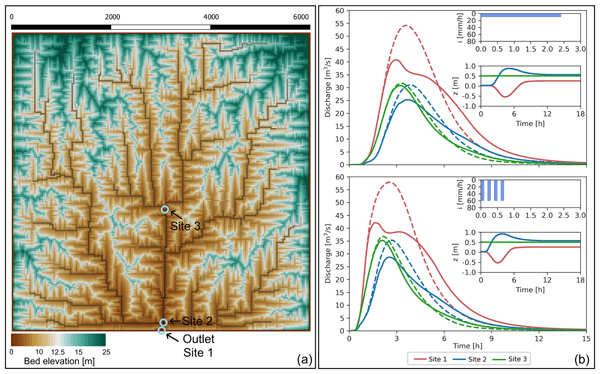
Rivers shape landscapes by moving sediments and changing their beds, but existing computer models oversimplify these processes by only considering erosion. We developed new software that simulates how rivers transport sediments and change over time through both erosion and deposition. This helps scientists and engineers better predict river behavior for water management, flood prevention, and ecosystem protection.
Rocío Coloma, Vicente Saenger, Felipe Link, and Oscar Link
Nat. Hazards Earth Syst. Sci., 26, 2525–2550, https://doi.org/10.5194/nhess-26-2525-2026, https://doi.org/10.5194/nhess-26-2525-2026, 2026
Short summary
Short summary
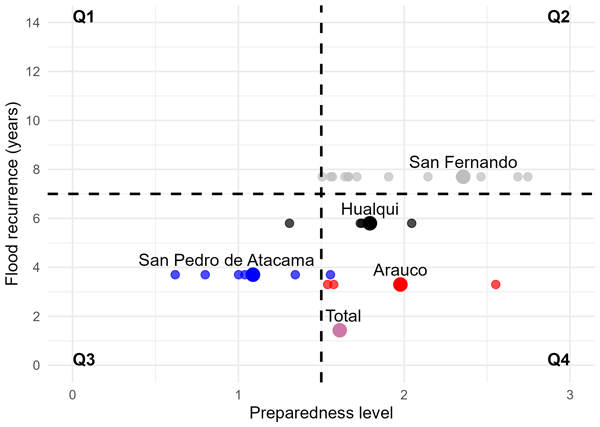
Based on a survey of 1007 residents in four different localities of Chile exposed to river floods, this study builds and applies a framework for assessment of flood risk perception and flood behaviour at the individual, household, neighbourhood and municipality levels. Obtained results suggest that risk communication and risk management strategies should be adapted to focus on the needs of specific neighbourhoods exposed to floods.
Alonso Pizarro, Oscar Link, and Demetris Koutsoyiannis
EGUsphere, https://doi.org/10.5194/egusphere-2025-6530, https://doi.org/10.5194/egusphere-2025-6530, 2026
Short summary
Short summary
We explored why bridge foundations erode over time and why floods alone do not explain this risk. Using many simulated river flows linked to a model that includes erosion and sediment refilling, we found that scour is highly variable, persistent, and only weakly linked to flood extremes. Sediment coming from upstream strongly alters erosion patterns. These results show that common design methods can misjudge risk, highlighting the need to account for uncertainty in safer bridge design.
Angel D. Monsalve, Samuel R. Anderson, Nicole M. Gasparini, and Elowyn M. Yager
Geosci. Model Dev., 18, 3427–3451, https://doi.org/10.5194/gmd-18-3427-2025, https://doi.org/10.5194/gmd-18-3427-2025, 2025
Short summary
Short summary
Rivers shape landscapes by moving sediments and changing their beds, but existing computer models oversimplify these processes by only considering erosion. We developed new software that simulates how rivers transport sediments and change over time through both erosion and deposition. This helps scientists and engineers better predict river behavior for water management, flood prevention, and ecosystem protection.
Cited articles
Apsilidis, N., Diplas, P., Dancey, C. L., and Bouratsis, P.: Time-resolved flow dynamics and Reynolds number effects at a wall–cylinder junction, J. Fluid Mech., 776, 475–511, https://doi.org/10.1017/jfm.2015.341, 2015.
Benson, A. H.: The horseshoe vortex in super-critical flow, in: Proceedings of the 26th IAHR World Congress, 26th IAHR World Congress, 20–24, ISBN 978-0727720566, 1995.
Berberović, E., Van Hinsberg, N. P., Jakirlić, S., Roisman, I. V., and Tropea, C.: Drop impact onto a liquid layer of finite thickness: Dynamics of the cavity evolution, Phys. Rev. E, 79, 036306, https://doi.org/10.1103/PhysRevE.79.036306, 2009.
Bouratsis, P., Diplas, P., Dancey, C. L., and Apsilidis, N.: Quantitative spatio-temporal characterization of scour at the base of a cylinder, Water, 9, 227, https://doi.org/10.3390/w9030227, 2017.
Buffington, J. M. and Montgomery, D. R.: Effects of hydraulic roughness on surface textures of gravel-bed rivers, Water Resour. Res., 35, 3507–3521, https://doi.org/10.1029/1999WR900138, 1999.
Carrivick, J. L., Smith, M. W., and Quincey, D. J.: Structure from Motion in the Geosciences, Wiley-Blackwell, 208 pp., ISBN 978-1-118-89584-9, https://doi.org/10.1002/9781118895818, 2016.
Chen, Q., Qi, M., Zhong, Q., and Li, D.: Experimental study on the multimodal dynamics of the turbulent horseshoe vortex system around a circular cylinder, Phys. Fluids, 29, 015106, https://doi.org/10.1063/1.4974523, 2017.
Curran, J. H. and Wohl, E. E.: Large woody debris and flow resistance in step-pool channels, Cascade Range, Washington, Geomorphology, 51, 141–157, https://doi.org/10.1016/S0169-555X(02)00333-1, 2003.
Dargahi, B.: The turbulent flow field around a circular cylinder, Exp. Fluids, 8, 1–12, https://doi.org/10.1007/BF00203058, 1989.
Dargahi, B.: Controlling Mechanism of Local Scouring, J. Hydraul. Eng., 116, 1197–1214, https://doi.org/10.1061/(ASCE)0733-9429(1990)116:10(1197), 1990.
Devenport, W. J. and Simpson, R. L.: Time-dependent and time-averaged turbulence structure near the nose of a wing-body junction, J. Fluid Mech., 210, 23–55, https://doi.org/10.1017/S0022112090001215, 1990.
Dey, S., Rathore, V., Penna, N., and Gaudio, R.: Hydrodynamics of flow over a gradually varied bed roughness, Phys. Fluids, 33, https://doi.org/10.1063/5.0074428, 2021.
Dissanayaka, K. D. C. R. and Tanaka, N.: Scour around the single emergent cylinder due to subcritical and supercritical approach flow conditions, ISH J. Hydraul. Eng., 29, 227–242, https://doi.org/10.1080/09715010.2023.2212632, 2023.
Escauriaza, C. and Sotiropoulos, F.: Initial stages of erosion and bed form development in a turbulent flow around a cylindrical pier, J. Geophys. Res.-Earth, 116, https://doi.org/10.1029/2010JF001749, 2011.
Fonstad, M. A.: Spatial variation in the power of mountain streams in the Sangre de Cristo Mountains, New Mexico, Geomorphology, 55, 75–96, https://doi.org/10.1016/S0169-555X(03)00133-8, 2003.
Hirt, C. W. and Nichols, B. D.: Volume of fluid (VOF) method for the dynamics of free boundaries, J. Comput. Phys., 39, 201–225, https://doi.org/10.1016/0021-9991(81)90145-5, 1981.
Hodge, R. A., Hoey, T. B., and Sklar, L. S.: Bed load transport in bedrock rivers: The role of sediment cover in grain entrainment, translation, and deposition, J. Geophys. Res., 116, F04028, https://doi.org/10.1029/2011JF002032, 2011.
Idaho C3+3 Collaboration: Falcon: High Performance Supercomputer, https://doi.org/10.7923/falcon.id, 2022.
Ippen, A. T.: High-velocity flow in open channels: A symposium: Mechanics of supercritical flow, Trans. Am. Soc. Civ. Eng., 116, 268–295, https://doi.org/10.1061/TACEAT.0006520, 1951.
Jasak, H.: OpenFOAM: Open source CFD in research and industry, Int. J. Nav. Archit. Ocean Eng., 1, 89–94, https://doi.org/10.2478/IJNAOE-2013-0011, 2009.
Javernick, L., Brasington, J., and Caruso, B.: Modeling the topography of shallow braided rivers using Structure-from-Motion photogrammetry, Geomorphology, 213, 166–182, https://doi.org/10.1016/j.geomorph.2014.01.006, 2014.
Jenssen, U. and Manhart, M.: Flow around a scoured bridge pier: a stereoscopic PIV analysis, Exp. Fluids, 61, https://doi.org/10.1007/s00348-020-03044-z, 2020.
Jenssen, U., Schanderl, W., Strobl, C., Unglehrt, L., and Manhart, M.: The viscous sublayer in front of a wall-mounted cylinder, J. Fluid Mech., 919, https://doi.org/10.1017/jfm.2021.411, 2021.
Kadivar, M., Tormey, D., and McGranaghan, G.: A review on turbulent flow over rough surfaces: Fundamentals and theories, Int. J. Thermofluids, 10, 100077, https://doi.org/10.1016/j.ijft.2021.100077, 2021.
Kirkil, G. and Constantinescu, G.: Effects of cylinder Reynolds number on the turbulent horseshoe vortex system and near wake of a surface-mounted circular cylinder, Phys. Fluids, 27, 075102, https://doi.org/10.1063/1.4923063, 2015.
Kirkil, G., Constantinescu, S. G., and Ettema, R.: Coherent Structures in the Flow Field around a Circular Cylinder with Scour Hole, J. Hydraul. Eng., 134, 572–587, https://doi.org/10.1061/(ASCE)0733-9429(2008)134:5(572), 2008.
Kothyari, U. C., Hashimoto, H., and Hayashi, K.: Effect of tall vegetation on sediment transport by channel flows, J. Hydraul. Res., 47, 700–710, https://doi.org/10.3826/jhr.2009.3317, 2009.
Lamouroux, N., Dolédec, S., and Gayraud, S.: Biological traits of stream macroinvertebrate communities: effects of microhabitat, reach, and basin filters, J. North Am. Benthol. Soc., 23, https://doi.org/10.1899/0887-3593(2004)023<0449:BTOSMC>2.0.CO;2, 2004.
Lancaster, J. and Hildrew, A. G.: Characterizing In-stream Flow Refugia, Can. J. Fish. Aquat. Sci., 50, 1663–1675, https://doi.org/10.1139/f93-187, 1993.
Laursen, E. M.: Scour in Supercritical Flow, Arizona Department of Transportation, The University of Arizona, Tucson, AZ, FHWA/AZ-88/105, 1988.
Lee, S. O. and Sturm, T. W.: Effect of Sediment Size Scaling on Physical Modeling of Bridge Pier Scour, J. Hydraul. Eng., 135, 793–802, https://doi.org/10.1061/(ASCE)HY.1943-7900.0000091, 2009.
Li, J., Qi, M., Fuhrman, D. R., and Chen, Q.: Influence of turbulent horseshoe vortex and associated bed shear stress on sediment transport in front of a cylinder, Exp. Therm. Fluid Sci., 97, 444–457, https://doi.org/10.1016/j.expthermflusci.2018.05.008, 2018.
Link, O., Klischies, K., Montalva, G., and Dey, S.: Effects of Bed Compaction on Scour at Piers in Sand-Clay Mixtures, J. Hydraul. Eng., 139, 1013–1019, https://doi.org/10.1061/(ASCE)HY.1943-7900.0000762, 2013.
Link, O., Mignot, E., Roux, S., Camenen, B., Escauriaza, C., Chauchat, J., Brevis, W., and Manfreda, S.: Scour at Bridge Foundations in Supercritical Flows: An Analysis of Knowledge Gaps, Water, 11, 1656, https://doi.org/10.3390/w11081656, 2019.
Luetzenburg, G., Kroon, A., and Bjørk, A. A.: Evaluation of the Apple iPhone 12 Pro LiDAR for an Application in Geosciences, Sci. Rep., 11, 1–9, https://doi.org/10.1038/s41598-021-01763-9, 2021.
Manga, M. and Kirchner, J. W.: Stress partitioning in streams by large woody debris, Water Resour. Res., 36, 2373–2379, https://doi.org/10.1029/2000WR900153, 2000.
Martínez, B., Guerra, M., Riviere, N., Mignot, E., and Link, O.: RANS simulation of supercritical open channel flows around obstacles, J. Hydraul. Res., 63, 1–14, https://doi.org/10.1080/00221686.2024.2446570, 2025.
Masteller, C. C. and Finnegan, N. J.: Interplay between grain protrusion and sediment entrainment in an experimental flume, J. Geophys. Res.-Earth, 122, 274–289, https://doi.org/10.1002/2016JF003943, 2017.
Menter, F., Kuntz, M., and Langtry, R.: Ten Years of Industrial Experience with the SST Turbulence Model, Turbul. Heat Mass Transf., 4, 625–632, 2003.
Mignot, E. and Riviere, N.: Bow-wave-like hydraulic jump and horseshoe vortex around an obstacle in a supercritical open channel flow, Phys. Fluids, 22, 117105, https://doi.org/10.1063/1.3505013, 2010.
Mignot, E., Moyne, T., Doppler, D., and Riviere, N.: Clear-water scouring process in a flow in supercritical regime, J. Hydraul. Eng., 142, 04015063, https://doi.org/10.1061/(ASCE)HY.1943-7900.0001100, 2016.
Moeckel, W. E.: Approximate method for predicting form and location of detached shock waves ahead of plane or axially symmetric bodies, Lewis Flight Propulsion Laboratory, Cleveland, Ohio, 19930082597, https://ntrs.nasa.gov/citations/19930082597 (last access: 22 June 2026), 1949.
Monsalve, A.: angelmons/EGUSPHERE-2025-4327: Initial public release (v1.0.0), Zenodo [code], https://doi.org/10.5281/zenodo.20650590, 2026.
Monsalve, A. and Yager, E. M.: Bed Surface Adjustments to Spatially Variable Flow in Low Relative Submergence Regimes, Water Resour. Res., 53, 9350–9367, https://doi.org/10.1002/2017WR020845, 2017.
Monsalve, A. D., Yager, E. M., Turowski, J. M., and Rickenmann, D.: A probabilistic formulation of bed load transport to include spatial variability of flow and surface grain size distributions, Water Resour. Res., 52, 3579–3598, https://doi.org/10.1002/2015WR017694, 2016.
Monsalve, A., Yager, E. M., and Schmeeckle, M. W.: Effects of bedforms and large protruding grains on near-bed flow hydraulics in low relative submergence conditions., J. Geophys. Res.-Earth, 122, 1845–1866, https://doi.org/10.1002/2016JF004152, 2017.
Monsalve, A., Yager, E. M., and Tonina, D.: Evaluating Apple iPhone LiDAR measurements of topography and roughness elements in coarse bedded streams, J. Ecohydraulics, 1–11, https://doi.org/10.1080/24705357.2023.2204087, 2023.
Monsalve, A., Reeder, W. J., Adler, K., Moreto, J. R., Liu, X., and Tonina, D.: Spatial variations of velocity and pressure fields induced by large-scale (single stalk) and small-scale (sediment) roughness elements, Adv. Water Resour., 199, 104954, https://doi.org/10.1016/j.advwatres.2025.104954, 2025.
Morgan, J. A., Brogan, D. J., and Nelson, P. A.: Application of Structure-from-Motion photogrammetry in laboratory flumes, Geomorphology, 276, 125–143, https://doi.org/10.1016/j.geomorph.2016.10.021, 2017.
Nepf, H. M.: Flow and Transport in Regions with Aquatic Vegetation, Annu. Rev. Fluid Mech., 44, 123–142, https://doi.org/10.1146/annurev-fluid-120710-101048, 2012.
Paik, J., Escauriaza, C., and Sotiropoulos, F.: On the bimodal dynamics of the turbulent horseshoe vortex system in a wing-body junction, Phys. Fluids, 19, 045107, https://doi.org/10.1063/1.2716813, 2007.
Paik, J., Escauriaza, C., and Sotiropoulos, F.: Coherent structure dynamics in turbulent flows past in-stream structures: Some insights gained via numerical simulation, J. Hydraul. Eng., 136, 981–993, https://doi.org/10.1061/(ASCE)HY.1943-7900.0000089, 2010.
Pope, S. B.: Turbulent Flows, 1st edn., Cambridge University Press, https://doi.org/10.1017/CBO9780511840531, 2000.
Raudkivi, A. J.: Functional trends of scour at bridge piers, J. Hydraul. Eng., 112, 1–13, https://doi.org/10.1061/(ASCE)0733-9429(1986)112:1(1), 1986.
Riviere, N., Vouaillat, G., Launay, G., and Mignot, E.: Emerging obstacles in supercritical open-channel flows: Detached hydraulic jump versus wall-jet-like bow wave, J. Hydraul. Eng., 143, 04017011, https://doi.org/10.1061/(ASCE)HY.1943-7900.0001291, 2017.
Roux, S., Link, O., Riviere, N., and Mignot, E.: Live-bed pier scour in supercritical open-channel flows, J. Hydraul. Res., 60, 675–685, https://doi.org/10.1080/00221686.2022.2041499, 2022.
Rusche, H.: Computational fluid dynamics of dispersed two-phase flows at high phase fractions, PhD thesis, Imperial College London, London, UK, http://hdl.handle.net/10044/1/8110 (last access: 22 June 2026), 2002.
Schanderl, W. and Manhart, M.: Reliability of wall shear stress estimations of the flow around a wall-mounted cylinder, Comput. Fluids, 128, 16–29, https://doi.org/10.1016/j.compfluid.2016.01.002, 2016.
Schanderl, W., Jenssen, U., and Manhart, M.: Near-Wall Stress Balance in Front of a Wall-Mounted Cylinder, Flow Turbul. Combust., 99, 665–684, https://doi.org/10.1007/s10494-017-9865-3, 2017a.
Schanderl, W., Jenssen, U., Strobl, C., and Manhart, M.: The structure and budget of turbulent kinetic energy in front of a wall-mounted cylinder, J. Fluid Mech., 827, 285–321, https://doi.org/10.1017/jfm.2017.486, 2017b.
Sheppard, D. M., Odeh, M., and Glasser, T.: Large Scale Clear-Water Local Pier Scour Experiments, J. Hydraul. Eng., 130, 957–963, https://doi.org/10.1061/(ASCE)0733-9429(2004)130:10(957), 2004.
Smith, H. E. J., Monsalve, A. D., Turowski, J. M., Rickenmann, D., and Yager, E. M.: Controls of local grain size distribution, bed structure and flow conditions on sediment mobility, Earth Surf. Proc. Land., 48, 1990–2004, https://doi.org/10.1002/esp.5599, 2023.
Soto, J., Link, O., and Brevis, W.: Elucidating the importance of sediment avalanches in scour at obstacles, J. Hydraul. Res., 60, 62–73, https://doi.org/10.1080/00221686.2020.1866694, 2022.
Strelets, M.: Detached eddy simulation of massively separated flows, in: 39th Aerospace Sciences Meeting and Exhibit, Aerospace Sciences Meetings, AIAA Paper 2001-0878, https://doi.org/10.2514/6.2001-879, 2001.
Tritico, H. M. and Hotchkiss, R. H.: Unobstructed and obstructed turbulent flow in gravel bed rivers, J. Hydraul. Eng., 131, 635–645, https://doi.org/10.1061/(ASCE)0733-9429(2005)131:8(635), 2005.
Unglehrt, L., Jenssen, U., Kurz, F., Schanderl, W., Kreuzinger, J., Schwertfirm, F., and Manhart, M.: Large–Eddy Simulation of the flow inside a scour hole around a circular cylinder using a cut cell immersed boundary method, Flow Turbul. Combust., 109, 893–929, https://doi.org/10.1007/s10494-022-00379-x, 2022.
Van Leer, B.: Towards the ultimate conservative difference scheme. II. Monotonicity and conservation combined in a second-order scheme, J. Comput. Phys., 14, 361–370, https://doi.org/10.1016/0021-9991(74)90019-9, 1974.
Weller, H., Greenshields, C., Bainbridge, W., Peltola, J., Niemi, T., Schlegel, F., Lehnigk, R., Kníř, J., and Contino, F.: OpenFOAM, version 9, The OpenFOAM Foundation Ltd, London, UK [code], https://openfoam.org/version/9/ (last access: 1 June 2026), 2021.
Weller, H. G., Tabor, G., Jasak, H., and Fureby, C.: A tensorial approach to computational continuum mechanics using object-oriented techniques, Comput. Phys., 12, 620–631, https://doi.org/10.1063/1.168744, 1998.
Woodget, A. S., Carbonneau, P. E., Visser, F., and Maddock, I. P.: Quantifying submerged fluvial topography using hyperspatial resolution UAS imagery and structure from motion photogrammetry, Earth Surf. Process. Landf., 40, 47–64, https://doi.org/10.1002/esp.3613, 2015.
Wu, W. and Piomelli, U.: Effects of surface roughness on a separating turbulent boundary layer, J. Fluid Mech., 841, 552–580, https://doi.org/10.1017/jfm.2018.101, 2018.
Yager, E. M., Dietrich, W. E., Kirchner, J. W., and McArdell, B. W.: Patch dynamics and stability in steep, rough streams, J. Geophys. Res.-Earth, 117, 1–16, https://doi.org/10.1029/2011JF002253, 2012.
Yager, E. M., Schmeeckle, M. W., and Badoux, A.: Resistance Is Not Futile: Grain Resistance Controls on Observed Critical Shields Stress Variations, J. Geophys. Res.-Earth, 123, 3308–3322, https://doi.org/10.1029/2018JF004817, 2018.
Yager, E. M., Shim, J., Hodge, R., Monsalve, A., Tonina, D., Johnson, J. P. L., and Telfer, L.: Pro+: Automated protrusion and critical shear stress estimates from 3D point clouds of gravel beds, Earth Surf. Process. Landf., 49, 2155–2170, https://doi.org/10.1002/esp.5822, 2024.
Zalesak, S. T.: Fully multidimensional flux-corrected transport algorithms for fluids, J. Comput. Phys., 31, 335–362, https://doi.org/10.1016/0021-9991(79)90051-2, 1979.
Zanke, U.: On the influence of turbulence on the initiation of sediment motion, Int. J. Sediment Res., 18, 17–31, 2003.
Short summary
Mountain rivers create fast-flowing water that behaves differently around obstacles compared to slower flows. We used computer simulations and digital bed representation to study how rough riverbeds affect water flow. Our research shows individual grains completely change water movement, creating chaotic patterns instead of organized flows. This makes forces on riverbeds much more variable than previously thought, important for understanding how mountain rivers shape landscapes.
Mountain rivers create fast-flowing water that behaves differently around obstacles compared to...


