
Articles | Volume 14, issue 5
https://doi.org/10.5194/esurf-14-729-2026
© Author(s) 2026. This work is distributed under
the Creative Commons Attribution 4.0 License.
the Creative Commons Attribution 4.0 License.
https://doi.org/10.5194/esurf-14-729-2026
© Author(s) 2026. This work is distributed under
the Creative Commons Attribution 4.0 License.
the Creative Commons Attribution 4.0 License.
Research article
| 
08 Sep 2026
Research article |
| 08 Sep 2026
| 08 Sep 2026
Seasonal and inter-annual evolution of the deformation of two Arctic landslides
Andreas Aspaas
CORRESPONDING AUTHOR

The Njord Centre, Departments of Geosciences and Physics, University of Oslo, Oslo, Norway
Section for Landslides and Avalanches, Norwegian Water Resources and Energy Directorate, Oslo, Norway
Grégory Bievre
Univ. Grenoble Alpes, Grenoble INP, Univ. Savoie Mont Blanc, CNRS, IRD, Univ. Gustave Eiffel, ISTerre, Grenoble, France
Pascal Lacroix
Univ. Grenoble Alpes, Grenoble INP, Univ. Savoie Mont Blanc, CNRS, IRD, Univ. Gustave Eiffel, ISTerre, Grenoble, France
Nadège Langet
Department of Applied Seismology, NORSAR, Kjeller, Norway
Juditha Aga
Department of Geosciences, University of Oslo, 0313 Oslo, Norway
Ingrid Skrede
Section for Landslides and Avalanches, Norwegian Water Resources and Energy Directorate, Tromsø, Norway
Lene Kristensen
Section for Landslides and Avalanches, Norwegian Water Resources and Energy Directorate, Trondheim, Norway
Bernd Etzelmüller
Department of Geosciences, University of Oslo, 0313 Oslo, Norway
François Renard
The Njord Centre, Departments of Geosciences and Physics, University of Oslo, Oslo, Norway
Univ. Grenoble Alpes, Grenoble INP, Univ. Savoie Mont Blanc, CNRS, IRD, Univ. Gustave Eiffel, ISTerre, Grenoble, France
Related authors
No articles found.
Juditha Aga, Antoni G. Lewkowicz, and Sebastian Westermann
The Cryosphere, 20, 5225–5245, https://doi.org/10.5194/tc-20-5225-2026, https://doi.org/10.5194/tc-20-5225-2026, 2026
Short summary
Short summary
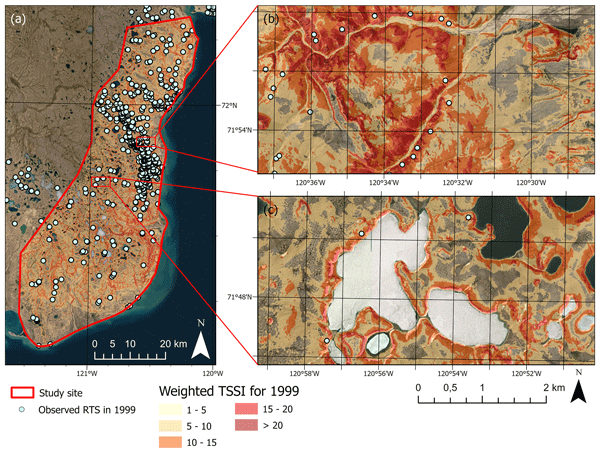
In this study, we explore the influence of a warming climate on landslides in ice-rich permafrost slopes. Using climate, terrain and soil data, we built a model that simulates permafrost thaw and its impact on slope stability over time. We tested the model on Banks Island, Canada, and it reproduced years with many new landslide observations and identified the most susceptible slopes. The model can also be applied to other permafrost regions, and to both past and future climate conditions.
Liss Marie Andreassen, Ketil Isaksen, Lukas J. Monrad-Krohn, Jogscha M. Abderhalden, Luc Girod, Jessica De Marco, Bernd Etzelmüller, Simon Oldani, and Rune Strand Ødegård
EGUsphere, https://doi.org/10.5194/egusphere-2026-3152, https://doi.org/10.5194/egusphere-2026-3152, 2026
Short summary
Short summary
Juvfonne is a small ice patch and contains the oldest ice dated in Norway so far. Juvfonne prevails due to drifting snow and can fill up after years with surface lowering. However, the reduction in area and volume over the period 2010–2025 reveal that Juvfonne is vulnerable to the current warming. Ice thickness measurements conducted in September 2025 reveal a current maximum thickness of less than 9 meters and an interpolated mean thickness of < 3 meters.
Simon Filhol, Clément Misset, Noélie Bontemps, Diego Cusicanqui, Emmanuel Paquet, Marie Dumont, Olivier Gagliardini, Pascal Lacroix, Simon Gascoin, Guillaume Thirel, Julien Brondex, Pascal Hagenmuller, Eric Larose, Philipp Schoeneich, Denis Roy, Emmanuel Thibert, Nicolas Eckert, Félix de Montety, Robin Mainieri, Alexandre Hauet, Frédéric Gottardi, Johan Berthet, Alexandre Baratier, Frédéric Liébault, Małgorzata Chmiel, Guillaume Piton, Guillaume Chambon, Guillaume James, Philippe Frey, Philip Deline, Laurent Astrade, Christian Vincent, Dominique Laigle, Alain Recking, Fatima Karbou, Adrien Mauss, Mylène Bonnefoy-Demongeot, Firmin Fontaine, Mickael Langlais, Etienne Berthier, and Antoine Blanc
EGUsphere, https://doi.org/10.5194/egusphere-2026-971, https://doi.org/10.5194/egusphere-2026-971, 2026
Short summary
Short summary
On June 21 2024, the village of La Bérarde, in the French Alps, was devastated by a flood destroying centuries old buildings. This study is an interdisciplinary work to decipher the causes and chronology of the event. The flood started with decadal rain falling on a thick snowpack. A lake observed on top of a glacier few days prior, had drained post event. With climate change, should we expect more similar compound events for alpine communities?
Benedetta Dini, Pascal Lacroix, and Marie-Pierre Doin
Nat. Hazards Earth Syst. Sci., 26, 863–879, https://doi.org/10.5194/nhess-26-863-2026, https://doi.org/10.5194/nhess-26-863-2026, 2026
Short summary
Short summary
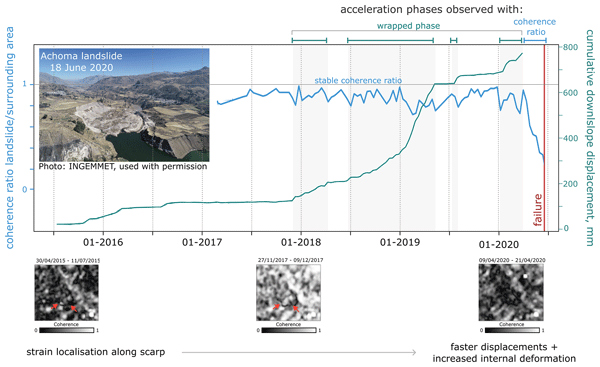
Landslides can occur without warning. Traditional satellite radar (InSAR) methods are valuable but have limitations. We show that lesser-used radar signals can act as early warning markers, revealing instability up to five years before failure in a Peruvian landslide, even when standard methods fail or underestimate displacement. These alternative radar approaches complement existing techniques and could transform early detection and targeted monitoring across large regions.
Alexandru Onaca, Flavius Sîrbu, Valentin Poncoş, Christin Hilbich, Tazio Strozzi, Petru Urdea, Răzvan Popescu, Oana Berzescu, Bernd Etzelmüller, Alfred Vespremeanu-Stroe, Mirela Vasile, Delia Teleagă, Dan Birtaş, Iosif Lopătiţă, Simon Filhol, Alexandru Hegyi, and Florina Ardelean
Earth Surf. Dynam., 13, 981–1001, https://doi.org/10.5194/esurf-13-981-2025, https://doi.org/10.5194/esurf-13-981-2025, 2025
Short summary
Short summary
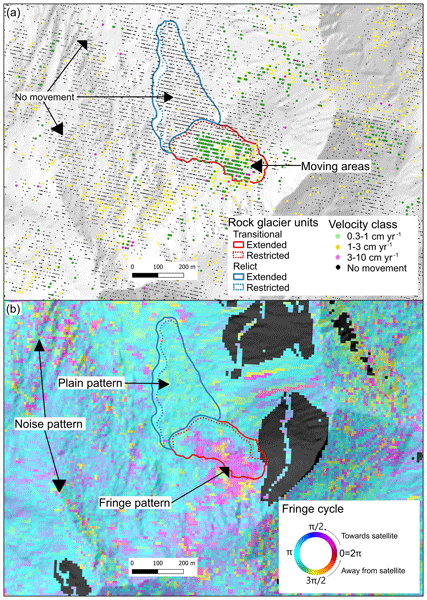
This study establishes a methodology for the study of slow-moving rock glaciers in marginal permafrost and provides the basic knowledge for understanding rock glaciers in South East Europe. By using a combination of different methods (remote sensing, geophysical survey, thermal measurements), we found out that, on the transitional rock glaciers, low ground ice content (i.e. below 20 %) produces horizontal displacements of up to 3 cm per year.
Diego Cusicanqui, Pascal Lacroix, Xavier Bodin, Benjamin Aubrey Robson, Andreas Kääb, and Shelley MacDonell
The Cryosphere, 19, 2559–2581, https://doi.org/10.5194/tc-19-2559-2025, https://doi.org/10.5194/tc-19-2559-2025, 2025
Short summary
Short summary
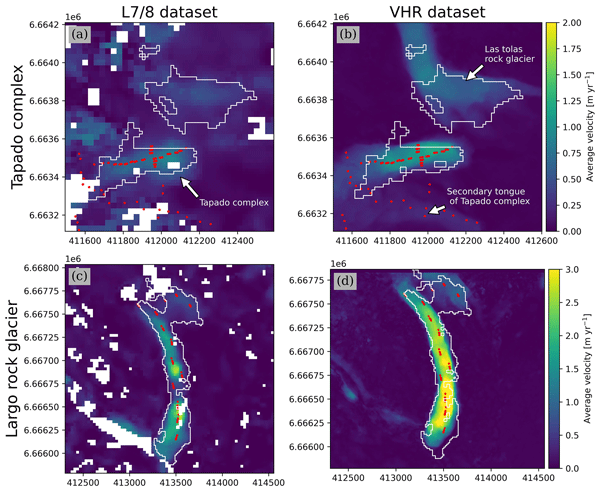
This study presents a robust methodological approach to detect and analyse rock glacier kinematics using Landsat 7/Landsat 8 imagery. In the semiarid Andes, 382 landforms were monitored, showing an average velocity of 0.37 ± 0.07 m yr⁻¹ over 24 years, with rock glaciers moving 23 % faster. Results demonstrate the feasibility of using medium-resolution optical imagery, combined with radar interferometry, to monitor rock glacier kinematics with widely available satellite datasets.
Juditha Aga, Livia Piermattei, Luc Girod, Kristoffer Aalstad, Trond Eiken, Andreas Kääb, and Sebastian Westermann
Earth Surf. Dynam., 12, 1049–1070, https://doi.org/10.5194/esurf-12-1049-2024, https://doi.org/10.5194/esurf-12-1049-2024, 2024
Short summary
Short summary
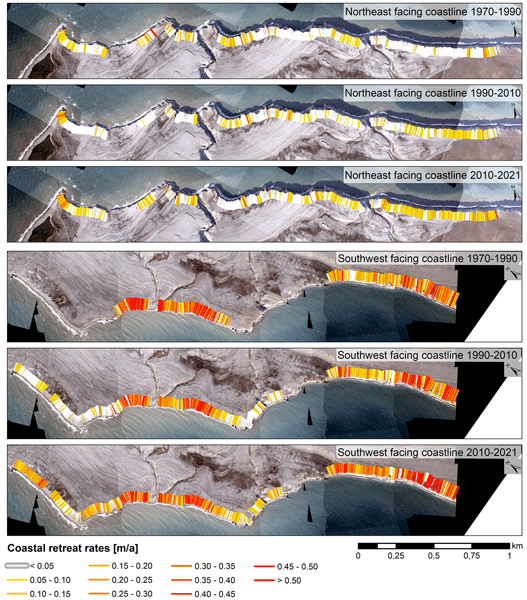
Coastal rock cliffs on Svalbard are considered to be fairly stable; however, long-term trends in coastal-retreat rates remain unknown. This study examines changes in the coastline position along Brøggerhalvøya, Svalbard, using aerial images from 1970, 1990, 2010, and 2021. Our analysis shows that coastal-retreat rates accelerate during the period 2010–2021, which coincides with increasing storminess and retreating sea ice.
Coline Bouchayer, Ugo Nanni, Pierre-Marie Lefeuvre, John Hult, Louise Steffensen Schmidt, Jack Kohler, François Renard, and Thomas V. Schuler
The Cryosphere, 18, 2939–2968, https://doi.org/10.5194/tc-18-2939-2024, https://doi.org/10.5194/tc-18-2939-2024, 2024
Short summary
Short summary
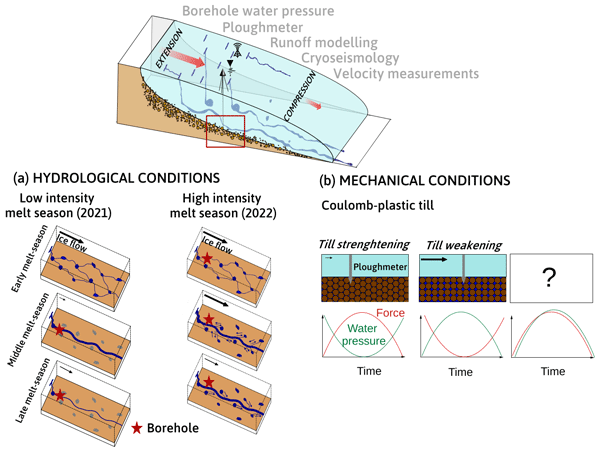
We explore the interplay between surface runoff and subglacial conditions. We focus on Kongsvegen glacier in Svalbard. We drilled 350 m down to the glacier base to measure water pressure, till strength, seismic noise, and glacier surface velocity. In the low-melt season, the drainage system adapted gradually, while the high-melt season led to a transient response, exceeding drainage capacity and enhancing sliding. Our findings contribute to discussions on subglacial hydro-mechanical processes.
Bernd Etzelmüller, Ketil Isaksen, Justyna Czekirda, Sebastian Westermann, Christin Hilbich, and Christian Hauck
The Cryosphere, 17, 5477–5497, https://doi.org/10.5194/tc-17-5477-2023, https://doi.org/10.5194/tc-17-5477-2023, 2023
Short summary
Short summary
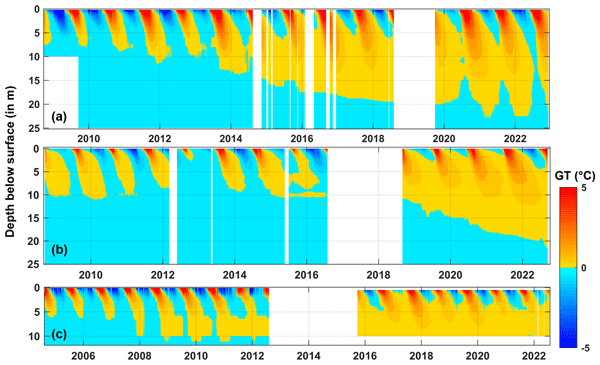
Permafrost (permanently frozen ground) is widespread in the mountains of Norway and Iceland. Several boreholes were drilled after 1999 for long-term permafrost monitoring. We document a strong warming of permafrost, including the development of unfrozen bodies in the permafrost. Warming and degradation of mountain permafrost may lead to more natural hazards.
Anatoly O. Sinitsyn, Sara Bazin, Rasmus Benestad, Bernd Etzelmüller, Ketil Isaksen, Hanne Kvitsand, Julia Lutz, Andrea L. Popp, Lena Rubensdotter, and Sebastian Westermann
EGUsphere, https://doi.org/10.5194/egusphere-2023-2950, https://doi.org/10.5194/egusphere-2023-2950, 2023
Preprint archived
Short summary
Short summary
This study looked at under the ground on Svalbard, an archipelago close to the North Pole. We found something very surprising – there is water under the all year around frozen soil. This was not known before. This water could be used for drinking if we manage it carefully. This is important because getting clean drinking water is very difficult in Svalbard, and other Arctic places. Also, because the climate is getting warmer, there might be even more water underground in the future.
Juditha Aga, Julia Boike, Moritz Langer, Thomas Ingeman-Nielsen, and Sebastian Westermann
The Cryosphere, 17, 4179–4206, https://doi.org/10.5194/tc-17-4179-2023, https://doi.org/10.5194/tc-17-4179-2023, 2023
Short summary
Short summary
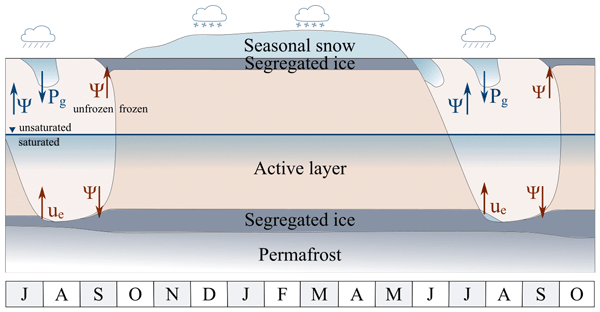
This study presents a new model scheme for simulating ice segregation and thaw consolidation in permafrost environments, depending on ground properties and climatic forcing. It is embedded in the CryoGrid community model, a land surface model for the terrestrial cryosphere. We describe the model physics and functionalities, followed by a model validation and a sensitivity study of controlling factors.
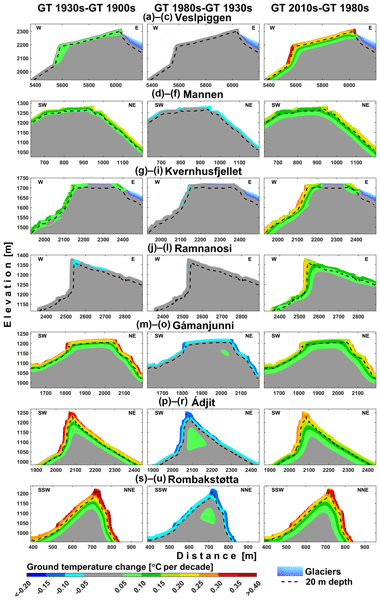
Justyna Czekirda, Bernd Etzelmüller, Sebastian Westermann, Ketil Isaksen, and Florence Magnin
The Cryosphere, 17, 2725–2754, https://doi.org/10.5194/tc-17-2725-2023, https://doi.org/10.5194/tc-17-2725-2023, 2023
Short summary
Short summary
We assess spatio-temporal permafrost variations in selected rock walls in Norway over the last 120 years. Ground temperature is modelled using the two-dimensional ground heat flux model CryoGrid 2D along nine profiles. Permafrost probably occurs at most sites. All simulations show increasing ground temperature from the 1980s. Our simulations show that rock wall permafrost with a temperature of −1 °C at 20 m depth could thaw at this depth within 50 years.
Sebastian Westermann, Thomas Ingeman-Nielsen, Johanna Scheer, Kristoffer Aalstad, Juditha Aga, Nitin Chaudhary, Bernd Etzelmüller, Simon Filhol, Andreas Kääb, Cas Renette, Louise Steffensen Schmidt, Thomas Vikhamar Schuler, Robin B. Zweigel, Léo Martin, Sarah Morard, Matan Ben-Asher, Michael Angelopoulos, Julia Boike, Brian Groenke, Frederieke Miesner, Jan Nitzbon, Paul Overduin, Simone M. Stuenzi, and Moritz Langer
Geosci. Model Dev., 16, 2607–2647, https://doi.org/10.5194/gmd-16-2607-2023, https://doi.org/10.5194/gmd-16-2607-2023, 2023
Short summary
Short summary
The CryoGrid community model is a new tool for simulating ground temperatures and the water and ice balance in cold regions. It is a modular design, which makes it possible to test different schemes to simulate, for example, permafrost ground in an efficient way. The model contains tools to simulate frozen and unfrozen ground, snow, glaciers, and other massive ice bodies, as well as water bodies.
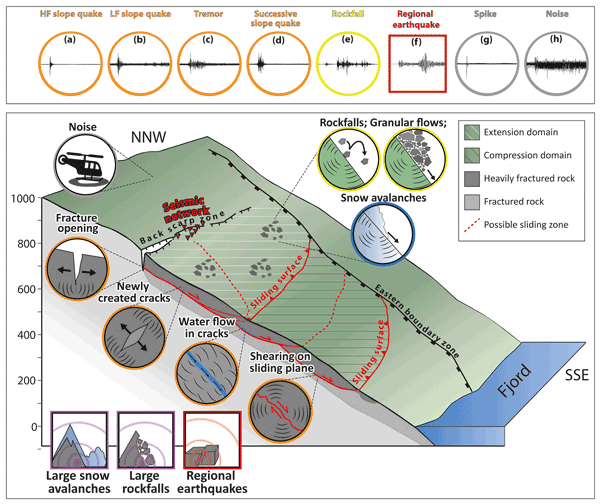
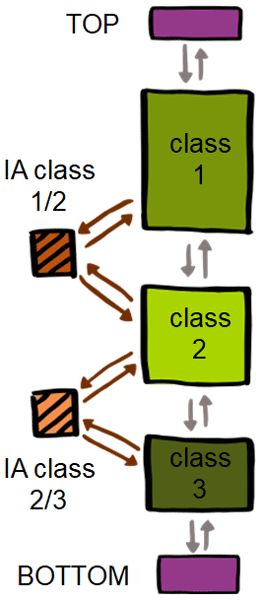
Nadège Langet and Fred Marcus John Silverberg
Earth Surf. Dynam., 11, 89–115, https://doi.org/10.5194/esurf-11-89-2023, https://doi.org/10.5194/esurf-11-89-2023, 2023
Short summary
Short summary
Microseismic events recorded on the Åknes rock slope in Norway during the past 15 years are automatically divided into eight classes. The results are analysed and compared to meteorological data, showing a strong increase in the microseismic activity in spring mainly due to freezing and thawing processes.
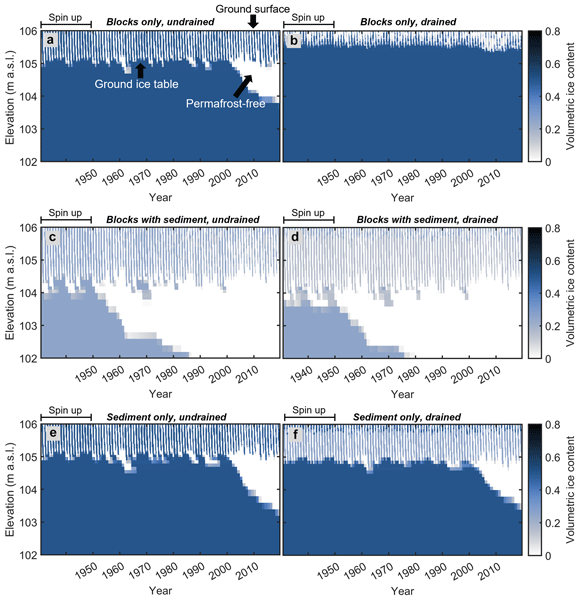
Cas Renette, Kristoffer Aalstad, Juditha Aga, Robin Benjamin Zweigel, Bernd Etzelmüller, Karianne Staalesen Lilleøren, Ketil Isaksen, and Sebastian Westermann
Earth Surf. Dynam., 11, 33–50, https://doi.org/10.5194/esurf-11-33-2023, https://doi.org/10.5194/esurf-11-33-2023, 2023
Short summary
Short summary
One of the reasons for lower ground temperatures in coarse, blocky terrain is a low or varying soil moisture content, which most permafrost modelling studies did not take into account. We used the CryoGrid community model to successfully simulate this effect and found markedly lower temperatures in well-drained, blocky deposits compared to other set-ups. The inclusion of this drainage effect is another step towards a better model representation of blocky mountain terrain in permafrost regions.

Karianne S. Lilleøren, Bernd Etzelmüller, Line Rouyet, Trond Eiken, Gaute Slinde, and Christin Hilbich
Earth Surf. Dynam., 10, 975–996, https://doi.org/10.5194/esurf-10-975-2022, https://doi.org/10.5194/esurf-10-975-2022, 2022
Short summary
Short summary
In northern Norway we have observed several rock glaciers at sea level. Rock glaciers are landforms that only form under the influence of permafrost, which is frozen ground. Our investigations show that the rock glaciers are probably not active under the current climate but most likely were active in the recent past. This shows how the Arctic now changes due to climate changes and also how similar areas in currently colder climates will change in the future.
Aldo Bertone, Chloé Barboux, Xavier Bodin, Tobias Bolch, Francesco Brardinoni, Rafael Caduff, Hanne H. Christiansen, Margaret M. Darrow, Reynald Delaloye, Bernd Etzelmüller, Ole Humlum, Christophe Lambiel, Karianne S. Lilleøren, Volkmar Mair, Gabriel Pellegrinon, Line Rouyet, Lucas Ruiz, and Tazio Strozzi
The Cryosphere, 16, 2769–2792, https://doi.org/10.5194/tc-16-2769-2022, https://doi.org/10.5194/tc-16-2769-2022, 2022
Short summary
Short summary
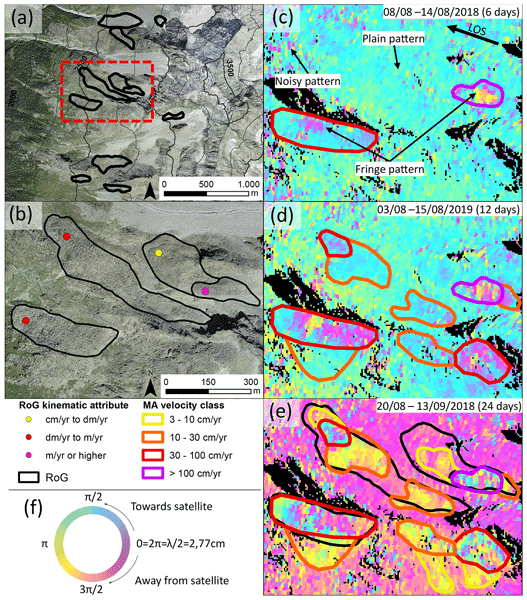
We present the guidelines developed by the IPA Action Group and within the ESA Permafrost CCI project to include InSAR-based kinematic information in rock glacier inventories. Nine operators applied these guidelines to 11 regions worldwide; more than 3600 rock glaciers are classified according to their kinematics. We test and demonstrate the feasibility of applying common rules to produce homogeneous kinematic inventories at global scale, useful for hydrological and climate change purposes.
Noah D. Smith, Eleanor J. Burke, Kjetil Schanke Aas, Inge H. J. Althuizen, Julia Boike, Casper Tai Christiansen, Bernd Etzelmüller, Thomas Friborg, Hanna Lee, Heather Rumbold, Rachael H. Turton, Sebastian Westermann, and Sarah E. Chadburn
Geosci. Model Dev., 15, 3603–3639, https://doi.org/10.5194/gmd-15-3603-2022, https://doi.org/10.5194/gmd-15-3603-2022, 2022
Short summary
Short summary
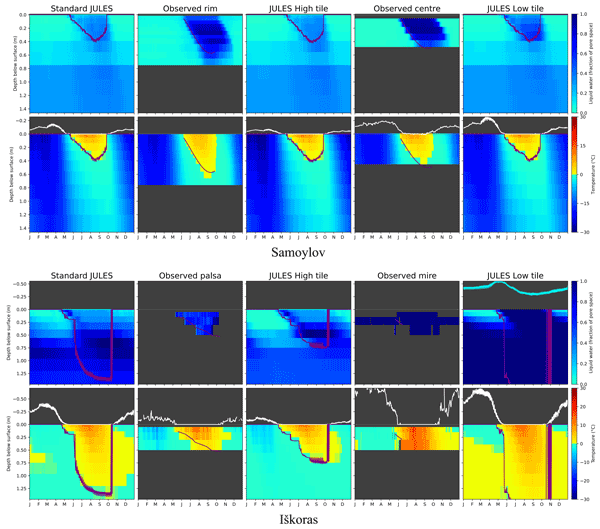
The Arctic has large areas of small mounds that are caused by ice lifting up the soil. Snow blown by wind gathers in hollows next to these mounds, insulating them in winter. The hollows tend to be wetter, and thus the soil absorbs more heat in summer. The warm wet soil in the hollows decomposes, releasing methane. We have made a model of this, and we have tested how it behaves and whether it looks like sites in Scandinavia and Siberia. Sometimes we get more methane than a model without mounds.
Jacques Mourey, Pascal Lacroix, Pierre-Allain Duvillard, Guilhem Marsy, Marco Marcer, Emmanuel Malet, and Ludovic Ravanel
Nat. Hazards Earth Syst. Sci., 22, 445–460, https://doi.org/10.5194/nhess-22-445-2022, https://doi.org/10.5194/nhess-22-445-2022, 2022
Short summary
Short summary
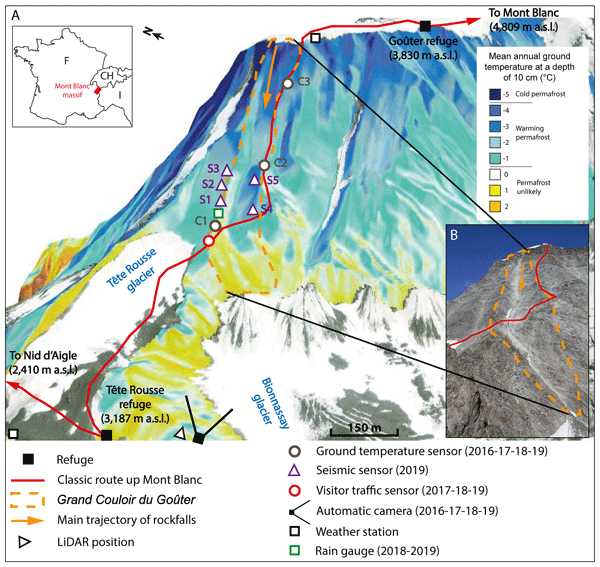
More frequent rockfalls in high alpine environments due to climate change are a growing threat to mountaineers. This hazard is particularly important on the classic route up Mont Blanc. Our results show that rockfalls are most frequent during snowmelt periods and the warmest hours of the day, and that mountaineers do not adapt to the local rockfall hazard when planning their ascent. Disseminating the knowledge acquired from our study caused management measures to be implemented for the route.
Bernd Etzelmüller, Justyna Czekirda, Florence Magnin, Pierre-Allain Duvillard, Ludovic Ravanel, Emanuelle Malet, Andreas Aspaas, Lene Kristensen, Ingrid Skrede, Gudrun D. Majala, Benjamin Jacobs, Johannes Leinauer, Christian Hauck, Christin Hilbich, Martina Böhme, Reginald Hermanns, Harald Ø. Eriksen, Tom Rune Lauknes, Michael Krautblatter, and Sebastian Westermann
Earth Surf. Dynam., 10, 97–129, https://doi.org/10.5194/esurf-10-97-2022, https://doi.org/10.5194/esurf-10-97-2022, 2022
Short summary
Short summary
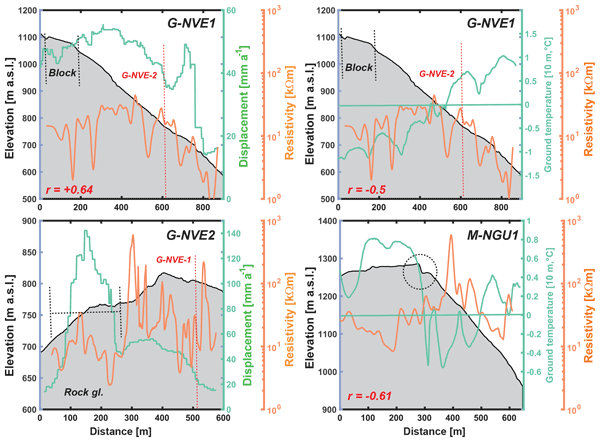
This paper is a multi-authored study documenting the possible existence of permafrost in permanently monitored rockslides in Norway for the first time by combining a multitude of field data, including geophysical surveys in rock walls. The paper discusses the possible role of thermal regime and rockslide movement, and it evaluates the possible impact of atmospheric warming on rockslide dynamics in Norwegian mountains.
Cited articles
Agliardi, F., Scuderi, M. M., Fusi, N., and Collettini, C.: Slow-to-fast transition of giant creeping rockslides modulated by undrained loading in basal shear zones, Nat. Commun., 11, 1352, https://doi.org/10.1038/s41467-020-15093-3, 2020. a
Albaric, J., Kühn, D., Ohrnberger, M., Langet, N., Harris, D., Polom, U., Lecomte, I., and Hillers, G.: Seismic Monitoring of Permafrost in Svalbard, Arctic Norway, Seismol. Res. Lett., 92, 2891–2904, https://doi.org/10.1785/0220200470, 2021. a
Allen, S. and Huggel, C.: Extremely warm temperatures as a potential cause of recent high mountain rockfall, Global Planet. Change, 107, 59–69, 2013. a
Aspaas, A.: JupyterLab Notebooks: Loading, preprocessing, correlations, and figures, Version 2, Zenodo [code], https://doi.org/10.5281/zenodo.17968496, 2025. a
Aspaas, A. and Renard, F.: Seasonal and Inter-Annual Evolution of the Deformation of Two Arctic Landslides, NIRD RDA [data set], https://doi.org/10.11582/2026.ESP7OMHG, 2026. a
Ben-Yehoshua, D., Sæmundsson, Þ., Helgason, J. K., Belart, J. M., Sigurðsson, J. V., and Erlingsson, S.: Paraglacial exposure and collapse of glacial sediment: The 2013 landslide onto Svínafellsjökull, southeast Iceland, Earth Surf. Proc. Land., 47, 2612–2627, 2022. a
Bièvre, G., Joseph, A., and Bertrand, C.: Preferential Water Infiltration Path in a Slow-Moving Clayey Earthslide Evidenced by Cross-Correlation of Hydrometeorological Time Series (Charlaix Landslide, French Western Alps), Geofluids, 2018, 9593267, https://doi.org/10.1155/2018/9593267, 2018. a
Bismans, F. J.: Specification of the ARDL Model, in: Dynamic Econometrics: Models and Applications, Springer Nature Switzerland, Imprint: Palgrave Macmillan, 169–196, 2025. a
Blikra, L. H., Christiansen, H. H., Kristensen, L., and Lovisolo, M.: Characterization, geometry, temporal evolution and controlling mechanisms of the Jettan Rock-Slide, Northern Norway, in: Engineering Geology for Society and Territory, Vol. 2: Landslide Processes, Springer, 273–278, https://doi.org/10.1007/978-3-319-09057-3_40, 2015. a, b, c
Bogner, L., Bruland, C., Hadziioannou, C., Obermann, A., and Langet, N.: Seismic Noise Interferometry to Disentangle Environmental Effects from Irreversible Subsurface Changes at the Åknes Rockslide in Western Norway, Seismol. Res. Lett., 97, https://doi.org/10.1785/0220250420, 2026. a
Böhme, M., Hermanns, R. L., Oppikofer, T., Fischer, L., Bunkholt, H. S., Eiken, T., Pedrazzini, A., Derron, M.-H., Jaboyedoff, M., Blikra, L. H., and Nilsen, B.: Analyzing complex rock slope deformation at Stampa, western Norway, by integrating geomorphology, kinematics and numerical modeling, Eng. Geol., 154, 116–130, 2013. a
Böhme, M., Bunkholt, H., Dehls, J., Oppikofer, T., Hermanns, R., Dalsegg, E., Kristensen, L., Lauknes, T. R., and Eriksen, H. Ø.: Geologisk modell og fare-og risikoklassifisering av det ustabile fjellpartiet Gamanjunni 3 i Manndalen, Troms, https://www.ngu.no/publikasjon/geologisk-mo
dell-og-fare-og-risikoklassifisering-av-det-ustabile-fjellpartiet-0 (last access: 7 August 2026), 2016a. a, b, c, d
Böhme, M., Bunkholt, H., Oppikofer, T., Dehls, J., Hermanns, R., Eriksen, H., Lauknes, T., and Eiken, T.: Using 2D InSAR, dGNSS and structural field data to understand the deformation mechanism of the unstable rock slope Gamanjunni 3, northern Norway, in: Landslides and engineered slopes. Experience, theory and practice, CRC Press, 443–449, ISBN 978-1-138-02988-0, 2016b. a, b, c, d, e
Böhme, M., Hermanns, R., Gosse, J., Hilger, P., Eiken, T., Lauknes, T., and Dehls, J.: Comparison of monitoring data with paleo–slip rates: cosmogenic nuclide dating detects acceleration of a rockslide, Geology, 47, 339–342, 2019. a
Bontemps, N., Lacroix, P., Larose, E., Jara, J., and Taipe, E.: Rain and small earthquakes maintain a slow-moving landslide in a persistent critical state, Nat. Commun., 11, 780, https://doi.org/10.1038/s41467-020-14445-3, 2020. a, b, c
Brocher, T. M.: Empirical Relations between Elastic Wavespeeds and Density in the Earth's Crust, B. Seismol. Soc. Am., 95, 2081–2092, https://doi.org/10.1785/0120050077, 2005. a, b
Cardinali, M., Ardizzone, F., Galli, M., Guzzetti, F., and Reichenbach, P.: Landslides triggered by rapid snow melting: the December 1996–January 1997 event in Central Italy, in: Proceedings 1st Plinius conference on Mediterranean storms, Bios Publisher, Cosenza, 439–448, https://geomorphology.irpi.cnr.it/publications/repository/public/ proceedings/2000/landslides-triggered-by-rapid-snow-melting-the-december-1996-january-1997-event-in-central-italy.pdf (last access: 7 August 2026), 2000. a
CSG: DMS EW (Version 4.9.21.9.): Centro Sercizi de Geoingegneria (CSG) [software], https://www.csgsrl.eu/eng/dms-software.html (last access: 12 August 2025), 2007. a
Czekirda, J., Etzelmüller, B., Westermann, S., Isaksen, K., and Magnin, F.: Post-Little Ice Age rock wall permafrost evolution in Norway, The Cryosphere, 17, 2725–2754, https://doi.org/10.5194/tc-17-2725-2023, 2023. a
Dai, C., Kilroy, C., Svennevig, K., and Higman, B.: Landslides in Greenland from ArcticDEM time series analysis, Landslides, 1–10, https://doi.org/10.1007/s10346-025-02500-3, 2025. a
Danabasoglu, G., Lamarque, J.-F., Bacmeister, J., Bailey, D. A., DuVivier, A. K., Edwards, J., Emmons, L. K., Fasullo, J., Garcia, R., Gettelman, A., Hannay, C., Holland, M. M., Large, W. G., Lauritzen, P. H., Lawrence, D. M., Lenaerts, J. T. M., Lindsay, K., Lipscomb, W. H., Mills, M. J., Neale, R., Oleson, K. W., Otto-Bliesner, B., Phillips, A. S., Sacks, W., Tilmes, S., van Kampenhout, L., Vertenstein, M., Bertini, A., Dennis, J., Deser, C., Fischer, C., Fox-Kemper, B., Kay, J. E., Kinnison, D., Kushner, P. J., Larson, V. E., Long, M. C., Mickelson, S., Moore, J. K., Nienhouse, E., Polvani, L., Rasch, P. J., and Strand, W. G.: The community earth system model version 2 (CESM2), J. Adv. Model. Earth Sy., 12, e2019MS001916, https://doi.org/10.1029/2019MS001916, 2020. a
Dobry, R., Oweis, I., and Urzua, A.: Simplified procedures for estimating the fundamental period of a soil profile, B. Seismol. Soc. Am., 66, 1293–1321, 1976. a
Donnini, M., Santangelo, M., Gariano, S. L., Bucci, F., Peruccacci, S., Alvioli, M., Althuwaynee, O., Ardizzone, F., Bianchi, C., Bornaetxea, T., Brunetti, M. T., Cardinali, M., Esposito, G., Grita, S., Marchesini, I., Melillo, M., Salvati, P., Yazdani, M., and Fiorucci, F.: Landslides triggered by an extraordinary rainfall event in Central Italy on September 15, 2022, Landslides, 20, 2199–2211, 2023. a
Elvebakk, H.: Borehullslogging med optisk televiewer, Jettan 1, Nordnesfjellet, Kåfjord kommune, Troms, https://www.ngu.no/publikasjon/borehullslogging-med-optisk- televiewer-jettan-1-nordnesfjellet-kafjord-kommune-troms (last access: 7 August 2026), 2013. a, b
Elvebakk, H.: Borehullslogging med optisk televiewer, Bh 2 og Bh 3, Jettan, Nordnesfjellet, Kåfjord kommune, Troms, https://www.ngu.no/publikasjon/borehullslogging-med-optisk- televiewer-jettan-1-nordnesfjellet-kafjord-kommune-troms (last access: 7 August 2026), 2014. a, b
ESRI: ArcGIS Pro (Version 3.1.3.), ESRI [software], https://www.esri.com/en-us/arcgis/products/arcgis-pro/overview (last access: 15 June 2026), 2023. a
Etzelmüller, B., Czekirda, J., Magnin, F., Duvillard, P.-A., Ravanel, L., Malet, E., Aspaas, A., Kristensen, L., Skrede, I., Majala, G. D., Jacobs, B., Leinauer, J., Hauck, C., Hilbich, C., Böhme, M., Hermanns, R., Eriksen, H. Ø., Lauknes, T. R., Krautblatter, M., and Westermann, S.: Permafrost in monitored unstable rock slopes in Norway – new insights from temperature and surface velocity measurements, geophysical surveying, and ground temperature modelling, Earth Surf. Dynam., 10, 97–129, https://doi.org/10.5194/esurf-10-97-2022, 2022. a, b, c
Fiddes, J. and Gruber, S.: TopoSCALE v.1.0: downscaling gridded climate data in complex terrain, Geosci. Model Dev., 7, 387–405, https://doi.org/10.5194/gmd-7-387-2014, 2014. a
Finnegan, N., Brodsky, E., Savage, H., Nereson, A., and Murphy, C.: Seasonal slow landslide displacement is accommodated by mm-scale stick-slip events, Geophys. Res. Lett., 49, e2022GL099548, https://doi.org/10.1029/2022GL099548, 2022. a
Fiolleau, S., Uhlemann, S., Wielandt, S., and Dafflon, B.: Understanding slow-moving landslide triggering processes using low-cost passive seismic and inclinometer monitoring, J. Appl. Geophys., 215, 105090, https://doi.org/10.1016/j.jappgeo.2023.105090, 2023. a
Foglino, V., Foglino, L., Foglino, S., and Lovisolo, M.: New multi-inclinometric geotechnical monitoring systems – the importance of alignment calibration and testing for reliability and correct data interpretation, in: FMGM 2015: Proceedings of the Ninth Symposium on Field Measurements in Geomechanics, edited by: Dight, P., Australian Centre for Geomechanics, 161–171, https://doi.org/10.36487/ACG_rep/1508_07_Foglino, 2015. a
Frauenfelder, R., Isaksen, K., Lato, M. J., and Noetzli, J.: Ground thermal and geomechanical conditions in a permafrost-affected high-latitude rock avalanche site (Polvartinden, northern Norway), The Cryosphere, 12, 1531–1550, https://doi.org/10.5194/tc-12-1531-2018, 2018. a
Ganerød, G. V.: Geological logging of drill core from borehole NN-01-12 at Jettan, Nordnes mountain in Troms county, Northern Norway, https://www.ngu.no/publikasjon/geological-logging-drill-core-
borehole-nn-01-12-jettan-nordnes-mountain-troms-county (last access: 7 August 2026), 2013. a, b
Ganerød, G. V.: Geological logging of drill cores from borehole BH 02-13 and BH 03-13 at Jettan, Nordnes mountain in Troms county, Northern Norway, https://www.ngu.no/publikasjon/geological-logging-drill-core- borehole-bh-02-13-and-bh-03-13-jettan-nordnes-mountain (last access: 7 August 2026), 2014. a, b
Geological Survey of Norway (NGU): Faktaark: Ustabile fjellpartier – Gámanjunni, https://www.nve.no/media/10999/gamanjunni.pdf, last access: 17 October 2025. a
Grämiger, L. M., Moore, J. R., Gischig, V. S., Ivy-Ochs, S., and Loew, S.: Beyond debuttressing: Mechanics of paraglacial rock slope damage during repeat glacial cycles, J. Geophys. Res.-Earth, 122, 1004–1036, 2017. a
Gruber, S. and Haeberli, W.: Permafrost in steep bedrock slopes and its temperature-related destabilization following climate change, J. Geophys. Res.-Earth, 112, https://doi.org/10.1029/2006JF000547, 2007. a
Gruber, S., Hoelzle, M., and Haeberli, W.: Permafrost thaw and destabilization of Alpine rock walls in the hot summer of 2003, Geophys. Res. Lett., 31, https://doi.org/10.1029/2004GL020051, 2004. a
Haakenstad, H. and Breivik, Ø.: NORA3. Part II: precipitation and temperature statistics in complex terrain modeled with a nonhydrostatic model, J. Appl. Meteorol. Clim., 61, 1549–1572, 2022. a
Haakenstad, H., Breivik, Ø., Furevik, B. R., Reistad, M., Bohlinger, P., and Aarnes, O. J.: NORA3: A nonhydrostatic high-resolution hindcast of the North Sea, the Norwegian Sea, and the Barents Sea, J. Appl. Meteorol. Clim., 60, 1443–1464, 2021. a
Hadziioannou, C., Larose, E., Coutant, O., Roux, P., and Campillo, M.: Stability of monitoring weak changes in multiply scattering media with ambient noise correlation: Laboratory experiments, J. Acoust. Soc. Am., 125, 3688–3695, 2009. a
Handwerger, A. L., Rempel, A. W., Skarbek, R. M., Roering, J. J., and Hilley, G. E.: Rate-weakening friction characterizes both slow sliding and catastrophic failure of landslides, P. Natl. Acad. Sci. USA, 113, 10281–10286, 2016. a
Handwerger, A. L., Lacroix, P., Bell, A. F., Booth, A. M., Huang, M.-H., Mudd, S. M., Bürgmann, R., and Fielding, E. J.: Multi-sensor remote sensing captures geometry and slow-to-fast sliding transition of the 2017 Mud Creek landslide, Sci. Rep.-UK, 15, 29831, https://doi.org/10.1038/s41598-025-11399-8, 2025. a
Hauck, C. and Hilbich, C.: 4-phase model simulations Gámanjunni, Technical report, Department of Geosciences, University of Freiburg, https://www.nve.no/media/7646/report-gamanjunni-4phasemodel-unifr-2018.pdf (last access: 17 October 2025), 2018. a
Hermanns, R., Oppikofer, T., Anda, E., Blikra, L., Böhme, M., Bunkholt, H., Crosta, G., Dahle, H., Devoli, G., Fischer, L., Jaboyedoff, M., Loew, S., Sætre, S., and Yugsi Molina, F. X.: Hazard and risk classification for large unstable rock slopes in Norway, Italian Journal of Engineering Geology and Environment, 2013, 245–254, 2013. a, b
Herrmann, R. B.: Computer Programs in Seismology: An Evolving Tool for Instruction and Research, Seismol. Res. Lett., 84, 1081–1088, https://doi.org/10.1785/0220110096, 2013. a
Hilger, P., Hermanns, R. L., Czekirda, J., Myhra, K. S., Gosse, J. C., and Etzelmüller, B.: Permafrost as a first order control on long-term rock-slope deformation in (Sub-) Arctic Norway, Quaternary Sci. Rev., 251, 106718, https://doi.org/10.1016/j.quascirev.2020.106718, 2021. a, b
Høydedata: Høydedata, https://hoydedata.no/LaserInnsyn2/ (last access: 10 May 2024), 2024. a
Hungr, O., Leroueil, S., and Picarelli, L.: The Varnes classification of landslide types, an update, Landslides, 11, 167–194, 2014. a
Iverson, R. M.: Landslide triggering by rain infiltration, Water Resour. Res., 36, 1897–1910, 2000. a
Iverson, R. M.: Regulation of landslide motion by dilatancy and pore pressure feedback, J. Geophys. Res.-Earth, 110, https://doi.org/10.1029/2004JF000268, 2005. a
Iverson, R. M. and Major, J. J.: Rainfall, ground-water flow, and seasonal movement at Minor Creek landslide, northwestern California: Physical interpretation of empirical relations, Geol. Soc. Am. Bull., 99, 579–594, 1987. a
Kääb, A. and Røste, J.: Rock glaciers across the United States predominantly accelerate coincident with rise in air temperatures, Nat. Commun., 15, 7581, https://doi.org/10.1038/s41467-024-52093-z, 2024. a
Lacroix, P., Belart, J. M., Berthier, E., Sæmundsson, Þ., and Jónsdóttir, K.: Mechanisms of landslide destabilization induced by glacier-retreat on Tungnakvíslarjökull area, Iceland, Geophys. Res. Lett., 49, e2022GL098302, https://doi.org/10.1029/2022GL098302, 2022. a, b
Le Breton, M., Bontemps, N., Guillemot, A., Baillet, L., and Larose, E.: Landslide monitoring using seismic ambient noise correlation: challenges and applications, Earth-Sci. Rev., 216, 103518, https://doi.org/10.1016/j.earscirev.2021.103518, 2021. a, b
Leshchinsky, B., Olsen, M. J., Mohney, C., O'Banion, M., Bunn, M., Allan, J., and McClung, R.: Quantifying the sensitivity of progressive landslide movements to failure geometry, undercutting processes and hydrological changes, J. Geophys. Res.-Earth, 124, 616–638, 2019. a
Liu, Z., Liang, C., Sens-Schönfelder, C., Hu, W., Sun, X., Zhang, T., Xu, R., Jiang, Z., and Jiang, H.: Monitoring crack opening via seismic velocity variation to assess that fatal effect of precipitation for landslide motion, Earth Planet. Sc. Lett., 644, 118922, https://doi.org/10.1016/j.epsl.2024.118922, 2024. a, b, c
Lussana, C.: seNorge observational gridded dataset. seNorge_2018, versions 21.09 and 21.10. MET report, Report 072021, https://www.google.com/url?sa=t&rct=j&q=&esrc=s&source=web&cd=&ved=2ahUKEwiA2ratjpiWAxVsFRAIHS0jATIQFnoECBcQAQ&url=https%3A%2F%2Fwww.met.no%2Fpublikasjoner%2Fmet-report%2Fmet-report-2021%2F_%2Fattachment%2Fdownload%2F5abd0cf0-9a45-4c38-8ee2-1484150009f9%3Aaa5a68ca6035f7baa3856a0d371f6a822c23c29b%2FMET-report-7-2021.pdf&usg=AOvVaw2ejCzDyJk_sa1lL7TOwMNj&opi=89978449 (last access: 7 August 2026), 2021. a
Magnin, F., Etzelmüller, B., Westermann, S., Isaksen, K., Hilger, P., and Hermanns, R. L.: Permafrost distribution in steep rock slopes in Norway: measurements, statistical modelling and implications for geomorphological processes, Earth Surf. Dynam., 7, 1019–1040, https://doi.org/10.5194/esurf-7-1019-2019, 2019. a, b, c
Mainsant, G., Larose, E., Brönnimann, C., Jongmans, D., Michoud, C., and Jaboyedoff, M.: Ambient seismic noise monitoring of a clay landslide: Toward failure prediction, J. Geophys. Res.-Earth, 117, https://doi.org/10.1029/2011JF002159, 2012. a, b
Mamot, P., Weber, S., Schröder, T., and Krautblatter, M.: A temperature- and stress-controlled failure criterion for ice-filled permafrost rock joints, The Cryosphere, 12, 3333–3353, https://doi.org/10.5194/tc-12-3333-2018, 2018. a, b
NGU: Faktaark: Ustabile fjellpartier – Jettan, https://geo.ngu.no/ api/faktaark/ustabilefjell2/visHovedpunkt.php?more=false& globalid=%7B56DB8DD2-876C-4514-8B0D-A4E825206E85 %7D, last access: 17 October 2025. a
NORSAR: NORSAR station network, NORSAR [data set], https://doi.org/10.21348/d.no.0001, 1971. a
Painter, S. L. and Karra, S.: Constitutive model for unfrozen water content in subfreezing unsaturated soils, Vadose Zone J., 13, vzj2013-04, https://doi.org/10.2136/vzj2013.04.0071, 2014. a
Pandas Developers: pandas.DataFrame.resample, https://pandas.pydata.org/docs/reference/api/pandas.DataFrame.resample.html, last access: 17 November 2025a. a
Patton, A. I., Rathburn, S. L., Capps, D. M., McGrath, D., and Brown, R. A.: Ongoing Landslide Deformation in Thawing Permafrost, Geophys. Res. Lett., 48, e2021GL092959, https://doi.org/10.1029/2021GL092959, 2021. a
Pei, Y., Qiu, H., Zhu, Y., Wang, J., Yang, D., Tang, B., Wang, F., and Cao, M.: Elevation dependence of landslide activity induced by climate change in the eastern Pamirs, Landslides, 20, 1115–1133, 2023. a
Penna, I., Magnin, F., Nicolet, P., Etzelmüller, B., Hermanns, R., Böhme, M., Kristensen, L., Nöel, F., Bredal, M., and Dehls, J. F.: Permafrost controls the displacement rates of large unstable rock-slopes in subarctic environments, Global Planet. Change, 220, 104017, https://doi.org/10.1016/j.gloplacha.2022.104017, 2023a. a, b, c, d
Penna, I., Nicolet, P., Hermanns, R., Böhme, M., and Nöel, F.: Preliminary inventory of rock avalanche deposits and their related sources in Norway: Regional distribution, main features and topographic constraints, https://www.ngu.no/publikasjon/ preliminary-inventory-rock-avalanche-deposits-and-their-related
-sources-norway-regional (last access: 7 August 2026), 2023b. a
Pogrebiskiy, M. and Chernyshev, S.: Determination of the Permeability of the Frozen Fissured Rock Massif in the Vicinity of the Kolyma Hydroelectric Power Station (Oshenka Vodopronishaemosti Merzlogo Greshinovatogo Massiva Gornkh Porod Uchastka Kolmskoy ges), Tech. rep., Corps of Engineers, US Army, Hannover, New Hampshire, https://doi.org/10.1016/0148-9062(78)91715-1, 1977. a
Raftery, A. E.: Bayesian model selection in social research, Sociol. Methodol., 111–163, https://doi.org/10.2307/271063, 1995. a, b
Rantanen, M., Karpechko, A. Y., Lipponen, A., Nordling, K., Hyvärinen, O., Ruosteenoja, K., Vihma, T., and Laaksonen, A.: The Arctic has warmed nearly four times faster than the globe since 1979, Communications Earth & Environment, 3, 168, https://doi.org/10.1038/s43247-022-00498-3, 2022. a
Ravanel, L., Magnin, F., and Deline, P.: Impacts of the 2003 and 2015 summer heatwaves on permafrost-affected rock-walls in the Mont Blanc massif, Sci. Total Environ., 609, 132–143, 2017. a
Rechberger, C., Fey, C., and Zangerl, C.: Structural characterisation, internal deformation, and kinematics of an active deep-seated rock slide in a valley glacier retreat area, Eng. Geol., 286, 106048, https://doi.org/10.1016/j.enggeo.2021.106048, 2021. a
Rønning, J., Dalsegg, E., Heincke, B., Juliussen, H., and Tønnesen, J.: Geofysiske målinger på Nordnesfjellet sommeren 2007, Kåfjord kommune, Troms, NGU Rapport 2008.024, https://www.ngu.no/publikasjon/geofysiske-
malinger-pa-nordnesfjellet-sommeren-2007-kafjord-kommune-troms (last access: 7 August 2026), 2008. a, b, c, d, e
Ruggeri, P., Fruzzetti, V. M., Ferretti, A., and Scarpelli, G.: Seismic and rainfall induced displacements of an existing landslide: Findings from the continuous monitoring, Geosciences, 10, 90, https://doi.org/10.3390/geosciences10030090, 2020. a
Saemundsson, T., Petursson, H., Kneisel, C., and Beylich, A.: Monitoring of the Tjarnardalir landslide, in central North Iceland, in: First North America Landslide Conference, vol. 23, edited by: Schaefer, V. R., Schuster, R. L., and Turner, A. K., AEG Publication, 1029–1040, https://www.researchgate.net/profile/Thorsteinn-Saemundsson/ publication/252133948_The_Tjarnardalir_landslide_in_central _north_Iceland_-_recent_movements_causes_and_triggering_
factors/links/595b889b458515117741a50f/The-Tjarnardalir-landslide-in-central-north-Iceland-recent-movements-causes-and-triggering-factors.pdf (last access: 7 August 2026), 2007. a
scikit-learn developers: MinMaxScaler, Version 0.24, scikit-learn [software], https://scikit-learn.org/stable/modules/generated/sklearn.preprocessing.MinMaxScaler.html (last access: 10 January 2024), 2024. a
SciPy Developers: scipy.signal.savgol_filter, https://docs.scipy.org/doc/scipy/reference/generated/scipy.signal.savgol_filter.html (last access: 17 November 2024), 2025. a
Sens-Schönfelder, C. and Wegler, U.: Passive image interferometry and seasonal variations of seismic velocities at Merapi Volcano, Indonesia, in: Seismic Interferometry: History and Present Status, Society of Exploration Geophysicists, https://doi.org/10.1190/1.9781560801924, 2008. a
Shugar, D. H., Jacquemart, M., Shean, D., Bhushan, S., Upadhyay, K., Sattar, A., Schwanghart, W., McBride, S., De Vries, M. V. W., Mergili, M., Emmer, A., Deschamps-Berger, C., McDonnell, M., Bhambri, R., Allen, S., Berthier, E., Carrivick, J. L., Clague, J. J., Dokukin, M., Dunning, S. A., Frey, H., Gascoin, S., Haritashya, U. K., Huggel, C., Kääb, A., Kargel, J. S., Kavanaugh, J. L., Lacroix, P., Petley, D., Rupper, S., Azam, M. F., Cook, S. J., Dimri, A. P., Eriksson, M., Farinotti, D., Fiddes, J., Gnyawali, K. R., Harrison, S., Jha, M., Koppes, M., Kumar, A., Leinss, S., Majeed, U., Mal, S., Muhuri, A., Noetzli, J., Paul, F., Rashid, I., Sain, K., Steiner, J., Ugalde, F., Watson, C. S., and Westoby, M. J.: A massive rock and ice avalanche caused the 2021 disaster at Chamoli, Indian Himalaya, Science, 373, 300–306, 2021. a
Skrede, I.: Jettan, Nordnesfjellet, Kåfjord, Troms–indre geometri og struktur, kinematikk og styrande faktorar av eit ustabilt fjellparti, basert på strukturellanalyse, geomorfologi og overvakingsdata, Master's thesis, UiT Norges arktiske universitet, https://hdl.handle.net/10037/5622 (last access: 7 August 2026), 2013. a, b, c, d
Svennevig, K., Hicks, S. P., Forbriger, T., Lecocq, T., Widmer-Schnidrig, R., Mangeney, A., Hibert, C., Korsgaard, N. J., Lucas, A., Satriano, C., Anthony, R. E., Mordret, A., Schippkus, S., Rysgaard, S., Boone, W., Gibbons, S. J., Cook, K. L., Glimsdal, S., Løvholt, F., VanNoten, K., Assink, J. D., Marboeuf, A., Lomax, A., Vanneste, K., Taira, T., Spagnolo, M., DePlaen, R., Koelemeijer, P., Ebeling, C., Cannata, A., Harcourt, W. D., Cornwell, D. G., Caudron, C., Poli, P., Bernard, P., Larose, E., Stutzmann, E., Voss, P. H., Lund, B., Cannavo, F., Castro-Díaz, M. J., Chaves, E., Dahl-Jensen, T., DePinhoDias, N., Déprez, A., Develter, R., Dreger, D., Evers, L. G., Fernández-Nieto, E., Ferreira, A. M. G., Funning, G., Gabriel, A.-A., Hendrickx, M., Kafka, A. L., Keiding, M., Kerby, J., Khan, S. A., Dideriksen, A. K., Lamb, O. D., Larsen, T. B., Lipovsky, B., Magdalena, I., Malet, J-P., Myrup, M., Rivera, L., Ruiz-Castillo, E., Wetter, S., and Wirtz, B.: A rockslide-generated tsunami in a Greenland fjord rang Earth for 9 days, Science, 385, 1196–1205, 2024. a
Themeßl, M. J., Gobiet, A., and Heinrich, G.: Empirical-statistical downscaling and error correction of regional climate models and its impact on the climate change signal, Climatic Change, 112, 449–468, 2012. a
Vick, L. M., Berg, J. N., Eggers, M., Hormes, A., Skrede, I., and Blikra, L. H.: Keynote Lecture: The Jettan Rockslide – An Engineering Geological Overview, in: Understanding and Reducing Landslide Disaster Risk, edited by: Arbanas, Ž., Bobrowsky, P. T., Konagai, K., Sassa, K., and Takara, K., Springer, Cham, https://doi.org/10.1007/978-3-030-60713-5_28, 2021. a, b, c, d
Vionnet, V., Brun, E., Morin, S., Boone, A., Faroux, S., Le Moigne, P., Martin, E., and Willemet, J.-M.: The detailed snowpack scheme Crocus and its implementation in SURFEX v7.2, Geosci. Model Dev., 5, 773–791, https://doi.org/10.5194/gmd-5-773-2012, 2012. a
Walden, J., Jacquemart, M., Higman, B., Hugonnet, R., Manconi, A., and Farinotti, D.: Landslide activation during deglaciation in a fjord-dominated landscape: observations from southern Alaska (1984–2022), Nat. Hazards Earth Syst. Sci., 25, 2045–2073, https://doi.org/10.5194/nhess-25-2045-2025, 2025. a
Wathelet, M., Chatelain, J.-L., Cornou, C., Di Giulio, G., Guillier, B., Ohrnberger, M., and Savvaidis, A.: Geopsy: A User-Friendly Open-Source Tool Set for Ambient Vibration Processing, Seismol. Res. Lett., 91, 1878–1889, https://doi.org/10.1785/0220190360, 2020. a
Watlet, A., Whiteley, J., Dashwood, B., Morgan, D., Lane, V., Finch, L., Gunn, D., Lecocq, T., and Chambers, J.: Seismic response of a slow-moving landslide: exploring data from two years of seismic monitoring at the Hollin Hill Landslide Observatory (UK), Seismica, 5, https://doi.org/10.26443/seismica.v5i1.1478, 2026. a
Westermann, S., Ingeman-Nielsen, T., Scheer, J., Aalstad, K., Aga, J., Chaudhary, N., Etzelmüller, B., Filhol, S., Kääb, A., Renette, C., Schmidt, L. S., Schuler, T. V., Zweigel, R. B., Martin, L., Morard, S., Ben-Asher, M., Angelopoulos, M., Boike, J., Groenke, B., Miesner, F., Nitzbon, J., Overduin, P., Stuenzi, S. M., and Langer, M.: The CryoGrid community model (version 1.0) – a multi-physics toolbox for climate-driven simulations in the terrestrial cryosphere, Geosci. Model Dev., 16, 2607–2647, https://doi.org/10.5194/gmd-16-2607-2023, 2023. a, b, c, d
Short summary
Climate change increases landslide risk in cold regions. We analyzed 12 years of GPS, borehole, water, and seismic data from two landslides in Arctic Norway, one with permafrost and one without. Both accelerate in spring and autumn due to water infiltration. One slip zone shows increasing snowmelt sensitivity while seismic data reveal seasonal stiffness changes. Results advance understanding of water-driven landslide dynamics in Arctic climates.
Climate change increases landslide risk in cold regions. We analyzed 12 years of GPS, borehole,...


