
Articles | Volume 14, issue 1
https://doi.org/10.5194/esurf-14-55-2026
© Author(s) 2026. This work is distributed under
the Creative Commons Attribution 4.0 License.
the Creative Commons Attribution 4.0 License.
https://doi.org/10.5194/esurf-14-55-2026
© Author(s) 2026. This work is distributed under
the Creative Commons Attribution 4.0 License.
the Creative Commons Attribution 4.0 License.
Research article
| 
16 Jan 2026
Research article |
| 16 Jan 2026
| 16 Jan 2026
Safeguarding Cultural Heritage: Integrating laser scanning, InSAR, vibration monitoring and rockfall/granular flow runout modelling at the Temple of Hatshepsut, Egypt

Chair of Landslide Research, TUM School of Engineering and Design, Technical University of Munich, Munich, Germany
Mohamed Ismael
Department of Mining, Petroleum, and Metallurgical Engineering, Faculty of Engineering, Cairo University, Giza, Egypt
UNESCO Chair on Science and Technology for Cultural Heritage, Faculty of Engineering, Cairo University, Giza, Egypt
Mostafa Ezzy
Department of Mining, Petroleum, and Metallurgical Engineering, Faculty of Engineering, Cairo University, Giza, Egypt
UNESCO Chair on Science and Technology for Cultural Heritage, Faculty of Engineering, Cairo University, Giza, Egypt
Markus Keuschnig
GEORESEARCH Research Institute, Wals, Austria
Alexander Mendler
Chair of Non-destructive Testing, TUM School of Engineering and Design, Technical University of Munich, Munich, Germany
Johanna Kieser
Chair of Landslide Research, TUM School of Engineering and Design, Technical University of Munich, Munich, Germany
Michael Krautblatter
Chair of Landslide Research, TUM School of Engineering and Design, Technical University of Munich, Munich, Germany
Christian U. Grosse
Chair of Non-destructive Testing, TUM School of Engineering and Design, Technical University of Munich, Munich, Germany
Hany Helal
Department of Mining, Petroleum, and Metallurgical Engineering, Faculty of Engineering, Cairo University, Giza, Egypt
UNESCO Chair on Science and Technology for Cultural Heritage, Faculty of Engineering, Cairo University, Giza, Egypt
Related authors
Bernd Etzelmüller, Justyna Czekirda, Florence Magnin, Pierre-Allain Duvillard, Ludovic Ravanel, Emanuelle Malet, Andreas Aspaas, Lene Kristensen, Ingrid Skrede, Gudrun D. Majala, Benjamin Jacobs, Johannes Leinauer, Christian Hauck, Christin Hilbich, Martina Böhme, Reginald Hermanns, Harald Ø. Eriksen, Tom Rune Lauknes, Michael Krautblatter, and Sebastian Westermann
Earth Surf. Dynam., 10, 97–129, https://doi.org/10.5194/esurf-10-97-2022, https://doi.org/10.5194/esurf-10-97-2022, 2022
Short summary
Short summary
This paper is a multi-authored study documenting the possible existence of permafrost in permanently monitored rockslides in Norway for the first time by combining a multitude of field data, including geophysical surveys in rock walls. The paper discusses the possible role of thermal regime and rockslide movement, and it evaluates the possible impact of atmospheric warming on rockslide dynamics in Norwegian mountains.
Maike Offer, Ingo Hartmeyer, Samuel Weber, Markus Keuschnig, and Michael Krautblatter
Earth Surf. Dynam., 14, 661–683, https://doi.org/10.5194/esurf-14-661-2026, https://doi.org/10.5194/esurf-14-661-2026, 2026
Short summary
Short summary
This study presents a year-round automated electrical resistivity tomography monitoring of a steep permafrost rockwall combined with borehole temperature, anchor load and piezometer observations. The joint analysis revealed seasonal phases with enhanced mechanical forcing of rockwalls related to high hydrostatic and cryostatic pressures, which are of particular interest for understanding preconditioning of rock instabilities.
Riccardo Scandroglio, Samuel Weber, Jonas K. Limbrock, and Michael Krautblatter
The Cryosphere, 20, 4787–4809, https://doi.org/10.5194/tc-20-4787-2026, https://doi.org/10.5194/tc-20-4787-2026, 2026
Short summary
Short summary
This study monitors changes in frozen rock on Mount Zugspitze over 17 years using monthly electrical resistivity measurements. By linking this data to rock temperature and applying advanced analysis, it reveals a 40 % loss of permafrost in the past decade. Thawing accelerates during summer, highlighting increasing risks of rock instability as temperatures rise.
Felix Pfluger, Samuel Weber, Natalie Barbosa, Florentin Hofmeister, Johannes Leinauer, Peter Wegmann, and Michael Krautblatter
Earth Surf. Dynam., 14, 601–634, https://doi.org/10.5194/esurf-14-601-2026, https://doi.org/10.5194/esurf-14-601-2026, 2026
Short summary
Short summary
The 2024 Platteikogel rock slope failure (Tyrol, Austria) highlights how cryospheric changes promote slope failure. We demonstrate how the system feedback of ice apron loss, permafrost warming, increase in rockfall activity, and changes in groundwater conditions accelerate mechanical destabilization, and as a consequence likely peaked in the observed failure. Today, rapidly vanishing ice aprons potentially mark source zones for future rock slides.
Philipp Daniel Gewalt, Thomas C. Wagner, and Michael Krautblatter
EGUsphere, https://doi.org/10.5194/egusphere-2026-1699, https://doi.org/10.5194/egusphere-2026-1699, 2026
Short summary
Short summary
Sediments move through mountain landscapes during heavy rainfall. Climate change will alter the occurrence of heavy rainfall, potentially changing sediment transport. To understand how, we investigate how mountain sediment transport responded to past climate changes. We show that sediments in small, steep catchments are moved by less extreme precipitation compared to larger, gentler catchments. This means that catchment form and area control future sediment transport in a changing climate.
Katharina Wetterauer, Sebastian Müller, Michael Krautblatter, Shiva P. Pudasaini, and Ivo Baselt
EGUsphere, https://doi.org/10.5194/egusphere-2026-1235, https://doi.org/10.5194/egusphere-2026-1235, 2026
Short summary
Short summary
Contrasting mobility responses of erosive debris flows are poorly understood. Here, the role of bed inertia in debris-flow evolution and runout is experimentally assessed using distinct bed-density contrasts. Erosion is higher and runout longer over low-density beds, whereas equal- and high-density beds congruently show shallower erosion and shorter runout. The results indicate that solid density alone cannot explain mobility changes and that particle shape and internal friction also contribute.
Samuel Weber, Jan Beutel, Michael Dietze, Alexander Bast, Robert Kenner, Marcia Phillips, Johannes Leinauer, Simon Mühlbauer, Felix Pfluger, and Michael Krautblatter
Earth Surf. Dynam., 13, 1157–1179, https://doi.org/10.5194/esurf-13-1157-2025, https://doi.org/10.5194/esurf-13-1157-2025, 2025
Short summary
Short summary
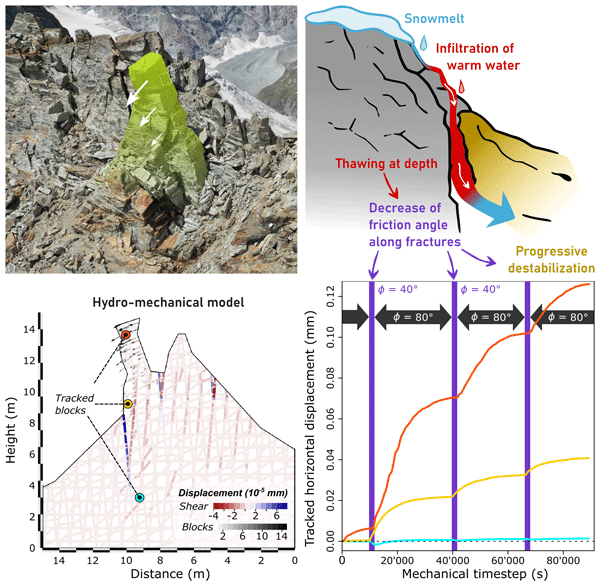
On 13 June 2023, a freestanding rock pillar on the Matterhorn collapsed after years of weakening. Our study examines this progressive destabilization by analyzing field data and integrating lab experiments into a hydro-mechanical model. We highlight the critical role of water infiltration into frozen rock, intensified by climate warming, as a widespread driver of the rising frequency of rockfalls in high mountain permafrost regions.
Riccardo Scandroglio, Samuel Weber, Till Rehm, and Michael Krautblatter
Earth Surf. Dynam., 13, 295–314, https://doi.org/10.5194/esurf-13-295-2025, https://doi.org/10.5194/esurf-13-295-2025, 2025
Short summary
Short summary
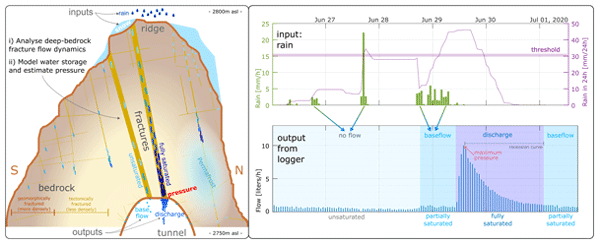
Despite the critical role of water in alpine regions, its presence in bedrock is frequently neglected. This research examines the dynamics of water in fractures using 1 decade of measurements from a tunnel 50 m underground. We provide new insights into alpine groundwater dynamics, revealing that up to 800 L d-1 can flow in one fracture during extreme events. These quantities can saturate the fractures, enhance hydraulic conductivity, and generate pressures that destabilize slopes.
Maike Offer, Samuel Weber, Michael Krautblatter, Ingo Hartmeyer, and Markus Keuschnig
The Cryosphere, 19, 485–506, https://doi.org/10.5194/tc-19-485-2025, https://doi.org/10.5194/tc-19-485-2025, 2025
Short summary
Short summary
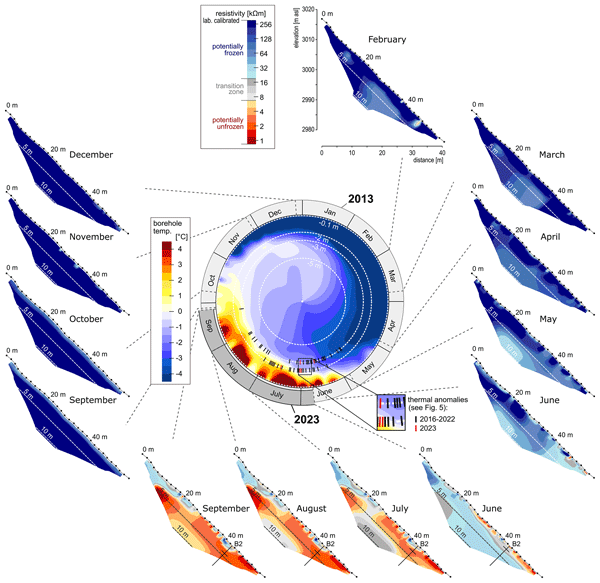
We present a unique long-term dataset of measurements of borehole temperature, repeated electrical resistivity tomography, and piezometric pressure to investigate the complex seasonal water flow in permafrost rockwalls. Our joint analysis shows that permafrost rocks are subjected to enhanced pressurised water flow during the thaw period, resulting in push-like warming events and long-lasting rock temperature regime changes.
Felix Pfluger, Samuel Weber, Joseph Steinhauser, Christian Zangerl, Christine Fey, Johannes Fürst, and Michael Krautblatter
Earth Surf. Dynam., 13, 41–70, https://doi.org/10.5194/esurf-13-41-2025, https://doi.org/10.5194/esurf-13-41-2025, 2025
Short summary
Short summary
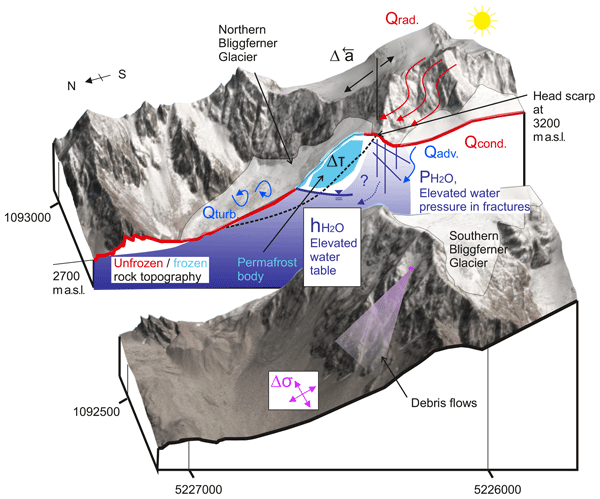
Our study explores permafrost–glacier interactions with a focus on their implications for preparing or triggering high-volume rock slope failures. Using the Bliggspitze rock slide as a case study, we demonstrate a new type of rock slope failure mechanism triggered by the uplift of the cold–warm dividing line in polythermal alpine glaciers, a widespread and currently under-explored phenomenon in alpine environments worldwide.
Johannes Leinauer, Michael Dietze, Sibylle Knapp, Riccardo Scandroglio, Maximilian Jokel, and Michael Krautblatter
Earth Surf. Dynam., 12, 1027–1048, https://doi.org/10.5194/esurf-12-1027-2024, https://doi.org/10.5194/esurf-12-1027-2024, 2024
Short summary
Short summary
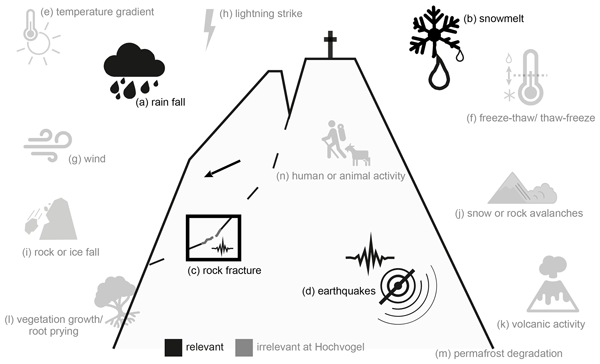
Massive rock slope failures are a significant alpine hazard and change the Earth's surface. Therefore, we must understand what controls the preparation of such events. By correlating 4 years of slope displacements with meteorological and seismic data, we found that water from rain and snowmelt is the most important driver. Our approach is applicable to similar sites and indicates where future climatic changes, e.g. in rain intensity and frequency, may alter the preparation of slope failure.
Natalie Barbosa, Johannes Leinauer, Juilson Jubanski, Michael Dietze, Ulrich Münzer, Florian Siegert, and Michael Krautblatter
Earth Surf. Dynam., 12, 249–269, https://doi.org/10.5194/esurf-12-249-2024, https://doi.org/10.5194/esurf-12-249-2024, 2024
Short summary
Short summary
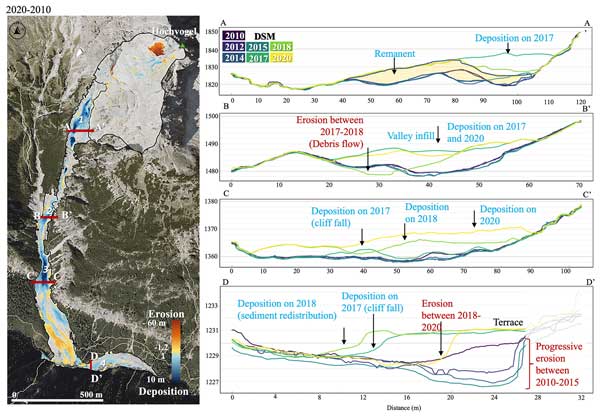
Massive sediment pulses in catchments are a key alpine multi-risk component. Combining high-resolution aerial imagery and seismic information, we decipher a multi-stage >130.000 m³ rockfall and subsequent sediment pulses over 4 years, reflecting sediment deposition up to 10 m, redistribution in the basin, and finally debouchure to the outlet. This study provides generic information on spatial and temporal patterns of massive sediment pulses in highly charged alpine catchments.
Sibylle Knapp, Michael Schwenk, and Michael Krautblatter
Earth Surf. Dynam., 10, 1185–1193, https://doi.org/10.5194/esurf-10-1185-2022, https://doi.org/10.5194/esurf-10-1185-2022, 2022
Short summary
Short summary
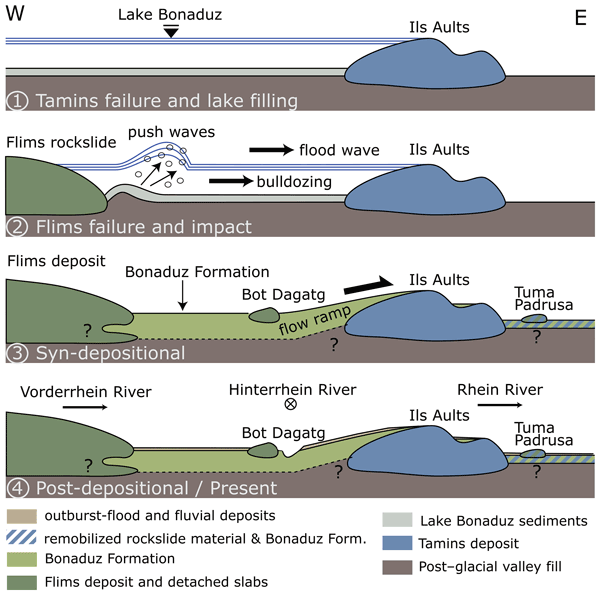
The Flims area in the Swiss Alps has fascinated the researchers with its complex geological history ever since. Especially the order of events related to the Tamins and Flims rockslides has long been debated. This paper presents novel results based on up to 160 m deep geophysical profiles, which show onlaps of the Bonaduz Formation onto the Tamins deposits (Ils Aults) and thus indicate that the Tamins rockslide occurred first. The consecutive evolution of this landscape is shown in four phases.
Shiva P. Pudasaini and Michael Krautblatter
Earth Surf. Dynam., 10, 165–189, https://doi.org/10.5194/esurf-10-165-2022, https://doi.org/10.5194/esurf-10-165-2022, 2022
Short summary
Short summary
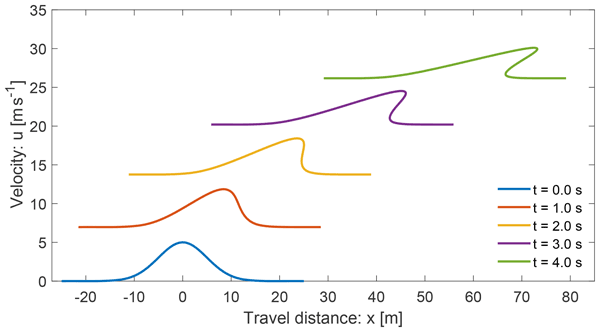
We present the first physics-based general landslide velocity model incorporating internal deformation and external forces. Voellmy–inviscid Burgers' equations are specifications of the novel advective–dissipative system. Unified analytical solutions constitute a new foundation of landslide velocity, providing key information to instantly estimate impact forces and describe breaking waves and folding, revealing that landslide dynamics are architectured by advection and reigned by forcing.
Bernd Etzelmüller, Justyna Czekirda, Florence Magnin, Pierre-Allain Duvillard, Ludovic Ravanel, Emanuelle Malet, Andreas Aspaas, Lene Kristensen, Ingrid Skrede, Gudrun D. Majala, Benjamin Jacobs, Johannes Leinauer, Christian Hauck, Christin Hilbich, Martina Böhme, Reginald Hermanns, Harald Ø. Eriksen, Tom Rune Lauknes, Michael Krautblatter, and Sebastian Westermann
Earth Surf. Dynam., 10, 97–129, https://doi.org/10.5194/esurf-10-97-2022, https://doi.org/10.5194/esurf-10-97-2022, 2022
Short summary
Short summary
This paper is a multi-authored study documenting the possible existence of permafrost in permanently monitored rockslides in Norway for the first time by combining a multitude of field data, including geophysical surveys in rock walls. The paper discusses the possible role of thermal regime and rockslide movement, and it evaluates the possible impact of atmospheric warming on rockslide dynamics in Norwegian mountains.
Carolin Kiefer, Patrick Oswald, Jasper Moernaut, Stefano Claudio Fabbri, Christoph Mayr, Michael Strasser, and Michael Krautblatter
Earth Surf. Dynam., 9, 1481–1503, https://doi.org/10.5194/esurf-9-1481-2021, https://doi.org/10.5194/esurf-9-1481-2021, 2021
Short summary
Short summary
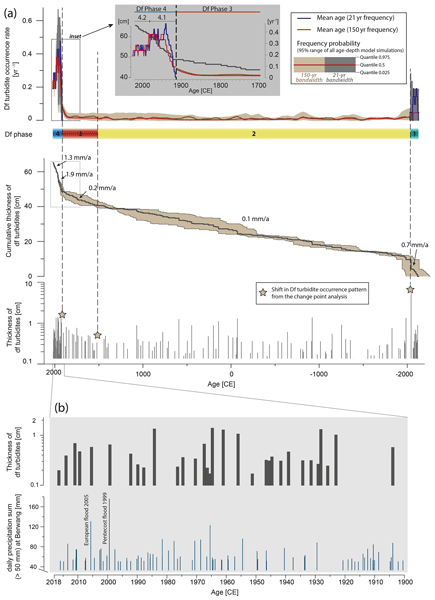
This study provides amphibious investigations of debris flow fans (DFFs). We characterize active DFFs, combining laser scan and sonar surveys at Plansee. We discover a 4000-year debris flow record in sediment cores, providing evidence for a 7-fold debris flow frequency increase in the 20th and 21st centuries, coincident with 2-fold enhanced rainstorm activity in the northern European Alps. Our results indicate climate change as being the main factor controlling debris flow activity.
Cited articles
Abdallah, T. and Helal, H.: Risk evaluation of rock mass sliding in El-Deir El-Bahary valley, Luxor, Egypt, Bulletin of the International Association of Engineering Geology-Bulletin de l'Association Internationale de Géologie de l'Ingénieur, 42, 3–9, https://doi.org/10.1007/BF02592614, 1990.
Abellán, A., Calvet, J., Vilaplana, J. M., and Blanchard, J.: Detection and spatial prediction of rockfalls by means of terrestrial laser scanner monitoring, Geomorphology, 119, 162–171, https://doi.org/10.1016/j.geomorph.2010.03.016, 2010.
Abellán, A., Vilaplana, J. M., Calvet, J., García-Sellés, D., and Asensio, E.: Rockfall monitoring by Terrestrial Laser Scanning – case study of the basaltic rock face at Castellfollit de la Roca (Catalonia, Spain), Nat. Hazards Earth Syst. Sci., 11, 829–841, https://doi.org/10.5194/nhess-11-829-2011, 2011.
Abellán, A., Oppikofer, T., Jaboyedoff, M., Rosser, N. J., Lim, M., and Lato, M. J.: Terrestrial laser scanning of rock slope instabilities, Earth Surface Processes and Landforms, 39, 80–97, https://doi.org/10.1002/esp.3493, 2014.
Alcaíno-Olivares, R., Perras, M. A., Ziegler, M., and Leith, K.: Thermo-Mechanical Cliff Stability at Tomb KV42 in the Valley of the Kings, Egypt, in: Understanding and Reducing Landslide Disaster Risk: Volume 1 Sendai Landslide Partnerships and Kyoto Landslide Commitment, edited by: Sassa, K., Springer International Publishing AG, Cham, 471–478, https://doi.org/10.1007/978-3-030-60196-6_38, 2021.
Allen, S. K., Schneider, D., and Owens, I. F.: First approaches towards modelling glacial hazards in the Mount Cook region of New Zealand's Southern Alps, Nat. Hazards Earth Syst. Sci., 9, 481–499, https://doi.org/10.5194/nhess-9-481-2009, 2009.
Arnold, D.: Die Tempel Ägyptens: Götterwohnungen, Baudenkmäler, Kultstätten, Bechtermünz, Augsburg, ISBN 3860472151, 1996.
Aubry, M.-P., Berggren, W. A., Dupuis, C., Ghaly, H., Ward, D., King, C., Knox, R. W. O., Ouda, K., Youssef, M., and Galal, W. F.: Pharaonic necrostratigraphy: a review of geological and archaeological studies in the Theban Necropolis, Luxor, West Bank, Egypt, Terra Nova, 21, 237–256, https://doi.org/10.1111/j.1365-3121.2009.00872.x, 2009.
Aubry, M.-P., Dupuis, C., Berggren, W. A., Ghaly, H., Ward, D., King, C., Knox, R. W. O., Ouda, K., and Youssef, M.: The role of geoarchaeology in the preservation and management of the Theban Necropolis, West Bank, Egypt, Proceedings of the Yorkshire Geological Society, 61, 134–147, https://doi.org/10.1144/pygs2016-366, 2016.
Badawy, A., Abdel-Monem, S. M., Sakr, K., and Ali, S.: Seismicity and kinematic evolution of middle Egypt, Journal of Geodynamics, 42, 28–37, https://doi.org/10.1016/j.jog.2006.04.003, 2006.
Bartelt, P., Valero, C. V., Feistl, T., Christen, M., Bühler, Y., and Buser, O.: Modelling cohesion in snow avalanche flow, J. Glaciol., 61, 837–850, https://doi.org/10.3189/2015JoG14J126, 2015.
Berardino, P., Fornaro, G., Lanari, R., and Sansosti, E.: A new algorithm for surface deformation monitoring based on small baseline differential SAR interferograms, IEEE Trans. Geosci. Remote Sensing, 40, 2375–2383, https://doi.org/10.1109/TGRS.2002.803792, 2002.
Bertoldi, G., D'Agostino, V., and McArdell, B. W.: An integrated method for debris flow hazard mapping using 2D runout models, in: Conference proceedings, 12th Congress INTERPRAEVENT, ISBN 9783901164194, 2012.
Beshr, A. M., Kamel Mohamed, A., ElGalladi, A., Gaber, A., and El-Baz, F.: Structural characteristics of the Qena Bend of the Egyptian Nile River, using remote-sensing and geophysics, The Egyptian Journal of Remote Sensing and Space Science, 24, 999–1011, https://doi.org/10.1016/j.ejrs.2021.11.005, 2021.
Bessette-Kirton, E. K., Moore, J. R., Geimer, P. R., Finnegan, R., Häusler, M., and Dzubay, A.: Structural Characterization of a Toppling Rock Slab From Array-Based Ambient Vibration Measurements and Numerical Modal Analysis, J. Geophys. Res.-Earth Surface, 127, https://doi.org/10.1029/2022JF006679, 2022.
Bianchini, S., Palamidessi, A., Centauro, I., Tofani, V., Spizzichino, D., and Tapete, D.: Satellite radar interferometry for the assessment of ground instability at a cultural heritage site: the case study of Civita di Bagnoregio, Italy, Rivista Italiana di Geotecnica, 1302, 67–78, https://doi.org/10.19199/0557-1405.rig.25.008, 2025.
Bolliger, D., Schlunegger, F., and McArdell, B. W.: Comparison of debris flow observations, including fine-sediment grain size and composition and runout model results, at Illgraben, Swiss Alps, Nat. Hazards Earth Syst. Sci., 24, 1035–1049, https://doi.org/10.5194/nhess-24-1035-2024, 2024.
Carlà, T., Intrieri, E., Raspini, F., Bardi, F., Farina, P., Ferretti, A., Colombo, D., Novali, F., and Casagli, N.: Perspectives on the prediction of catastrophic slope failures from satellite InSAR, Scientific Reports, 9, 14137, https://doi.org/10.1038/s41598-019-50792-y, 2019.
Caviezel, A., Lu, G., Demmel, S. E., Ringenbach, A., Bühler, Y., Christen, M., and Bartelt, P.: RAMMS:ROCKFALL – A Modern 3-Dimensional Simulation Tool Calibrated on Real World Data, 53rd U.S. Rock Mechanics/Geomechanics Symposium, https://www.dora.lib4ri.ch/wsl/islandora/object/wsl:22147 (last access: 14 January 2026), 2019.
Caviezel, A., Ringenbach, A., Demmel, S. E., Dinneen, C. E., Krebs, N., Bühler, Y., Christen, M., Meyrat, G., Stoffel, A., Hafner, E., Eberhard, L. A., Rickenbach, D. von, Simmler, K., Mayer, P., Niklaus, P. S., Birchler, T., Aebi, T., Cavigelli, L., Schaffner, M., Rickli, S., Schnetzler, C., Magno, M., Benini, L., and Bartelt, P.: The relevance of rock shape over mass-implications for rockfall hazard assessments, Nature Communications, 12, 5546, https://doi.org/10.1038/s41467-021-25794-y, 2021.
Chen, C. W. and Zebker, H. A.: Phase unwrapping for large SAR interferograms: statistical segmentation and generalized network models, IEEE Trans. Geosci. Remote Sensing, 40, 1709–1719, https://doi.org/10.1109/TGRS.2002.802453, 2002.
Christen, M., Bühler, Y., Bartelt, P., Leine, R., Glover, J., Schweizer, A., Graf, C., McArdell, B. W., Gerber, W., Deubelbeiss, Y., Feistl, T., and Volkwein, A: Integral hazard management using a unified software environment, in: 12th Congress Interpraevent, 77–86, http://hdl.handle.net/20.500.11850/61165 (last access: 14 January 2026), 2012.
Chudzik, P., El Younsy, A.-R. M., Galal, W. F., and Salman, A. M.: Geological appraisal of the Theban cliff overhanging the Hatshepsut temple at Deir el-Bahari, Polish Archaeology in the Mediterranean, 30, 275–295, 2022.
Cleveland, R. B.: STL: A seasonal-trend decomposition procedure based on loess, J. Off. Stat., 6, 3–73, 1990.
Colesanti, C. and Wasowski, J.: Investigating landslides with space-borne Synthetic Aperture Radar (SAR) interferometry, Engineering Geology, 88, 173–199, https://doi.org/10.1016/j.enggeo.2006.09.013, 2006.
Collins, B. D. and Stock, G. M.: Rockfall triggering by cyclic thermal stressing of exfoliation fractures, Nature Geosci., 9, 395–400, https://doi.org/10.1038/ngeo2686, 2016.
Corominas, J., Matas, G., and Ruiz-Carulla, R.: Quantitative analysis of risk from fragmental rockfalls, Landslides, 16, 5–21, https://doi.org/10.1007/s10346-018-1087-9, 2019.
Ćwiek, A.: Old and Middle Kingdom tradition in the Temple of Hatshepsut at Deir el-Bahari, Études et Travaux (Institut des Cultures Méditerranéennes et Orientales de l'Académie Polonaise des Sciences), 61–93, ISBN 978-8392231981, 2014.
de Falco, A., Resta, C., and Squeglia, N.: Satellite and on-site monitoring of subsidence for heritage preservation: A critical comparison from Piazza del Duomo in Pisa, Italy, in: Geotechnical Engineering for the Preservation of Monuments and Historic Sites III, edited by: Lancellotta, R., Viggiani, C., Flora, A., de Silva, F., and Mele, L., CRC Press, London, 548–559, https://doi.org/10.1201/9781003308867-39, 2022.
de Haas, T., McArdell, B. W., Conway, S. J., McElwaine, J. N., Kleinhans, M. G., Salese, F., and Grindrod, P. M.: Initiation and Flow Conditions of Contemporary Flows in Martian Gullies, Journal of Geophysical Research. Planets, 124, 2246–2271, https://doi.org/10.1029/2018JE005899, 2019.
Dehls, J. F., Bredal, M., Penna, I., Larsen, Y., Aslan, G., Bendle, J., Böhme, M., Hermanns, R., Haugsnes, V. S., and Noel, F.: InSAR Norway: Advancing Geohazard Understanding through Wide-Area Analysis, EGU General Assembly 2024, Vienna, Austria, 14–19 April 2024, EGU24-4400, https://doi.org/10.5194/egusphere-egu24-4400, 2024.
De Pedrini, A., Ambrosi, C., and Scapozza, C.: The 1513 Monte Crenone rock avalanche: numerical model and geomorphological analysis, Geogr. Helv., 77, 21–37, https://doi.org/10.5194/gh-77-21-2022, 2022.
Dietrich, A. and Krautblatter, M.: Deciphering controls for debris-flow erosion derived from a LiDAR-recorded extreme event and a calibrated numerical model (Roßbichelbach, Germany), Earth Surface Processes and Landforms, 44, 1346–1361, https://doi.org/10.1002/esp.4578, 2019.
Draebing, D., Mayer, T., Jacobs, B., and McColl, S. T.: Alpine rockwall erosion patterns follow elevation-dependent climate trajectories, Commun. Earth Environ., 3, 1–12, https://doi.org/10.1038/s43247-022-00348-2, 2022.
Draebing, D., Mayer, T., McColl, S., Schlecker, M., and Jacobs, B.: Relief and elevation set limits on mountain size, Research Square [preprint], https://doi.org/10.21203/rs.3.rs-5156557/v1, 2024.
Dupuis, C., Aubry, M.-P., King, C., Knox, R. W., Berggren, W. A., Youssef, M., Galal, W. F., and Roche, M.: Genesis and geometry of tilted blocks in the Theban Hills, near Luxor (Upper Egypt), Journal of African Earth Sciences, 61, 245–267, https://doi.org/10.1016/j.jafrearsci.2011.06.001, 2011.
Engen, S. H., Gjerde, M., Scheiber, T., Seier, G., Elvehøy, H., Abermann, J., Nesje, A., Winkler, S., Haualand, K. F., Rüther, D. C., Maschler, A., Robson, B. A., and Yde, J. C.: Investigation of the 2010 rock avalanche onto the regenerated glacier Brenndalsbreen, Norway, Landslides, 21, 2051–2072, https://doi.org/10.1007/s10346-024-02275-z, 2024.
Erismann, T. H. and Abele, G.: Dynamics of rockslides and rockfalls: With 10 tables, Springer, Berlin, Heidelberg, 316 pp., ISBN 978-3662046395, 2001.
Ezzy, M., Jacobs, B., Krautblatter, M., Grosse, C. U., Helal, H., and Ismael, M.: Assessment of the rock fall geo-hazards of the sub-vertical rock cliffs behind the Mortuary Temple of Hatshepsut (MTH), Luxor, Egypt, Engineering Geology, 358, 108429, https://doi.org/10.1016/j.enggeo.2025.108429, 2025.
Ferretti, A., Prati, C., and Rocca, F.: Permanent scatterers in SAR interferometry, IEEE Trans. Geosci. Remote Sensing, 39, 8–20, https://doi.org/10.1109/36.898661, 2001.
Ferretti, A., Fumagalli, A., Novali, F., Prati, C., Rocca, F., and Rucci, A.: A New Algorithm for Processing Interferometric Data-Stacks: SqueeSAR, IEEE Trans. Geosci. Remote Sensing, 49, 3460–3470, https://doi.org/10.1109/TGRS.2011.2124465, 2011.
Frank, F., McArdell, B. W., Oggier, N., Baer, P., Christen, M., and Vieli, A.: Debris-flow modeling at Meretschibach and Bondasca catchments, Switzerland: sensitivity testing of field-data-based entrainment model, Nat. Hazards Earth Syst. Sci., 17, 801–815, https://doi.org/10.5194/nhess-17-801-2017, 2017.
Gado, T. A., El-Hagrsy, R. M., and Rashwan, I. M. H.: Projection of rainfall variability in Egypt by regional climate model simulations, Journal of Water and Climate Change, 13, 2872–2894, https://doi.org/10.2166/wcc.2022.003, 2022.
Gaisecker, T. and Czerwonka-Schröder, D.: RIEGL V-Line Scanners for Permanent Monitoring Applications and integration capabilities into customers risk management [White Paper], RIEGL Laser Measurement Systems GmbH & DMT GmbH & Co. KG, https://doi.org/10.13140/RG.2.2.27800.06409, 2022.
Gigli, G., Morelli, S., Fornera, S., and Casagli, N.: Terrestrial laser scanner and geomechanical surveys for the rapid evaluation of rock fall susceptibility scenarios, Landslides, 11, 1–14, https://doi.org/10.1007/s10346-012-0374-0, 2014.
Gili, J. A., Ruiz-Carulla, R., Matas, G., Moya, J., Prades, A., Corominas, J., Lantada, N., Núñez-Andrés, M. A., Buill, F., Puig, C., Martínez-Bofill, J., Saló, L., and Mavrouli, O.: Rockfalls: analysis of the block fragmentation through field experiments, Landslides, 19, 1009–1029, https://doi.org/10.1007/s10346-021-01837-9, 2022.
Graber, A. and Santi, P.: Power law models for rockfall frequency-magnitude distributions: review and identification of factors that influence the scaling exponent, Geomorphology, 418, 108463, https://doi.org/10.1016/j.geomorph.2022.108463, 2022.
Graf, C., Christen, M., McArdell, B. W., and Bartelt, P.: Overview of a decade of applied debris-flow runout modeling in Switzerland, An: challenges and recommendations, in: 7th International Conference on Debris-Flow Hazards Mitigation, Golden, Colorado, USA, 10–13 June 2019, https://doi.org/10.25676/11124/173155, 2019.
Hanssen, R. F.: Subsidence monitoring using contiguous and PS-InSAR: Quality assessment based on precision and reliability, Proc. 11th FIG Sym. Def. Measur., Santorini, Grecia, https://www.fig.net/resources/proceedings/2003/santorini_comm6/C-INSAR/C2.pdf (last access: 14 January 2026), 2003.
Hartmeyer, I., Keuschnig, M., Delleske, R., Krautblatter, M., Lang, A., Schrott, L., Prasicek, G., and Otto, J.-C.: A 6-year lidar survey reveals enhanced rockwall retreat and modified rockfall magnitudes/frequencies in deglaciating cirques, Earth Surf. Dynam., 8, 753–768, https://doi.org/10.5194/esurf-8-753-2020, 2020a.
Hartmeyer, I., Delleske, R., Keuschnig, M., Krautblatter, M., Lang, A., Schrott, L., and Otto, J.-C.: Current glacier recession causes significant rockfall increase: the immediate paraglacial response of deglaciating cirque walls, Earth Surf. Dynam., 8, 729–751, https://doi.org/10.5194/esurf-8-729-2020, 2020b.
Hesthammer, J. and Fossen, H.: Evolution and geometries of gravitational collapse structures with examples from the Statfjord Field, northern North Sea, Marine and Petroleum Geology, 16, 259–281, 1999.
Hungr, O., Leroueil, S., and Picarelli, L.: The Varnes classification of landslide types, an update, Landslides, 11, 167–194, https://doi.org/10.1007/s10346-013-0436-y, 2014.
Intrieri, E., Raspini, F., Fumagalli, A., Lu, P., Del Conte, S., Farina, P., Allievi, J., Ferretti, A., and Casagli, N.: The Maoxian landslide as seen from space: detecting precursors of failure with Sentinel-1 data, Landslides, 15, 123–133, https://doi.org/10.1007/s10346-017-0915-7, 2018.
Jaboyedoff, M., Oppikofer, T., Abellán, A., Derron, M.-H., Loye, A., Metzger, R., and Pedrazzini, A.: Use of LIDAR in landslide investigations: a review, Natural Hazards, 61, 5–28, https://doi.org/10.1007/s11069-010-9634-2, 2012.
Jackson, R. L., Green, I., and Marghitu, D. B.: Predicting the coefficient of restitution of impacting elastic-perfectly plastic spheres, Nonlinear Dyn., 60, 217–229, https://doi.org/10.1007/s11071-009-9591-z, 2010.
Jacobs, B. and Krautblatter, M.: LiDAR-basierte Quantifizierung von strukturellen Einflüssen auf Steinschlagaktivität in alpinen Kalksteinwänden, in: Fachsektionstage Geotechnik – Interdisziplinäres Forum, 6–8 September 2017, Congress Centrum Würzburg Tagungsband, ISBN 978-3-946039-03-7, 2017.
Jacobs, B., Stammberger, V., and Krautblatter, M.: Geomorphic Hazard Mitigation in touristically developed Alpine Gorges: a Benchmark Study in the Höllental Gorge, Bavaria, in: INTERPRAEVENT 2024 Conference Proceedings, ISBN 78-3-901164-32-3, 2024.
Karakhanyan, A., Avagyan, A., and Sourouzian, H.: Archaeoseismological studies at the temple ofAmenhotep III, Luxor, Egypt, Ancient Earthquakes, edited by: Sintubin, M., Geological Society of America, Boulder, Colo., https://doi.org/10.1130/2010.2471(17), 2010.
Kenner, R., Gischig, V., Gojcic, Z., Quéau, Y., Kienholz, C., Figi, D., Thöny, R., and Bonanomi, Y.: The potential of point clouds for the analysis of rock kinematics in large slope instabilities: examples from the Swiss Alps: Brinzauls, Pizzo Cengalo and Spitze Stei, Landslides, 19, 1357–1377, https://doi.org/10.1007/s10346-022-01852-4, 2022.
King, C., Dupuis, C., Aubry, M.-P., Berggren, W. A., Knox, R. O., Galal, W. F., and Baele, J.-M.: Anatomy of a mountain: The Thebes Limestone Formation (Lower Eocene) at Gebel Gurnah, Luxor, Nile Valley, Upper Egypt, Journal of African Earth Sciences, 136, 61–108, https://doi.org/10.1016/j.jafrearsci.2017.05.008, 2017.
Klemm, R. and Klemm, D. D.: Steine und Steinbrüche im Alten Ägypten, Springer Berlin Heidelberg, Berlin, Heidelberg, ISBN 978-3540546856, 1993.
Krautblatter, M. and Moser, M.: A nonlinear model coupling rockfall and rainfall intensity based on a four year measurement in a high Alpine rock wall (Reintal, German Alps), Nat. Hazards Earth Syst. Sci., 9, 1425–1432, https://doi.org/10.5194/nhess-9-1425-2009, 2009.
Kromer, R., Lato, M., Hutchinson, D. J., Gauthier, D., and Edwards, T.: Managing rockfall risk through baseline monitoring of precursors using a terrestrial laser scanner, Can. Geotech. J., 54, 953–967, https://doi.org/10.1139/cgj-2016-0178, 2017a.
Kromer, R. A., Abellán, A., Hutchinson, D. J., Lato, M., Chanut, M.-A., Dubois, L., and Jaboyedoff, M.: Automated terrestrial laser scanning with near-real-time change detection – monitoring of the Séchilienne landslide, Earth Surf. Dynam., 5, 293–310, https://doi.org/10.5194/esurf-5-293-2017, 2017b.
Kumar, S., Sharma, A., and Singh, K.: A Comprehensive Review on Debris Flow Landslide Assessment Using Rapid Mass Movement Simulation (RAMMS), Geotech. Geol. Eng., 42, 5447–5475, https://doi.org/10.1007/s10706-024-02887-1, 2024.
Lague, D., Brodu, N., and Leroux, J.: Accurate 3D comparison of complex topography with terrestrial laser scanner: Application to the Rangitikei canyon (N-Z), ISPRS Journal of Photogrammetry and Remote Sensing, 82, 10–26, https://doi.org/10.1016/j.isprsjprs.2013.04.009, 2013.
Leinauer, J., Dietze, M., Knapp, S., Scandroglio, R., Jokel, M., and Krautblatter, M.: How water, temperature, and seismicity control the preconditioning of massive rock slope failure (Hochvogel), Earth Surf. Dynam., 12, 1027–1048, https://doi.org/10.5194/esurf-12-1027-2024, 2024.
Li, H., Li, X., Li, W., Zhang, S., and Zhou, J.: Quantitative assessment for the rockfall hazard in a post-earthquake high rock slope using terrestrial laser scanning, Engineering Geology, 248, 1–13, https://doi.org/10.1016/j.enggeo.2018.11.003, 2019.
Lipińska, J.: The Temple of Tuthmosis III: Architecture, Deir el-Bahari, II, edited by: Kazimierz, M., Éd. Scientifiques de Pologne, Varsovie, https://opac.ub.lmu.de/Record/4226114 (last access: 15 January 2026), 1977.
Lipińska, J.: Deir el-Bahari – Temple of Thutmosis III, in: Seventy years of Polish archaeology in Egypt, edited by: Laskowska-Kusztal, E., Polish Centre of Mediterranean Archaeology Univ. of Warsaw, Warsaw, 105–114, ISBN 978-83-903796-1-6, 2007.
Margottini, C., Bobrowsky, P., Gigli, G., Ruther, H., Spizzichino, D., and Vlcko, J.: Rupestrian World Heritage Sites: Instability Investigation and Sustainable Mitigation, in: Advancing Culture of Living with Landslides, edited by: Sassa, K., Mikoš, M., and Yin, Y., Springer International Publishing, Cham, 23–50, https://doi.org/10.1007/978-3-319-59469-9_2, 2017.
Marija, L., Martin, Z., Jordan, A., and Matthew, P.: Rockfall susceptibility and runout in the Valley of the Kings, Natural Hazards, 110, 451–485, https://doi.org/10.1007/s11069-021-04954-9, 2022.
Massaro, L., Forte, G., de Falco, M., Rauseo, F., and Santo, A.: Rockfall source identification and trajectory analysis from UAV-based data in volcano-tectonic areas: a case study from Ischia Island, Southern Italy, Bulletin of the International Association of Engineering Geology – Bulletin de l'Association Internationale de Géologie de l'Ingénieur, 83, https://doi.org/10.1007/s10064-024-03569-1, 2024.
Matasci, B., Stock, G. M., Jaboyedoff, M., Carrea, D., Collins, B. D., Guérin, A., Matasci, G., and Ravanel, L.: Assessing rockfall susceptibility in steep and overhanging slopes using three-dimensional analysis of failure mechanisms, Landslides, 15, 859–878, https://doi.org/10.1007/s10346-017-0911-y, 2018.
Mendler, A., Rada Erazo, J. D., Ismael, M., Ezzy, M., Jacobs, B., Haberland, C., Krautblatter, M., Helal, H., and Grosse, C. U.: Vibration Monitoring of the Rock Formation Above the Hatshepsut Temple, eJNDT, 29, https://doi.org/10.58286/29649, 2024.
Mohadjer, S., Ehlers, T. A., Nettesheim, M., Ott, M. B., Glotzbach, C., and Drews, R.: Temporal variations in rockfall and rock-wall retreat rates in a deglaciated valley over the past 11 ky, Geology, 48, 594–598, https://doi.org/10.1130/G47092.1, 2020.
Moore, J. R., Geimer, P. R., Finnegan, R., and Michel, C.: Dynamic Analysis of a Large Freestanding Rock Tower (Castleton Tower, Utah), Bulletin of the Seismological Society of America, 109, 2125–2131, https://doi.org/10.1785/0120190118, 2019.
Nakamura, Y.: A method for dynamic characteristics estimation of subsurface using microtremor on the ground surface, Quarterly Report of RTRI, Railway Technical Research Institute (RTRI), 30, https://trid.trb.org/View/294184 (last access: 14 January 2026), 1989.
Naville, E.: The Temple of Deir El Bahari: Its Plan, its Founders, and its first Explorers.: Introductory Memoir, Twelfth memoir of the Egypt Exploration Fund, Offices of the Egypt exploration fund, London, 1894.
Naville, E.: The XIth Dynasty Temple at Deir El Bahari: Part I, Twenty-eights memoir of the Egypt Exploration Fund, Offices of the Egypt exploration fund, London, 1907.
Naville, E.: The XIth Dynasty Temple at Deir El Bahari: Part III, Thirty-second memoir of the Egypt Exploration Fund, Offices of the Egypt exploration fund, London, 1913.
Noël, F., Nordang, S. F., Jaboyedoff, M., Digout, M., Guerin, A., Locat, J., and Matasci, B.: Comparing Flow-R, Rockyfor3D and RAMMS to Rockfalls from the Mel de la Niva Mountain: A Benchmarking Exercise, Geosciences, 13, 200, https://doi.org/10.3390/geosciences13070200, 2023.
Pawlikowski, M. and Wasilewski, M.: Some remarks on jointing in the Theban limestones in the region of Deir el-Bahari, Egypt, Geologia/Akademia Górniczo-Hutnicza im. Stanisława Staszica w Krakowie, 30, 47–56, 2004.
Pechnikov, A.: PyGMTSAR (Python InSAR), Zenodo [code], https://doi.org/10.5281/zenodo.7725131, 2024.
RAMMS AG: RAMMS:DEBRISFLOW User Manual: User Manual v1.8 Debrisflow, https://ramms.ch/wp-content/uploads/RAMMS_DBF_Manual.pdf (last access: 28 March 2025), 2024a.
RAMMS AG: RAMMS:ROCKFALL User Manual: User Manual v1.8 Rockfall, https://ramms.ch/wp-content/uploads/RAMMS_ROCK2_Manual.pdf (last access: 28 March 2025), 2024b.
RIEGL, L. M. S.: Data Sheet, RIEGL VZ-400, 19 September 2014, https://www.rieglusa.com/wp-content/uploads/vz-400-datasheet-new.pdf (last access: 10 November 2025), 2014.
Rosser, N. J., Brain, M. J., Petley, D. N., Lim, M., and Norman, E. C.: Coastline retreat via progressive failure of rocky coastal cliffs, Geology, 41, 939–942, https://doi.org/10.1130/G34371.1, 2013.
Ruiz-Carulla, R., Corominas, J., Gili, J. A., Matas, G., Lantada, N., Moya, J., Prades, A., Núñez-Andrés, M. A., Buill, F., and Puig, C.: Analysis of Fragmentation of Rock Blocks from Real-Scale Tests, Geosciences, 10, 308, https://doi.org/10.3390/geosciences10080308, 2020.
Said, R.: The Geology of Egypt, Routledge, ISBN 9781351410427, 2017.
Sala, Z., Hutchinson, D. J., and Harrap, R.: Simulation of fragmental rockfalls detected using terrestrial laser scans from rock slopes in south-central British Columbia, Canada, Nat. Hazards Earth Syst. Sci., 19, 2385–2404, https://doi.org/10.5194/nhess-19-2385-2019, 2019.
Salm, B.: Flow, flow transition and runout distances of flowing avalanches, Ann. Glaciol., 18, 221–226, https://doi.org/10.3189/S0260305500011551, 1993.
Santos Delgado, G., Martínez, R. J., Monterrubio Pérez, S., and Del Carmen Yenes Varela, M.: Control de Movimientos con Técnica de Láser Escáner 3D en Laderas Inestables de laCuenca del Duero. El Caso de Aguilarejos (Valladolid), in: VII Simposio Nacional sobre Taludes y Laderas Inestables, 27–30 October 2009, 243–255, ISBN 9788496736771, 2009.
Schraml, K., Thomschitz, B., McArdell, B. W., Graf, C., and Kaitna, R.: Modeling debris-flow runout patterns on two alpine fans with different dynamic simulation models, Nat. Hazards Earth Syst. Sci., 15, 1483–1492, https://doi.org/10.5194/nhess-15-1483-2015, 2015.
Sellmeier, B. and Thuro, K.: Comparison of two 3D rockfall codes on behalf of a case study in the Bavarian Alps, Geomechanics and Tunnelling, 10, 15–23, https://doi.org/10.1002/geot.201600071, 2017.
Shen, N., Wang, B., Ma, H., Zhao, X., Zhou, Y., Zhang, Z., and Xu, J.: A review of terrestrial laser scanning (TLS)-based technologies for deformation monitoring in engineering, Measurement, 223, 113684, https://doi.org/10.1016/j.measurement.2023.113684, 2023.
Solari, L., Ciampalini, A., Raspini, F., Bianchini, S., and Moretti, S.: PSInSAR Analysis in the Pisa Urban Area (Italy): A Case Study of Subsidence Related to Stratigraphical Factors and Urbanization, Remote Sensing, 8, 120, https://doi.org/10.3390/rs8020120, 2016.
Spreafico, M. C., Perotti, L., Cervi, F., Bacenetti, M., Bitelli, G., Girelli, V. A., Mandanici, E., Tini, M. A., and Borgatti, L.: Terrestrial Remote Sensing techniques to complement conventional geomechanical surveys for the assessment of landslide hazard: The San Leo case study (Italy), European Journal of Remote Sensing, 48, 639–660, 2015.
Strunden, J., Ehlers, T. A., Brehm, D., and Nettesheim, M.: Spatial and temporal variations in rockfall determined from TLS measurements in a deglaciated valley, Switzerland, J. Geophys. Res.-Earth Surface, 120, 1251–1273, https://doi.org/10.1002/2014JF003274, 2015.
Utlu, M., Öztürk, M. Z., Şimşek, M., and Akgümüş, M. F.: Evaluation of rockfall hazard based on UAV technology and 3D Rockfall Simulations, International Journal of Environment and Geoinformatics, 10, 1–16, https://doi.org/10.30897/ijegeo.1323768, 2023.
van Overschee, P. and de Moor, B.: A unifying theorem for three subspace system identification algorithms, Automatica, 31, 1853–1864, https://doi.org/10.1016/0005-1098(95)00072-0, 1995.
Weber, S., Fäh, D., Beutel, J., Faillettaz, J., Gruber, S., and Vieli, A.: Ambient seismic vibrations in steep bedrock permafrost used to infer variations of ice-fill in fractures, Earth and Planetary Science Letters, 501, 119–127, https://doi.org/10.1016/j.epsl.2018.08.042, 2018.
Wendeler, C., Bühler, Y., Bartelt, P., and Glover, J.: Application of three-dimensional rockfall modelling to rock face engineering, Geomechanics and Tunnelling, 10, 74–80, https://doi.org/10.1002/geot.201600073, 2017.
Winiwarter, L., Anders, K., Czerwonka-Schröder, D., and Höfle, B.: Full four-dimensional change analysis of topographic point cloud time series using Kalman filtering, Earth Surf. Dynam., 11, 593–613, https://doi.org/10.5194/esurf-11-593-2023, 2023.
Winlock, H. E.: Excavations At Deir El Bahari: 1911–1931, The MacMillan Company, New York, https://doi.org/10.11588/diglit.55201, 1942.
Witte, B. and Schmidt, H.: Vermessungskunde und Grundlagen der Statistik für das Bauwesen, 6., überarb. Aufl., Wichmann, Heidelberg, 678 pp., ISBN 978-3-87907-435-8, 2006.
Wyllie, D. C.: Rock fall engineering, First issued in paperback, CRC Press Taylor & Francis Group, Boca Raton, London, New York, 243 pp., ISBN 9781138077621, 2017.
Zachert, K.: Preliminary report on the activities of the Polish Cliff Mission working at Deir El-Bahari between 28th January and 12th March 2014, University of Warsaw, https://www.academia.edu/8581023/Preliminary_report_on_the_activities_of_the_Polish_Cliff_Mission_working_at_Deir_El_Bahari_between_28th_January_and_12th_March_2014 (last access: 14 January 2026), 2014a.
Zachert, K.: Preliminary report on the results of the works done by the Polish Cliff Mission at Deir el-Bahari in the season: October–December 2014, University of Warsaw, https://www.academia.edu/12746709/Preliminary_report_on_the_results_of_the_works_done_by_the_Polish_Cliff_Mission_at_Deir_el_Bahari_in_the_season_October_December_2014 (last access: 14 January 2026), 2014b.
Zachert, K.: Preliminary report on the works of the Polish Cliff Mission at Deir el-Bahari in the season: 22 September–10 December 2015, University of Warsaw, https://www.academia.edu/20032515/Preliminary_report_on_the_works_of_the_Polish_Cliff_Mission_at_Deir_el_Bahari_in_the_season_22_September_10_December_2015 (last access: 14 January 2026), 2014c.
Zimmermann, F., McArdell, B. W., Rickli, C., and Scheidl, C.: 2D Runout Modelling of Hillslope Debris Flows, Based on Well-Documented Events in Switzerland, Geosciences, 10, 70, https://doi.org/10.3390/geosciences10020070, 2020.
Short summary
The Mortuary Temple of Hatshepsut is one of Egypt's key heritage sites but is potentially threatened by rockfalls from a 100 m high limestone cliff. We transferred established monitoring techniques from alpine environments to this UNESCO World Heritage Site and evaluated their performance in a historically sensitive desert environment. Our study presents the first evidence-based event and impact analysis of rockfalls at the Temple of Hatshepsut, providing vital data for future risk assessment.
The Mortuary Temple of Hatshepsut is one of Egypt's key heritage sites but is potentially...


