
Articles | Volume 14, issue 4
https://doi.org/10.5194/esurf-14-653-2026
© Author(s) 2026. This work is distributed under
the Creative Commons Attribution 4.0 License.
the Creative Commons Attribution 4.0 License.
https://doi.org/10.5194/esurf-14-653-2026
© Author(s) 2026. This work is distributed under
the Creative Commons Attribution 4.0 License.
the Creative Commons Attribution 4.0 License.
ESurf Letters
| Highlight paper
| 
26 Aug 2026
ESurf Letters | Highlight paper |
| 26 Aug 2026
| 26 Aug 2026
From regular to random: a unifying framework for step-pool spacing

GFZ Helmholtz Centre for Geosciences, 14473 Potsdam, Germany
Jens M. Turowski
GFZ Helmholtz Centre for Geosciences, 14473 Potsdam, Germany
Related authors
Evan N. Dethier, Christian M. Erikson, and Carl E. Renshaw
EGUsphere, https://doi.org/10.5194/egusphere-2025-5691, https://doi.org/10.5194/egusphere-2025-5691, 2025
Short summary
Short summary
Large, landslide-like failures in permafrost sediment, called thaw slumps, appear to be expanding across much of the Arctic. We investigated a region in Russia where more than 1700 such failures occurred during a heatwave in 2020. We used satellites to show that river sediment transport downstream of slumps spiked to more than double background levels. We find that erosion from slumps can rapidly change rivers and that rivers can be an early indicator of upstream thaw slump failure.
David Puhl, Jens M. Turowski, Christoff Andermann, Michael Dietze, Kristen L. Cook, Gen K. Li, and Basanta R. Adhikari
EGUsphere, https://doi.org/10.5194/egusphere-2026-4202, https://doi.org/10.5194/egusphere-2026-4202, 2026
Short summary
Short summary
Large earthquakes trigger widespread landslides that increase the amount of sediment delivered to rivers. We studied suspended sediment grain sizes in a major Himalayan river basin following the 2015 Gorkha Earthquake in Nepal. We found coarser suspended sediments near heavily affected areas during the first year after the earthquake, with the signal disappearing downstream. These findings improve our understanding of how far and for how long earthquakes influence river sediment transport.
Jun Zhang, Yong Li, Xiaojun Guo, Dongri Song, and Jens M. Turowski
EGUsphere, https://doi.org/10.5194/egusphere-2026-3226, https://doi.org/10.5194/egusphere-2026-3226, 2026
This preprint is open for discussion and under review for Natural Hazards and Earth System Sciences (NHESS).
Short summary
Short summary
Debris flows often move as multiple surges, like pulses of muddy water. Scientists have struggled to predict their overall behavior. By analyzing global data, we discovered hidden statistical laws governing how surges evolve and organize. We used these rules to build a computer model that recreates real surge sequences and predicts their size and frequency. This work provides a powerful new tool for assessing debris-flow hazards and improving early warning systems.
Evan N. Dethier, Christian M. Erikson, and Carl E. Renshaw
EGUsphere, https://doi.org/10.5194/egusphere-2025-5691, https://doi.org/10.5194/egusphere-2025-5691, 2025
Short summary
Short summary
Large, landslide-like failures in permafrost sediment, called thaw slumps, appear to be expanding across much of the Arctic. We investigated a region in Russia where more than 1700 such failures occurred during a heatwave in 2020. We used satellites to show that river sediment transport downstream of slumps spiked to more than double background levels. We find that erosion from slumps can rapidly change rivers and that rivers can be an early indicator of upstream thaw slump failure.
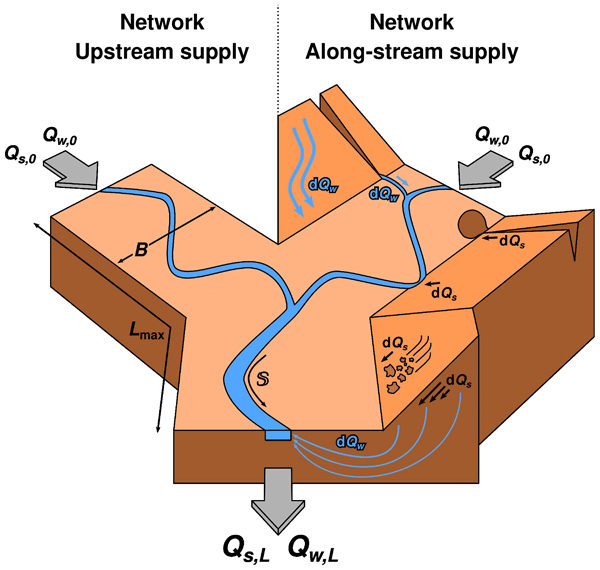
Fergus McNab, Taylor F. Schildgen, Jens M. Turowski, and Andrew D. Wickert
Earth Surf. Dynam., 13, 1059–1092, https://doi.org/10.5194/esurf-13-1059-2025, https://doi.org/10.5194/esurf-13-1059-2025, 2025
Short summary
Short summary
Alluvial rivers form networks, but many concepts we use to analyse their long-term evolution derive from models that treat them as single streams. We develop a model including tributary interactions and show that, while patterns of sediment output can be similar for network and single-segment models, complex signal propagation affects aggradation and incision within networks. We argue that understanding a specific catchment's evolution requires a model with its specific network structure.
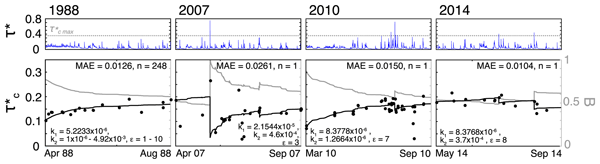
Claire C. Masteller, Joel P. L. Johnson, Dieter Rickenmann, and Jens M. Turowski
Earth Surf. Dynam., 13, 593–605, https://doi.org/10.5194/esurf-13-593-2025, https://doi.org/10.5194/esurf-13-593-2025, 2025
Short summary
Short summary
This paper presents a novel model that predicts how gravel riverbeds may evolve in response to differences in the frequency and severity of flood events. We test our model using a 23-year-long record of river flow and gravel transport from the Swiss Prealps. We find that our model reliably captures yearly patterns in gravel transport in this setting. Our new model is a major advance towards better predictions of river erosion that account for the flood history of a gravel-bed river.
Matanya Hamawi, Joel P. L. Johnson, Susan Bilek, Jens M. Turowski, and John B. Laronne
EGUsphere, https://doi.org/10.5194/egusphere-2025-591, https://doi.org/10.5194/egusphere-2025-591, 2025
Short summary
Short summary
Water level suddenly rises during flash floods in dry regions having a distinct impact on bedload – large sediment rolling and saltating on the riverbed. Using sensor-equipped pebbles and seismic monitoring in a field setting, we demonstrate that bedload activity is very high in both shallow and deep sudden flows. These findings can help improve bedload transport models, particularly when using seismic sensors, by providing new insights into bedload dynamics.
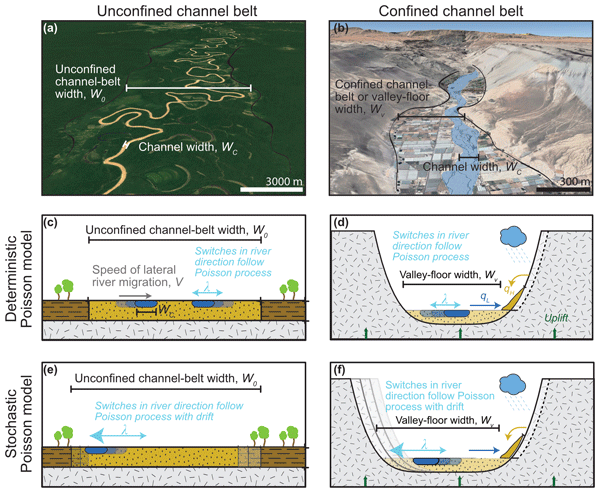
Jens M. Turowski, Fergus McNab, Aaron Bufe, and Stefanie Tofelde
Earth Surf. Dynam., 13, 97–117, https://doi.org/10.5194/esurf-13-97-2025, https://doi.org/10.5194/esurf-13-97-2025, 2025
Short summary
Short summary
Channel belts comprise the area affected by a river due to lateral migration and floods. As a landform, they affect water resources and flood hazard, and they often host unique ecological communities. We develop a model describing the evolution of channel-belt area over time. The model connects the behaviour of the river to the evolution of the channel belt over a timescale of centuries. A comparison to selected data from experiments and real river systems verifies the random walk approach.
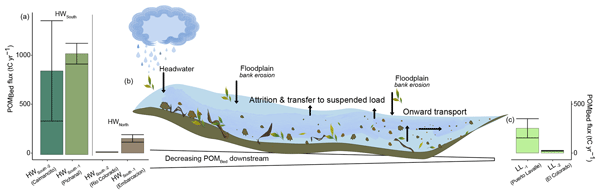
Sophia Dosch, Niels Hovius, Marisa Repasch, Joel Scheingross, Jens M. Turowski, Stefanie Tofelde, Oliver Rach, and Dirk Sachse
Earth Surf. Dynam., 12, 907–927, https://doi.org/10.5194/esurf-12-907-2024, https://doi.org/10.5194/esurf-12-907-2024, 2024
Short summary
Short summary
The transport of plant debris in rivers is an important part of the global carbon cycle and influences atmospheric carbon levels through time. We sampled plant debris at the bed of a lowland river and determined the sources as it is transported hundreds of kilometers. Plant debris can persist at the riverbed, but mechanical breakdown reduces its amount, and it is only a small fraction compared to the suspended load. This plant debris and transport patterns need further investigation globally.
Jens Martin Turowski, Aaron Bufe, and Stefanie Tofelde
Earth Surf. Dynam., 12, 493–514, https://doi.org/10.5194/esurf-12-493-2024, https://doi.org/10.5194/esurf-12-493-2024, 2024
Short summary
Short summary
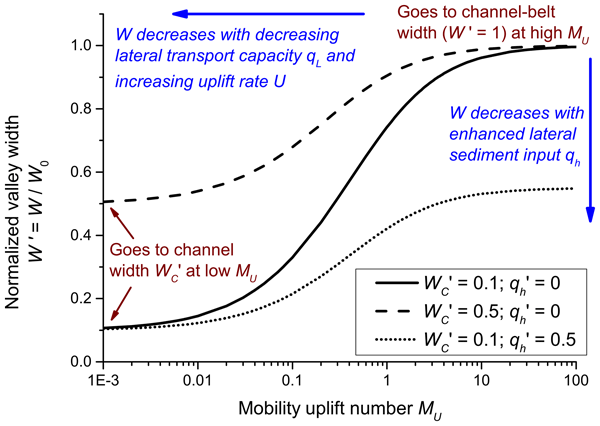
Fluvial valleys are ubiquitous landforms, and understanding their formation and evolution affects a wide range of disciplines from archaeology and geology to fish biology. Here, we develop a model to predict the width of fluvial valleys for a wide range of geographic conditions. In the model, fluvial valley width is controlled by the two competing factors of lateral channel mobility and uplift. The model complies with available data and yields a broad range of quantitative predictions.
Chuanqi He, Ci-Jian Yang, Jens M. Turowski, Richard F. Ott, Jean Braun, Hui Tang, Shadi Ghantous, Xiaoping Yuan, and Gaia Stucky de Quay
Earth Syst. Sci. Data, 16, 1151–1166, https://doi.org/10.5194/essd-16-1151-2024, https://doi.org/10.5194/essd-16-1151-2024, 2024
Short summary
Short summary
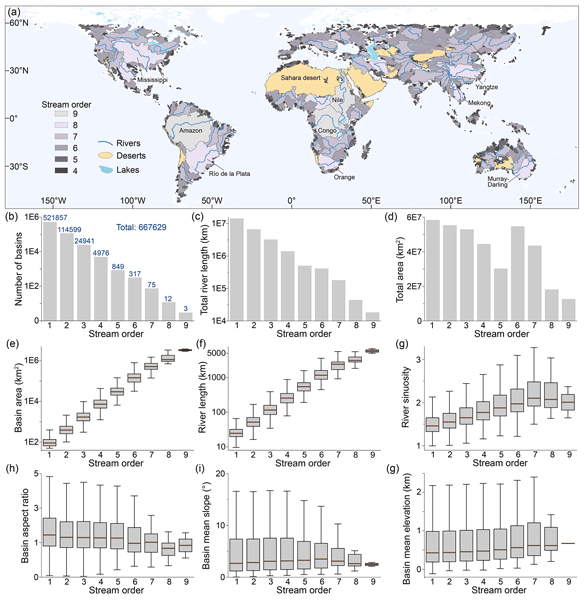
The shape of drainage basins and rivers holds significant implications for landscape evolution processes and dynamics. We used a global 90 m resolution topography to obtain ~0.7 million drainage basins with sizes over 50 km2. Our dataset contains the spatial distribution of drainage systems and their morphological parameters, supporting fields such as geomorphology, climatology, biology, ecology, hydrology, and natural hazards.
Jens M. Turowski, Gunnar Pruß, Anne Voigtländer, Andreas Ludwig, Angela Landgraf, Florian Kober, and Audrey Bonnelye
Earth Surf. Dynam., 11, 979–994, https://doi.org/10.5194/esurf-11-979-2023, https://doi.org/10.5194/esurf-11-979-2023, 2023
Short summary
Short summary
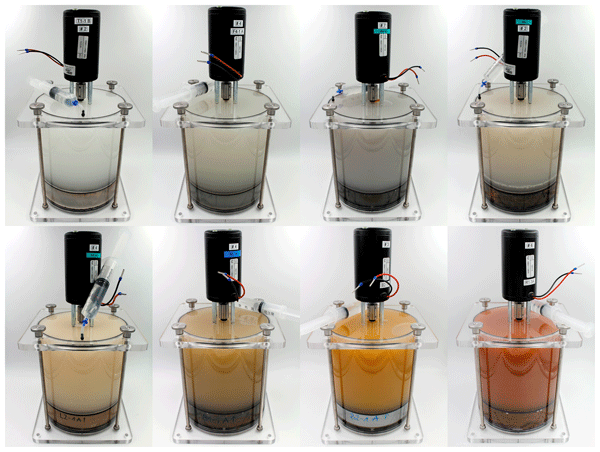
Rivers can cut into rocks, and their strength modulates the river's erosion rates. Yet, which properties of the rock control its response to erosive action is poorly understood. Here, we describe parallel experiments to measure rock erosion rates under fluvial impact erosion and the rock's geotechnical properties such as fracture strength, elasticity, and density. Erosion rates vary over a factor of a million between different rock types. We use the data to improve current theory.
Ci-Jian Yang, Pei-Hao Chen, Erica D. Erlanger, Jens M. Turowski, Sen Xu, Tse-Yang Teng, Jiun-Chuan Lin, and Jr-Chuang Huang
Earth Surf. Dynam., 11, 475–486, https://doi.org/10.5194/esurf-11-475-2023, https://doi.org/10.5194/esurf-11-475-2023, 2023
Short summary
Short summary
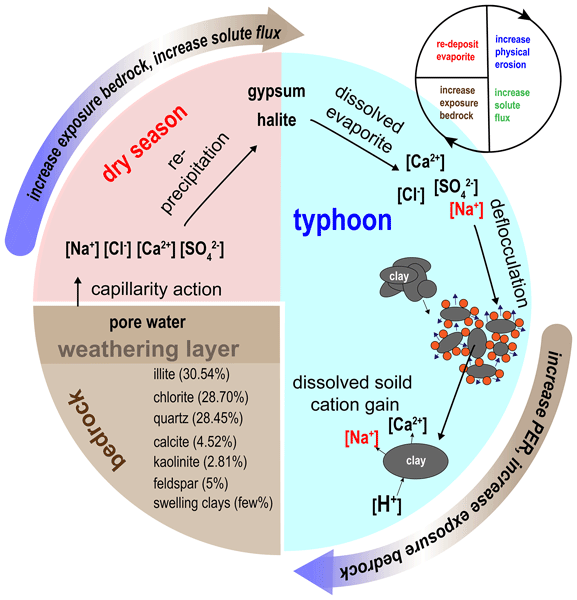
Observations of the interaction between extreme physical erosion and chemical weathering dynamics are limited. We presented major elements of stream water in the badland catchment at 3 h intervals during a 3 d typhoon. The excess sodium in the evaporite deposits causes material dispersion through deflocculation, which enhances the suspended sediment flux. Moreover, we observed a shift from predominantly evaporite weathering at peak precipitation to silicate weathering at peak discharge.
Cited articles
Badoux, A., Andres, N., and Turowski, J. M.: Damage costs due to bedload transport processes in Switzerland, Nat. Hazards Earth Syst. Sci., 14, 279–294, https://doi.org/10.5194/nhess-14-279-2014, 2014.
Benda, L., Hassan, M. A., Church, M., and May, C. L.: Geomorphology of Steepland Headwaters: The Transition from Hillslopes to Channels, JAWRA J. Am. Water Resour. Assoc., 41, 835–851, https://doi.org/10.1111/j.1752-1688.2005.tb03773.x, 2005.
Chartrand, S. M., Jellinek, M., Whiting, P. J., and Stamm, J.: Geometric scaling of step-pools in mountain streams: Observations and implications, Geomorphology, 129, 141–151, https://doi.org/10.1016/j.geomorph.2011.01.020, 2011.
Chin, A.: Step pools in stream channels, Prog. Phys. Geogr., 13, 391–407, https://doi.org/10.1177/030913338901300304, 1989.
Chin, A.: On the origin of step-pool sequences in mountain streams, Geophys. Res. Lett., 26, 231–234, https://doi.org/10.1029/1998GL900270, 1999a.
Chin, A.: The morphologic structure of step–pools in mountain streams, Geomorphology, 27, 191–204, https://doi.org/10.1016/S0169-555X(98)00083-X, 1999b.
Chin, A.: The geomorphic significance of step–pools in mountain streams, Geomorphology, 55, 125–137, https://doi.org/10.1016/S0169-555X(03)00136-3, 2003.
Chin, A. and Phillips, J. D.: The self-organization of step-pools in mountain streams, Geomorphology, 83, 346–358, https://doi.org/10.1016/j.geomorph.2006.02.021, 2007.
Chin, A. and Wohl, E.: Toward a theory for step pools in stream channels, Prog. Phys. Geogr., 29, 275–296, https://doi.org/10.1191/0309133305pp449ra, 2005.
Church, M. and Zimmermann, A.: Form and stability of step-pool channels: Research progress, Water Resour. Res., 43, https://doi.org/10.1029/2006WR005037, 2007.
Comiti, F.: Local scouring in natural and artificial step pool systems, PhD dissertation, University of Padova, https://pro.unibz.it/staff2/fcomiti/web_comiti/condensato.pdf (last access: 12 April 2025), 2003.
Comiti, F. and Mao, L.: Recent Advances in the Dynamics of Steep Channels, in: Gravel-Bed Rivers, John Wiley & Sons, Ltd, 351–377, https://doi.org/10.1002/9781119952497.ch26, 2012.
Comiti, F., Andreoli, A., and Lenzi, M. A.: Morphological effects of local scouring in step–pool streams, Earth Surf. Process. Landf., 30, 1567–1581, https://doi.org/10.1002/esp.1217, 2005.
Curran, J. C.: Step–pool formation models and associated step spacing, Earth Surf. Process. Landf., 32, 1611–1627, https://doi.org/10.1002/esp.1589, 2007.
Curran, J. C. and Wilcock, P. R.: Characteristic dimensions of the step-pool bed configuration: An experimental study, Water Resour. Res., 41, https://doi.org/10.1029/2004WR003568, 2005.
Curran, J. H. and Wohl, E. E.: Large woody debris and flow resistance in step-pool channels, Cascade Range, Washington, Geomorphology, 51, 141–157, https://doi.org/10.1016/S0169-555X(02)00333-1, 2003.
Erikson, C. M., Warburton, K. L. P., and Renshaw, C. E.: A Roughness-Based Model for Incipient Step-Pool Formation in Alluvial Streams, J. Geophys. Res.-Earth Surf., 131, e2025JF008564, https://doi.org/10.1029/2025JF008564, 2026a.
Erikson, C. M., Turowski, J. M., Curran, J. C., Wohl, E., and Badoux, A.: Compilation of Step-Pool Stream Sequence Spacing, GFZ Data Services [data set], https://doi.org/10.5880/GFZ.AVXH.2026.002, 2026b.
Fields, J. F., Renshaw, C. E., Dethier, E. N., and Magilligan, F. J.: The longer arc of channel recovery post-dam removal, Geomorphology, 468, 109442, https://doi.org/10.1016/j.geomorph.2024.109442, 2025.
Giménez-Curto, L. A. and Corniero, M. A.: Comment on “Characteristic dimensions of the step-pool bed configuration: An experimental study” by Joanna C. Curran and Peter R. Wilcock, Water Resour. Res., 42, https://doi.org/10.1029/2005WR004296, 2006.
Golly, A., Turowski, J. M., Badoux, A., and Hovius, N.: Testing models of step formation against observations of channel steps in a steep mountain stream, Earth Surf. Process. Landf., 44, 1390–1406, https://doi.org/10.1002/esp.4582, 2019.
Grant, G. E.: Critical flow constrains flow hydraulics in mobile-bed streams: A new hypothesis, Water Resour. Res., 33, 349–358, https://doi.org/10.1029/96WR03134, 1997.
Johnson, J. P. L.: Clustering statistics, roughness feedbacks, and randomness in experimental step-pool morphodynamics, Geophys. Res. Lett., 44, 3653–3662, https://doi.org/10.1002/2016GL072246, 2017.
Judd, H. and Peterson, D.: Hydraulics of Large Bed Element Channels, Y Rep., https://digitalcommons.usu.edu/water_rep/285 (last access: 23 June 2026), 1969.
Kennedy, J. F.: The Formation of Sediment Ripples, Dunes, and Antidunes, Annu. Rev. Fluid Mech., 1, 147–168, https://doi.org/10.1146/annurev.fl.01.010169.001051, 1969.
Lee, A. J.: The hydraulics of steep streams, Ph.D., University of Sheffield (United Kingdom), England, https://etheses.whiterose.ac.uk/id/eprint/14801/ (last access: 20 August 2024), 1998.
Lenzi, M. A.: Step–pool evolution in the Rio Cordon, northeastern Italy, Earth Surf. Process. Landf., 26, 991–1008, https://doi.org/10.1002/esp.239, 2001.
Lenzi, M. A.: Stream bed stabilization using boulder check dams that mimic step-pool morphology features in Northern Italy, Geomorphology, 45, 243–260, https://doi.org/10.1016/S0169-555X(01)00157-X, 2002.
Lenzi, M. A. and Comiti, F.: Local scouring and morphological adjustments in steep channels with check-dam sequences, Geomorphology, 55, 97–109, https://doi.org/10.1016/S0169-555X(03)00134-X, 2003.
Milzow, C., Molnar, P., McArdell, B. W., and Burlando, P.: Spatial organization in the step-pool structure of a steep mountain stream (Vogelbach, Switzerland), Water Resour. Res., 42, https://doi.org/10.1029/2004WR003870, 2006.
Montgomery, D. R. and Buffington, J. M.: Channel-reach morphology in mountain drainage basins, GSA Bull., 109, 596–611, https://doi.org/10.1130/0016-7606(1997)109<0596:CRMIMD>2.3.CO;2, 1997.
Montgomery, D. R., Buffington, J. M., Smith, R. D., Schmidt, K. M., and Pess, G.: Pool Spacing in Forest Channels, Water Resour. Res., 31, 1097–1105, https://doi.org/10.1029/94WR03285, 1995.
O'Connor, J. E., Duda, J. J., and Grant, G. E.: 1000 dams down and counting, Science, 348, 496–497, https://doi.org/10.1126/science.aaa9204, 2015.
Palucis, M. C. and Lamb, M. P.: What controls channel form in steep mountain streams?, Geophys. Res. Lett., 44, 7245–7255, https://doi.org/10.1002/2017GL074198, 2017.
Richardson, K. and Carling, P. A.: Morphology and origin of alluvial step-pools: A synthesis of experimental and field data from formative flows, Earth-Sci. Rev., 222, 103823, https://doi.org/10.1016/j.earscirev.2021.103823, 2021.
Saletti, M. and Hassan, M. A.: Width variations control the development of grain structuring in steep step-pool dominated streams: insight from flume experiments, Earth Surf. Process. Landf., 45, 1430–1440, https://doi.org/10.1002/esp.4815, 2020.
Simon, A., Doyle, M., Kondolf, M., Shields Jr., F. d., Rhoads, B., and McPhillips, M.: Critical Evaluation of How the Rosgen Classification and Associated “Natural Channel Design” Methods Fail to Integrate and Quantify Fluvial Processes and Channel Response1, JAWRA J. Am. Water Resour. Assoc., 43, 1117–1131, https://doi.org/10.1111/j.1752-1688.2007.00091.x, 2007.
Turowski, J. M., Badoux, A., Leuzinger, J., and Hegglin, R.: Large floods, alluvial overprint, and bedrock erosion, Earth Surf. Process. Landf., 38, 947–958, https://doi.org/10.1002/esp.3341, 2013.
Waters, K. A. and Curran, J. C.: Investigating step-pool sequence stability, Water Resour. Res., 48, https://doi.org/10.1029/2011WR011436, 2012.
Whittaker, J. G. and Jaeggi, M. N. R.: Origin of Step-Pool Systems in Mountain Streams, J. Hydraul. Div., 108, 758–773, https://doi.org/10.1061/JYCEAJ.0005873, 1982.
Wohl, E. E. and Thompson, D. M.: Velocity characteristics along a small step–pool channel, Earth Surf. Process. Landf., 25, 353–367, https://doi.org/10.1002/(SICI)1096-9837(200004)25:4<353::AID-ESP59>3.0.CO;2-5, 2000.
Yager, E. M., Dietrich, W. E., Kirchner, J. W., and McArdell, B. W.: Prediction of sediment transport in step-pool channels, Water Resour. Res., 48, https://doi.org/10.1029/2011WR010829, 2012.
Zhang, C., Hassan, M. A., Saletti, M., Zimmermann, A. E., Xu, M., and Wang, Z.: A Unit-Scale Framework for Designing Step-Pool Sequences, J. Hydraul. Eng., 149, 04022033, https://doi.org/10.1061/(ASCE)HY.1943-7900.0002033, 2023.
Zimmermann, A. and Church, M.: Channel morphology, gradient profiles and bed stresses during flood in a step–pool channel, Geomorphology, 40, 311–327, https://doi.org/10.1016/S0169-555X(01)00057-5, 2001.
Zimmermann, A., Church, M., and Hassan, M. A.: Step-pool stability: Testing the jammed state hypothesis, J. Geophys. Res.-Earth Surf., 115, https://doi.org/10.1029/2009JF001365, 2010.
Editorial statement
Mountain streams comprise between 60 and 80% of total global river length. A primary trait of these streams are step-pool sequences. Whether the spacing of these features are regularly or randomly spaced is matter of debate. Erikson and Turowski resolve longstanding tension between the two competing models. Using data on natural, experimental, and numerically simulated step-pool sequences, they demonstrate that step-pool spacing rarely matches either assumption, but rather exists within a continuum. The findings of Erikson and Turowski challenge existing step-pool formation models, emphasize that efforts to replicate or install step-pools are fundamentally misguided when assuming regularity or randomness, and offer a potential alternative.
Mountain streams comprise between 60 and 80% of total global river length. A primary trait of...
Short summary
The expected spacing of step-pool sequences has long been mired in debate, hampering stream restoration efforts. We define a continuum to evaluate the degree of regularity and randomness across step-pools from field observations, flume experiments, and numerical simulations and show that the full range is occupied without one formation mechanism dominating. Bounds related to channel hydraulics provide a way to track dynamic step spacing without assuming a mechanism.
The expected spacing of step-pool sequences has long been mired in debate, hampering stream...


