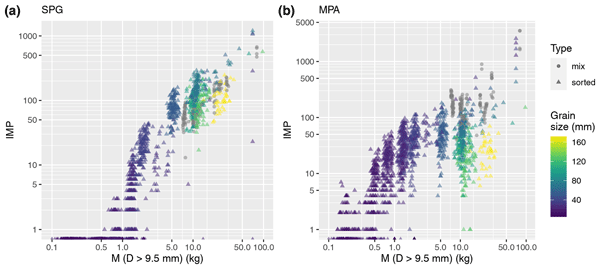
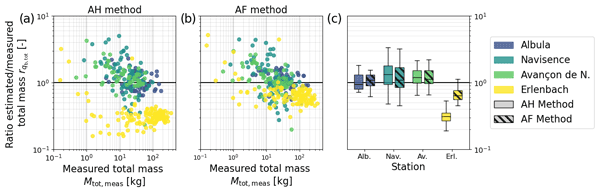
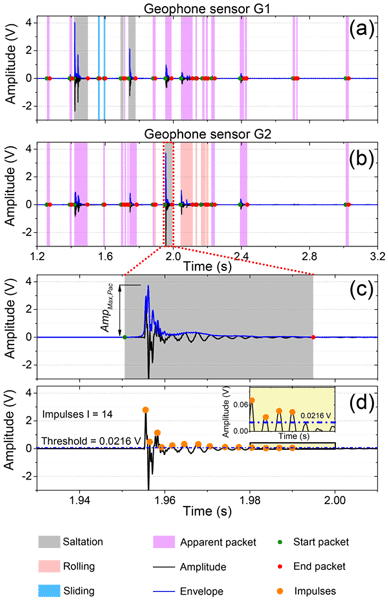
Baldig, D. and Rickenmann, D.: Schweizer Plattengeophon (SPG): Umrechnung von Paketdaten in fraktionierte Geschiebetransportraten und einige Analysen dazu, Eidgenössische Forschungsanstalt für Wald, Schnee und Landschaft, internal report, 31 Oktober 2024, https://doi.org/10.16904/envidat.459, 2024.
Bathurst, J. C.: Effect of coarse surface layer on bed-load transport, J. Hydraul. Eng., 133, 03117004-1-14, https://doi.org/10.1061/(ASCE)0733-9429(2007)133:11(1192), 2007.
Buffington, J. M. and Montgomery, D. R.: A systematic analysis of eight decades of incipient motion studies, with special reference to gravel-bedded rivers, Water Resour. Res., 33, 1993–2029, https://doi.org/10.1029/96WR03190, 1997.
Bunte, K. and Abt, S. R.: Effect of sampling time on measured gravel bed load transport rates in a coarse-bedded stream, Water Resour. Res., 41, W11405, https://doi.org/10.1029/2004WR003880, 2005.
Bunte, K., Abt, S. R., Potyondy, J. P., and Swingle, K. W.: A comparison of coarse bedload transport measured with bedload traps and Helley-Smith samplers, Geodin. Acta, 21, 53–66, https://doi.org/10.3166/ga.21.53-66, 2008.
Cheng, N.-S.: Exponential formula for bedload transport, J. Hydraul. Eng., 128, 942–946, https://doi.org/10.1061/(ASCE)0733-9429(2002)128:10(942), 2002.
Church, M.: Bed material transport and the morphology of alluvial river channels, Annu. Rev. Earth Planet. Sci., 34, 325–354, https://doi.org/10.1146/annurev.earth.33.092203.122721, 2006.
Church, M.: Mountains and montane channels, in: Sediment cascades, edited by: Burt, T. P. and Allison, R. J., John Wiley-Blackwell, Oxford, UK, 17–53, https://doi.org/10.1002/9780470682876.ch2, 2010.
Cohen, H., Laronne, J. B., and Reid, I.: Simplicity and complexity of bed load response during flash floods in a gravel bed ephemeral river: A 10 year field study, Water Resour. Res., 46, W11542, https://doi.org/10.1029/2010WR009160, 2010.
Coviello, V., Vignoli, G., Simoni, S., Bertoldi, W., Engel, M., Buter, A., Marchetti, G., Andreoli, A., and Comiti, F.: Bedload Fluxes in a Glacier-Fed River at Multiple Temporal Scales, Water Resour. Res., 58, e2021WR031873, https://doi.org/10.1029/2021WR031873, 2022.
Diplas, P., Dancey, C. L., Celik, A. O., Valyrakis, M., Greer, K., and Akar, T.: The role of impulse on the initiation of particle movement under turbulent flow conditions, Science, 322, 717–720, https://doi.org/10.1126/science.1158954, 2008.
Dwivedi, A., Melville, B. W., Shamseldin, A. Y., and Guha, T.: Flow structures and hydrodynamic force during sediment entrainment, Water Resour. Res., 47, W01509, https://doi.org/10.1029/2010WR009089, 2011.
Elgueta-Astaburuaga, M. A., Hassan, M. A., Saletti, M., and Clarke, G. K. C.: The effect of episodic sediment supply on bedloa
d variability and sediment mobility, Water Resour. Res., 54, 6319–6335, https://doi.org/10.1029/2017WR022280, 2018.
Gaeuman, D., Andrews, E. D., Krause, A., and Smith, W.: Predicting fractional bedload transport rates: Application of the Wilcock-Crowe equations to a regulated gravel-bed river, Water Resour. Res., 45, W06409, https://doi.org/10.1029/2008WR007320, 2009.
Gaeuman, D., Holt, C. R., and Bunte, K.: Maximum likelihood parameter estimation for fitting bedload rating curves, Water Resour. Res., 51, 281–301, https://doi.org/10.1002/2014WR015872, 2015.
Golly, A., Turowski, J. M., Badoux, A., and Hovius, N.: Controls and feedbacks in the coupling of mountain channels and hillslopes, Geology, 45, 307–310, https://doi.org/10.1130/G38831.1, 2017.
Gomez, B., Naff, R. L., and Hubbell, D. W.: Temporal variations in bedload transport rates associated with the migration of bedforms, Earth Surf. Proc. Land., 14, 135–156, https://doi.org/10.1002/esp.3290140205, 1989.
Johnson, J. P. L.: Gravel threshold of motion: a state function of sediment transport disequilibrium?, Earth Surf. Dynam., 4, 685–703, https://doi.org/10.5194/esurf-4-685-2016, 2016.
Johnson, J. P. L., Aronovitz, A. C., and Kim, W.: Coarser and rougher: Effects of fine gravel pulses on experimental step-pool channel morphodynamics, Geophys. Res. Lett., 42, 8432–8440, https://doi.org/10.1002/2015gl066097, 2015.
Kreisler, A., Moser, M., Aigner, J., Rindler, R., Tritthart, M., and Habersack, H.: Analysis and classification of bedload transport events with variable process characteristics, Geomorphology, 291, 57–68, https://doi.org/10.1016/j.geomorph.2016.06.033, 2017.
Lisle, T. E., Iseya, F., and Ikeda, H.: Response of a channel with alternate bars to a decrease in supply of mixed-size bed load: A flume experiment, Water Resour. Res., 33, 1971–1981, https://doi.org/10.1029/93WR01673, 1997.
Mao, L., Comiti, F., Carillo, R., and Penna, D.: Sediment Transport in Proglacial Rivers, in: Geomorphology of proglacial systems, Geography of the Physical Environment, edited by: Heckmann, T. and Morche, D., Springer Nature Switzerland AG, 199–217, https://doi.org/10.1007/978-3-319-94184-4_12, 2019.
Masteller, C. C. and Finnegan, N. J.: Interplay between grain protrusion and sediment entrainment in an experimental flume, J. Geophys. Res.-Earth, 122, 274–289, https://doi.org/10.1002/2016JF003943, 2017.
Masteller, C. C., Finnegan, N. J., Turowski, J. M., Yager, E. M., and Rickenmann, D.: History-dependent threshold for motion revealed by continuous bedload transport measurements in a steep mountain stream, Geophys. Res. Lett., 46, 2583–2591, https://doi.org/10.1029/2018GL081325, 2019.
Meyer-Peter, E. and Müller, R.: Formulas for bed-load transport, Proceedings of the 2nd Meeting, IAHR, 39–64,
https://repository.tudelft.nl/record/uuid:4fda9b61-be28-4703-ab06-43cdc2a21bd7 (last access: 8 February 2026), 1948.
Monsalve, A., Segura, C., Hucke, N., and Katz, S.: A bed load transport equation based on the spatial distribution of shear stress – Oak Creek revisited, Earth Surf. Dynam., 8, 825–839, https://doi.org/10.5194/esurf-8-825-2020, 2020.
Nelson, J. M., Shreve, R. L., McLean, S. R., and Drake, T. G.: Role of near-bed turbulence structure in bed load transport and bed form mechanics, Water Resour. Res., 31, 2071–2086, https://doi.org/10.1029/95WR00976, 1995.
Nicollier, T., Rickenmann, D., and Hartlieb, A.: Field Calibration of the Swiss Plate Geophone System at the Albula Stream and Comparison with Controlled Flume Experiments, SedHyd2019, Federal Interagency Sedimentation and Hydrologic Modeling Conference, June 2019, Reno, NV,
https://www.sedhyd.org/2019/proceedings/SEDHYD_Proceedings_2019_Volume4.pdf (last access: 8 February 2026), 2019.
Nicollier, T., Rickenmann, D., Boss., S, Travaglini, E., and Hartlieb, A.: Calibration of the Swiss plate geophone system at the Zinal field site with direct bedload samples and results from controlled flume experiments, in: River Flow 2020, edited by: Uijttewaal, W., Franca, M. J., Valero, D., Chavarrias, V., Arbós, C. Y., Schielen, R., and Crosato, A., CRC Press, 901–909, ISBN 9781003110958, 2020.
Nicollier, T., Rickenmann, D., and Hartlieb, A.: Field and flume measurements with the impact plate: Effect of bedload grain-size distribution on signal response, Earth Surf. Proc. Land., 46, 1504–1520, https://doi.org/10.1002/esp.5117, 2021.
Nicollier, T., Antoniazza, G., Ammann, L., Rickenmann, D., and Kirchner, J. W.: Toward a general calibration of the Swiss plate geophone system for fractional bedload transport, Earth Surf. Dynam., 10, 929–951, https://doi.org/10.5194/esurf-10-929-2022, 2022.
Nitsche, M., Rickenmann, D., Kirchner, J. W., Turowski, J. M., and Badoux, A.: Macro-roughness and variations in reach-averaged flow resistance in steep mountain streams, Water Resources Research, 48, W12518, https://doi.org/10.1029/2012WR012091, 2012.
Parker, G.: Transport of gravel and sediment mixtures, in: ASCE Manual of Practice 110 – Sedimentation Engineering: Processes, Measurements, Modeling, and Practice, edited by: Garcia, M. H., American Society of Civil Engineers, 165–252, https://doi.org/10.1061/9780784408148.ch03, 2008.
Phillips, C. B. and Jerolmack, D. J.: Bankfull transport capacity and the threshold of motion in coarse-grained rivers, Water Resour. Res., 55, 11316–11330, https://doi.org/10.1029/2019WR025455, 2019.
Piton, G. and Recking, A.: The concept of travelling bedload and its consequences for bedload computation in mountain streams, Earth Surf. Proc. Land., 42, 1505–1519, https://doi.org/10.1002/esp.4105, 2017.
Pretzlav, K. L. G., Johnson, J. P. L., and Bradley, D. N.: Smartrock transport in a mountain stream: Bedload hysteresis and changing thresholds of motion, Water Resour. Res., 56, e2020WR028150, https://doi.org/10.1029/2020WR028150, 2020.
Recking, A.: Influence of sediment supply on mountain streams bedload transport, Geomorphology, 175, 139–150, https://doi.org/10.1016/j.geomorph.2012.07.005, 2012.
Recking, A.: Simple method for calculating reach-averaged bed-load transport, J. Hydraul. Eng., 139, 70–75, https://doi.org/10.1061/(ASCE)HY.1943-7900.0000653, 2013.
Recking, A., Liébault, F., Peteuil, C., and Jolimet, T.: Testing several bed load transport equations with consideration of time scales, Earth Surf. Proc. Land., 37, 774–789, https://doi.org/10.1002/esp.3213, 2012.
Recking, A., Piton, G., Vazquez-Tarrio, D., and Parker, G.: Quantifying the morphological print of bedload transport, Earth Surf. Proc. Land., 41, 809–822, https://doi.org/10.1002/esp.3869, 2016.
Rickenmann, D.: Sediment transport in Swiss torrents, Earth Surf. Proc. Land., 22, 937–951, https://doi.org/10.1002/(SICI)1096-9837(199710)22:10<937::AID-ESP786>3.0.CO;2-R, 1997.
Rickenmann, D.: Bed-load transport measurements with geophones and other passive acoustic methods, J. Hydraul. Eng., 143, 03117004-1-14, https://doi.org/10.1061/(ASCE)HY.1943-7900.0001300, 2017.
Rickenmann, D.: Variability of bed load transport during six summers of continuous measurements in two Austrian mountain streams (Fischbach and Ruetz), Water Resour. Res., 54, 107–131, https://doi.org/10.1002/2017WR021376, 2018.
Rickenmann, D.: Effect of sediment supply on cyclic fluctuations of the disequilibrium ratio and threshold transport discharge, inferred from bedload transport measurements over 27 years at the Swiss Erlenbach stream, Water Resour. Res., 56, e2020WR027741, https://doi.org/10.1029/2020WR027741, 2020.
Rickenmann, D.: Bedload transport fluctuations, flow conditions, and disequilibrium ratio at the Swiss Erlenbach stream: results from 27 years of high-resolution temporal measurements, Earth Surf. Dynam., 12, 11–34, https://doi.org/10.5194/esurf-12-11-2024, 2024.
Rickenmann, D. and Koschni, A.: Sediment loads due to fluvial transport and debris flows during the 2005 flood events in Switzerland, Hydrol. Proc., 24, 993–1007, https://doi.org/10.1002/hyp.7536, 2010.
Rickenmann, D. and McArdell, B. W.: Continuous measurement of sediment transport in the Erlenbach stream using piezoelectric bedload impact sensors, Earth Surf. Proc. Land., 32, 1362–1378, https://doi.org/10.1002/esp.1478, 2007.
Rickenmann, D. and Recking, A.: Evaluation of flow resistance in gravel-bed rivers through a large field data set, Water Resour. Res., 47, W07538, https://doi.org/10.1029/2010WR009793, 2011.
Rickenmann, D., Turowski, J. M., Fritschi, B., Klaiber, A., and Ludwig, A.: Bedload transport measurements at the Erlenbach stream with geophones and automated basket samplers, Earth Surf. Proc. Land., 37, 1000–1011, https://doi.org/10.1002/esp.3225, 2012.
Rickenmann, D., Antoniazza, G., Wyss, C. R., Fritschi, B., and Boss, S.: Bedload transport monitoring with acoustic sensors in the Swiss Albula mountain river, Proc. IAHS, 375, 5–10, https://doi.org/10.5194/piahs-375-5-2017, 2017.
Rickenmann, D., Nicollier, T., Boss, S., and Badoux, A.: Four years of bedload transport measurements in the Swiss mountain river Albula, in: River Flow 2020, edited by: Uijttewaal, W., Franca, M. J., Valero, D., Chavarrias, V., Arbós, C. Y., Schielen, R., and Crosato, A., CRC Press, 1749–1755, ISBN 9781003110958, 2020a.
Rickenmann, D., Antoniazza, G., Nicollier, T., Wyss, C., Boss, S., Fritschi, B., Steeb, N., and Badoux, A.: Sediment transport observations in Swiss mountain streams, EnviDat [data set], https://doi.org/10.16904/envidat.459, 2020b.
Rickenmann, D., Ammann, L., Nicollier, T., Boss, S., Fritschi, B., Antoniazza, G., Steeb, N., Chen, Z., Wyss, C., and Badoux, A.: Comparison of calibration characteristics of different acoustic impact systems for measuring bedload transport in mountain streams, Earth Surf. Dynam., 10, 1165–1183, https://doi.org/10.5194/esurf-10-1165-2022, 2022.
Rickenmann, D., Hug Peter, D., Ammann, L., Nicollier, T., and Badoux, A.: Indirekte Geschiebetransportmessung, Teil 2: Fraktionierter Transport, Unsicherheiten, Perspektiven, Wasser, Energie, Luft, 116, 111–119, 2024a.
Rickenmann, D., Hug Peter, D., Ammann, L., Nicollier, T., Boss, S., Fritschi, B., Wyss, C., Antoniazza, G., and Badoux, A.: Surrogate bedload measurements in mountain rivers: system comparison, uncertainty, new prototype, in: Conference Proceedings INTERPRAEVENT 2024, edited by: Schneider, J., et al., 691–695, ISBN 978-3-901164-32-3,
https://www.interpraevent.at/en/proceeding/proceedings-ip-2024 (last access: 8 February 2026), 2024b.
Rindler, R., Schwarz, S., Lammer, A., Shire-Peterlechner, D., Gmeiner, P., Liedermann, M., Tritthart, M., and Habersack, H.: From glaciers to large rivers: Lessons and insights from long-term bedload monitoring, Earth Surf. Proc. Land., 50, e70059, https://doi.org/10.1002/esp.70059, 2025.
Schmeeckle, M. W. and Nelson, J. M.: Direct numerical simulation of bedload transport using a local, dynamic boundary condition, Sedimentology, 50, 279–301, https://doi.org/10.1046/j.1365-3091.2003.00555.x, 2003.
Schneider, J. M., Rickenmann, D., Turowski, J. M., Bunte, K., and Kirchner, J. W.: Applicability of bedload transport models for mixed-size sediments in steep streams considering macro-roughness, Water Resour. Res., 51, 5260–5283, https://doi.org/10.1002/2014WR016417, 2015a.
Schneider, J. M., Rickenmann, D., Turowski, J. M., and Kirchner, J. W.: Self-adjustment of stream bed roughness and flow velocity in a steep mountain channel, Water Resour. Res., 51, 7838–7859, https://doi.org/10.1002/2015WR016934, 2015b.
Schneider, J. M., Rickenmann, D., Turowski, J. M., Schmid, B., and Kirchner, J. W.: Bed load transport in a very steep mountain stream (Riedbach, Switzerland): Measurement and prediction, Water Resour. Res., 52, 9522–9541, https://doi.org/10.1002/2016WR019308, 2016.
Turowski, J. M., Yager, E. M., Badoux, A., Rickenmann, D., and Molnar, P.: The impact of exceptional events on erosion, bedload transport and channel stability in a step-pool channel, Earth Surf. Proc. Land., 34, 1661–1673, https://doi.org/10.1002/esp.1855, 2009.
Valyrakis, M., Diplas, P., Dancey, C. L., Greer, K., and Celik, A. O.: Role of instantaneous force magnitude and duration on particle entrainment, J. Geophys. Res.-Earth, 115, https://doi.org/10.1029/2008JF001247, 2010.
Vanzo, D., Peter, S., Vonwiller, L., Bürgler, M., Weberndorfer, M., Siviglia, A., Conde, D., and Vetsch, D. F.: basement v3: A modular freeware for river process modelling over multiple computational backends, Environ. Model. Softw., 143, 105102, https://doi.org/10.1016/j.envsoft.2021.105102, 2021.
Vázquez-Tarrío, D., Piégay, H., and Menéndez-Duarte, R.: Textural signatures of sediment supply in gravel-bed rivers
: Revisiting the armour ratio, Earth-Sci. Rev., 207, 103211, https://doi.org/10.1016/j.earscirev.2020.103211, 2020.
Villaret, C., Hervouet, J. M., Kopmann, R., Merkel, U., and Davies, A. G.: Morphodynamic modeling using the Telemac finite-element system, Comput. Geosci., 53, 105–113, https://doi.org/10.1016/j.cageo.2011.10.004, 2013.
Warburton, J.: Observations of bed load transport and channel bed changes in a proglacial mountain stream, Arctic Alpine Res., 24, 195–203, https://doi.org/10.1080/00040851.1992.12002946, 1992.
Wilcock, P. R. and Crowe, J. C.: Surface-based transport model for mixed-size sediment, J. Hydraul. Eng., 129, 120–128, https://doi.org/10.1061/(ASCE)0733-9429(2003)129:2(120), 2003.
Wilcock, P. R. and McArdell, B. W.: Surface-based fractional transport rates: Mobilization thresholds and partial transport of a sand–gravel sediment, Water Resour. Res., 29, 1297–1312, https://doi.org/10.1029/92WR02748, 1993.
Wilcock, P., Pitlick, J., and Cui, Y.: Sediment transport primer: estimating bed-material transport in gravel-bed rivers. Gen. Tech. Rep. RMRS-GTR-22, U.S. Department of Agriculture, Forest Service, Rocky Mountain Research Station, Fort Collins, Colorado, USA, 78 pp., https://doi.org/10.2737/RMRS-GTR-226, 2009.
Yavuz, V. S.: Calculation sedimentation by sediment modelling using HEC-RAS, in: River Flow 2024, edited by: Carnacina, I., Abdellatif, M., Andredaki, M., Cooper, J., Lumbroso, D., and Ruiz-Villanueva, V., CRC Press, 698–706, https://doi.org/10.1201/9781003475378-102, 2025.