Articles | Volume 13, issue 2
https://doi.org/10.5194/esurf-13-277-2025
© Author(s) 2025. This work is distributed under
the Creative Commons Attribution 4.0 License.
https://doi.org/10.5194/esurf-13-277-2025
© Author(s) 2025. This work is distributed under
the Creative Commons Attribution 4.0 License.
Hillslope diffusion and channel steepness in landscape evolution models
David G. Litwin
CORRESPONDING AUTHOR
Earth Surface Process Modelling, GFZ Helmholtz Centre for Geosciences, Potsdam, Germany
Luca C. Malatesta
Earth Surface Process Modelling, GFZ Helmholtz Centre for Geosciences, Potsdam, Germany
Leonard S. Sklar
School of Environmental Science, Simon Fraser University, Burnaby, Canada
Related authors
No articles found.
Boris Gailleton, Luca C. Malatesta, Guillaume Cordonnier, and Jean Braun
Geosci. Model Dev., 17, 71–90, https://doi.org/10.5194/gmd-17-71-2024, https://doi.org/10.5194/gmd-17-71-2024, 2024
Short summary
Short summary
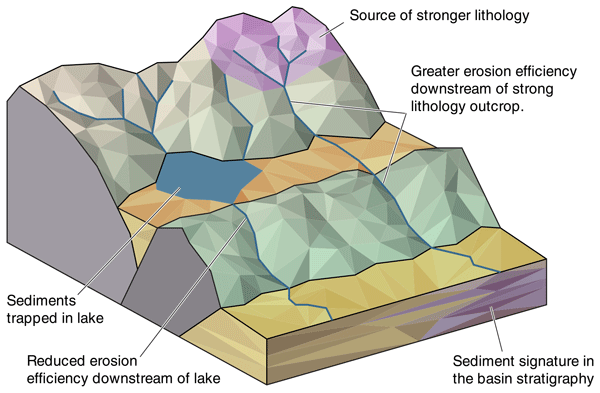
This contribution presents a new method to numerically explore the evolution of mountain ranges and surrounding areas. The method helps in monitoring with details on the timing and travel path of material eroded from the mountain ranges. It is particularly well suited to studies juxtaposing different domains – lakes or multiple rock types, for example – and enables the combination of different processes.
Cited articles
Andrews, D. J. and Bucknam, R. C.: Fitting Degradation of Shoreline Scarps by a Nonlinear Diffusion Model, J. Geophys. Res., 92, 12857–12867, 1987. a
Barnhart, K. R., Glade, R. C., Shobe, C. M., and Tucker, G. E.: Terrainbento 1.0: a Python package for multi-model analysis in long-term drainage basin evolution, Geosci. Model Dev., 12, 1267–1297, https://doi.org/10.5194/gmd-12-1267-2019, 2019. a, b
Barnhart, K. R., Hutton, E. W. H., Tucker, G. E., Gasparini, N. M., Istanbulluoglu, E., Hobley, D. E. J., Lyons, N. J., Mouchene, M., Nudurupati, S. S., Adams, J. M., and Bandaragoda, C.: Short communication: Landlab v2.0: a software package for Earth surface dynamics, Earth Surf. Dynam., 8, 379–397, https://doi.org/10.5194/esurf-8-379-2020, 2020a. a, b, c
Barnhart, K. R., Tucker, G. E., Doty, S. G., Glade, R. C., Shobe, C. M., Rossi, M. W., and Hill, M. C.: Projections of Landscape Evolution on a 10,000 Year Timescale With Assessment and Partitioning of Uncertainty Sources, J. Geophys. Res.-Earth Surf., 125, e2020JF005795, https://doi.org/10.1029/2020JF005795, 2020b. a
Beaumont, C., Fullsack, P., and Hamilton, J.: Erosional control of active compressional orogens, in: Thrust Tectonics, edited by: McClay, K. R., 1–18 pp., Springer Netherlands, Dordrecht, ISBN 978-94-011-3066-0, https://doi.org/10.1007/978-94-011-3066-0_1, 1992. a, b
Bonetti, S., Bragg, A. D., and Porporato, A.: On the theory of drainage area for regular and non-regular points, P. Roy. Soc. A, 474, 20170693, https://doi.org/10.1098/rspa.2017.0693, 2018. a
Bovy, B. and Lange, R.: fastscape-lem/fastscape: Release v0.1.0, Zenodo, https://doi.org/10.5281/ZENODO.8375653, 2023. a, b, c
Braun, J. and Sambridge, M.: Modelling landscape evolution on geological time scales: a new method based on irregular spatial discretization, Basin Research, 9, 27–52, https://doi.org/10.1046/j.1365-2117.1997.00030.x, 1997. a
Braun, J. and Willett, S. D.: A very efficient O(n), implicit and parallel method to solve the stream power equation governing fluvial incision and landscape evolution, Geomorphology, 180–181, 170–179, https://doi.org/10.1016/j.geomorph.2012.10.008, 2013. a, b
Campforts, B., Schwanghart, W., and Govers, G.: Accurate simulation of transient landscape evolution by eliminating numerical diffusion: the TTLEM 1.0 model, Earth Surf. Dynam., 5, 47–66, https://doi.org/10.5194/esurf-5-47-2017, 2017. a, b, c
Campforts, B., Shobe, C. M., Steer, P., Vanmaercke, M., Lague, D., and Braun, J.: HyLands 1.0: a hybrid landscape evolution model to simulate the impact of landslides and landslide-derived sediment on landscape evolution, Geosci. Model Dev., 13, 3863–3886, https://doi.org/10.5194/gmd-13-3863-2020, 2020. a, b
Clubb, F. J., Mudd, S. M., Milodowski, D. T., Hurst, M. D., and Slater, L. J.: Objective extraction of channel heads from high-resolution topographic data, Water Resour. Res., 50, 4283–4304, https://doi.org/10.1002/2013WR015167, 2014. a
Davy, P. and Lague, D.: Fluvial erosion/transport equation of landscape evolution models revisited, J. Geophys. Res.-Earth Surf., 114, https://doi.org/10.1029/2008JF001146, 2009. a, b
Dietrich, W.: High Resolution Topography over Gabilan Mesa, CA 2003. National Center for Airborne Laser Mapping (NCALM), Distributed by OpenTopography [data set], https://doi.org/10.5069/G947481V, 2020. a
Egholm, D. L., Knudsen, M. F., and Sandiford, M.: Lifespan of mountain ranges scaled by feedbacks between landsliding and erosion by rivers, Nature, 498, 475–478, https://doi.org/10.1038/nature12218, 2013. a, b
Fernandes, N. F. and Dietrich, W. E.: Hillslope evolution by diffusive processes: The timescale for equilibrium adjustments, Water Resour. Res., 33, 1307–1318, https://doi.org/10.1029/97WR00534, 1997. a
Fernandes, V. M., Roberts, G. G., White, N., and Whittaker, A. C.: Continental‐Scale Landscape Evolution: A History of North American Topography, J. Geophys. Res.-Earth Surf., 124, 2689–2722, https://doi.org/10.1029/2018JF004979, 2019. a
Ferrier, K. L. and Perron, J. T.: The importance of hillslope scale in responses of chemical erosion rate to changes in tectonics and climate, J. Geophys. Res.-Earth Surf., 125, e2020JF005562, https://doi.org/10.1029/2020JF005562, 2020. a
Finnegan, N. J., Klier, R. A., Johnstone, S., Pfeiffer, A. M., and Johnson, K.: Field evidence for the control of grain size and sediment supply on steady‐state bedrock river channel slopes in a tectonically active setting, Earth Surf. Process. Landf., 42, 2338–2349, https://doi.org/10.1002/esp.4187, 2017. a
Ganti, V., Passalacqua, P., and Foufoula-Georgiou, E.: A sub-grid scale closure for nonlinear hillslope sediment transport models, J. Geophys. Res.-Earth Surf., 117, F2, https://doi.org/10.1029/2011JF002181, 2012. a, b
Gasparini, N. M., Tucker, G. E., and Bras, R. L.: Network-scale dynamics of grain-size sorting: implications for downstream fining, stream-profile concavity, and drainage basin morphology, Earth Surf. Process. Landf., 29, 401–421, https://doi.org/10.1002/esp.1031, 2004. a
Goren, L., Willett, S. D., Herman, F., and Braun, J.: Coupled numerical–analytical approach to landscape evolution modeling, Earth Surf. Process. Landf., 39, 522–545, https://doi.org/10.1002/esp.3514, 2014. a, b
Guryan, G. J., Johnson, J. P. L., and Gasparini, N. M.: Sediment Cover Modulates Landscape Erosion Patterns and Channel Steepness in Layered Rocks: Insights From the SPACE Model, J. Geophys. Res.-Earth Surf., 129, e2023JF007509, https://doi.org/10.1029/2023JF007509, 2024. a
Harel, M. A., Mudd, S. M., and Attal, M.: Global analysis of the stream power law parameters based on worldwide 10Be denudation rates, Geomorphology, 268, 184–196, https://doi.org/10.1016/j.geomorph.2016.05.035, 2016. a, b, c
Heimsath, A. M., Dietrich, W. E., Nishiizumi, K., Finkel, R. C., Mass, A., and National, L. L.: The Soil Production Function and Landscape Equilibrium, Nature, 388, 358–361, https://doi.org/10.1144/SP312.8, 1997. a
Hergarten, S.: Rivers as linear elements in landform evolution models, Earth Surf. Dynam., 8, 367–377, https://doi.org/10.5194/esurf-8-367-2020, 2020. a, b
Hergarten, S. and Pietrek, A.: Self-organization of channels and hillslopes in models of fluvial landform evolution and its potential for solving scaling issues, Earth Surf. Dynam., 11, 741–755, https://doi.org/10.5194/esurf-11-741-2023, 2023. a, b
Hobley, D. E. J., Adams, J. M., Nudurupati, S. S., Hutton, E. W. H., Gasparini, N. M., Istanbulluoglu, E., and Tucker, G. E.: Creative computing with Landlab: an open-source toolkit for building, coupling, and exploring two-dimensional numerical models of Earth-surface dynamics, Earth Surf. Dynam., 5, 21–46, https://doi.org/10.5194/esurf-5-21-2017, 2017. a, b
Howard, A. D. and Kerby, G.: Channel changes in badlands, GSA Bull., 94, 739–752, https://doi.org/10.1130/0016-7606(1983)94<739:CCIB>2.0.CO;2, 1983. a
Johnson, J. P. L. and Whipple, K. X.: Evaluating the controls of shear stress, sediment supply, alluvial cover, and channel morphology on experimental bedrock incision rate, J. Geophys. Res.-Earth Surf., 115, https://doi.org/10.1029/2009JF001335, 2010. a
Johnson, J. P. L., Whipple, K. X., Sklar, L. S., and Hanks, T. C.: Transport slopes, sediment cover, and bedrock channel incision in the Henry Mountains, Utah, J. Geophys. Res.-Earth Surf., 114, 2007JF000862, https://doi.org/10.1029/2007JF000862, 2009. a
Lai, L. S.-H., Roering, J. J., Finnegan, N. J., Dorsey, R. J., and Yen, J.-Y.: Coarse sediment supply sets the slope of bedrock channels in rapidly uplifting terrain: Field and topographic evidence from eastern Taiwan, Earth Surf. Process. Landf., 46, 2671–2689, https://doi.org/10.1002/esp.5200, 2021. a
Lamb, M. P., Finnegan, N. J., Scheingross, J. S., and Sklar, L. S.: New insights into the mechanics of fluvial bedrock erosion through flume experiments and theory, Geomorphology, 244, 33–55, https://doi.org/10.1016/j.geomorph.2015.03.003, 2015. a
Lavé, J. and Avouac, J. P.: Fluvial incision and tectonic uplift across the Himalayas of central Nepal, J. Geophys. Res.-Solid Earth, 106, 26561–26591, https://doi.org/10.1029/2001JB000359, 2001. a
Litwin, D.: Scripts for “Hillslope diffusion and channel steepness in landscape evolution models”, Zenodo [code], https://doi.org/10.5281/zenodo.13143154, 2024. a
Litwin, D. G., Tucker, G. E., Barnhart, K. R., and Harman, C. J.: Catchment coevolution and the geomorphic origins of variable source area hydrology, Water Resour. Res., 60, e2023WR034647, https://doi.org/10.1029/2023WR034647, 2024. a, b
Lyons, N. J., Val, P., Albert, J. S., Willenbring, J. K., and Gasparini, N. M.: Topographic controls on divide migration, stream capture, and diversification in riverine life, Earth Surf. Dynam., 8, 893–912, https://doi.org/10.5194/esurf-8-893-2020, 2020. a
Miller, J. R.: The Influence of Bedrock Geology on Knickpoint Development and Channel-Bed Degradation along Downcutting Streams in South-Central Indiana, The J. Geol., 99, 591–605, https://doi.org/10.1086/629519, 1991. a
Ott, R., Scherler, D., Huppert, K., Braun, J., and Bermudez, M.: Hillslope-controlled incision thresholds shape mountain range topography of the Northern Andes, EGU General Assembly 2024, Vienna, Austria, 14–19 Apr 2024, EGU24-2774, https://doi.org/10.5194/egusphere-egu24-2774, 2024. a
Passalacqua, P., Do Trung, T., Foufoula-Georgiou, E., Sapiro, G., and Dietrich, W. E.: A geometric framework for channel network extraction from lidar: Nonlinear diffusion and geodesic paths, J. Geophys. Res.-Earth Surf., 115, F1, https://doi.org/10.1029/2009JF001254, 2010. a
Pelletier, J. D.: Minimizing the grid-resolution dependence of flow-routing algorithms for geomorphic applications, Geomorphology, 122, 91–98, https://doi.org/10.1016/j.geomorph.2010.06.001, 2010. a, b
Perron, J. T.: Numerical methods for nonlinear hillslope transport laws, J. Geophys. Res.-Earth Surf., 116, F2, https://doi.org/10.1029/2010JF001801, 2011. a
Perron, J. T. and Royden, L.: An integral approach to bedrock river profile analysis, Earth Surf. Process. Landf., 38, 570–576, https://doi.org/10.1002/esp.3302, 2013. a
Roering, J. J., Kirchner, J. W., and Dietrich, W. E.: Evidence for Nonlinear, Diffusive Sediment Transport on Hillslopes and Implications for Landscape Morphology, Water Resour. Res., 35, 853–870, https://doi.org/10.1029/1998WR900090, 1999. a
Roering, J. J., Perron, J. T., and Kirchner, J. W.: Functional relationships between denudation and hillslope form and relief, Earth Planet. Sci. Lett., 264, 245–258, https://doi.org/10.1016/j.epsl.2007.09.035, 2007. a
Roy, S. G., Tucker, G. E., Koons, P. O., Smith, S. M., and Upton, P.: A fault runs through it: Modeling the influence of rock strength and grain-size distribution in a fault-damaged landscape, J. Geophys. Res.Earth Surf., 121, 1911–1930, https://doi.org/10.1002/2015JF003662, 2016. a
Royden, L. and Perron, T.: Solutions of the stream power equation and application to the evolution of river longitudinal profiles, J. Geophys. Res.-Earth Surf., 118, 497–518, https://doi.org/10.1002/jgrf.20031, 2013. a
Ruetenik, G. A., Jansen, J. D., Val, P., and Ylä-Mella, L.: Optimising global landscape evolution models with 10Be, Earth Surf. Dynam., 11, 865–880, https://doi.org/10.5194/esurf-11-865-2023, 2023. a, b
Salles, T.: Badlands: A parallel basin and landscape dynamics model, SoftwareX, 5, 195–202, https://doi.org/10.1016/j.softx.2016.08.005, 2016. a
Seidl, M. and Dietrich, W. E.: The Problem of Channel Erosion into Bedrock, in: Functional Geomorphology, Vol. 23, 101–124 pp., Catena Verlag, Cremlingen-Destedt, Germany, ISBN 3-923381-32-8, 1992. a
Shen, H., Lynch, B., Poulsen, C. J., and Yanites, B. J.: A modeling framework (WRF-Landlab) for simulating orogen-scale climate-erosion coupling, Comput. Geosci., 146, 104625, https://doi.org/10.1016/j.cageo.2020.104625, 2021. a, b
Shobe, C. M., Tucker, G. E., and Rossi, M. W.: Variable-Threshold Behavior in Rivers Arising From Hillslope-Derived Blocks, J. Geophys. Res.-Earth Surf., 123, 1931–1957, https://doi.org/10.1029/2017JF004575, 2018. a
Sklar, L. S.: Grain Size in Landscapes, Annu. Rev. Earth Planet. Sci., 52, 663–692, https://doi.org/10.1146/annurev-earth-052623-075856, 2024. a
Sklar, L. S. and Dietrich, W. E.: River longitudinal profiles and bedrock incision models: Stream power and the influence of sediment supply, in: Rivers Over Rock: Fluvial processes in Bedrock Channels, Vol. 107 of Geophysical Monograph Series, 237–260 pp., American Geophysical Union, 1998. a
Sklar, L. S. and Dietrich, W. E.: A mechanistic model for river incision into bedrock by saltating bed load, Water Resour. Res., 40, 6, https://doi.org/10.1029/2003WR002496, 2004. a
Sklar, L. S. and Dietrich, W. E.: The role of sediment in controlling steady-state bedrock channel slope: Implications of the saltation–abrasion incision model, Geomorphology, 82, 58–83, https://doi.org/10.1016/j.geomorph.2005.08.019, 2006. a
Snyder, N. P., Whipple, K. X., Tucker, G. E., and Merritts, D. J.: Landscape response to tectonic forcing: Digital elevation model analysis of stream profiles in the Mendocino triple junction region, northern California, GSA Bull., 112, 1250–1263, https://doi.org/10.1130/0016-7606(2000)112<1250:LRTTFD>2.0.CO;2, 2000. a
Theodoratos, N. and Kirchner, J. W.: Dimensional analysis of a landscape evolution model with incision threshold, Earth Surf. Dynam., 8, 505–526, https://doi.org/10.5194/esurf-8-505-2020, 2020. a, b
Tucker, G., Lancaster, S., Gasparini, N., and Bras, R.: The Channel-Hillslope Integrated Landscape Development Model (CHILD), in: Landscape Erosion and Evolution Modeling, Springer US, Boston, ISBN 978-1-4615-0575-4, https://doi.org/10.1007/978-1-4615-0575-4_12, 2001. a, b, c, d
USGS (United States Geological Survey): United States Geological Survey 3D Elevation Program 1 meter Digital Elevation Model, Distributed by OpenTopography [data set], https://doi.org/10.5069/G9NP22NT, 2021. a, b
Whipple, K. X. and Tucker, G. E.: Dynamics of the stream-power river incision model: Implications for height limits of mountain ranges, landscape response timescales, and research needs, J. Geophys. Res.-Solid Earth, 104, 17661–17674, https://doi.org/10.1029/1999JB900120, 1999. a
Whipple, K. X. and Tucker, G. E.: Implications of sediment-flux-dependent river incision models for landscape evolution, J. Geophys. Res.-Solid Earth, 107, ETG 3-1–ETG 3-20, https://doi.org/10.1029/2000JB000044, 2002. a, b
Willgoose, G., Bras, R. L., and Rodriguez‐Iturbe, I.: A coupled channel network growth and hillslope evolution model: 1. Theory, Water Resour. Res., 27, 1671–1684, https://doi.org/10.1029/91WR00935, 1991. a
Wohl, E. E.: Bedrock benches and boulder bars: Floods in the Burdekin Gorge of Australia, GSA Bull., 104, 770–778, https://doi.org/10.1130/0016-7606(1992)104<0770:BBABBF>2.3.CO;2, 1992. a
Wolf, S. G., Huismans, R. S., Braun, J., and Yuan, X.: Topography of mountain belts controlled by rheology and surface processes, Nature, 606, 516–521, https://doi.org/10.1038/s41586-022-04700-6, 2022. a, b
Yanites, B. J.: The Dynamics of Channel Slope, Width, and Sediment in Actively Eroding Bedrock River Systems, J. Geophys. Res.-Earth Surf., 123, 1504–1527, https://doi.org/10.1029/2017JF004405, 2018. a
Yanites, B. J., Tucker, G. E., Mueller, K. J., Chen, Y.-G., Wilcox, T., Huang, S.-Y., and Shi, K.-W.: Incision and channel morphology across active structures along the Peikang River, central Taiwan: Implications for the importance of channel width, GSA Bull., 122, 1192–1208, https://doi.org/10.1130/B30035.1, 2010. a
Yuan, X. P., Braun, J., Guerit, L., Rouby, D., and Cordonnier, G.: A new efficient method to solve the stream power law model taking into account sediment deposition, J. Geophys. Res.-Earth Surf., 124, 1346–1365, https://doi.org/10.1029/2018JF004867, 2019. a, b
Short summary
Channel–hillslope coupling in landscape evolution models can strongly affect channel profiles. When hillslope diffusion is applied everywhere and only topography is tracked, a new scaling predicts how detachment-limited channels steepen with hillslope diffusion. Field data support channel steepening to transport sediment but not as predicted by the scaling, highlighting the need for a critical inspection of channel–hillslope coupling approaches.
Channel–hillslope coupling in landscape evolution models can strongly affect channel profiles....